Author: Allan (Page 363 of 492)

So the People Begin to Sing

“Lord, I have heard of your fame; I stand in awe of your deeds, O Lord.” ~Habakkuk 3:2

The prophet’s song in Habakkuk 3 is his response to God’s revelation that things are about to get really bad for the people. Habakkuk has spent the better part of his prophesy questioning God, accusing God, lashing out at God for just standing around and watching while wickedness abounds. And God answers those laments by telling his prophet that things are about to get a whole lot worse. Eventually, the Lord says, things are going to work out. But you’re going to have to wait.

So, the people begin to sing. According to the way Habakkuk 3 is written, judging by the style and the directions for singing at the beginning and end, and the technical musical notes throughout, it appears that all of God’s people sang Habakkuk 3. Together.

Habakkuk 3 is a corporate song of corporate worship.

It recounts the ways God has delivered his people in the past. It gives glory to God for his actions in history. It praises God for his power and his might. The song remembers God, it honors God, it worships God.

The song doesn’t really answer any of Habakkuk’s questions. But the song gives Habakkuk a new perspective. It shapes his vision. The song leads Habakkuk to pen the greatest words of faith found in all of Holy Scripture:

“Though the fig tree does not bud and there are no grapes on the vines,
though the olive crop fails and the fields produce no food,
though there are no sheep in the pen and no cattle in the stalls,
yet I will  rejoice in the Lord,
I will be joyful in God my Savior.” ~Habakkuk 3:17-18

There’s something special about our corporate worship. There’s something really powerful in an assembly of God’s people coming together to give him praise. When God’s people assemble to worship him, when we come together to give ourselves to him in worship — and I’m not talking about showing up and sitting in a pew; I’m not talking about watching your watch and worrying about your lunch plans; I’m not talking about just going through the motions and checking off another duty or obeying another command —when we give ourselves wholly and holy to our God in praise, something really wonderful happens.

True worship of God, sacrificial praise in spirit and truth, recounting to God and to one another his marvelous deeds, leads directly to changed hearts. Attitudes change in real worship. Outlooks are shaped. World views are molded. Really worshiping God together always causes us to see things differently, to view things as they really are, to even look at one another in a more genuine Christ-like way. There’s strength in singing. There’s power in worship. Real worship moves us from fear and anxiety to faith and confidence and joy.

Real worship reminds us of what’s important. It focuses us on eternal, big-picture things instead of the little petty things that distract us from what our God is doing. Corporate worship is where things really make sense.

When’s the last time you really gave everything you have to God in praise? When’s the last time you joined your brothers and sisters and sang at the top of your lungs about God’s amazing deeds and matchless grace? Try it this Sunday. Scripture shows us that it’ll change your life.

Peace,

Allan

A Work Of Art

When one is confronted with a masterpiece, with a truly beautiful work of art, it’s never the work that is on trial. It’s the one who would dare to comment on the art. He’s on trial. If you’re standing in front of one of nature’s most glorious wonders or one of man’s most beautiful creations, it’s not the object of your attention that’s on trial. It’s you. Some things are so truly settled, so set in stone, so beyond debate, that to open our mouths and talk about them is not to bring some new revelation to light about the thing, but to make a commentary on ourselves.

Only an idiot would stand at the jaws of the Grand Canyon and shrug his shoulders and say, “Yeah, it’s allright.”

Only the musically ignorant would listen to Handel’s Messiah and say, “It’s not quite catchy enough.”

Only the artistically blind could witness the Sistine Chapel and say, “It’s a little too involved.”

Some things are so well established and so universally recognized as greatness that to stand before them immediately puts one on trial.

Dirk Nowitzki’s performance in last night’s Western Conference Finals opener against Oklahoma City is like that. After last night, Dirk is no longer on trial. It’s those who would dare to discuss him who are being judged.

Dirk was incredible last night, eh? His game-high 48-points came in deadly efficient fashion. Fade away Js over double-teams. High-arcing one-legged fall-away Js. Off the glass. Nothing but net. Around the rim and in. Backing down defenders. Driving through defenders. Spinning moves to the baseline for a sick dunk. Dirk missed only three shots from the field. And I can’t remember any of them.

OKC tried at least six different defenders on Dirk. And he destroyed them. Ate ’em up. They tried to front him, back him, double-team him; they went big, they went small; they tried everything. Dirk drew 16 fouls from those defenders. They put their lesser version of Dirk, Kevin Durant, on the Big German in the second half and he picked up two fouls in four seconds.

Nowitzki made an NBA playoff record two dozen straight free throws. He went twelve or fifteen from the floor. Six rebounds. Four assists. Four blocked shots.

And did you notice his postgame performance? Did you recognize that it was almost as incredible as what he did for those 41 minutes on the court? Did you see the way Dirk walked off the floor just like it was another day at the office? He acted in the locker room and at the podium like he had just gone 8-24 for 19 points in a January win over the Wizards.

Don’t say anything about Dirk anymore. Don’t say anything unless it’s about his greatness. Your criticism would tell us nothing about Nowitzki. But it would reveal a whole lot about you.

Peace,

Allan

Oligopistos

Our youngest daughter, Carley, is quite the artist. She’s always drawing, always creating on the computer, always painting and coloring. And she loves to read. She’s insatiable. Voracious. She’s the kid who won’t put her book down while she walks from the couch to the kitchen to get a glass of water. She walks and reads. She packs a book for every four-minute trip to Wal-Mart or seven-minute ride to church.

And, she’s very talented. Of course. Duh.

Now I’ve been blown away by a poem Carley wrote for a 5th grade contest at Green Valley Elementary. She read it last night at their poetry recital in front of over a hundred students and parents. And, yeah, it’s very good.

Faith will spread through hearts and minds;
Oh, a feeling so divine.
It lifts you up to higher ground,
saving you from yourself.
Though hope is gone and love is dead,
faith still lives on strong.
So walk with pride, but do not test;
come from the shadows and from the dark;
let this feeling fill your heart.
Come with me; keep your eyes on the prize;
walk on water; fly above.
But come with me, oligopistos,
ye of little faith.

That’s right. My eleven-year-old daughter incorporating some New Testament greek into her fifth grade poem. What could possibly make her preacher daddy more proud? If she ever finds a word that rhymes with homothumadon, look out!

~~~~~~~~~~~~~~~

The trash-talking started long before the Mavericks had completed their historic sweep of the Lakers. My sister, Rhonda, who lives in OKC with her basketball freak husband and kids, began texting Whitney and me with predictions of doom for Dallas if they were to meet their beloved Thunder in the conference finals. Once the Mavs beat LA, I started it back up again with, “Would you rather your Thunder beat Memphis in seven games and get swept by Dallas, or lose to the Grizzlies and avoid the humiliation?”

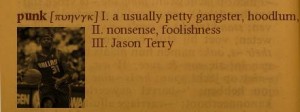
Rhonda and Geoff were in the arena up there in January when the Mavs beat the Thunder in a regular season game in OKC. And they took exception to the way Jason Terry celebrated and, in their words, taunted the crowd. So I get this picture from Geoff on Sunday:

Oh, yeah. It’s on. I’m a little concerned about Kidd and J. J. Barea because the Mavs are facing a young athletic set of guards for the first time all postseason. And there’s no way Dallas will have the same open looks at three-pointers that they got against the older, worn-out, slow to rotate Lakers’ front court. In the end, though, OKC doesn’t have an answer for Dirk. And Tyson Chandler ought to get about five blocks per game. Kevin Durant may average 30-points in this series. And this may very well be his coming out party. But the Mavs will prevail. It just won’t be easy. Dallas in six.

~~~~~~~~~~~~~~~~~~~~~~~~~~~~~

We hauled the girls out to the Dallas Arboretum on Saturday to take in the beauty of White Rock Lake and all the blooms of spring. We also wanted to check out my great friend Kevin Henrichson’s Little Mermaid castle. Kevin’s architectural firm, GHA, designed and constructed the grand-prize winning castle last February as part of the Dallas Blooms exhibits. And it’ll remain on display there with the other fairy tale castles at the Arboretum through the remainder of 2011.

The castle was nice and all, Kevin, but, honestly, I’m much more interested in your other major design and construction project. Please hurry up and get that In-N-Out location built on Precinct Line!

Peace,

Allan

Renew Them In Our Day

“Lord, I have heard of your fame;
I stand in awe of your deeds, O Lord.
Renew them in our day,
in our time make them known.” ~Habakkuk 3:2

I’m still learning how to pray. I read the psalms and I read the prayers of the prophets and I realize I have such a long way to go. In order to pray with the mind of Christ, I must pray the will of the Father. But during my moments of most honest reflection, I admit, I’m usually praying for the will of the preacher.

Habakkuk prays that God’s deeds, not his own deeds or desires, might be renewed. Usually, I’m sorry to say, I’m talking to God about some specific project or idea or initiative and asking him to renew my work. I’m cruising along preaching and ministering and administrating and doing what a good preacher in a good church is supposed to do and everything’s great. But as soon as somebody bumps the table, as soon as there’s a little mess, suddenly prayer becomes very, very important to me. Now I’m really alert to prayer and the deep need for prayer and my intense dependence on prayer.

And I beg God to renew my work. God, fix my preaching. Lord, help our Small Groups. God, would you please revive my Bible class? Lord, build my ministry back up. If I’m not careful, my interest is really on what I’m building and not really on what God may actually want. It’s humbling to admit, and a tough lesson to learn, that quite possibly God’s not nearly as interested in my little stacks of programs and sermons as I am.

God, renew your deeds. Revive your work.

Do a new work, Lord. Don’t just refurbish or clean up what I’m doing. God, create something brand new here, something I haven’t even thought about. Do something I would never dream of, Lord. For your purposes. To your eternal glory, God. May your will be done in my preaching, not mine. May your will be done at Legacy, not mine. Lord, may your will be done in our Small Groups, in our elders’ meetings, and in this community, just like it is in heaven.

Renew your deeds, God. Not mine.

~~~~~~~~~~~~~~~~~~~~~~~~~~~

I’ve added a new link to the list there on the right. This is a blog I read regularly and have been meaning to include on my site for quite a while. I’ve just not taken the time.

John Mark Hicks’ blog, John Mark Hicks Ministries, is a wonderful source for Restoration and Church of Christ history and perspective. John Mark’s is a prophetic voice, speaking God’s Word into the culture and into our churches with spirit and truth. And, as regular readers to my blog know, I’m a huge fan of his research and writings on the Lord’s Supper, baptism, and our corporate worship assemblies. His trilogy of books on those three “sacraments” are among the best written on the topics in decades. “Come to the Table” is arguably the greatest work on communion ever produced by a C of C scholar. OK, I know. All that sounds a little over the top. Sorry. Hicks is good. You’ll like his blog.

Peace,

Allan

People People

My Jesus is a people person. He absolutely loves a crowd.

Yeah, there were times when our Lord went alone into the desert or climbed a mountain to pray. But it’s much more typical in the Gospels for Jesus to be interacting with people. The eyewitnesses paint a picture of Jesus constantly mixing it up with the multitudes, meeting strangers on the road, hanging out with family and friends. Mostly Jesus is known for eating and drinking with gusto in the homes of sinners and saints, with the prostitutes and the Pharisees, men and women, Gentiles and Jews.

Praying with people. Worshiping with people. Walking with people. Fishing with people. Teaching and debating with people. Laughing and crying with people.

Jesus was a supremely social, communal person. Whatever it was that the Father called the Son to do, he had no interest in doing it by himself. Just a casual glance at Jesus is enough to tell us today that we are fully living as God-created humans, not in our solitude and isolation, but in our relationships and connections with others.

We are people people.

We need God, yes. And we so desperately need one another. You can’t do this faith solo.

Peace,

Allan

Ordering Jesus Around

The royal official in John 4 orders Jesus to do what he wants. He commands Jesus. This ruler has a sick son, a son who is dying in Capernaum, and he tells Jesus, “Come down before my child dies.” He’s ordering Jesus. He’s telling Jesus what to do.

And Jesus complies.

Ah, see, you didn’t think it was going this way, did you?

This royal official is a man of means and a man of power. This man is well connected. He’s got pull. This man spends most of every day ordering people around. And when he finds out there’s a healer out there who can take care of his boy, he rushes to command Jesus to do just that.

And Jesus agrees. He does it. Boom! Right there on the spot. The boy is healed immediately.

The royal official had no idea who Jesus really was. He didn’t know. He had completely misunderstood Jesus’ mission, his purpose for living on earth. Jesus was a man who could meet the ruler’s immediate and personal needs. This person was only thinking of himself and his family.

And it seems that Jesus was OK with that.

Please know that people are going to come to you, also, to command you and order you around to meet their own felt needs. People are going to misunderstand you and your mission. They’re not going to care a whole lot about your call to ministry or your obligations to our Lord and the big picture concerns of his Kingdom. Your Kingdom priorities and your Kingdom goals won’t matter to some of the people who will direct you to do what they want you to do no matter what. Sometimes people will approach you in order to use you; they will come to you intent on exploiting you so they can continue living their comfortable lives.

Our job, as I understand it, is to show them the love of Christ and share with them his compassion. We’re called by our Savior to give these people his blessings and his mercy and grace. We offer to them out of the abundance of what we’ve been given by God. Jesus loves people. And his greatest desire is to help them, to take care of them, even when they come to him to misuse him.

This is not a call to promote unhealthiness or immaturity in God’s Church. Sometimes the people who have been disciples of Jesus the longest are the very ones who will exploit you and your ministry in their own selfish interests and for their own self-serving purposes. Catering to them is not what I’m talking about.

The story at the end of John 4 is about compassion and the love of Jesus for those who don’t know any better. Jesus took orders from a guy who didn’t even know who he was. I suppose I can, too.

Peace,

Allan

« Older posts Newer posts »