Author: Allan (Page 362 of 492)

A Den of Robbers

“Is it not written, ‘My house will be called a house of prayer for all nations’? But you have made it ‘a den of robbers.'” ~Mark 11:17

What made Jesus so mad that day at the temple? What riled him to the point of flipping tables and scattering coins and driving out doves and sheep? We generally speculate that pilgrims and travelers were being ripped off. Religious officials were probably cheating worshipers on the exchange rate between their Roman coins and the temple-approved currency. Sellers of cattle and sheep were overcharging and taking advantage of those who had come so far to sacrifice and whose animals had been harmed or blemished in some way along the journey.

Those things may very well be true. And if they were, that would surely upset our Lord. The only problem is that none of those things are attested to in Scripture. We have no scriptural evidence that anybody was being cheated out of money. The Gospels don’t speak or even hint at any economic wrongdoing.

We get the idea, I think, from Jesus’ statement about the temple being turned in to a “den of robbers.” But I believe we’ve missed the point. Jesus is not talking about money or possessions here. He’s quoting the Prophets. And if we go to the passages he quotes, it’s pretty clear what’s got him so angry.

Isaiah 56 is about God’s holy provision for those outside the nation of Israel. God loves the whole world, not just the Jews. And he’s going to take care of them, too. Isaiah 56 promises the “foreigner who has bound himself to the Lord” that he will never be excluded from God’s people. Eunuchs who keep God’s commands will always have a place “within my temple and its walls.” All foreigners who love the Lord:

“these will I bring to my holy mountain
and give them joy in my house of prayer.
Their burnt offerings and sacrifices
will be accepted on my altar;
for my house will be called
a house of prayer for all nations.” ~Isaiah 56:7

God has provided a place at his temple for Gentiles to gather and worship. God has promised covenant to these Gentiles and has sanctified a place for them to participate in the community life of God’s people. Gentiles, too, can experience the glory of God. Gentiles, too, can make sacrifices to God in faith that he will accept the offerings and forgive them of their sins. Gentiles, too, have a place in the Kingdom of God.

But it’s in these very temple courts — the Gentile courts, the Court of the Gentiles — where religious leaders are setting up shop and selling animals. They would never allow the inner parts of God’s temple to be turned in to a noisy, smelly, chaotic mess. They would never do anything to disrupt the expressions of praise and sacrifice from their own people in their special places. But these Gentiles? Yeah, let’s sell the animals there.

They are interfering with the divine provision of God. They are compromising God’s promises to the world. They’re messing with God’s plan. They’re depriving people of the space God has given them in which to worship. It’s a house of prayer for all nations, not just for people who look like me and talk like me and dress like me and behave like me. It’s not just for people who worship and sing and pray just exactly like us. It’s for everybody!

No wonder Jesus was so angry.

So, what’s it like at your church? Are the Hispanics relegated to an upstairs classroom in the back of the building? And is that classroom cluttered with leftover chairs and three ice chests from the youth trip? Where do the deaf worship in your church? Is it just understood that the homeless and the jobless and the “unchurched” won’t fit in? So nobody really tries?

Forget about the actual physical space for a minute. Do the ones who are not just like us — the new members, the move-ins, the poor, the young people, the old people, the divorced, the minorities — have a forum in your church to express their praise to God? Are they stared at, talked about, isolated, and discouraged from worshiping God? Or are they smiled at, hugged on, sung with, and encouraged to worship? Sometimes our haughtiness and complaints, our snide comments and dirty looks, our letters and threats rob our own brothers and sisters in Christ of their God-sanctioned forum and venue for giving him thanksgiving and praise. As Jesus says in John 2:16, “How dare you!”

“Accept one another, then, just as Christ accepted you, in order to bring praise to God.” ~Romans 15:7

Peace,

Allan
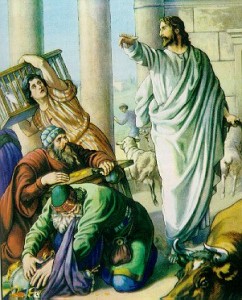
Get These Out Of Here!

“Get these out of here! How dare you turn my Father’s house into a market!” ~John 2:16

If Jesus were to walk into your church building tonight would he praise God for what is happening there or would he start flipping over pews? If Jesus walked into my church building on Sunday would he see empty ritual and dead tradition or would he recognize a living and vibrant people being transformed by a genuine relationship with God? What if he wandered into your elders’ meeting? What if he showed up to watch you prepare a sermon? Would Jesus be pleased to go through all the church policies in the secretary’s file cabinet? Or would that cause him to wince in pain?

When Jesus disturbs things in the Jerusalem temple, he is acting out his prophetic message. It’s not the power of the whip that makes his message succeed. It is his moral power, the power of the truth, that strikes the hearts of the people and so captures Christian readers today. Those who confront Jesus after the episode appear to know that Jesus is right and that the temple has become something other than what God had always intended. The purpose of the holy temple has been compromised. Maybe they sense something of God’s divine and righteous anger at work in Jesus.

Jesus is pointing out the problems with the institution of the temple. He is confronting its misdirection and its brokenness. In the process, he points out very clearly that the real activity of God, the real temple, is Christ Jesus himself. In other words, the focal point of the people’s religion has to be replaced by something — no, someone! — new.

The local church — my local church, your local church — is a fallen institution. It’s filled with sinners, filled with people just like you and me. Yes, the church aspires to goodness. But, admittedly, sometimes we succomb to programs and agendas that have very little to do with the Kingdom of God. Sometimes life in our churches can be driven by petty financial interests or social comforts and desires. We sometimes play religious politics, church leaders acting as representatives of their particular constituents, when deciding church policy. We may give in to pressures to be more modern and contemporary. We may bow to petitions to defend empty traditions and dead habits.

If Jesus walked in for a visit would he be outraged over the things we argue about? Would he be appalled at the ways we sing? Or don’t sing? Would he question some of the lines we draw or challenge some of the rules we keep? Honestly, we have plenty of religious customs and practices — even doctrines — that have everything to do with tradition and habit but may have little to do with our risen Lord. We must be willing to allow Jesus to step into our church worlds and openly critique the things we do and the ways we do them. Could the things we cherish and defend stand up to Jesus’ prophetic viewpoint?

I truly believe that everything we do in our churches and in our individual lives as disciples of Christ must have as its foundation the very Gospel we preach and teach. The root of our words and deeds must be connected to the life, death, and resurrection of Jesus. Our traditions and rituals must be born out of and give expression to the Lord who welcomes and forgives and loves and sacrifices. The One who invites all to his wedding feast, the One who gives in abundance the riches of heaven must be the informing and driving force behind every single thing that happens in church.

It’s OK to review and evaluate our habits. It’s allright to challenge our traditions. If they stand up to Christ’s critique, then affirm them. Teach them and practice them in all holiness and sincerity. But by all means be able to explain to your people and your community the hows and whys. If they can’t meet the Gospel standard, then discard them. Destroy them and abolish them in faith and trust in God. And be able to explain the hows and whys based on a true understanding of what Jesus came to this earth to do. And what he came to this earth to change.

~~~~~~~~~~~~~~~~~~~~

You’ve got to watch this 90-second video they’re showing at American Airlines Center to pump up the Mavs fans during these NBA Finals. The video features the most accomplished athletes in the history of DFW talking to Mavericks fans about what it means to win it all. An intense Emmitt Smith. A relaxed Daryl Johnston sitting in front of a couple of Super Bowl trophies. A no-nonsense Troy Aikman. An overly-animated Tony Dorsett with his Heisman Trophy. A blank-stare, monotone, can-we-just-get-this-over-with Nolan Ryan with the A.L. Championship hardware. Mike Modano. Gary Patterson with TCU’s Rose Bowl trophy. Roger Staubach in front of a portrait of downtown Dallas. And Ron Washington from the Rangers dugout in Arlington.

You must watch the video all the way through, all the way to the end.

Classic.

Peace,

Allan

The Back of the Line

“Thanks be to God who always leads us in triumphal procession!” ~2 Corinthians 2:14

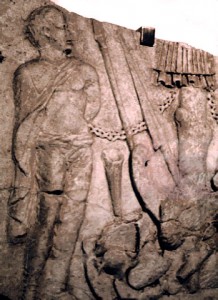
The apostle Paul writes while enduring great anxiety over his brothers and sisters in Corinth. He writes to give them a new perspective. He writes to bolster his own strength and faith. He writes about a great Roman military victory parade. The conquering general rides in a gold chariot up front. The senate and magistrates follow. Behind them are the royal and military musicians. The spoils of war, the loot from the conquered lands, is paraded next. And then the captives in chains, the prisoners of war, in the back of the line.

Paul says, “I’m in this parade! You’re in this parade! God is leading us in this triumphal procession! We’re all in this parade together!”

But the technical nature of the term and the linguistic nature of the verb can only mean one thing: Paul is not at the front of the parade with God. He’s at the back of the line with the captives.

Paul sees himself as a slave to Christ. He’s been captured by Christ, he’s a trophy belonging to Jesus, he’s one of the spoils of God’s great victory over sin and death. Paul is thrilled to be in the metaphorical chains of the conquering Christ and the unstoppable Kingdom of God. Paul shows us in a very graphic way his understanding of Christian ministry. He paints a vivid picture of himself — a picture of all of us — being led by Jesus in a long line to our own suffering and death.

See, the captives are the physical evidence of the victory. The conqueror receives the glory and honor due him when the world sees the people he’s defeated. The people at the back of the line, the conquered people in chains, are a display of and a testimony to the glory and majesty and power and authority of the conqueror in the gold chariot up front.

That’s Paul. That’s us. That’s the way he sees things.

“It seems to me that God has put us apostles on display at the end of the procession, like men condemned to die.” ~1 Corinthians 4:9

Paul goes on in that 1 Corinthians 4 passage to say we are humiliated. We’re ridiculed. We are the objects of great wrath and scorn. We’re spit upon by the crowds as we walk to our executions.

Things don’t always look so good from the back of a line like this. It doesn’t always feel good. Sometimes it’s downright painful.

But this is exactly where our Father wants us. God doesn’t want us better; he wants us deader! Dead to ourselves! Dead to the world! Completely dependent on God! Totally leaning on him for every step, every move, every breath! Wholly reliant on him for life itself!

Paul counts it as a blessing and a privilege to be led by Christ as his captive, as his slave, and to participate in this way as a part of God’s triumph. Paul has actually grown comfortable at the back of this line. He’s come to understand that “the all-surpassing power is from God and not from us.” He knows that “all of this is from God” and none of it is from his own strength or smarts. He knows that “our competence comes from God.”

Those are the lessons learned from the back of the line.

And that’s precisely where ministry is done. From the back of the line. God is glorified in his captured people. He is praised and honored by his slaves. May we stop wrestling with the chains and fully embrace them in complete submission to our Lord and King.

Peace,

Allan

The Joy of One

The apostle Paul changed his travel plans in order to spare the Corinthian Christians a great deal of pain. “For if I grieve you,” he writes, “who is left to make me glad?” Paul says he didn’t want to be distressed by the very people who are supposed to make him rejoice (2 Corinthians 1:23-2:4).

Paul really loved these people.

Despite their problems and spiritual immaturity, Paul really had a deep affection for this group. And he didn’t want to hurt them. Not only that, he wanted to do everything he could to please them. He was willing and eager to inconvenience himself for their sake.

He longed to “work with them for their joy” because his own joy was so tightly wound up in theirs. Paul understood that, in the Body of Christ, the joy of one is the joy of the other. Their happiness made Paul happy. Their gladness led directly to Paul’s rejoicing. He wouldn’t have it any other way.

When we were planning a bi-lingual worship assembly a couple of years ago, I was confronted by a well-meaning brother who couldn’t comprehend how singing songs in Spanish would be an encouragement to us Anglos. If our worship time is to be a time of edification, he reasoned, how is singing some of our songs in Spanish going to edify the English speakers? How does that lift me up? My response went this way: Do you think that hearing 900 white brothers and sisters in Christ sing a song of praise and encouragement in their native language will give a lift to the 40 or so Spanish-speakers in our assembly that day? Will it make them feel good? Will it make them feel valued and appreciated? Will they experience acceptance in our efforts to sing in their language? Will they feel joy?

If the answer is ‘yes’ — and it is — then doesn’t that give you great joy, too? Doesn’t it make your heart happy to know that a group of your brothers and sisters is encouraged and gladened by something you did? Does that not edify you at all? Of course it does. In the Body of Christ, the joy of one is the joy of the other.

Yes, we are called to sacrifice for others. Yes, we are commanded to put the needs of others ahead of our own. Absolutely, we are directed by Scripture and the way of our Lord to serve our brothers and sisters. But that never means one of the things we have to sacrifice is our own happiness. Our joy is never compromised just because we’re taking care of somebody else. In Christ, our mature understanding is that our happiness results from making others happy. Our greatest needs are truly met, more deeply met, when we work to meet the needs of others.

~~~~~~~~~~~~~~~~~~~~~

Peja and Terry got their looks in Game One. Dirk got the ball on the blocks. And J. J. penetrated the lane as always. It’s just that the shots didn’t fall. The threes were too strong off the back of the rim. Dirk seemed like he was rushing things. And Barea’s little running teardrops didn’t…well…drop. I hate to think that it was unfamiliarity with the Eastern Conference arena they only visit once a year. I hate to imagine it was a matter of not being comfortable with the Heat’s gym. That just sounds weak.

But that’s really the only hope we have, right?

Hopefully it’s just as simple as the Mavs’ shots didn’t fall. It was an off shooting night. Everybody regains their touch tonight. It has to be that way. Because if it’s something more than that — LeBron’s defense, Chandler’s shaky confidence, Jet choking in another big series, Dirk’s finger, a soft Mavs’ interior, Miami’s fresher and faster legs — Big D is in big trouble.

Peace,

Allan

WDJD

I like the idea of “What would Jesus do?” I like that concept. But I don’t believe that’s necessarily what the Bible is getting at when it links our beliefs and our behavior. As our theology shapes our practices, I think it’s much more about discovering the character of Christ and acting in concert with that character.

Following the death and resurrection of Jesus, it doesn’t seem like the apostles wondered what Jesus would do if were in their shoes. It wasn’t “What would Jesus do if he were me?” It’s not “What would Jesus do if were here right now?” It looks like the thought of the early Christians and the teachings and example of the apostles was, “Because of what Jesus has done, how should I act?”

“What did Jesus do?”

What decision will I make today that embodies the very character of the God who gave up everything for the sake of the world? What decision right now reflects the integrity of the Christ as he lived and died for the salvation of others? How does my decision today fit in with the eternal purposes of God in Christ?

Forgive one another as God in Christ forgave you. Accept one another as Christ has accepted you. Love one another as God loves you.

It appears to me that the apostle Paul took the truth of the Gospel into account with every single decision he made in life. Every single plan, every move, was made after first considering carefully the Gospel implications. Even something as normal and routine as changing his travel plans was done “in the holiness and sincerity that are from God.” Paul rearranged his schedule “not according to worldly wisdom but according to God’s grace.”

I have conversations from time to time — 20 and 30 minute conversations — about something we’re doing or not doing at our church. Something somebody really likes or something somebody really doesn’t like much at all. Some activity or practice or decision that has this person talking. And I listen to these long, heated, passionate pleas, and not one time does the person mention God. Or Jesus. Not one time does the truth of the Gospel get inserted into the discussion.

The faithfulness of God and the character of Christ must be the determining factor in everything we do as a church of his people and in our own individual ministries and lives.

It’s not so much “What would Jesus do?” It’s more like “Because of what Jesus did, and because of what God is doing through Christ today, what kind of a person am I and what kinds of choices and decisions do I make?

Go Mavs,

Allan

On Earth As It Is In Heaven

Jesus prays to our Father, “Your Kingdom come, your will be done on earth as it is in heaven.” Jesus preaches the Kingdom of God. Jesus declares the coming of the Kingdom of God. He proclaims, “It is at hand!” It’s here! The Kingdom! Look at it!

Jesus brings the Kingdom to earth. He does God’s will on earth just as it is in heaven.

Jesus casts out demons because there are no demons in heaven.
Jesus heals because there is no sickness in heaven.
Jesus feeds because there is no hunger in heaven.
Jesus raises the dead because there is no death in heaven.

“Your will be done on earth as it is in heaven.”

Are you praying this prayer? Jesus said it was a good idea to pray this prayer, to ask God to please do his will on earth just like it’s done in heaven. Are you bringing the Kingdom of God to your part of the earth? Are you obeying his will like the rocks and the trees and the oceans and the animals obey his will?

There is no revenge in heaven. There is no hate in heaven. There are no arguments in heaven. There are no disagreements in heaven. No suspicion. No politics. No war. No division of any kind. No violence, verbal or physical. No mistrust. No gossip. No complaining. You won’t find any of those things in heaven.

Is the will of God being obeyed in your church just like it is in heaven? In your elders’ meetings? In your congregational committees? In your marriage? In your family around your dinner table at night? Are you bringing the Kingdom of God to your workplace? To your school? To the Little League team you’re coaching or the civic club to which you belong?

If God has completely eradicated selfish behavior and gamesmanship and competition in heaven, if that is his holy will, why would you insist on bringing any of that into his Church? Or putting up with it?

The rivers and the trees and the squirrels and the fish all obey God’s will on earth just as it is in heaven. What’s wrong with us?

~~~~~~~~~~~~~~~~~~~~~~~

Rodney Ashlock had just begun his Sermon Seminar session on the book of Esther Tuesday evening when the WeatherBug app on my laptop started chirping. I opened it up to learn that a tornado warning had been issued for parts of Tarrant County that included my home in North Richland Hills. A quick check of the radar revealed an ominous red and purple blob heading right for my neighborhood and a pretty impressive hook echo bearing down on my house.

I dashed outside the lecture hall there on the Austin Grad campus to check in by phone with Carrie-Anne and the girls. She answered her cell phone and her voice was almost drowned out by the sound of the sirens. Before I could get more than a couple of sentences out, I heard our house phone ring. She kept me on line as she answered it. It was the city, calling to warn residents of the coming tornado and to urge them to seek immediate shelter. I asked if she and our daughters were OK.

“Yeah, we’re hiding in the laundry room with the radio and the phone. We’ve got a couple of mattresses in here. The girls are a little nervous. And I’m putting clothes in the dryer.”

Now THAT is a wife of noble character! Protecting the children and doing the wash! Who can find a woman like that? She is worth far more than rubies. Her husband has full confidence in her and lacks nothing.

~~~~~~~~~~~~~~~~~~~

Too much Dirk last night for the Thunder. Too much Dirk. Here’s hoping Chicago can somehow force a couple of more games in the Eastern Conference series to wear out that unholy trio in Miami and buy the senior Mavs some much-needed down time.

Peace,

Allan

« Older posts Newer posts »