Author: Allan (Page 349 of 492)

Joy at the Table

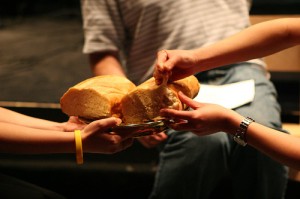
The Lord’s Supper is the central, communal, corporate act of God’s Church. Instituted by our Savior, passed on by the apostles, and practiced for centuries by God’s people, our communion meal has historically served as the primary reason for Christian gathering and the climax of the Christian assembly. It’s the high point. The pinnacle.

As most of you know by now, my great desire is to see the Lord’s Supper returned in our churches to the rightful place of prominence it has always enjoyed until recently. In our Church of Christ assemblies, our communion time needs to be the highlight. And it’s not. Not always.

And it won’t be — not consistently, anyway — until we return the joy.

When presenting the case for expressions of joy and gladness and celebrations of happiness during our Lord’s Meal, I’m often reminded by well-meaning brothers and sisters that our time at the table is meant for remembering the death of Jesus. It’s inappropriate, they say, to rejoice when thinking about death. Our time at the table is for somber introspection and solemn reflection, not conversation and singing and grinning. Certainly not laughter.

First, I would say our Sunday communion has much, much more to do with the Resurrection than with the Crucifixion. Much more. I would suggest the first Christians didn’t really think about Jesus’ death during their Sunday meals. They were too overcome by the fact that the Christ really was alive. That was the focus of communion.

But if a person insists that the communion meal is about remembering the death — and people will do this by quoting 1 Corinthians 11:26: “proclaim the Lord’s death until he comes.” — we’re on solid ground to celebrate in that case, too.

For the writers of Scripture, the death of Jesus was and is good news. It’s great news! And it is more than appropriate at the table of Christ  to express the pleasure and the joy that are caused by his death. To “proclaim” means to announce publicly and clearly what has happened and what it means eternally. It’s not to be whispered through cupped hands into the ears of a just a few disciples in the room. The good news is to be shouted with joy.

The Eucharist (thanksgiving, right?) is the perfect time and place, not to mention the most practical form, for showing and confessing that the death of Jesus is totally different from a natural event or a criminal act or some tragic loss. The death of Jesus gives us no reason to accuse or moan or lament or complain.

Those celebrating the Lord’s Supper know the pain and the shame, the horror and scandal, of Christ’s death. However, we rejoice in the crucifixion and praise the slaughtered Lamb because God has raised him from the dead and accepted his intercession on our behalf. In Paul’s theology and in the message of John, Hebrews, 1 Peter, and Revelation, the Crucified One is always the living and reigning Christ. The One who rules the Church and the world and who will come again is the crucified Christ.

We have abundant reason to rejoice in Christ’s death and praise the crucified yet living Lamb.

And until we recapture that sense of great joy around our living Lord’s table, we will continue to commemorate a solemn service instead of a celebratory feast. It will remain a weekly task to be performed instead of a community meal to be enjoyed. And it will stay in the background. It won’t ever rise past the preacher or the music in terms of proper position and prominence in our Sunday assemblies.

What if our Sunday communion services sounded and felt more like what you’re going to experience around your dining room table this coming Thusday? What if, when we dine with our risen Lord on Sundays, joy were the prevailing mood?

~~~~~~~~~~~~~~~~~~~~~~~~~~~

More than $7,500 raised for Madison Knebusch and her family at yesterday’s spaghetti lunch. Praise God!

Bad news received just this afternoon regarding the PET scan today on Madison’s right lung. Another round of chemotherapy to begin later this week.

“Yet I will rejoice in the Lord.” ~Habakkuk 3:18

We love you, Madison and Levi and Shannon, Britton, Londen, Gracyn, and Hudson. Our hearts are breaking with yours as you endure this horrible trial. We ache for you and with you. And all of us want so desperately to do something to help. We want so badly to help. And, honestly, sometimes we don’t even know what to say. We don’t have the words. Sometimes we say dumb things and do dumb things out of a deep love for you that is compelling us to try anything to provide you with encouragement and comfort. Please be patient with us and forgive us.

Please know how much we love you.

We trust in our loving Father. We ask for increased faith. And we continually lift you up to our mighty God for his divine purposes.

Grace & Peace,

Allan

Immersed in Prayer

I’m so blessed to be here at Central. And so privileged to be serving with a group of church elders who rely so much on our heavenly Father and so little on themselves. What a joy!

The shepherds here at Central are an accomplished bunch. Each of them has enjoyed many levels of success in business, in society, in family, and in church life. I’m serving with men who are retired educators, retired TXDOT roadworkers, and retired CPS social workers. Our elders include a dentist, an opthalmologist, and a pharmaceutical salesman who used to play college football and still looks like he could line up against Demarcus Ware. We’ve got a power plant engineer, an oil and gas engineer who’s achieved at the highest levels of the international energy industry, and a man who’s constructed half the big buildings in Amarillo. There’s a commercial real estate leader, a hospice administrator, and a financial planner. These are competent men. Full of brains and brawn, experts in their fields, offices full of awards and trophies and medals. Well respected leaders of commerce and service and trade. Big thinkers, excellent communicators, magnetic personalities.

And you wouldn’t know any of it by walking into one of our elders meetings.

Because they spend so much time praying.

They don’t rely on their own achievements or gifts. They don’t count on their own cunning or craft. They depend wholly on God. Constantly. Consistently.

Three quick examples that have blown me away recently:

Two weeks ago we were in the middle of a question regarding an issue — a policy, really — that had been implemented some time ago but had been put on hold by the preacher search. Two of our shepherds who stood to benefit the most from re-starting the policy had brought it up and requested that we move forward. Following some very brief discussion, it was decided unanimously to get it going again. To which one of those two elders said, “Hey, I really appreciate the vote; thank you so much for the decision. But, can we not implement it just yet? Can we take the next two weeks and just commit to praying about this? I want to make sure this is really God’s will and not just a decision we’ve made tonight based on anything else. Let’s all promise to pray about this for two weeks and then come together on it one more time. If, after two weeks of prayer, nothing’s changed, then let’s move forward with our God’s blessing.”

Last night we were in the middle of our budget presentation. It’s a two-million-dollar annual budget. Lots of numbers. Lots of decisions. Lots of ministries and buildings and salaries and maintenance and outreach. Lots of detail. And right in the middle of it, one of our shepherds stopped the whole meeting down. “Hey, guys, we’ve really been blessed here by our God. Over 90% of the pledges for our capital campaign, more than 200-thousand dollars in extra giving for extra ministries that aren’t even in our budget, debt-free with emergency money in reserve. Can we just stop for a minute or two and thank our Father?”

And we did. We stopped everything, put our arms around each other, and prayed. This elder confessed his lack of faith, told God in front of all of us that there was a time when he never would have imagined these kinds of blessings for Central. He begged for forgiveness and then poured out his heart and guts in praise and thanksgiving to the faithful Giver of all good gifts.

And then again, at the end of last night’s meeting, another prayer. Of course. It’s what these guys do. “Lord, empower us and enable us to walk with people, to help people and serve people, who won’t serve us back. To walk with people who may not even love us back.”

Whoa.

My spirit is refreshed to be among so many who won’t hardly make a move without immersing it in prayer. I am re-energized by this faithful focus on the One who is the source of all energy. I’m thrilled with the commitment all around me to be in constant communication with the Originator of all joy. And I’m confident and bold, full of courage and strength, as we all depend so completely on the Father who promises to work everything out to his glory and praise.

Preachers, I beg you to pray. Elders, I beg you to immerse your meetings in prayer. Teachers, small group leaders, deacons and ministry leaders and committee chairs, drown your meetings in prayer. There’s not another thing you can do that can produce more peace and courage around the table than to confess to God in the presence of one another that he alone is the instigator and finisher of all the great works of the Kingdom of Heaven.

Peace,

Allan

At That Time…

“At that time Jesus said, “I praise you, Father, Lord of heaven and earth…” ~Matthew 11:25

The words at the beginning of this passage in Matthew that lead directly to our Lord’s little prayer of thanksgiving refer to that time in Jesus’ life when he’s having to answer questions about his mission and denounce unrepentant cities. John the Baptist is openly questioning the Messiahship of Jesus. His closest family and friends in the fishing villages around Galilee are ignoring his message.

How do you think all this rejection made Jesus feel? How do you think Jesus was doing at that time?

With one word, how would you describe your current situation? Where are you right now? In one word, what’s going on with you at this time?

Content? Frustrated? Happy? Angry? Confused? Overwhelmed? Hectic? Depressed? Worried? Confident? Scared?

Jesus seems pretty confident that his heavenly Father is behind these perceived setbacks and that these disappointments are actually a part of God’s holy will. And he gives thanks. Jesus gives thanks for the problems he’s encountering and praises God for working in them to spread the Word and advance the Kingdom.

The powerful and unstoppable energies of the Kingdom of God are always moving, always growing, always surging just beneath the surface. All around us. Huge rivers of prayer and faith and hope and praise and forgiveness and salvation and rescue and holiness flow right by us every day. In every single nook and cranny, hidden in the shadows, overlooked in the crowds, drowned out sometimes by the noise, are the eternal works of our gracious Redeemer.

So, like our Lord, we give thanks. At that time. At this time. We give thanks.

~~~~~~~~~~~~~~~~~~~~~~~~

Two Sundays ago Kevin Schaffer, our marvelously talented worship minister, stopped us down right in the middle of song to correct our clapping. We were singing “King of Kings.” You know how it goes: King of kings and Lord of lords, glory (CLAP!) Hallelujah. And our congregation was butchering the clapping. We were clapping before the word, during the word, after the word; it was a mess. Near the end of the first stanza, Kevin had had enough and he stopped us.

“We are going to learn how to clap. And we’re going to start with just one. Just one clap. Do it with me…”

And he proceeded to teach us and show us how to clap. It worked really well. Kevin was very patient with us and we all had a good laugh. After we had practiced together for a few minutes, it actually sounded pretty good the second time around. There’s hope here at Central.

I was reminded of that episode by a blog post written by Jon Acuff. It’s called “Clapping Our Hands: A Step-By-Step Guide to the Death of Rhythm.” A dear friend of mine forwarded it to me this morning. Jon hilariously nails the reasons our churches have a hard time clapping during congregational singing and gets inside the minds of the congregants to show us what everybody’s really thinking as the song begins, why the clapping is all over the place, and why it dies out completely before the song’s even over. It’s a quick, light, funny read about why our church clapping sounds like “somebody lit a box of hand firecrackers.” Click here to read it. And try to click on the downbeat, not the upbeat.

Peace,

Allan

Counter Cultural Jesus

Everything about our Savior flies right in the face of what the culture says is important. The values our culture upholds are counter to everything Jesus stands for. The ideas and philosophies our culture exalts are actually opposed to our Christ and his Kingdom.

Our culture says fight for our freedoms and assert your rights; Jesus willingly gave up his rights and his freedoms for the sake of others. The culture says gain more and more wealth and status and power; Jesus left behind all the wealth and status and power he enjoyed at the right hand of the Father to serve others. Culture says defend yourself at all costs, don’t let anybody mistreat you; Jesus walked purposefully into his own torture and to the cross to die. Culture works hard to establish and maintain boundaries between people of different colors, different languages, different backgrounds and zip codes and tax brackets; Jesus invites all the people of every nation, tribe, and tongue to enjoy a common feast at his one table.

Jesus is completely counter-cultural.

I asked our Wednesday night Bible class this week in what ways the Central church is counter cultural, in what ways do we go against what society says is the proper thing to do? One of the first things somebody shouted out was that we feed the poor, we take care of the needy.

But that’s not counter cultural. Our society applauds those who feed the poor. The popular media produce slick feature stories for mass consumption about people who take care of the needy. Fancy buildings are named after those who minister to the less fortunate.

Somebody else said we proclaim God, we believe in God and profess his name. No, that’s not counter cultural, either. Not at all. This society absolutely upholds a belief in God as fundamental. Basic. I asked if any of the 75-80 people in the room had ever even met anybody who claimed there was no God. Only one woman raised her hand. Believing in God is a very cultural thing here. Very cultural.

The conversation went on and on, and I could write several pages about it. The bottom line is that some of the things we’re so proud of as disciples of our radical Lord don’t hardly make any ripples at all in our society. They don’t stick out as different from the crowd. We’re doing what everybody else is doing; we’re just attaching Jesus’ holy name to it.

We can do better. We can do more.

I mean, we’re still, for the most part, segregating our church body from the ones we’re blessing with food and monetary assistance. Some of us are in a huge multi-million dollar building with coffee bars and cushioned chairs and some of us are crammed in a crowded house across the street. We still betray our prejudices when our conversations are sprinkled with “us” and “them.” Some of us are watching Fox News four and five hours a day and listening to political talk radio, filling our hearts and our souls with angry words and malicious thoughts that oppose the very ideals of love and joy and peace for which our Lord died.

In 413 AD, Augustine wrote in “City of God” that Christians were villified by society because they were so different from what the culture expected. You can go back and read for yourself how the earliest Christians were criticized by the culture: Christians are bad citizens; Christians don’t march; they don’t fight; they don’t build; they don’t help govern; Christians are mixing the classes and races at common meals in common living quarters; they’re destroying the social structures of the society; they’re not patriotic; they’re not loyal to the Empire; they say we are to serve one God instead of the State; they advocate forgiveness toward our nation’s enemies.

Those are the teachings of the Church. Those are the apostolic interpretations of Scripture. And those teachings and that way of life is completely counter to the ways and powers and authorities of this world. It got Christians in trouble back then. That kind of living gets Christians in trouble today. Right here in Amarillo.

(When your Bible class is taking prayer requests this coming Sunday morning, try requesting that we pray together for the Iraqi and Afghanistani soldiers, that God would protect them and return them safely to their families. See where that’ll get you.)

We can do better. We can do more.

Someone Wednesday night pointed out that Central decided a dozen years ago to stay right where we are in this downtown location instead of moving away to a nicer, more upscale neighborhood on the outer margins of the city borders. Ah, yes. Very counter cultural.

Culture looks at deteriorating property values and changing demographics and says, “Get out while you can.” Culture sees declining church attendance and lower contribution numbers and says, “You’ve gotta leave.”

Central saw the very same things and said, instead, “We’ve gotta stay.” Central made the very difficult choice to eschew financial and geographical security, to put off any cares and concerns about attendance and buildings and cash, to fight through very real fears and anxieties of the unknown in order to fully embrace Christ’s mission in this zip code.

I praise God for that. Amen.

And I look forward to that great day when all the barriers have been destroyed here on earth just as they are in heaven. I long for that day when we truly worship our one God together as his children, when we truly fellowship together around that one table. Sooner, rather than later. Right here at Central. A clearly counter cultural vision that would get us in trouble with society. It would cause ripples. It would be noticed. It would be criticized. And it would bring glory and honor to our eternal Father.

We can do more. We can do better.

Peace,

Allan

Middle Class American Jesus?

We’re studying the radical ideas of discipleship found in the Gospel of Mark in our Wednesday night class here at Central. Tonight, we look at the idea of getting behind Jesus that is so prevalent in Mark’s writings. Jesus is in front, we are in back. Jesus leads, we follow. It’s not enough to be on the way with Jesus, we must recognize our place behind Jesus on that way. Behind him. Not beside him. Certainly not in front of him. He’s leading, I’m following. He’s leading, his Church is following. Jesus must be the one in front.

And the Church says, “Duh!”

What we’re going to talk about tonight is the fact that we are called to follow Jesus so that we do Jesus things in Jesus ways. Ways and means do matter a great deal to our Lord. How we do something is just as important as what it is we’re doing. The ways and means must always be consistent with the end.

Look at the call to follow: “If anyone would come behind me, he must deny himself and take up his cross and follow me.” ~Mark 8:34

Jesus calls us to completely abandon ourselves. He calls us to leave our certainty for uncertainty; to flee safety for danger; to ignore self-preservation and embrace self-denunciation; to run from security to accept downward mobility. In a world that prizes self-promotion, we claim to be following a Lord who calls us to crucify ourselves.

And we have a great tendency to spiritualize all that. We want to turn the radical call of Jesus into just a metaphor. His teachings are mainly just abstract thoughts, right? It’s figurative language, right? Jesus speaks in extremes to hopefully make us think differently, but not necessarily act differently.

Wait a second…

We’re starting to redefine Christianity here. We’re starting to define Jesus by our thoughts and ideas, not his. We want Jesus to keep us comfortable when, all along, Jesus came to this earth to shake us out of our comforts in order to save us.

David Platt, in his little book, Radical, says we’re always wanting to turn our Sovereign Lord into a nice, harmless, non-threatening, middle-class, American Jesus:

A Jesus who doesn’t mind materialism and who would never call us to give away everything we have. A Jesus who would not expect us to forsake our closest relationships so that he receives all our affection. A Jesus who is fine with nominal devotion that does not infringe on our comforts, because, after all, he loves us just the way we are. A Jesus who wants us to be balanced, who wants us to avoid dangerous extremes, and who, for that matter, wants us to avoid danger altogether. A Jesus who brings us comfort and prosperity as we live out our Christian spin on the American dream.

Jesus came here to save us; to shake us, to move us, to transform us into the perfect image of the Son of God. That doesn’t happen by doing things our way. That doesn’t happen by doing things the way the rest of the world does things. It happens when we fully submit to the impossibly difficult task of doing things the Jesus way, when we trust our Lord enough to allow him to work in and through us as we make the faithful attempts to live like him, when we dedicate ourselves to following through life and through death the One who goes before us.

“Whoever wants to save his life will lose it, but whoever loses his life for me and for the Gospel will save it.” ~Mark 8:35

Peace,

Allan

Like Little Children

“Unless you change and become like children, you will never enter the Kingdom of Heaven.” ~Jesus

Better writers than me, smarter theologians, more faithful Christians, have wrestled to put into words exactly what Jesus means when he says we have to become like little children if we’re to have any chance at his Kingdom. Some have pointed to child-like innocence; those are the ones who’ve never had kids. Others stress the humility of a child; those are the ones who’ve never experienced losing a game of Monopoly to a sibling. Still others say Jesus was talking about the selflessness of a child; to which I say, “What??!??”

I think Jesus is talking about complete, whole, utter dependence. Dependence on God the way a child depends on her parents for everything: for food and shelter, protection and provision, education and discipline, security, acceptance, and love. A child depends on his parents for everything. A little child can do nothing without them. And God longs for us to have that same dependence on him.

Carlo Caretto spent his Christian ministry writing and teaching about the freedom and real presence of God one feels when he finally decides to depend on the Lord for everything. His works remind us that it’s our privilege, not our punishment, to become like little children.

In a letter to his sister Dolcidia, a Catholic nun, in March 1955, he writes:

“Becoming like children is not easy for those who have been complicated by sin. To become little children means to increase our feeling for God’s fatherhood over us; it means to think and act as little children do towards a father they love. He looks after everything, he resolves everything, and so on. When does a little child ever worry about tomorrow? Never: the father takes care of it. Isn’t that right?

All our plans, even on the road to holiness, are perfectly useless. The real plan is in his hand and we need to go to him like children seeking love.”

Caretto prayed all the time that he might become “little, little, little. Small, small, small.”

Most of us think we’re too big. Most of us.

Me, too.

Peace,

Allan

« Older posts Newer posts »