Author: Allan (Page 297 of 492)

Around the Table: Part 8b

“Therefore, whoever eats the bread or drinks the cup of the Lord in an unworthy manner will be guilty of sinning against the body and blood of the Lord. A man ought to examine himself before he eats of the bread and drinks of the cup. For anyone who eats and drinks without recognizing the body [of the Lord] eats and drinks judgment on himself.” ~1 Corinthians 11:27-29

I’m trying to keep these Around the Table posts from being too long. So allow me today to clean up a little bit from yesterday’s observations from Paul’s Lord’s Supper correctives in 1 Corinthians 11.

A lot of our distorted communion theology comes from the misunderstanding and misapplication of two key phrases in these three verses. These two phrases, as we’ll see more clearly in future posts, have been used and misused in all the worst ways to shift the Lord’s Supper over the centuries from the celebratory communal meal as it was originally intended to today’s solemn introspective snack.

Eating in a Worthy Manner

The word Paul uses here is not an adjective, it’s an adverb. It’s anaxios, which could be translated as “unworthily” or “unworthy manner.” The word describes the way one eats and drinks, not whether one is worthy to eat or drink in the first place. None of us is worthy to eat and drink in righteous relationship at the same table as our God. Or, put another way, all of us, by the grace of God and the blood of his Son, are worthy to share a meal at the Lord’s feast. Our worthiness to be at the table is not in question; that was settled at the cross of Christ. Praise God! What’s in question is how we eat when we’re gathered at our Lord’s Meal with other Christian brothers and sisters. According to the particular situation that Paul’s addressing there in Corinth, eating in an unworthy manner means eating in a way that only concerns yourself or your peers. It means eating in a selfish way that erects barriers between people and groups of people. It means drawing lines at the table between people of different backgrounds, different life circumstances, or different color, language, or race. Eating in a worthy manner is not about silently meditating on the cross of Jesus or reflecting on one’s own sins committed during the previous week. It’s not about quickly judging yourself and deciding you’d better not take a cracker crumb this week or, yeah, I’m good enough to participate today. It’s not private introspection; it’s public action. Worthy manner means considering the needs of others around the table more important than your own. It means sharing. It means paying attention to the people around you. Which leads us to…

Recognizing the Body:

First, it’s not “recognizing the body of the Lord.” The earliest original Greek language manuscripts do not contain “of the Lord.” Those three words were added to the text somewhere along the way, probably several centuries later, undoubtedly to help shift the mood of the Supper to one of quiet reflection. (There was a reason for that. Again, we’ll see it more clearly and explore it more thoroughly in upcoming posts.) Everyone at the table, in Paul’s words, must recognize the body while they eat and drink. Recognize the body? How can that possibly mean anything other than the Church?

Earlier, in the same conversation, Paul has used “body” to describe the church: “Because there is one loaf, we, who are many, are one body, for we all partake of the one loaf” (1 Corinthians 10:17). Later, in the same letter, he leaves no doubt as to what he means when he uses the word “body” at least 17 times in 16 verses to mean “church” (1 Corinthians 12:12-27). This is just the way Paul writes; he loves to refer to the gathered saints as “the body.”

“…for the sake of his body, which is the Church.” ~Colossians 1:24

“…to be head over everything for the Church, which is his body.” ~Ephesians 1:23

“For we are all members of one body.” ~Ephesians 4:25

“…just as Christ does the Church — for we are members of his body.” ~Ephesians 5:30

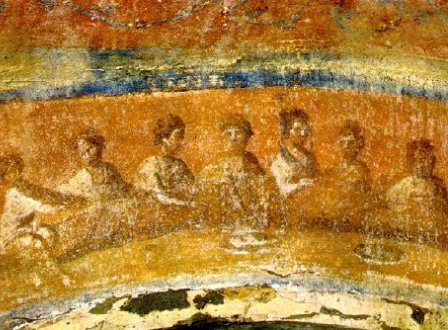
To recognize the body at the Lord’s Supper is to recognize God’s Church as a united community. This is about acknowledging the communal meaning of the Meal. The Lord’s Supper is a powerful witness to unity, it’s a strong testimony to a tangible fellowship that transcends all barriers. Especially in the context of the particular issues in Corinth, Paul’s command to recognize the body can only mean to recognize all the people around the table together. This is not about concentrating on the battered body of Jesus hanging on the cross. It’s not about tuning out distractions, not making eye contact with anybody, being super quiet, so as individuals we can focus on the death of our Lord. It’s just the opposite; it’s exactly the opposite! It’s explicitly about tuning in to everybody and everything around us, about making eye contact and physical contact with our brothers and sisters, it’s a command to talk and visit and smile and chat and welcome and serve, to focus on the resurrection community we’re blessed by God to share together.

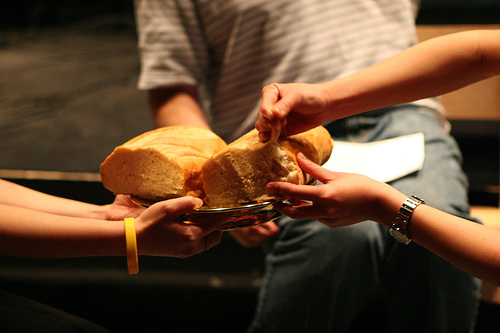
You know, the communion meal is genius. It really is. God knew what he was doing when he gave us this Supper. Because you can’t do communion by yourself. You can’t do communion on TV, you can’t order it on-line, and you don’t get communion at a drive-thru. In order to do communion, you have to be within arm’s reach of other people. You must be within touching distance of other Christians. You have to share a loaf, you have to serve a cup, you have to look at each other. Doing it by yourself is not communion. Doing it by yourself even in a room full of hundreds of people is not communion. Distorting these two key phrases in 1 Corinthians 11 has profoundly damaged our Lord’s Supper. Expressing the intended communal aspects of the meal is what’s required. It’s what must be recovered.

Peace,

Allan

Around the Table: Part 8

“When you come together, it is not the Lord’s Supper you eat, for as you eat, each of you goes ahead without waiting for anybody else. One remains hungry, another gets drunk… When you come together to eat, wait for each other.” ~1 Corinthians 11:20-21, 33

Paul’s instructions/corrections to the Corinthians regarding the communion meal are the earliest and oldest written accounts in existence about the Lord’s Supper. What we find is not an elaborate or systematic blueprint of the church’s meal; we have a narrow and focused response to a very particular and localized problem. However, in this response in 1 Corinthians 10 and 11, we find Paul’s very clear Lord’s Supper theology that informs and instructs the Lord’s Meal today: the church’s supper should be shared as a communal act that breaks down barriers between people and proclaims and promotes Christian unity. That’s what the meal is all about. But that’s not what’s happening at this church in Corinth.

The main overarching problem in Corinth is division within the church. Paul acknowledges the issue right out of the gate. He appeals to them in the name of Jesus to “agree with one another so that there may be no divisions among you and that you may be perfectly united in mind and thought” (1 Corinthians 1:10ff). The same exhortations appear again in chapter three where Paul points out their jealousy and arguing and pleads with them to stop. Elsewhere, it appears that these Christians were taking pride in their spiritual gifts, exalting some gifts over others, differentiating and dividing along lines of giftedness. And those decidedly anti-Christians attitudes were being expressed and manifested on the Lord’s Day at the table.

The Problem: Not Waiting for Others (11:21, 33)

Paul tells them they’re gathering for the Lord’s Supper, they’re calling it the Lord’s Supper, they’re saying all the right prayers and repeating all the right rituals, but it’s definitely not the Lord’s Supper. “You’re each eating your own supper,” he says. Why? Because you’re not sharing. You’re not waiting. You’re thinking only of yourself. You’re showing no regard for your own brothers and sisters who are going hungry while you’re stuffing your face and getting drunk. The problem is not that they were eating a full meal — the Lord’s Supper had always been a full meal (dipenon) and would be a full meal for another couple of centuries — it was that they weren’t sharing. This meal wasn’t about Christian unity, it was about taking care of one’s own needs over those of another. This, of course, is in direct violation of the way of Jesus. The rich homeowners were eating and drinking while the working class members of the church were getting nothing at all. This meal was being shaped by the culture instead of the Christ. The Gospel of Jesus is intended to break down barriers, to destroy division, and unite all people in his salvation blood. Instead, around this Corinthian table, poor people were being humiliated in the corner while rich people were gorging themselves in the main dining room. Even if they had no idea what the Lord’s Supper was about, common courtesy demands they refrain from getting fat and drunk while others are going hungry. Instead, they were making a mockery of the Gospel by their selfish behavior.

The Corrective: Pointing to Jesus (11:23-24)

Paul tells the Corinthians he cannot praise them for their awful behavior at the table. Their manners need correcting. So, he reminds them about their Lord. He reminds them that Jesus, “on the night he was betrayed,” gave up his very body and blood for the sake of others. The meal, Paul says, remembers the self-giving nature of our Savior. Our covenant with God, he recalls for these Christians, is based on sacrifice and service. It’s ratified by death. Around the table, we proclaim with one another that death and resurrection. Our actions at the table with one another must reflect and express that same sacrificial and servant-hearted nature of our Lord “until he comes.”

The Instructions: Wait for Each Other (11:33-34)

Paul does not discourage the eating of the meal. He does not command them to stop eating and drinking at the Lord’s Supper. Instead, he tells them how to eat and drink together around the Lord’s table. This follows his obvious pattern in correcting other abuses in the Corinthian congregation. He doesn’t tell them to stop speaking in tongues; he says, “When you speak in tongues, do it this way.” He doesn’t tell the disruptive women to stop praying; he says, “When the women pray, do it this way.” He doesn’t tell them not to eat meals at their Lord’s Day gatherings; he says, “When you come together to eat, do it this way.” Wait for each other. Eat and drink together. Share with one another. Consider the needs of others more important than your own. Now, if you’re unable to wait, if you’re incapable of restraining yourself, if you just can’t help it, go ahead and “eat at home so that when you meet together it may not result in judgment” (1 Corinthians 11:34). Don’t stop eating the Lord’s Supper. Eat it together, Paul says, in a way that honors the forever-giving nature and way of our risen and coming Lord.

Conclusions: Communal Intent of the Meal

Over the past 1,300 or so years, culture has turned the Lord’s Meal into a time of silent, individualistic piety. The Supper is restricted to the recesses of each individual’s mind and personal thoughts. In Corinth, the communion meal was restricted to class and socio-economic status. Today, it’s mainly a private affair. We have turned a celebratory meal designed by our God to proclaim and express unity and community and salvation into an individual ritually swallowing a crumb and drinking a sip while silently staring at the floor. I’m not completely certain how we recover the communal aspect of the church’s meal while worshiping in an auditorium with several hundred people, but we must try. Maybe we could use bigger portions of bread and more juice in bigger cups. Maybe we could all hold the cracker bits and tiny cups and wait for each other to eat and drink at the same time. Maybe we should enjoy a time of welcome and hospitality — a time to “shake hands and be friendly” — leading up to our time at the table. Singing together during the meal. Reading Scripture together during the meal. Instructing our churches to share with one another in the pews our favorite words of Jesus, our favorite deeds of our Lord, our favorite passage of Scripture, or our favorite song during the meal. Truthfully, there is more communion happening while passing a hot dog to a stranger at a football game than in most communion services in our churches on Sunday mornings. The form is the function; the medium is the message. It’s important that we recover the communal aspect of the Lord’s Supper.

The Lord’s Supper is serious. Not because it’s quiet time or meditation time or a time to solemnly reflect on Jesus’ death. It’s serious because the communion meal bears witness to the Gospel. It reflects and expresses the good news of salvation from God in the sacrificial death and powerful resurrection and eternal reign of the Christ. Judgment will come to those who deny the Gospel message and its values around the table (1 Corinthians 11:27-29). My advice would be to make sure communion is not about you. Make sure it’s about the people around you.

Peace,

Allan

You Are Not a Grasshopper

The worst thing the ten spies said to God’s people upon their return from scouting out the Promised Land isn’t that the Canaanites are bigger and stronger. It isn’t that the cities are too big and too well fortified. It isn’t that we seem like grasshoppers in their eyes.

The worst thing they said was, “We seem like grasshoppers in our own eyes.” (Numbers 13:33)

It’s OK to seem like grasshoppers in the world’s eyes. There’s nothing wrong with being seen as grasshoppers in the eyes of the community. But God’s people who have the promises of God and have experienced the past history of God’s deliverance and salvation are not grasshoppers!

God already said, “I’m giving it to you.” Joshua and Caleb can’t believe their ears. Caleb says, “Wait, we can do this. We should do this. We have to do this.”

But the people say, “No, the obstacles are too big and we are too small.”

But Caleb, who understands the promises of God, says, “It’s not about how small we are, it’s about how big our God is.”

The God of Abraham, Isaac, and Jacob; the God of Joshua and Caleb; the God of David and Jonathan; the God of our risen Lord Jesus is a God who slays giants and destroys enemies and conquers lands. And that God of Israel is the God of you and the God of me. And he gives us that same great power in his eternal promises.

You are not a grasshopper. Neither am I. The size of the obstacles and cliffs, hurdles and gaps, is nothing compared to the greatness of our God. May we take courage in the salvation past of our God and bold steps in his faithful promises.

Peace,

Allan

Table in the Desert

“Can God spread a table in the desert?” ~Psalm 78:19

The psalmist asks if God can really provide a feast for his people out in the middle of the remote wilderness. Is it possible? Can God provide nourishment and life where there is none?

The answer gushes powerfully from a rock. Streams flow abundantly. Water in the desert. Thirst-quenching life in the middle of certain death.

The psalmist sees the water. And he follows up with, “But can he also give us food? Can he supply meat for his people?” (Psalm 78:20)

And the Almighty Creator of heaven and earth opens up the skies to rain down manna and quail. The grain from heaven, the “bread of angels.” He “rained meat down on them.” They ate “till they had more than enough.”

“He sent them all the food they could eat.” (Psalm 78:25)

Yes, our God can spread a table in the desert. He can open up a 24-hour-all-you-can-eat smorgasbord right in the middle of your desert. Right in the middle of your driest condition. Right in the darkest part of your worst night. Down in the lonely depths of your deepest valley. He can shine bright light into your scariest situation. He can bring life from your dead-as-a-doornail, going-through-the-motions rut. Absolutely. Yes, he can.

Our God prepares a table for us in the presence of our enemies. And we eat with God in complete communion and perfect peace. Protected. Provided for. Saved.

Our God is sufficient. He is able. And he covers us with his tent and promises us we will hunger and thirst no more.

Peace,

Allan

Members of God’s House

People are looking for a connection. We have a human need to belong to something, to be a part of something, to be a part of some group. We get our identity, in large part, from the groups to which we belong. And that something, or some group, should be successful and popular. Even if it’s only a sports team, that drive to identify with something is enormous.

So we buy the jerseys. We refer to “our” teams as “we” and “us.” We have a need to belong, to connect, to have some sense of fitting in this world. And it’s from this sense of belonging — at work, at school, at the club, at the football stadium — that gives us the confidence and ability to relate and accomplish things. Our own families, of course, are foundational in giving us a true sense of belonging.

“You are no longer foreigners and aliens, but fellow citizens with God’s people and members of God’s household, built on the foundation of the apostles and prophets, with Christ Jesus himself as the chief cornerstone.” ~Ephesians 2:19-20

We do belong. We belong to God and to God’s family. That’s our connection.

Christ has brought us home to God. We live in God’s house as his much-loved sons and daughters. We belong with God and are involved in what he is doing. The other people in the house are family with us. This home defines us. Christ gives us a place in this world. And from that connection, that sense of belonging, we grow in our abilities to relate to each other and accomplish great things for the Kingdom.

Remember where home is. Remember who’s your family.

~~~~~~~~~~~~~~~~~~~~~~~~~~~~~~~~~

The “4 Amarillo” cooperative coalition among the four downtown Amarillo churches made the list of the year’s top “headliners” in the local Amarillo Globe News. You can read the article in yesterday’s paper by clicking here.

Peace,

Allan

« Older posts Newer posts »