Author: Allan (Page 290 of 492)

God Always Finishes What He Starts

“…being confident of this, that he who began a good work in you will carry it on to completion.” ~Philippians 1:6

God always finishes what he starts. Always. That’s why Paul can look back on what looks like a really lousy time in Philippi with gratitude and joy. Because God had started something in Philippi. And God always finishes what he starts.

God started something in Abraham when Abraham was a hundred years old and married to a barren old lady; and he finished it by giving Abraham more descendants than the sands on the shore. God started something with Joseph in the bottom of a well; and he finished it by feeding the whole world. God started something with a baby named Moses who was ordered to be killed by the most powerful ruler on the planet; and he finished it by rescuing his people out of slavery. God started something with David, the youngest and least impressive of all the sons of a shepherd in Judah; and he finished it by blessing his holy people with more peace and prosperity than they had ever known. God started something in Peter, a middle school flunkee fisherman, working the graveyard shift on the smelly nets at the Sea of Galilee; and he finished it by making Peter and his words a foundational pillar of his eternal Church. God always finishes what he starts.

What has God started in you? I’m not asking what God has finished in you — he’s not finished yet; I don’t care who or where you think you are, God is not done with you. But what has he started in you? Was it thirty years ago? Was it just a couple of weeks ago? What has God started with you?

Maybe you’re thinking, “God has not started anything in me.” Maybe what you remember, maybe your past, is so troubling and so difficult, maybe your present is so bad, you don’t feel like God’s done anything.

No. God has started something in you. He has. I don’t know where you’ve been. I don’t know all the people and places and events in your life. But I do know that our God has never, ever left you. Never.

I would also say that just the fact that you’re reading this post, that you’re right now hearing the word of God and considering his eternal promises means he has started something with you. And you can trust. You can know. He who began a good work in you will carry it to completion.

Abraham lied about his wife and had a son with Hagar instead of Sarah; but God didn’t quit. Joseph was rotting away in an Egyptian prison; but God didn’t give up. The Israelites built a golden calf and brought idols into the Temple; but God didn’t stop. David intentionally broke half of the Ten Commandments in one terrible weekend; but God didn’t throw in the towel. Peter publically denied the Christ, Paul was ruthlessly killing Christians, the evil powers of this planet and beyond had conspired to murder Jesus on a cross; but that didn’t slow God down one bit.

God has started something. Something in you. And God always finishes what he starts.

Peace,

Allan

Shine!

Vacation Bible School began today at Central with the simple and powerful theme of “Shine!” Yes, there are strobe lights and glitter and sparklers all over the worship center today and a giant disco ball hanging over the stage; everything is pointing the kids to the idea of “Shine!” It reminds me of a Stephen Curtis Chapman song, See the Glory. It’s a song about being fully awake to life in Christ, fully alive to what God is doing all around us. One of the stanzas, I think, really captures the idea that sometimes we’re just kind of sleepwalking through life:

I’m playing Gameboy standing in the middle of the Grand Canyon;
I’m eating candy sittin’ at the gourmet feast;
I’m wading in a puddle when I could be swimming in the ocean.
Tell me, what’s the deal with me?
(I know the time has come for me to)
Wake up and see the glory!

Of course, the apostle Paul said it first: “Wake up, O sleeper, rise from the dead, and Christ will shine on you!” (Ephesians 5:14)

Open your eyes. Pay attention. Don’t be lulled to sleep by the monotony of the sameness in your daily life. Don’t be distracted by the noise and activity and flashing lights of the world. God is fixing things. God is restoring things. God is re-creating everything to his eternal praise and glory. Including you!

Pray today that he will open your eyes and show you clearly what he’s doing right under your nose. And then jump in!

Peace,

Allan

Out of Control

Another reflection or two based on Stanley Hauerwas’ latest book, “Approaching the End: Eschatological Reflections on Church, Politics, and Life.”

One of Hauerwas’ favorite lines goes something like this: “Being a Christian means undergoing the training necessary to know how to live out of control.” We do live under the illusions that we are mostly in control of what happens to us and around us. Especially here in the United States, we like to think that very little is out of our control. And, that flies in the face of our Christian theology, yes? We follow a Lord who gave up all control, who put on the shelf every bit of status and power, who emptied himself of all mastery and prayed, “Not my will, but yours be done.”

And he taught us to pray and to live in that same way.

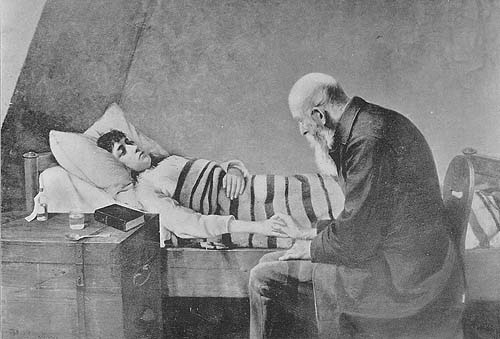
Hauerwas makes the point in one of the last essays in this latest collection that sickness is one way God trains us to rely on him.

Because of the staggering advances in technology and modern medicine, our approach to sickness sometimes betrays an attitude about sickness that might be close to the same attitude non-Christians have about sickness. (Go ahead and read that sentence again if you need to. Sorry.) Sometimes the God we pray to when we are sick is only a “god of the gaps.” He’s the “middle-man” between us and the doctors and experts, the MRIs and CT Scans, that do the real job of healing. Praying to God that way makes him to be a deistic God whose existence is not much more than an insurance policy for us against disaster. But a god like that is not the God who came to us in the flesh and suffered with us in pain and death.

The God we worship taught us to pray, “Not my will, but yours be done.” We’re all going to get sick. We’re all going to suffer in this life. We’re all going to get hurt, to get disappointed, to get injured, and die. But those are not the kinds of things that fuel our prayers. Our prayers should be motivated by the eternal and right-now presence of God. Hauerwas writes:

“The story that determines the Christian body is the story of Emmanuel, God with us. This is the story we were baptized into, which means we have already died. Therefore, the hope we share is ultimately not a hope to get through life unscathed, but a hope to remain faithful until the end. It is the hope of the resurrection.”

“Illness usually comes as an unexpected guest, threatening to disorder our routines and make our lives incoherent. The stories that constitute our lives are meant to give us a sense of control and to assure us that we know where we are and in what time we live. Yet the stories that we may actually be living may not be the ones we think we are living, but our illusions are dear to us. Illness often destroys our illusions as well as our confidence that we are in control.”

When we get sick, we realize that we are not in control. We acknowledge that God is in control and we lean on him more. We depend on God to sustain us, to give us life, to bless us with breath. When we’re sick, we need God. We recognize our powerlessness and our inabilities to fix the situation. We’re reminded that we are out of control and that we really, really need God.

And isn’t that where God wants you?

Peace,

Allan

A More Faithful Church

“I have little use for purity, but I do pray for a more faithful church. A more faithful church would, I suspect, make being a Christian more difficult but also more interesting.” ~Stanley Hauerwas, Approaching the End

One of the many reasons I read Stanley Hauerwas is that he is widely recognized as the greatest theologian in America. Another reason is that he’s from Pleasant Grove, my old neighborhood in the southeast corner of Dallas. The main reason I read Hauerwas is that he writes so eloquently and inspirationally about the role of Christ’s Church in the world. He consistently points to the holy mission of God’s people and paints with bold color and lofty strokes a picture of what Christians worshiping and working and living together should look like today. I’ve just finished reading Hauerwas’ latest book, Approaching the End: Eschatological Reflections on Church, Politics, and Life.” And I’m anxious to share some of it with you.

The church in the U. S. today, according to Hauerwas and just about anybody paying attention, is in a “buyer’s market.” It’s in survival mode. It’s approaching the end. And so a whole lot of them are more concerned with staying alive and viable, by their own definitions, than with pursuing the mission of God. Some of these churches are already dead. They’ve been dead for a long time. But we don’t recognize them as dead because they still appear to be in business. The problem, though, is that their business may only be accidentally related to Christianity.

“The general societal approval and support the church has enjoyed particularly in America is coming to an end. Of course one of the costs Christians have paid for the social and political status they have enjoyed is not to take their Christian identity so seriously that they might destabilize the social order by, for example, challenging the presumption that war is a necessity if democracies are to survive. Thus I am long on record as thinking the loss of Christendom to be a ‘good thing.'”

I, too, have believed for a while now that the loss of Christendom — the culture actually propping up the church and supporting its values, Christianity seen as routine and normal by society, the church depending on the Empire to help it with its mission — to be a good thing. All this coddling by the culture has made us soft. (Now this is me, not Hauerwas.) At some point, whether it’s over ordaining homosexual ministers, protesting against federally funded violence and murder, or protecting the poor, the church is going to discover that we are not friends with the culture. And the church will be shocked. What we’ll learn is that we were never intended to be friends with the culture; we’re intended by God in Christ to convert the culture, not conform to it.

Now, when that day comes, I don’t think we’ll be arrested or jailed or beaten or shot. No, the government will first threaten our tax-exempt status.

And then we’ll all have decisions to make.

Some of our churches will bow to the dollar and pay homage to the Empire to protect the tax-exempt status. After all, they have never known a church to pay taxes to Caesar, they’ve never known a church not in cahoots with the nation, and their imagination to be a church free from the government’s control has been terminally damaged. But some of our churches will be more faithful. Some of our churches will proclaim the Christian confession that “Jesus is Lord,” not Caesar, and actually become the alternative society that our Lord established at the empty garden tomb.

It’ll be difficult. Less money for our programs. Less status for our platforms. Less community support for our evangelism. It’ll be difficult. But a whole lot more interesting. Being the political movement we were always meant to be, the more faithful counter-society, will be very interesting.

“Jesus was not successful. Jesus did not promise his followers that if they did things right, they would conquer with time. The non-coerciveness of agape includes renouncing the promise of power; it includes renouncing the mechanical model of how to move history. Yet that acknowledgement does not mean simple despair or unconcern. It rather means a promise of victory, the paradigm of which is the Resurrection.”

Hauerwas gets in trouble for saying that the first order of business for the church is not to make the world just, but to make the world the world. But he’s right. How will the world ever know it needs saving, that it needs forgiveness and healing and reconciliation, how will the world ever know that it desperately needs Christ Jesus unless the Church shows it something totally different and new? And faithful? And interesting?

Peace,

Allan

Are You Bringing It?

Jesus prays to our Father, “Your Kingdom come, your will be done on earth as it is in heaven.” Jesus preaches the Kingdom of God. Jesus declares the Kingdom of God. He prays it. And he proclaims it: “It is at hand!” “It is here!” Jesus points it out: “The Kingdom! Yes! Look at it!”

But, more than that, Jesus brings the Kingdom of God to earth. He brings it. Jesus does God’s will on earth just as it is in heaven.

Jesus casts out demons because there are no demons in heaven.
Jesus heals because there is no sickness in heaven.
Jesus feeds because there is no hunger in heaven.
Jesus raises the dead because there is no death in heaven.

“Your will be done on earth as it is in heaven.”

Are you praying this prayer? Jesus said it was a good idea to pray this prayer, to ask God to please do his will here on earth just like it’s done in heaven. More importantly, are you bringing it? Are you bringing the Kingdom of God to your part of the earth? Are you obeying his will just like the rocks and the trees and the oceans and the animals obey his will?

There is no revenge in heaven. There is no hate in heaven. There are no arguments in heaven. There are no disagreements in heaven. No suspicion. No politics. No war. No division of any kind. No power-grabbing. No violence, verbal or physical. No mistrust. No complaining. You won’t find any of those things in heaven.

Do you find any of those things in your church? In your elders’ meetings? In your congregational committees? Are you bringing the Kingdom of God into your part of the world or some other, very different things? Into your marriage? Into your family around the dinner table at night? Are you bringing the Kingdom of God to your workplace? To your school? To the Little League team you’re coaching or the civic club to which you belong?

If God has completely eradicated selfish behavior and gamesmanship and competition in heaven, if that is his holy will, why would you tolerate it in your church? Or in your house? Why in the world would you actually insist on bringing it into your congregation? Or putting up with it?

The rivers and the trees and the squirrels and the fish all obey God’s will on earth just as it is in heaven. What’s wrong with us?

Peace,

Allan

People People

Our Jesus is a people person. He loves a crowd.

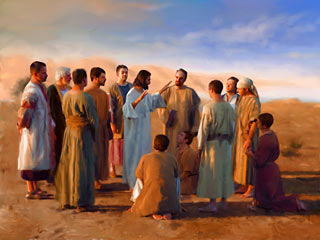
Yes, there were times when our Lord went alone into the desert or climbed a mountain to pray. But it’s much more typical in the Gospels for Jesus to be interacting with people. The eyewitnesses paint a picture of Jesus constantly mixing it up with the multitudes, meeting strangers on the road, hanging out with family and friends. Mostly Jesus was known for eating and drinking with gusto in the homes of sinners and religious leaders, with the prostitutes and the Pharisees, men and women, Jews and Gentiles.

Praying with people. Worshiping with people. Walking with people. Fishing with people. Teaching and debating with people. Laughing and crying with people.

Jesus was a supremely social, communal person. Whatever it was that the Father called the Son to do, he had no interest in doing it by himself. Just a casual glance at Jesus is enough to tell us today that we are fully living as God-created humans, not in our solitude or isolation, but in our relationships and connections with others. If we’re going to be Jesus followers, then we must be people people.

We need God, yes. And we desperately need each other.

Peace,

Allan

« Older posts Newer posts »