Author: Allan (Page 198 of 492)

Baptism and Faith

Peter and the apostles are announcing, they’re proclaiming in Acts 2, that the death, burial, and resurrection of Jesus has inaugurated the eternal Kingdom of God. Jesus of Nazareth is the promised Messiah! This holy one you killed but God has now raised to eternal life, this Jesus, is the bringer of God’s salvation for all people and he is now both Lord and Christ!

“When the people heard this, they were cut to the heart and said to Peter and the other apostles, ‘Brothers, what shall we do?’ Peter replied, ‘Repent and be baptized, every one of you, into the name of Jesus Christ for the forgiveness of your sins. And you will receive the gift of the Holy Spirit!” ~Acts 2:37-38

Forgiveness happens at baptism. So does God’s Holy Spirit taking up residence in your soul. Peter says “Repent and be baptized for the forgiveness of your sins” just like John the Baptist said “Repent and be baptized for the forgiveness of your sins.” In both cases, people are being cleansed on the inside and being made holy. People are being prepared for the coming presence of God.

That’s how people are saved: baptism. It’s a critical part of the Christian conversion process. The conversion stories in the New Testament are soaked with baptism. Men and women, Jew and Gentile, rich and poor — they hear the Good News, they believe it, and they’re baptized.

That’s what we believe and practice regarding baptism. We believe that is the biblical view: baptism is the time and place one is united with the crucified and risen Lord and receives eternal forgiveness of all sin and the gift of God’s indwelling Spirit.

But there’s something else we believe about baptism that we don’t talk about as much or as well. We believe it, we just don’t make it clear. So, let me be very, very clear: Baptism only works by faith in what God through Jesus has done and is doing for the sake of the world.

“You have been given fullness in Christ, who is the head over every power and authority… having been buried with him in baptism and raised with him through your faith in the power of God, who raised him from the dead. When you were dead in your sins and in the uncircumcision of your sinful nature, God made you alive with Christ. He forgave us all our sins.” ~Colossians 2:10-13

God made us alive with Christ and forgave our sins when we were buried with him in baptism and raised with him through faith in the power of God. Baptism is faith — faith is baptism. Baptism is not effectual for salvation because we believe in baptism or because of what we believe about baptism or because of how we believe baptism ought to be practiced. It’s got nothing to do with that. Baptism works through our faith in the work of God in Christ. It’s effectual only by faith. Otherwise, it’s just a quick bath; you’re just getting wet.

Baptism is God’s work, not ours, not yours. God is the One doing everything. It’s got nothing to do with my goodness or correctness or the right words being said or the right amount of water being used or how much or how little I know about what’s going on. Baptism is a divine act of pure grace. And anything that undermines that or adds to it is legalism and denies the Gospel of Christ.

Wait. But isn’t baptism itself legalistic? If we’re saved by grace alone through faith in Christ alone, why is baptism necessary? That’s a human work, right? Surely we’re not saved by human works.

Boy, those are all great questions. Thank you for asking them in that way.

Martin Luther, during the Reformation in the 1500s, gave us the language of saved by grace only through faith in Christ only. He taught and preached that human works have nothing to do with our salvation — it’s 100% faith and 0% works. He was so hard-core about that, he wanted to have the book of James struck from the New Testament. But Luther put baptism in the category of faith, not works. He called faith “the beggar’s hand.” It’s how we receive God’s gifts. And baptism is where we do the receiving. Luther put it in his church catechism in 1529:

“As our would-be wise new spirits assert that faith alone saves, and that works and external things avail nothing, we answer: It is true, indeed, that nothing in any of us is of any avail but faith. But faith must have something it believes, that is, of which it takes hold and upon which it stands and rests. Thus, faith clings to the water and believes that it is baptism in where there is pure salvation and life.”

Baptism is an expression of faith. It’s only effective through faith. In baptism we die and are raised with Christ, through faith. In baptism, we can’t do anything, we don’t accomplish anything or effect anything. In baptism, we receive everything.

Peace,

Allan

The Yanks Have Taken Our Dr Pepper!

This is not a call to arms or a prompt to panic. I don’t want anybody to overreact. The Diet Dr Pepper(s) with which I washed down my Western-style scrambled eggs at Calico County this morning tasted just fine. Nothing appears to have changed. Yet. This is intended solely as a notice to pay attention. Be aware.

The Yanks have officially absconded with the national soft drink of Texas and are now managing and directing the fortunes and future of our beloved 23-flavored nectar from Burlington, Massachusetts!

OK, maybe this is a prompt to panic.

The Keurig Company, makers of those annoying K-Cups and marketer of all things coffee, swallowed up Dr Pepper yesterday in what they’re calling a “merger.” The new company is now called Keurig Dr Pepper and they’re moving DP’s CEO from the Dr Pepper headquarters on Legacy Drive in Plano up to Massachusetts. Does Dr Pepper go with clam chowder? Are they planning to serve Dr Pepper at the Boston Bruins’ games? Are they going to put Red Sox logos on Dr Pepper bottles?

Coupled with tomorrow’s double-blood-super-full-blue moon, is this a sign that the end times are nigh?

Dr Pepper is not just the first and oldest soft drink in America, it’s uniquely Texan. Since folks in Central Texas rode into Morrison’s Old Drug Store to order a “Waco” in 1885, Texans like me have been drinking DP morning, noon, and night for generations. Only a wild-eyed Texan would dream of carbonating a volatile mix of 23-fruit flavors and serving it to his friends and customers. Only a state like ours could produce a legendary beverage with so many conflicting origin stories — mythologies, really — about its namesake and ingredients. And it’s ours. It belongs to us. We use it to quench our thirst on a blistering August afternoon and to baste our holiday turkeys and hams.

We don’t know what the future holds for Dr Pepper and for Texans who, on average, drink a Dr Pepper every three days — every man, woman, and child in the state. Here in the early going, I’m trying to remain positive. Perhaps Keurig can put hot Dr Pepper with a lemon twist in one of those little cups I can carry around in my pocket. That would be nice. Maybe in the coming years it’ll be easier to locate a Diet Dr Pepper when I’m in Chicago or New York. That would also be nice.

Again, this is just a notice to pay attention. Be aware. And, when you’re “taking” your Dr Pepper today at 10, 2, & 4, say a prayer for those Yanks. They’d better not mess this up.

Peace,

Allan

Silence Is Not Approval

I’ve been in more than a couple of conversations lately with Christian brothers and sisters who claim that Confederate flags and statues were never a problem for anybody until the national media began inflaming emotions and generally riling folks up. African-Americans didn’t care about the statues until only lately, black people weren’t bothered by the flags until recently.

How do they know?

Because they never heard anything different. Nobody ever said anything about it. Nobody complained. Nobody made any noise.

My response to that line of reasoning, that black people were not / are not bothered by the Confederate symbols because they did not/ do not complain, has been to attempt to persuade my brother or sister to see the situation from the viewpoint of the African-American.

How do we know unless we’ve been in their shoes? How do we really know?

What if a middle-aged black man walks past the Confederate statue in Elwood Park here in Amarillo every evening on his way home from a lousy job? Maybe his great-great grandfather was a slave in the South. Maybe his grandfather and his father spent their lives in and out of work, on and off welfare. Maybe none of them graduated high school, much less went to college. Maybe he feels the structures and systems in this country keep pushing him down. Maybe he feels oppressed by a government and by a society that has never given people like him a fair shot. He sees this statue every day, his kids attend Robert E. Lee Elementary School in their mostly black neighborhood, there are Confederate flags flying out the backs of pickups from Pullman Road to Soncy.

What are his options? Who’s he going to complain to? What’s this man’s recourse?

Just because he’s silent doesn’t mean he’s OK with everything.

Last week Justin Fairfax, the Lieutenant Governor of Virginia, quietly protested as his State Senate publicly and officially honored Confederate General “Stonewall” Jackson. Fairfax is the Senate’s presiding officer, but he temporarily handed off his duties so he wouldn’t be officially participating in the ceremony. His gesture, though, was so subtle, not very many people even realized it happened.

Isaac Bailey is a member of the Charlotte Observer’s editorial board. He wrote a column last week praising Fairfax’s stand and pointing out the irony and frustration most African-Americans experience in these situations:

“It’s long been a dilemma for black people in the South. If you protest and let your anger be known, you risk being called purveyors of hate or ‘outside agitators,’ and being accused of hardening racial divisions and stirring the pot. If you swallow your anger to get along with white counterparts who revere ancestors who raped and beat and enslaved your ancestors, you risk being accused of not really caring about symbols such as the Confederate flag and Confederate monuments. Your silence is used to suggest you are OK with how things are.”

That’s precisely how I’ve experienced it lately.

“I’ve lived here my whole life and black people have never had an issue with this statue. I know lots of African-Americans in this city and nobody’s ever complained about the name of that school.”

Minorities — by the very definition of the word in conjunction with the broken ways of our world — generally speaking, do not experience a status anywhere near the same level as others. In this country, because of the past history and the current structures and a thousand other very complicated factors, African-Americans do not have the same chances. The playing field is not level. In our city, African-Americans make up less than six-percent of the population. They are marginalized.

Where is the Church in all this? Where are the followers of Jesus?

In the past four or five months, I’ve heard Christians say things to my face, into my ears, about Charlottesville and statues and flags and minority peoples that are decidedly unChristian. Where are we?

I don’t have any advice for the school board or the city council on this. But I do have something to say to my brothers and sisters in Christ. Slippery slope arguments about erasing history and heritage are completely missing the point. The question for Christians is, will you identify with the city that’s fading away or with the enduring city that’s coming? Will you love your neighbor more than you love a flag or a statue? Will you love the African-American men and women of your city more than you love the history and heritage of the South?

My question for Christians who display that flag is this: if you know how African-Americans read that flag, if you know how that flag makes them feel vulnerable and oppressed, why would you continue flying it? Why would you insist? Why would you actually fight with your words and your good name for a statue that you know causes deep pain?

Scripture says be careful to do what is right in the eyes of everybody. Romans 12. In this same context, live in harmony with one another. Do not be proud, but be willing to associate with people of low position, people who don’t enjoy the same status or success. These are the very people chosen by Christ, remember? Not influential, not of noble birth, weak people, despised people, vulnerable and oppressed people. Have we forgotten who we are? That’s us!

Peace,

Allan

His Presence is the Proof: Part 4

“Jesus himself stood among them and said, ‘Peace be with you.'” ~Luke 24:36

It’s a greeting of comfort. Peace be with you. It’s a blessing from the risen Lord to all the people gathered around the table. The presence of Jesus ends our anxiety about what’s happened to Jesus and whether God’s plan for our salvation is still going. Well, guess what? Jesus is alive and God’s plan is on!

The disciples are almost paralyzed by the realization that Jesus really is risen from the dead. Everything written about Jesus has been fulfilled! Everything Jesus said would happen has! There’s great joy and amazement around the table because the disciples are experiencing what Scripture promised and what the angels and prophets had longed to see.

The presence of Jesus at the resurrection meal provides the proof that there’s a direct continuity between who we are today and who we’re going to be on that great day. Suffering is not an unfortunate detour, it’s the designated path. Death is not the end, it’s the transition to the new creation. Jesus is with us at the meal to prove to us that what he’s saying is right.

And his presence makes all of us first generation disciples. It places all of our meals together on the table at Emmaus. The risen Lord is with us when we eat with his disciples in his name. It’s not just the people he appeared to during those 40 days after he rose. We don’t have to keep our faith alive on a think diet of two-thousand-year old reports of the people who saw him back then. We’re not second-hand Christians removed by time and space from those powerful events in the Gospel. Jesus is with us. The risen Lord is really present.

Now, I don’t know what’s going on with you. You might be in the same spot as those two disciples on the way to Emmaus. You might be in a place of despair. You might be experiencing grief. Maybe some dreams have been dashed. Maybe you’ve been numb for so long you’re used to it. You’re living in a fog. You’re resigned to the bad news, the bad feelings, and bad circumstances. You’ve given in. You’ve almost given up.

Accept  the invitation to the Lord’s Table. Take your place and participate in the supper. Listen for his voice. Be open to his leading. Be comforted in the warmth of his presence. Experience the meal. The meal explains what it is about Christianity that grabs us and holds us in the middle of everything that’s so wrong with our world and with ourselves. Jesus is alive and I’m going to be, too! God’s promises are real and they’re coming true!

Peace,

Allan

His Presence is the Proof: Part 3

I asked Valerie last night if she did anything special for her 21st birthday. She told me that she and one of her good friends, Paige, had gone to Chick-Fil-A for lunch and Valerie had a Dr Pepper for the first time in over a month. See, Valerie is trying to eat healthier, she’s trying to exercise more — just like her old man, she’s really good at it during January and February. She ordered a water with her lunch, but Paige told her, “No, you’re getting a Dr Pepper.” Valerie replied, “I want water.” Paige insisted, “No. You want a Dr Pepper.” So, she got one. And it was amazing. I told Val, “You know, a lot of dads worry about their daughter turning 21 and looking for beer. You’re just craving a Dr Pepper.” She answered, “I love the burn.” Good kid.

~~~~~~~~~~~~~~~~~~~~~~~~~~~~~~

“He said to them, ‘How foolish you are, and how slow of heart to believe all that the prophets have spoken! Did not the Christ have to suffer these things and then enter his glory?’ And beginning with Moses and all the Prophets, he explained to them what was said in all the Scriptures concerning himself. As they approached the village to which they were going, Jesus acted as if he were going farther. But they urged him strongly, ‘Stay with us, for it is nearly evening; the day is almost over.’ So he went in to stay with them. When he was reclined at the table with them, he took bread, gave thanks, broke it, and began to give it to them. Then their eyes were opened and they recognized him.” ~Luke 24:25-31

Jesus calls these followers on the way to Emmaus foolish and slow of heart to believe the Scriptures. “This is God’s design,” he says. “This is how it has to be!” And when he opens the Scriptures, it’s not just a couple of isolated passages or a few random texts. He explains all of Scripture to them, it says — the whole story! He tells them that salvation can only be found when God’s anointed Son takes on our suffering, when he takes the whole world’s suffering into himself, when he dies under the crushing weight of that sin and suffering, and rises again as the beginning of God’s new creation, God’s brand new eternal people. This is what had to happen, and now it has!

At the Lord’s Meal, Friday turns into Sunday.

Their eyes are opened when Jesus breaks the bread. They recognize Jesus at the table.

Now, allow me to say this about that:

Knowing the information is one thing. Getting the correct content into our brains, understanding the logic, engaging the truth with our minds — that’s very important. We shouldn’t neglect that. But let’s also nurture the emotional experience at the table. Let’s pay more attention to the tangible, touchable, tasteable proof we experience in the Church’s Meal.

The future reality of resurrection of us is experienced in the present reality of the risen Lord around the table. He’s here! He’s with us at the table!

Some days it can feel like our sin or the devil has more power than we do. Some years it can feel that way, I know. But we have direct access to the Holy One of God who has already overcome whatever Satan throws your way. He has already defeated everything the devil might possibly use against you. And we have direct access to him! We eat and drink with him all the time!

Peace,

Allan

His Presence is the Proof: Part 2

Valerie Nicole is 21 today! Happy Birthday to our Little Middle! I wish I were there in OKC with you today, Sweetie.  Hopefully Aunt Rhonda is taking you to Ted’s for dinner!

We’re so proud of you, Val, and so blessed by God by your love for others and your joy for life. Have a wonderful day, daughter. We love you!

~~~~~~~~~~~~~~~~~~~~~~~~~~~~~~~~~~~~~~

If the story of the Prodigal Son is the greatest story Jesus ever told, the story of the two disciples on the way to Emmaus is the finest scene Luke ever penned. It’s got everything: sorrow, suspense, mystery, a little bit of humor, a gradual dawning of light, unexpected actions, and a flurry of excitement. This is such a great story. And it is so about us.

The story is found in Luke 24:13-35. And it opens with the two disciples walking and talking together on the way from Jerusalem to Emmaus. It’s Sunday, Resurrection Day. The tomb has been found empty, the women have seen some angels, but nobody has seen Jesus.

But the focus of this story, at least here in the beginning, is on these two Jesus-followers. They’re in despair. They’re experiencing grief. There’s been a death and it’s ended their dreams. They feel hopelessness. For the past three days they’ve been in this place between dashed hopes and maybe possibly daring to hope again. There’s maybe a tiny fraction of a glimmer of expectation. But mostly it’s bad. For three days it’s been terrible. And these two disciples have adjusted to the numbness. They’ve accepted the reality of the situation and now they’re moving on. They’re in a haze, but they’ve accepted it and they’ve got to live with it. They’re resigned to the bad news, the bad feelings, and the bad circumstances. They haven’t given up, but they’ve certainly given in.

And they’re talking about these things with each other. Serious things. Life things. They’re not talking about their golf game or the dry weather or if anybody can ever beat the Patriots. This is a raw human conversation about important things, things that matter. And Jesus says, “That’s a conversation I want to be a part of!”

He asked them, “What are you discussing as you walk along?”
They stood still, their faces downcast.

It was difficult to articulate everything that had happened, how horrible everything was, the despair they were feeling. They couldn’t talk about it. It’s almost like they didn’t want to talk about it.

But Jesus forces the tough conversation. And then he opens up the Scriptures to them: “Did not the Christ have to suffer these things and then enter his glory?”

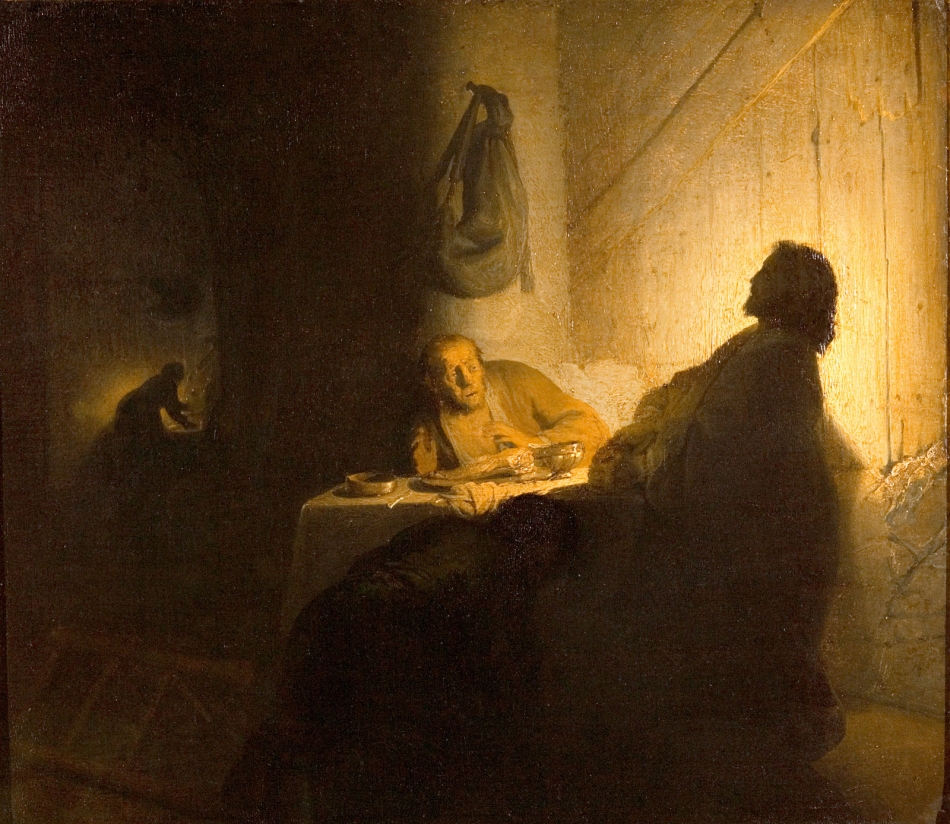
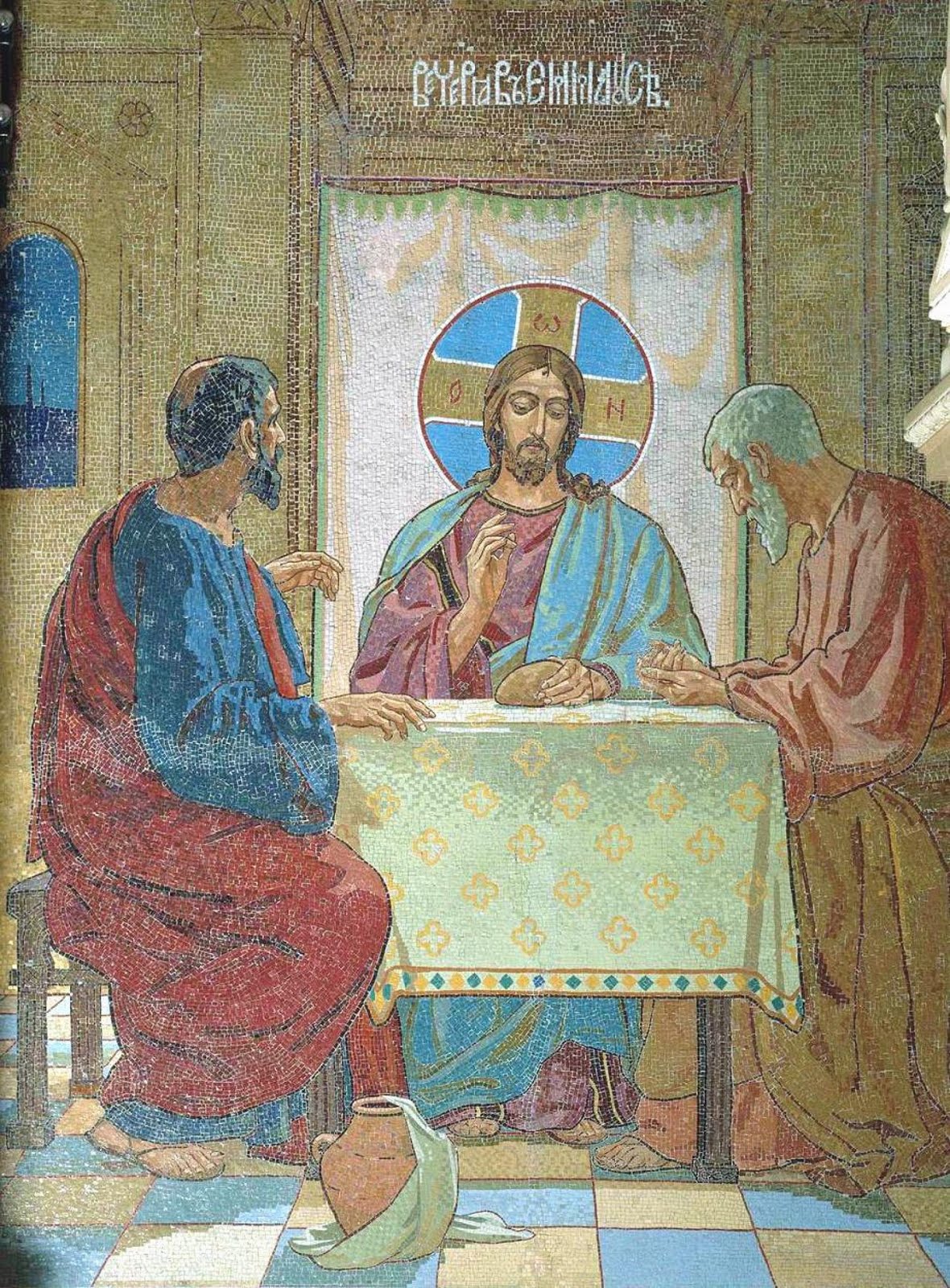
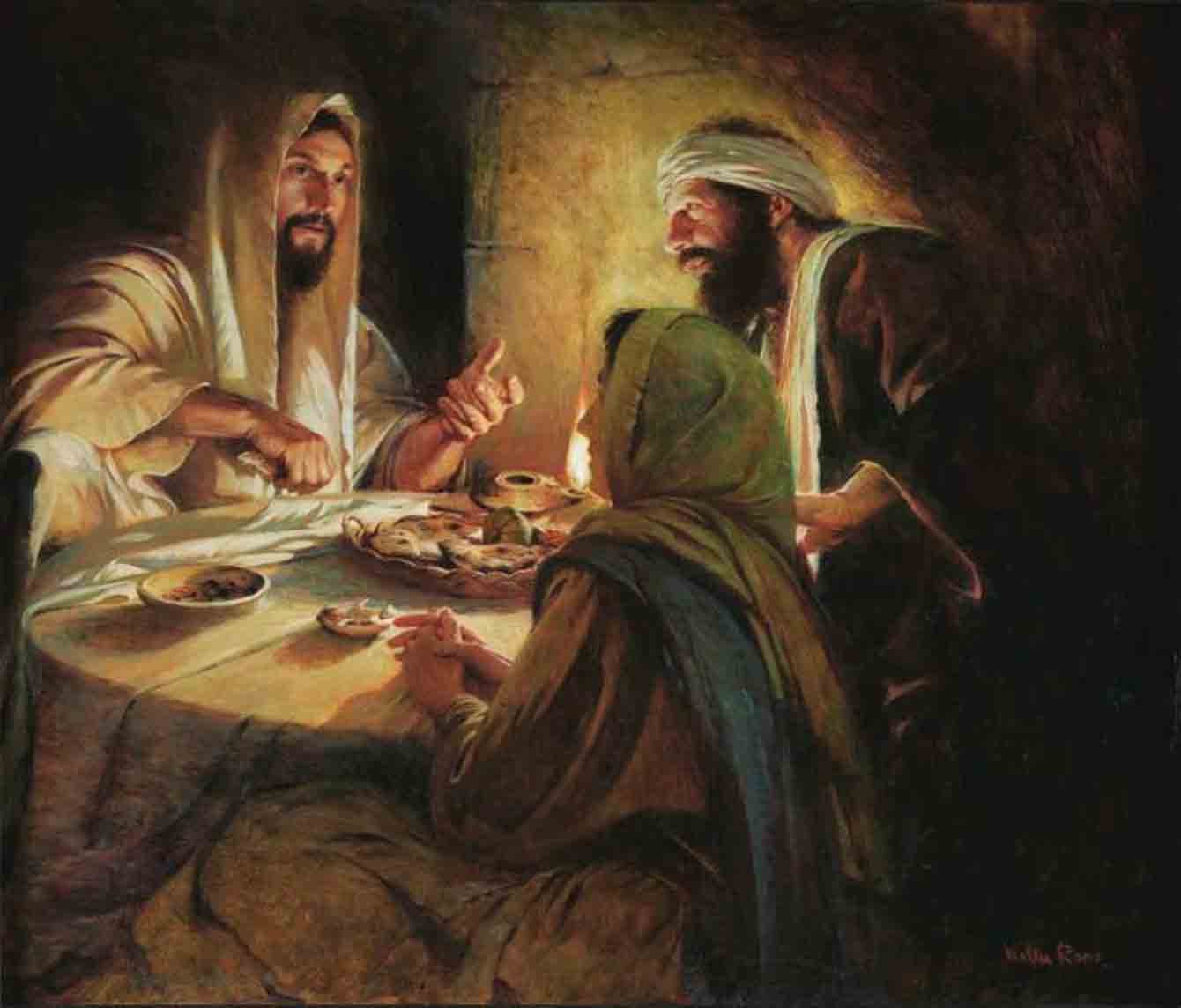
They arrive in Emmaus and the two disciples invite him into their home for dinner. And that’s where everything changes.

“When he was reclined at the table with them, he took bread, gave thanks, broke it, and began to give it to them. Then their eyes were opened and they recognized him.” ~Luke 24:30-31

The story of the resurrection meal in Luke 24 perfectly mirrors our experience as Christians. We go through seasons of sad dismay at the failure of our human hopes. We endure periods of frustration and doubt, depression and despair. Let’s face it, sometimes we can get into a dark place where we question where all this is headed. We wonder if God really is in control, if Jesus really is alive and reigning at the Father’s right hand, if things really are going to work out for me at the end.

Then we take our places at the table and we realize that Christ Jesus himself is with us. He warms our hearts with his truth, he comforts us with his presence, he assures us with his peace.

The realities of the Christian experience are revealed during our meals with the risen Lord. His presence with us at the table is proof that humility leads to victory, that suffering leads to glory, and that, through God in Christ, death leads to eternal life.

Peace,

Allan

« Older posts Newer posts »