A comment from Rob’s Dad regarding yesterday’s post: How do you reintroduce the joy? I love your point and wonder what steps and actions you would put in place?
 This is proving to be a difficult thing at best. Shifting our focus at the Lord’s Supper from individual introspection and silent meditation on Jesus’ death to a corporate celebration of joy and thanksgiving for Jesus’ resurrection and eternal life is going to take a long, long time. Normally when we’re talking about changing something in our corporate assemblies — instead, I should say making something we do better, more theologically correct, more transformational, more in tune with the Gospel of Christ — we have to deal with a few decades of bad teaching and shallow understanding. But with this communion thing, we’re tackling a distortion of the original intent and practice that has been more than 12 or 13 centuries in the making.
Understanding that most church leaders and congregations first need a thorough study of the Scriptures and Church history when it comes to the Lord’s Supper, I will offer a few suggestions and changes that should be prayerfully considered by all worship ministers and congregational elders to restore Gospel joy to the table and put the community back in communion.
 1) Sing songs of praise and thanksgiving before table time. Please notice that in your song book index, Lord’s Supper songs are categorically about the suffering and death of Jesus. Almost all of them. Singing only those kinds of songs in and around the Lord’s Supper will focus us exclusively on just one aspect of God’s salvation work through Christ. It narrows our understanding of what’s happening at communion. It actually counters what the Bible says about the great joy of the disciples as they ate with their Lord on that first Resurrection Sunday. Singing songs about death causes us to act like we’re at a funeral. There’s not much joy around the casket at a funeral. We eat and drink like it’s Friday instead of Sunday. Jesus is not dead; he is alive and reigning at the right hand of our Father in heaven! I would suggest singing songs of praise and thanksgiving. Any song that has the words “Thank you” in them would be great. Eucharist means thanksgiving, right?
 2) Explore other Lord’s Supper themes. In an effort to broaden the experience and deepen our understanding of communion, we ought to focus on a different theme each week. It’s not just about Jesus’ death. The table also expresses the unity of Christ’s Church, it points to the great eschatalogical wedding feast of the Lamb, it remembers Jesus’ meals and teachings during his ministry, it proclaims the Gospel, it reminds us to serve the needy, it prompts praise and thankgiving, it celebrates the Resurrection, it moves us to renew vows of loyal discipleship to our Lord, and, yes, it also rejoices in the sacrificial death of the Son of God. The apostle Paul ties the Lord’s Supper directly to our unity. Luke conects it to Jesus’ feeding of the multitudes. All the Gospels say the Lord’s Supper is a resurrection meal. Acts uses communion as an act of Christian fellowship and community. Jesus says the feast represents the Kingdom. Revelation shows us how it’s a participation in eternity. Why would we limit our table experiences on Sundays to just one of these many facets? Why not explore Exodus 24 and Isaiah 25 and Luke 24 and John 20 and Romans 6 and Revelation 5 in our Lord’s Supper meditations? Why not use songs from the “Invitation” index? There’s never been a better communion song written than “All Things Are Ready, Come To The Feast.” Why don’t we try that?
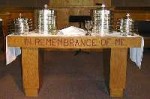 3) Smile. Don’t allow your guy presiding at the table to be grumpy. Don’t let him look so solemn like he’s carrying a coffin down the center aisle. Most of the time, these men don’t realize they look so sad or even angry. They just grew up thinking it was wrong to smile during communion. So, while they’re standing up in front of the entire congregation, waiting on the last of the bread trays to be collected and the men to get back in position for the distribution of the cup, they stare. They stare either blankly out into space or they stare holes through the walls where the men are scurrying into place for the next act. Again, I don’t think they’re doing it on purpose. One of the happiest, most cheerful, funniest guys I know at Legacy — a great friend — acts like a completely different man when he is presiding over the Lord’s Table on Sunday mornings. He looks mad. Tell your guys it’s OK to smile. If you’re up there, remember to relax. Breathe. Smile. Chill out. Christ is risen and he’s promised you eternal life. It’s OK to smile. In fact, it’s preferred.
 4) Direct the congregation to share during the supper. Most of us were taught to look down at our shoes or stare into the pages of our Bibles or close our eyes during communion. How about teaching your church to interact with one another instead? It’s communion, right? Community! Instead of keeping that special passage of Scripture to yourself, why not share it with the person next to you? “Hey, check this out; this verse always means a lot to me during communion.” Or maybe, “Hey, this is always what I think about during the Lord’s Supper.” Or perhaps grab a hymnal (if you’re blessed enough to even know what that is) and point out a favorite to a neighbor on your pew, “This song was always one of my favorite communion songs.” Instruct your church to pass the trays with a simple, “Christ’s Body broken for you” or “Christ’s blood poured out for you.” Something to get people talking and sharing. You could also announce a new rule in your congregation: nobody does communion by themselves! If somebody’s sitting alone, invite them to sit with you. Or you just go sit by them. Take your whole family and go join them for the meal. Instead of greeting visitors in your church at the beginning of the assembly, do it as you prepare for communion. Have everybody stand and greet one another and invite one another to the table. An atmosphere of joyful community around the table isn’t very natural anymore. It hasn’t been for a long time. We’re going to have to teach it and show it, model it and encourage it.
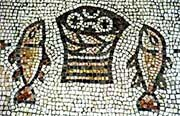 5) Enjoy communion after the sermon, not before. It’s much easier to tie the Table into the Word if it’s after the sermon. With just a little time and practice, you’ll find that it’s really very simple to continue the theme of the sermon and the songs and the prayers of the rest of the assembly right into this most important aspect of the day. Instead of the Lord’s Supper itself being “separate and apart,” it becomes the climax, the high point, what the whole rest of the assembly was leading us to. Pretty soon, the table becomes a very natural way to express and experience what’s been talked about and taught and preached through the sermon and the songs and the prayers that have come before.
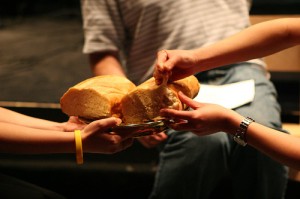
 6) Bigger pieces of bread and bigger cups of wine. Encourage bigger bites and drinks. It’s hard to latch on to the symbolism of a heavenly feast when it’s just a sip and a crumb. It’s like sprinkling water on somebody’s head for baptism instead of immersing all of him in a tub of water. It’s just not the same. Not even close. Unleavened bread was first introduced to the Church’s Lord’s Supper in the 900s in order to set the communion experience as so completely different from anybody’s every day meal experience that it would cause congregants to act differently, with more reverence and awe, more silence and solemnity. It was successful. Obviously. Chunks of bread and gulps of juice would help fix that a little.
These are just a few suggestions off the top of my head. What has your church done to restore the joy and community to our Lord’s Table? What would you try if you were allowed to? I’m always open to faithful suggestions.
Peace,
Allan







Recent Comments