(Today’s post is over 2,600 words. Forgive me. I’m not writing for you today, I’m writing for me. I don’t want to forget what God taught me this past Sunday. Reflecting on it here is the best way for me to remember. Every now and then you’re going to be subjected to stuff like this as I analyze and over-analyze my walk and my calling. Sorry.)
Elaine introduced me to George a couple of weeks ago. George grew up as an orphan in Kenya, born to a prostitute and abandoned to the Lakeside Orphanage. Elaine and a few other of our Central members met George two years ago on a mission trip to Kenya and, as is Elaine’s glorious habit, she’s kept in touch. George, through the generous work of Christian Relief Fund and by the ultra-generous grace of God, wound up working at the Alara school and is now a law student at the University in Nairobi. While on a winter break here in the states, George popped in to see Elaine and I was honored to be introduced.
A couple of days later Elaine asked if we could give George two or three minutes on Sunday to say ‘hi’ to the congregation and thank them for their prayers and support. “Absolutely!” I said. “Of course. We do that all the time.”
And we do. Every few weeks or so it seems we’re giving a missionary or a visiting evangelist a couple of minutes in the pulpit to thank the church. And I try to get them involved in the leading of our worship. I ask them to lead a prayer or read a passage of Scripture or something. It’s good for our church to see up close what our God is doing in other parts of the world. It broadens our understanding of the Kingdom, it raises our vision for what’s really happening, it deepens our commitment to our Father’s work in the world to see and to hear these kinds of reports.
So I told George on Thursday. And again on Saturday. And again Sunday morning right before our worship assembly began. “I’ll introduce you right at the start. I’ll call you up to the front. You take two or three minutes to thank the church. And then you’ll ask the congregation to stand for a reading of Psalm 23.” It would be fine. No, it would be more than fine. It would be great.
As I welcomed the congregation into the assembly I told them I was beside myself with anticipation about what our God was going to do with us today. I expressed to the whole church my excitement for the potential of this day, my enthusiasm for the unknown mighty work our Father was going to do during our Christian gathering. Of course, I was thinking about my sermon.
We were launching a time for selecting additional shepherds. Sunday was the first day to talk as a church family about additional elders at Central and to go over the process together. The sermon I had prepared was excellent. It was going to be one of my best, I just knew it. It challenged some of our long-held beliefs about those elder “qualifications” in Paul’s pastoral letters. It quoted Flavil Yeakley and Everett Ferguson. It painted the very clear differences between worldly leadership and spiritual leadership, between being a church administrator and being a godly shepherd. It praised our past and looked to the future. What a sermon! It contained a riveting illustration from the movie Dead Poet’s Society in which I was seriously considering jumping up on the communion table to say “Oh, captain; my captain!” It also had an illustration from a Herman Mellville novel to show my literary side and the requisite sports analogy to keep it real. What a sermon, indeed! When I was finished with this masterpiece of a sermon, our entire congregation would be inspired to choose Christ-like men through study and prayer. Our current elders would be moved to greater things as a result of my sermon. I knew God was already pleased with my sermon, but he’d be even more so after he saw and felt the response from the church. This was a really good sermon, the perfect sermon to kick off a crucial time in the continuing story of our congregation. I was really excited for what God was going to do with my sermon.
So, I welcomed the church and introduced George so he could say “thank you” and read Psalm 23 and we could all get on with what we came to do.
That was at 10:18 am.
At 10:46 am, George was still talking. I know what time it was because I looked at my watch about a zillion times.
George told our church family his story about growing up in poverty in Kenya, an orphan abandoned by his prostitute mother. He described the poverty in graphic terms and contrasted it to the wealth that surrounds us here in the states. He praised our God and exhorted us to do the same. He thanked God for delivering him from the pit and encouraged us to do the same. He boldly challenged our consumeristic culture in Texas and dared us to think outside ourselves to the poor and needy around the world and around our own zip codes. He courageously reminded us of how truly blessed we are and, as children of God and followers of his Christ, how much responsibility comes with it.
And I was upset.
While my church strained to understand every third or fourth word George said and labored to put it together, while my church family encouraged this young brother in Christ who was preaching his heart out with their “amens” and applause (applause!?!), I fidgeted in my seat and grew more and more anxious. And — I’m so ashamed to admit this — upset.
I told him two or three minutes! I told him to thank the church and then read Psalm 23! He’s talking for 30 minutes!
I looked at Kevin’s order of service. Can we cut some songs? I won’t have time to preach. Can we skip a prayer? I won’t have time to preach. As George kept talking, I began mentally chopping my sermon. I can lose the intro. I can take out an illustration. I can leave out a couple of Scripture references. I looked at Kevin, but he was focused on George. I looked at Elaine — maybe she can subtly gesture to George to get him to sit down — but she was zeroed in on the guest speaker. I fidgeted some more. I didn’t know what to do. I’m not going to have time to preach.
Thirty minutes after he began, George finally led us in that reading of Psalm 23. Then, once he sat down, we started to sing.
My God Reigns. Everlasting God. Be Unto Your Name. O, Draw Me, Lord.
And while we sang, my gracious and compassionate God, slow to anger and abounding in love and faithfulness, told me in no uncertain terms that I was being a short-sighted egotistical idiot and that I had no right to question the order of things or how they happen when his beloved children gather in his holy presence. I could almost hear our Father — almost — say to me, “Sit down, Allan! Who do you think you are? Sit down and be quiet.”
It was almost immediate. I really don’t know how to describe it. But in a flash, in a blink, I went suddenly from thinking about my plans and my time and my sermon t0 considering God’s plans and God’s time and God’s work. I often tell others to do this: try to figure out what God is doing and then do your best to join him. So as we sang, I practiced it myself.
God, what are you doing right now? What are you doing during this church service? Why is George here? Why did he take up all my sermon time? I don’t have time to preach now. Why? What do you want me to say? What do you want me to do? What is supposed to happen here?
I’m not sure how God did this, but he shot the 21st chapter from C. S. Lewis’ “The Screwtape Letters” right straight into my brain. In chapter twenty-one, the senior devil is teaching his nephew that men are so silly because they believe their time actually belongs to them:
“You will notice that nothing throws [the man] to a passion so easily as to find a tract of time which he reckoned on having at his own disposal unexpectedly taken from him. It is the unexpected visitor (when he looked forward to a quiet evening), or the friend’s talkative wife (turning up when he looked forward to a tete-a-tete with the friend), that throw him out of gear. Now he is not yet so uncharitable or slothful that these small demands on his courtesy are in themselves too much for it. They anger him because he regards his time as his own and feels that it is being stolen. You must therefore zealously guard in his mind the curious assumption “My time is my own.” Let him have the feeling that he starts each day as the lawful possessor of twenty-four hours. Let him feel as a grievous tax that portion of this property which he has to make over to his employers, and as a generous donation that further portion which he allows to his religious duties. But what he must never be permitted to doubt is that the total from which these deductions have been made was, in some mysterious sense, his own personal birthright.”
“He is also, in theory, committed to a total service of [God]; and if [God] appeared to him in bodily form and demanded that total service for even one day, he would not refuse. He would be greatly relieved if that one day involved nothing harder than listening to the conversation of a foolish woman; and he would be relieved almost to the pitch of disappointment if for one half-hour in that day [God] said, “Now you may go and amuse yourself.” Now, if he thinks about his assumption for a moment, even he is bound to realize that he is actually in this situation every day.”
What if our Father, in his infinite wisdom and matchless grace, had gathered a church family in Amarillo into his presence so they could encourage and bless a young preacher he had rescued from the slums of Kenya? What if God wanted nothing more than to use us to spur George on to things in the Kingdom grander and greater than any of us could imagine? What if God had planned for 23 years — or 2,300 years!!! — to bring George to Amarillo so he could be blown away by the love and grace, by the prayers and hugs of 750 Christians? Yeah, but he’s got this selfish pulpit guy in the way down there. That’s OK, God says. We’ll have George go first.
Finally, I began to see it. God, I think I see what you’re doing. Please help me to join you and make it just half as grand as you’ve planned it to be. Please help me to get out of your way here. Please, Father, help me to do the right thing that brings glory to you. And only you.
By this time, we were in the middle of communion. It was 11:10. I got up and walked four pews back to the nearest elder. I told him I wasn’t going to preach. He whispered to me, “Do you have anything in the sermon that’s critical to the elder selection schedule we’ve got?” I replied, “Apparently not.”
I walked around to where Mary was seated on the other side of the worship center to tell her she was only going to have about ten minutes with the kids for children’s worship. She didn’t ask any questions. I gulped a communion cup full of grape juice with Colby and McKaden (“The blood of Christ!”) and headed to the stage.
I asked the church to turn to John 10. It was 11:15 am. I walked to the edge of the platform, looked at George seated next to Elaine on the second pew, down to my right. I leaned over to him. “George, this is how you get 750 Texans to say ‘Amen!'” Then I stepped to the center of the stage and declared, “I’m not going to preach today.”
Once the thunderous ovation died down and we swept the bits of plaster that had fallen from the ceiling out of our hair, I proceeded to confess to my brothers and sisters in Christ that I had been convicted by our merciful God. I told our church that while George was boldly proclaiming the Gospel of Jesus, I was worried about my sermon. I confessed that while George was courageously challenging us to live more sacrificial lives in the name and manner of our Lord, I was anxious and concerned about my time in the pulpit. This young man, so full of God’s Spirit, was saying things our Father needed us to hear. And I wasn’t really listening. I told my church family that Scripture declares God is the one who raises orphans from the dust, he lifts the needy from the ashes, and seats them with princes. Hannah, the mother of Samuel sang that song! David, the great and glorious king, sang that song! And we were looking at it in George! George: living, breathing, flesh-and-blood proof of our God’s glory right in front of us. And I almost missed it. George had said a couple of times during his talk, “Look at me and see what our God can do!” He was right. I couldn’t come up with a better illustration. I could never write a better sermon than what we’ve already heard.
Then I paraphrased the passage from Screwtape. What if God only needed us today to blow George out of the water with our encouragement and blessing? What if that’s all we’re called to do today? Wouldn’t we do it with all of our might? Enthusiastically? With great gusto and energy?
I thanked George and gave praise to God.
I read a couple of verses from John 10 to remind us that our Father has placed us in Christ’s hands and nothing will ever snatch us away. We are saved. We are secure. We are redeemed for all eternity. So we submit. And we serve. And we sacrifice for the sake of the world.
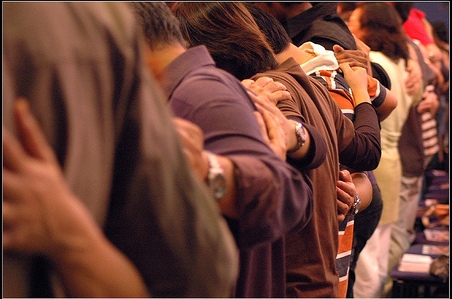
Then we gathered around George. All of us. We actually got up off our seats, out of our pews, and came forward. The whole church. It looked like 700 of the 750 in the house came down to gather around George. There were tears and giggles, hugs and high fives. And big, big, big smiles. We surrounded our brother from Kenya. We put our hands on him. George had hands on his head, his shoulders, his back, his arms. We almost dog-piled this poor kid. And then we prayed. Thanksgiving. Blessing. Praise. Encouragment.
His Christian Relief Fund sponsors were in the room. They’d never seen anything like it. Some guy who was born in Kenya, same tribe as George, a guy they had met Friday night at the only African restaurant in Amarillo, was in the room. He’d never seen anything like it. People George had never met before were getting his email address and his phone number. People were pledging financial support and vowing to keep in touch. I’d never seen anything like it. I had begun the service by declaring my eager anticipation over what God was going to do with us. And then, as always, he did more. Even as I questioned him, even as I selfishly ignored him, even as I sinfully rebelled against what he was doing, he did it. He always does.
From the moment that service ended (I had stopped looking at my watch by this time) up until just a few moments ago this Tuesday afternoon, I’ve received a fairly steady stream of compliments, phone calls, emails, texts, and in-person compliments for handling the situation Sunday with such grace and leadership. No. That’s not right. It was God’s grace and God’s leadership in spite of me, or despite me, certainly not because of me.
I’ve also heard the obligatory, “That was the best sermon you’ve ever preached!” joke at least 30 times.
I agree.
Peace,
Allan






Recent Comments