Category: Worship (Page 7 of 27)

You Have Come to God

I think Christians were having worship service disappointment issues even back when Hebrews was preached/written. There have probably been worship issues for every generation of God’s people that go all the way back to expectations that we set after that very first worship assembly at Mount Sinai.

That first worship service was crazy awesome! There’s thunder and lightning and smoke. God himself appears in a great fire. There’s the sound of a heavenly trumpet. The whole mountain is shaking. The people are trembling. God’s people are in the holy presence of God with all the smells and bells you would expect. This is a worship experience you can see and hear and smell and touch — something for all the senses!

How was church? Did they bring the Word?

Yeah, the Ten Commandments! Everybody came forward! They didn’t even get through one verse of Just As I Am!

I think this little church in the middle of the first century in the Roman Empire longed for that kind of worship. They wanted a worship experience where something happens — something transcendent, something powerful, something that moves me. Something.

These Christians were gathering on Sundays to read or recite from the Greek translation of the Hebrew Scriptures, to sing a song, to share a meal, and to pray. And I wonder if some of them think, “You know, they do worship better at the old temple in Jerusalem. The priests in the decorated robes, the smells of the incense, the sounds of the Levitical musicians and choirs, the dramatic spectacle of the sacrifices — now that’s a church service!”

Or, maybe, “My friends seem to have a really good worship experience at the pagan temple down the street. There’s rituals and chants and dancing and music and blood and sex and it’s loud and there’s lots of energy. Something happens there.”

The preacher in Hebrews knows these Christians are growing weary with worship. Some of them have stopped coming. They don’t go to church anymore. Or, not like they used to. So he reminds them what’s really happening at church. He tells them again about the unseen realities of what’s going on at worship. There’s more here than meets the eye. And he wants his church to hear it.

“You have come to Mount Zion, to the heavenly Jerusalem, the city of the living God. You have come to thousands upon thousands of angels in joyful assembly, to the church of the firstborn, whose names are written in heaven. You have come to God, the judge of all people, to the spirits of righteous men and women made perfect, to Jesus, the mediator of a new covenant, and to the sprinkled blood that speaks a better word than the blood of Abel.” ~Hebrews 12:22-24

How was church? How was church?!!?

You have come into the presence of God! And when you assemble with the people of God in the presence of God, things happen! Eternal things. Divine things. Salvation things. Whether you feel your pulse race or not, whether you feel moved or not, you have come into the presence of God! And there’s more going on than you can see or touch.

Faith is the assurance of things hoped for and the certainty — the conviction — of things we can’t see. So even if you see and feel nothing at worship, you have come into the presence of God.

The word is proselay in the Greek, to come or to approach. It’s the same word the preacher’s been using the whole sermon. “Let us come to the throne of grace with boldness (4:16). Christ Jesus is able to save all those who come to God through him (7:25). Let us come to God with a true heart in full assurance of faith (10:22). And now this, finally: You have come to God (12:23)!

How was church? Listen and I’ll tell you about church. You can’t see it, but God is at church and Jesus is at church and the angels and saints. And it’s eternal and powerful and it’s personal and relational and don’t you want to be a part of that?! Don’t you want to belong to that? Yes, be a part of the worshiping community of God’s covenant people! Why would you want to be anywhere else?

Peace,

Allan

How Was Church?

I have had many spectacular worship experiences in my life. I’ve had several wonderful, inspiring, awe-filled worship moments. I’ve broken down in tears while praying with a group of fellow ministers at the Western Wall of the temple mount in Jerusalem. Praying to God at that sacred place where our Lord actually appeared to his people, where his glory filled the temple and where his voice shook the hills, I was overcome with emotion. “God was here! He was actually here!” And I just wept.

I’ve recommitted my life to Christ with 15,000 worshipers at the state fairgrounds coliseum in Tulsa. Fifteen-thousand of my brothers and sisters worshiping God, singing praises to God, listening to Rubel Shelly preach about our forgiveness in Christ, about our right standing with God, challenging us to truly live into the realities of that righteousness. And the singing was just indescribably beautiful. Powerful. “God is here! God is right here speaking to me, talking to me, changing me.” And I made promises to God that night, standing right there on the coliseum floor, “Lord, I belong to you. Thank you, God. Please, do whatever you want with me. I’m yours. Thank you, God.”

I’ve marveled at the majesty and power of God at that first 4Amarillo gathering at First Baptist five years ago. I was stunned, I was overwhelmed at the gracious glimpse of heaven we got that night. Presbyterians and Methodists and Baptists and Church of Christers, singing to the Lord, holding hands, making promises to each other, loving each other in Christ. There were no barriers, no obstacles, nothing between us at all. I thought, “This is heaven! This is God’s perfect will being done on earth just as it is in heaven.” Christians from every denomination, from every stripe of the faith, worshiping together, one in Christ Jesus, united in the Spirit. And I was paralyzed in awesome wonder.

I’ve had a lot of amazing worship experiences in my life. Not too many of them have been at church.

You’ve had some great worship experiences in your life. On top of a mountain on Trek. Around a campfire at Bluehaven. On a mission trip in a foreign country. (I’ve heard people describe what they call life-changing worship on a KLUV cruise, which proves that one man’s heaven is another man’s hell.) We’ve all had what we would call great worship. And we think it ought to happen more often at church. There’s something inside us — an instinct, a deep desire, we just know — church ought to be a place where really awesome worship happens all the time.

But it doesn’t.

The songs are not my favorite and not everybody’s singing. The sermon is mediocre and not really relevant to my life. The prayers are uninspired. The room is dingy.

How as church today? Was it long today?

It’s always long.

And we all think the other church across town does it better. Something happens at that other church. The worship is awesome, the sermon is practical, the prayers just soar, and all the people are full of joy at that other church.

Two-thousand years ago, a congregation of Christians had the same problem. Just thirty-five or so years after the death and resurrection of Jesus, a group of Christians, probably in the capitol city of Rome, also had worship disappointment issues at church.

So a preacher had to remind them about what’s really happening at church. He tells them about the unseen realities of what’s going on in corporate worship. There’s more happening there/here than meets the eye. And he wants his church to hear it.

Hebrews 12:22-24 is a powerful passage about those unseen realities: divine beings, eternal souls, everlasting blood, the holy presence of Almighty God. These three verses go a long way in reshaping our views of and expectations for what happens in the worship center on Sunday mornings.

We’re going to look more closely at this familiar passage over the next two days. Why don’t you read it a couple of times today and tonight and then come back tomorrow to dive into the rich realities together.

Peace,

Allan

Keep It Between Yourself and God

oneheartwings“One man considers one day more sacred than another; another man considers every day alike. Each one should be fully convinced in his own mind. He who regards one day as special, does so to the Lord. He who eats meat, eats to the Lord, for he gives thanks to God; and he who abstains, does so to the Lord and gives thanks to God.” ~Romans 14:5-7

Paul tells the fractured house churches in Rome that each Christian or group of Christians should be fully convinced that the things they believe and practice are the right things in the eyes of God, but don’t you dare bind those things on other disciples who don’t feel the same way. If my brother or sister believes or practices something different from me, we assume he’s doing it to the Lord, she’s doing it before the Lord, they’re doing it in the presence of the Lord with a clear conscience. We assume that my sister with a different belief or a different practice is not believing or practicing arbitrarily. She’s not doing it with a bad attitude or with bad intentions. She’s doing it with careful study and serious prayer and reflection. And she’s fully convinced she’s doing the right thing. So everything’s fine, Paul says. Don’t judge her.

“For this very reason, Christ died and returned to life so that he might be the Lord.” ~Romans 14:9

But what if we’re talking about a “salvation issue?” OK. You already know how I feel about the term “salvation issue.” Besides, in this Romans context, Paul never once categorizes the issues and practices in terms of saving or condemning anybody. “Disputable matters” seems to be almost anything about which Christians might argue. And, in Paul’s words, Christians should keep those beliefs and practices between themselves and God.

“As one who is in the Lord Jesus, I am fully convinced that nothing is unclean in itself.” ~Romans 14:14
“Let us therefore make every effort to do what leads to peace and to mutual edification.” ~Romans 14:19
“Whatever you believe about these things keep between yourself and God.” ~Romans 14:22

Paul clearly identifies himself as one of the strong — he says it: “We who are strong!” But let’s notice that he doesn’t say the weak need to change their minds or their opinions or their practices. These Christians who disagree with him on church traditions and worship practices? He doesn’t call on them to change. In fact, Paul goes so far as to command them not to change their practices unless their minds are fully convinced.

Paul’s prayer is not that all the Christians in Rome come to the same opinion on these things. No. He’s praying that they may possess a unity of Spirit that transcends their differences.

Peace,

Allan

Confession at the Cross

Beware of exploring the spiritual disciplines. Practicing the traditional disciplines will force you to confront your sins. I know this first hand. Silence before God or a prolonged meditation on a Psalm tends to bring out the honest truth of your relationship with the Father. Fair warning. There’s no hiding it when you’re in that place with our God.

Yesterday at Central, we explored a few of the historic spiritual disciplines together. We began with our middle school and high school students reciting a prayer of invocation written by Walter Brueggemann in 1996 and ended with a benediction penned by John Newton in 1779. We prayed the Lord’s Prayer together at the table and we observed two moments of silence around Psalm 32. And we confessed.

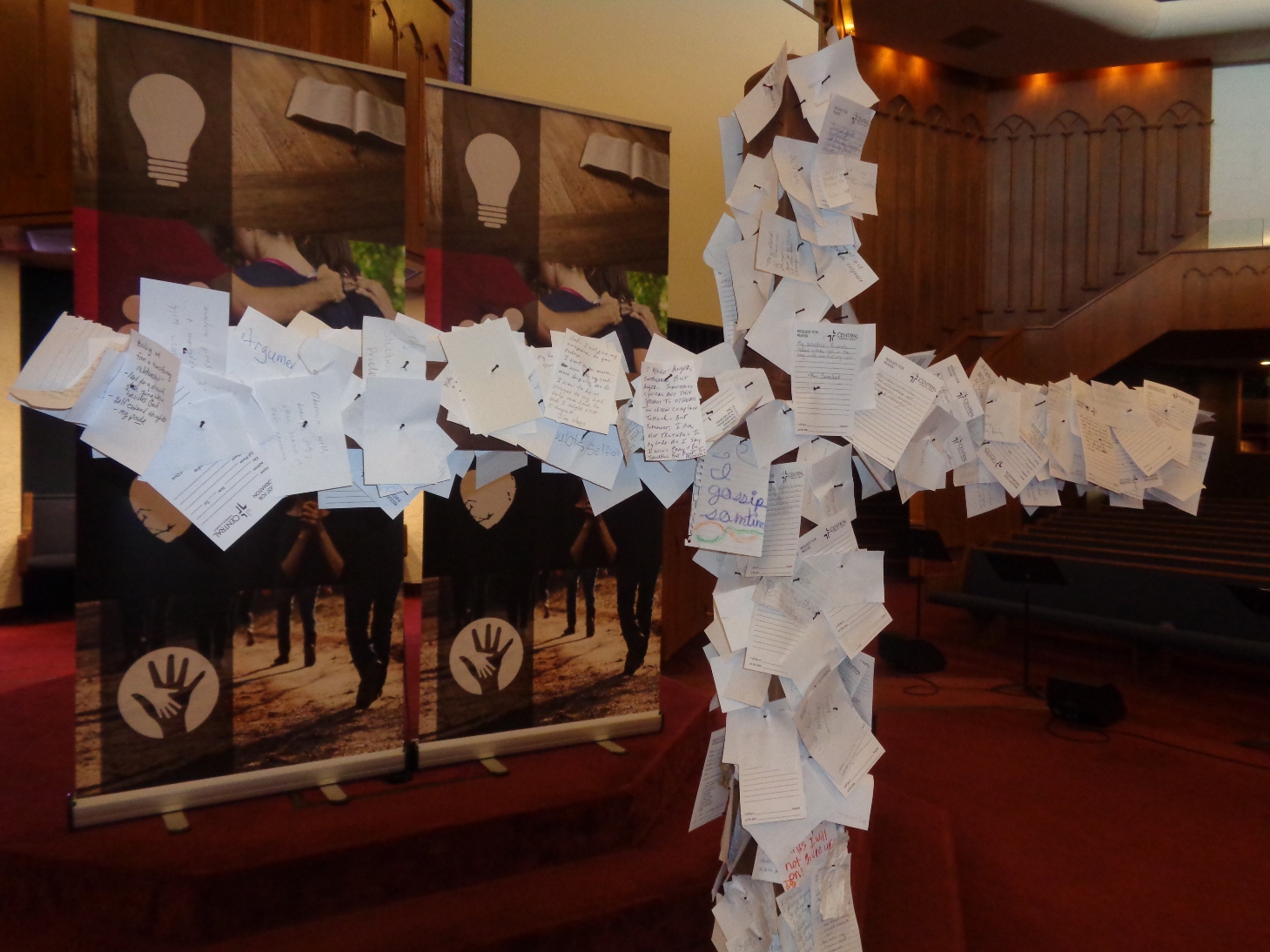
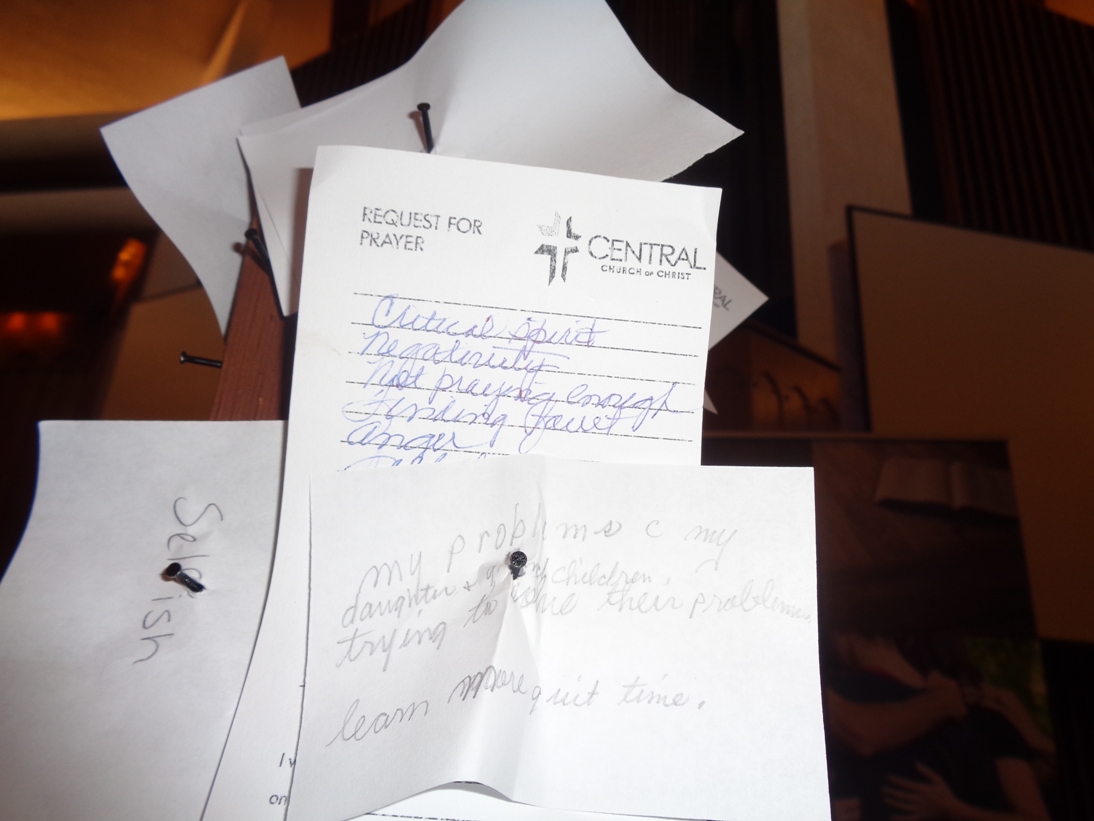
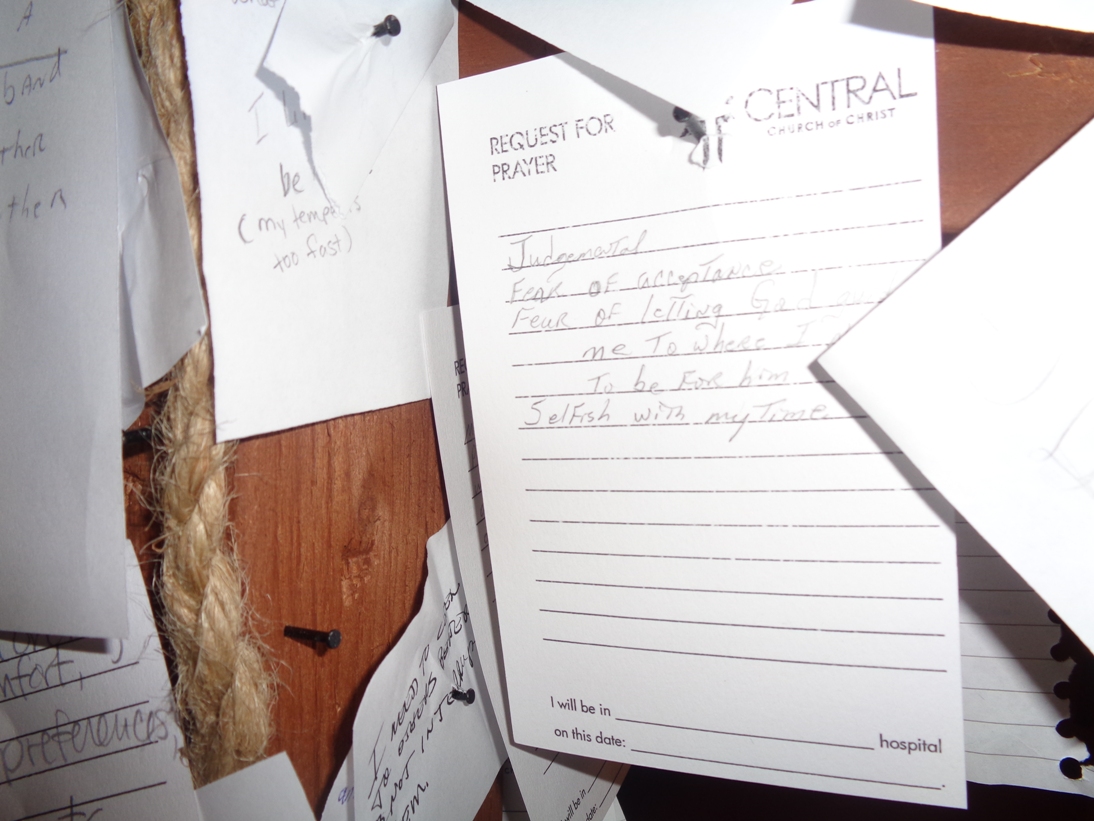
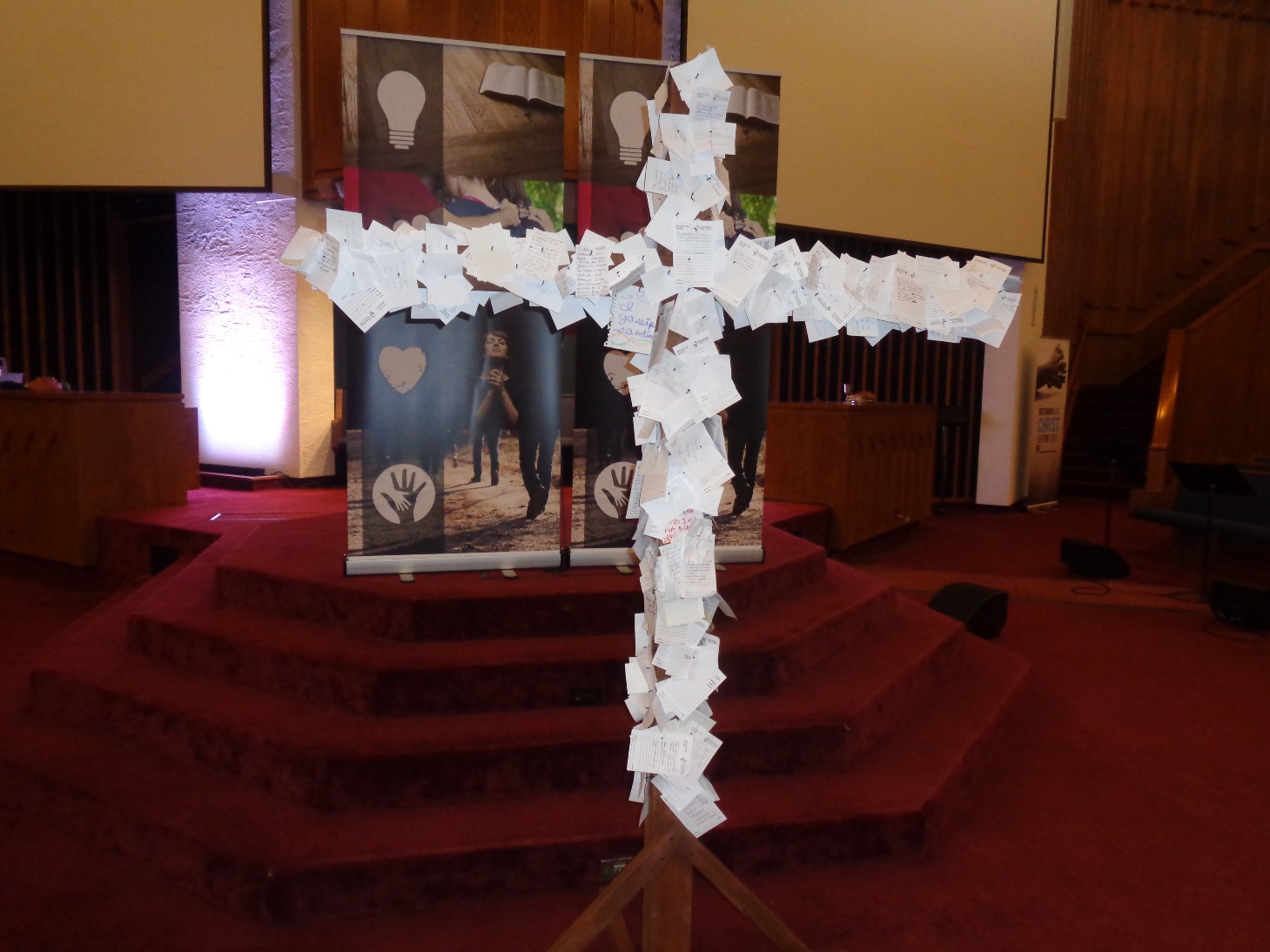
The inner life is about being in a place with God where he can work on you. And as we commit as a church family to pursuing a more holistic discipleship, which includes the traditional disciplines, confession just seemed like a good thing to do. If we’re going to be in that place with God, we’ve got to be up front with him about our sins. So we wrote down on pieces of paper the things that are wrong in our lives that need to be fixed by God, the attitudes of our hearts that need to be redeemed by God, and the situations in our lives that need to be given completely to him. And then we placed them on a large wooden cross at the front of our worship center.


The cross of Christ represents forgiveness and restoration and new life. It stands for a trust in God that he is bringing to completion that thing he has started in us. It reminds us that our Father has promised to make all things right — if things aren’t right in my life, it means that God’s not finished yet, he’s still working. So, after dwelling in Psalm 32 (“I acknowledged my sin to you and did not cover up my iniquity. I said, ‘I will confess my transgressions to the Lord’ – and you forgave the guilt of my sin.”) we brought our sins and our attitudes and our lives to the cross and left them there.

And they’re still in there.


I’ve walked in to our worship center twice already today to spend some time at that cross. I read the confessions, I see the lists of sins and attitudes that plague our people, and I can relate to a bunch of them. Reading the words on that cross today, praying for the people who wrote those words and placed them on the nails on the cross, brings to light sins and attitudes in my own life that I haven’t written down or even acknowledged yet that need to be forgiven and transformed by God.

I don’t ever want us to come into the worship center on a Sunday morning Just As I Am and leave an hour-and-a-half  later Just As I Was. Part of that corporate assembly experience is to be changed by God. Confession is good. Silence is good. Embracing a contemplative posture in the holy presence of God is good. You can’t hide anything when you get into that place with God. And it’s impossible to stay the same.

Peace,

Allan

Putting On Christ

“Clothe yourselves with the Lord Jesus Christ, and do not think about how to gratify the desires of the sinful nature.” ~Romans 13:14

Ash Wednesday marks the first day of Lent, the 40-day period of fasting and prayer that precedes Good Friday and Easter Sunday on the Church calendar. Going back to the early years of church history, Lent has traditionally been a time for personal abstinence and self-discipline. In the middle ages, it became particularly associated with a fast from eating meat. It developed into a teaching tool for the church and a reminder for all Christians: in your hunger, be reminded of all that Jesus suffered and sacrificed to win your salvation.

As you enter this season of Lent on your own or together with your family or community of faith, allow me to suggest that it’s not just about giving something up. It’s not only about sacrificing a certain type or amount of food or some other regular pleasure in order to participate in the sufferings of Christ or to remember his selfless preparation for the cross. At least as important is the idea and practice of taking something on, adding something new to your life in Christ.

Not only the surrender of material things, but the taking on of spiritual things, eternal things that draw us closer to Christ and, by the power of the Spirit, transform us more into his image is the best way to prepare for Easter. A new ministry. A new discipline. A new work for the benefit of others. A new prayer. A new friend. A new passage of Scripture. While you’re cleaning out your house over the next six weeks, pay attention to what you’re moving in to the empty spaces. Add something important. Commit to something Spirit-filled.

Peace,

Allan

Bring It With You

I want to ask you to stop saying something to your brothers and sisters in your church. If you’re a preacher or a prayer leader or a communion guy table talker or a call to worship person or an announcement maker in your congregation, I want to ask you to consider never again saying the following in front of your congregation:

“Let’s clear our minds of our worldly troubles and just focus on our worship.”
“Let’s put everything out of our thoughts and concentrate only on the sacrifice of Jesus.”
“Let’s get out of our heads everything that’s happened this week and just think about why we’re here.”
“Let’s leave the cares of the world out there and turn our attention to God.”

These are certainly well-intentioned phrases uttered by well-meaning men and women in our Christian assemblies. And I know most of us have heard them in church for most of our lives. But they don’t make any sense. They’re not only impractical suggestions, they’re actually contrary to what our Father asks us to do.

Truthfully, it’s impossible for most people to put their struggles out of their minds. How do you ask somebody to not think about their deep loss or their painful trial or their debilitating disease? Imagine for a moment…

“You want me to just forget about the fact that I’m in a wheelchair while we pray?”
“My wife’s got cancer; you want me to just put that aside while we sing Firm Foundation?”
“I’m supposed to block out the fact that I’ve been out of work for four months or that my daughter is in rehab or that my husband just left me while we read Philippians 2?”

We may as well be asking people to hold their breath for 60-minutes. Or to just stay home. It’s impossible. Why burden people by expecting them or asking them to do the impossible?

Secondly, our Father begs us to bring ourselves to him in our worship. All of ourselves — all of our hurts and pains, all of our wounds and scars, all of our sin and sickness. These things are a genuine part of who we are as people, these things have worked to shape us and form us into the men and women we are. Our theology says God is actually using those tribulations, he’s working in and through those very tough things, to teach us, to transform us, to make us more like his Son. In the Christian assembly, Philippians 2 should speak to a person’s doubts and fears. Our time at the Lord’s table should speak into a man’s sickness and shortcomings. The Church’s prayers and songs are intended to give meaning and purpose to a woman’s struggles and trials. Why would we ask people to put that aside or ignore those parts of us while we’re in the holy presence of our God who desires that we give all of ourselves to him?

I know you mean well when you say those things. But, please, stop.

Peace,

Allan

« Older posts Newer posts »