Category: Worship (Page 15 of 27)

Mind the Gap

During our 26 hours in London last summer on our return home from Kharkov, Ukraine, Carrie-Anne and I became quite comfortable riding the underground trains. Everything was clearly labeled, simple to find, not that big of a deal at all. I found myself especially intrigued by the “Mind the Gap” signs that were everywhere: in the stations, at the ticket counters, along the turnstiles, in the que, and even on the trains themselves. “Mind the Gap.” The friendly female voice on the recorded information messages reminded us at every stop to “mind the gap.”

See, there’s a gap between the train platform and the train itself. It’s no more than three or four inches across. It’s nothing really. I don’t think I ever would have noticed if it hadn’t been pointed out to me. Sometimes there’s a two or three inch difference in height, too, where the platform and the train come together. And, apparently, people were tripping on the gap and hurting themselves. So, a public service announcement program was born.

“Mind the Gap.” T-shirts. Billboards. Signs. Coffee mugs and computer mouse pads. “Mind the Gap.” Pay attention to the gap. Don’t forget the gap. Watch out for the gap. Don’t trip up on the gap.

There’s a gap between what we’re attempting to do in corporate worship each Sunday morning and what we’re actually doing. There’s a serious difference between who we are and who God is. When we gather to worship, there’s a canyon of contrast, a black hole of incongruity when it comes to what we think we’re doing and what’s actually taking place.

For a couple of weeks now, Kevin (Central’s amazing worship minister) and I have been planning my first Sunday. We’re less than two weeks away. We’re planning the songs. We’re planning the Scripture readings. We’re planning the prayers. The order. The communion service. The elders’ charge to me as the new preacher here. The appreciation we plan to show the search committee. We want it to be perfect. We want it to flow seamlessly. We want everything to work. We pray over it. We worry about it. We work it and re-work it together. Song and sermon and prayer and holy communion. God must be glorified and his children must be inspired. Song and prayer and sermon and communion. Do it again. We must take our people straight to his throne. We must pour ourselves out to our Father. Song and prayer, Word and table.

Even as we meticulously plan, I’m mindful of the gap.

What must our worship efforts look like to our holy God? Are they pitiful? Misguided? Sad? Shallow? Tragically funny? Do we miss the point entirely?

Annie Dillard wrote, “In two thousand years, we have not worked out the kinks. We positively glorify them. Week after week we witness the same miracle: that God is so mighty he can stifle his own laughter.”

I am always mindful of the gap. As I prepare sermons and dare to speak a Word from God to his people, I think about the gap. As I attempt to tie our table time directly to that Word each Sunday with a neatly composed prayer or a perfectly placed passage of Scripture, I remember the gap.

It’s there. I’m aware of it. But because of God’s matchless grace, I will not be tripped up by it. I won’t let it stop me from doing my best to please him and to encourage his people. Our Father smiles at our best and honest efforts, no matter how eternally foolish they may ultimately be. Mind the gap, yes. Be aware of it. But do not allow it to be a hurdle or a barrier between us and God. His patience is unlimited. His grace is beyond measure. His love for us is too great to adequately describe. And it renders the gap powerless against us.

Peace,

Allan

Filled With the Spirit

“Be filled with the Spirit. Speak to one another with psalms, hymns and spiritual songs. Sing and make music in your heart to the Lord, always giving thanks to God the Father for everything, in the name of our Lord Jesus Christ. Submit to one another out of reverence for Christ.” ~Ephesians 5:18-21

We worship in the Spirit. We submit to one another and sing and speak to one another in the Spirit. The Holy Spirit of God is who gives the Christian life its energy and enthusiasm. Its endurance. Its power!

Be filled with the Spirit.

This is an imperative. It’s a command. So we do take some responsibility here. This singing together and submitting to one another is either the means by which we pursue this filling of the Spirit or the result of being filled with the Spirit. Or both. Either way, Paul says when we sing together, when we pray together, when we really belong to one another, we are filled with the Spirit.

And that tells me that God is not a spectator when we gather for worship. Audience of one? No way! God is not the audience of our worship. Our God is an active participant with us — inside us — when we worship him together. God is not just sitting on his throne in heaven soaking up all the Hallelujahs and Amens. No. Through the Spirit, the Father and Son are engaged with us. Communing with us. Rejoicing with us. Transforming us. Changing us. Growing us. Shaping us more into the image of Christ.

Be filled with the Spirit.

Encountering God together — in our Sunday morning worship assemblies, Wednesday night Bible classes, Sunday evening small groups — being in the presence of God together allows us to recognize our own sinfulness and shortcomings. And that always leads to an acute recognition of his marvelous grace. And the power of God’s grace is not just forgiveness. It’s also transformation. New creature. New creation. Christ formed in you. Being saved. It’s a communal sanctification event that we participate in and experience together.

See you Sunday,

Allan

A Den of Robbers

“Is it not written, ‘My house will be called a house of prayer for all nations’? But you have made it ‘a den of robbers.'” ~Mark 11:17

What made Jesus so mad that day at the temple? What riled him to the point of flipping tables and scattering coins and driving out doves and sheep? We generally speculate that pilgrims and travelers were being ripped off. Religious officials were probably cheating worshipers on the exchange rate between their Roman coins and the temple-approved currency. Sellers of cattle and sheep were overcharging and taking advantage of those who had come so far to sacrifice and whose animals had been harmed or blemished in some way along the journey.

Those things may very well be true. And if they were, that would surely upset our Lord. The only problem is that none of those things are attested to in Scripture. We have no scriptural evidence that anybody was being cheated out of money. The Gospels don’t speak or even hint at any economic wrongdoing.

We get the idea, I think, from Jesus’ statement about the temple being turned in to a “den of robbers.” But I believe we’ve missed the point. Jesus is not talking about money or possessions here. He’s quoting the Prophets. And if we go to the passages he quotes, it’s pretty clear what’s got him so angry.

Isaiah 56 is about God’s holy provision for those outside the nation of Israel. God loves the whole world, not just the Jews. And he’s going to take care of them, too. Isaiah 56 promises the “foreigner who has bound himself to the Lord” that he will never be excluded from God’s people. Eunuchs who keep God’s commands will always have a place “within my temple and its walls.” All foreigners who love the Lord:

“these will I bring to my holy mountain
and give them joy in my house of prayer.
Their burnt offerings and sacrifices
will be accepted on my altar;
for my house will be called
a house of prayer for all nations.” ~Isaiah 56:7

God has provided a place at his temple for Gentiles to gather and worship. God has promised covenant to these Gentiles and has sanctified a place for them to participate in the community life of God’s people. Gentiles, too, can experience the glory of God. Gentiles, too, can make sacrifices to God in faith that he will accept the offerings and forgive them of their sins. Gentiles, too, have a place in the Kingdom of God.

But it’s in these very temple courts — the Gentile courts, the Court of the Gentiles — where religious leaders are setting up shop and selling animals. They would never allow the inner parts of God’s temple to be turned in to a noisy, smelly, chaotic mess. They would never do anything to disrupt the expressions of praise and sacrifice from their own people in their special places. But these Gentiles? Yeah, let’s sell the animals there.

They are interfering with the divine provision of God. They are compromising God’s promises to the world. They’re messing with God’s plan. They’re depriving people of the space God has given them in which to worship. It’s a house of prayer for all nations, not just for people who look like me and talk like me and dress like me and behave like me. It’s not just for people who worship and sing and pray just exactly like us. It’s for everybody!

No wonder Jesus was so angry.

So, what’s it like at your church? Are the Hispanics relegated to an upstairs classroom in the back of the building? And is that classroom cluttered with leftover chairs and three ice chests from the youth trip? Where do the deaf worship in your church? Is it just understood that the homeless and the jobless and the “unchurched” won’t fit in? So nobody really tries?

Forget about the actual physical space for a minute. Do the ones who are not just like us — the new members, the move-ins, the poor, the young people, the old people, the divorced, the minorities — have a forum in your church to express their praise to God? Are they stared at, talked about, isolated, and discouraged from worshiping God? Or are they smiled at, hugged on, sung with, and encouraged to worship? Sometimes our haughtiness and complaints, our snide comments and dirty looks, our letters and threats rob our own brothers and sisters in Christ of their God-sanctioned forum and venue for giving him thanksgiving and praise. As Jesus says in John 2:16, “How dare you!”

“Accept one another, then, just as Christ accepted you, in order to bring praise to God.” ~Romans 15:7

Peace,

Allan

So the People Begin to Sing

“Lord, I have heard of your fame; I stand in awe of your deeds, O Lord.” ~Habakkuk 3:2

The prophet’s song in Habakkuk 3 is his response to God’s revelation that things are about to get really bad for the people. Habakkuk has spent the better part of his prophesy questioning God, accusing God, lashing out at God for just standing around and watching while wickedness abounds. And God answers those laments by telling his prophet that things are about to get a whole lot worse. Eventually, the Lord says, things are going to work out. But you’re going to have to wait.

So, the people begin to sing. According to the way Habakkuk 3 is written, judging by the style and the directions for singing at the beginning and end, and the technical musical notes throughout, it appears that all of God’s people sang Habakkuk 3. Together.

Habakkuk 3 is a corporate song of corporate worship.

It recounts the ways God has delivered his people in the past. It gives glory to God for his actions in history. It praises God for his power and his might. The song remembers God, it honors God, it worships God.

The song doesn’t really answer any of Habakkuk’s questions. But the song gives Habakkuk a new perspective. It shapes his vision. The song leads Habakkuk to pen the greatest words of faith found in all of Holy Scripture:

“Though the fig tree does not bud and there are no grapes on the vines,
though the olive crop fails and the fields produce no food,
though there are no sheep in the pen and no cattle in the stalls,
yet I will  rejoice in the Lord,
I will be joyful in God my Savior.” ~Habakkuk 3:17-18

There’s something special about our corporate worship. There’s something really powerful in an assembly of God’s people coming together to give him praise. When God’s people assemble to worship him, when we come together to give ourselves to him in worship — and I’m not talking about showing up and sitting in a pew; I’m not talking about watching your watch and worrying about your lunch plans; I’m not talking about just going through the motions and checking off another duty or obeying another command —when we give ourselves wholly and holy to our God in praise, something really wonderful happens.

True worship of God, sacrificial praise in spirit and truth, recounting to God and to one another his marvelous deeds, leads directly to changed hearts. Attitudes change in real worship. Outlooks are shaped. World views are molded. Really worshiping God together always causes us to see things differently, to view things as they really are, to even look at one another in a more genuine Christ-like way. There’s strength in singing. There’s power in worship. Real worship moves us from fear and anxiety to faith and confidence and joy.

Real worship reminds us of what’s important. It focuses us on eternal, big-picture things instead of the little petty things that distract us from what our God is doing. Corporate worship is where things really make sense.

When’s the last time you really gave everything you have to God in praise? When’s the last time you joined your brothers and sisters and sang at the top of your lungs about God’s amazing deeds and matchless grace? Try it this Sunday. Scripture shows us that it’ll change your life.

Peace,

Allan

Whereby Earth Imitates Heaven

“The psalm blended all voices together, and caused one single fully harmonious chant to arise; young and old, rich and poor, women and men, slaves and free, all sang one single melody… All the inequalities of social life are here banished. Together we make up a single choir in perfect equality of rights and of expression whereby earth imitates heaven.” ~Ignatius, 110 AD

I had the most wonderful weekend singing with God’s children. You can’t believe all the singing.

Friday night and all day Saturday I was blessed to be able to sing praises to our Father with more than two thousand teenagers at WinterFest at the Arlington Convention Center. Over two thousand kids! Singing. Praising. Clapping. Stomping. Dancing. Twirling. Hand motions. Loud. Energetic. Enthusiastic. Singing of the very best kind. True offerings from the soul. Genuine praise and thanksgiving from the heart. The kind of singing that fosters Christian unity. The kind of singing that strengthens Christian bonds. The kind of singing that ushers one directly to the throne room of God.

I’ll bet we sang over a hundred different songs together at WinterFest Friday and Saturday. And not one of them — I promise — was written before 1980.

Sunday night, I was blessed to be able to sing praises to our Father with about two dozen of my Legacy brothers and sisters and another two dozen or so residents of the Sterling House Nursing Home in Richland Hills. As part of the NEXT challenge, our Small Group has teamed up with another to spend an hour with those sweet people at least once a month. About forty of us total Sunday evening. Singing. Praising. Toe tapping. Smiling. Head nodding. Amen-ing. Four part harmonies. Not too fast, not too slow. Just right. Singing of the very best kind. True offerings from the soul. Genuine praise and thanksgiving from the heart. The kind of singing that fosters Christian unity. The kind of singing that strengthens Christian bonds. The kind of singing that ushers one directly to the throne room of God.

I’ll bet we sang 25 different songs together at Sterling House Sunday night. And not one of them — I promise — was written after the Depression.

I want my children to take very seriously the words of Paul in Romans 12: In Christ, we who are many form one body, and each member belongs to all the others. That’s why our girls were right there with Carrie-Anne and me all weekend, with the crazy teenagers at WinterFest and with the sweet old people at Sterling House. I want my kids to see what I see, I want them to feel what I feel, to truly know what I know: that The Old Rugged Cross means as much to that older woman in the wheelchair as You Have Turned (my mourning into dancing, whoop! whoop!) means to that 12-year-old-girl clapping in the aisle. That it is critically important for the younger people to join in the congregational singing of Blessed Assurance and Anywhere with Jesus. And that it is just as important for the older people to join in the congregational singing of Days of Elijah and Lord, I Lift Your Name on High.

Why do the teens at WinterFest smile? Why do they sing? Because they’re expressing themselves to God — they’re declaring his praises and experiencing his grace — in their own style, in their own language, in their native tongue. They are free.

Why do the older people at Sterling House smile? Why do they sing? Same reason.

Now, does it give you joy to encourage a teenager in the faith? Does it bring you godly pleasure to tell a child he is important to you or that she is vital to your church family? Then why don’t you unfold your arms and wipe off that scowl and join them with gusto the next time your worship leader starts Blessed Be Your Name! Or is it only about you?

Teenaged brother or sister in Christ, does it make you feel good to encourage an older person? Does it lift your spirits to tell a senior citizen that she is vital to your church family? That he matters to you? Then why don’t you put down the iPhone and wipe the frown off your face and join them with gusto the next time your worship leader starts How Great Thou Art! Or is it only about you?

A gathering of God’s people all truly giving themselves to God in song really is incredible. But it only imitates heaven when the congregants are giving themselves to each other as well. The greatest joy I received and the greatest blessing I encountered over this wonderful weekend was in watching a couple of people almost twice my age shout out Couldn’t Keep It To Myself Friday night and watching the teens in our Small Groups sing A Wonderful Saviour Sunday night.

Earth really imitating heaven.

Peace,

Allan

The Presence of God and the Joy of His People

I don’t believe you can find a single communal meal in the Hebrew Scriptures that is eaten in sadness. When God’s people eat together, two things are true, without exception: 1) they eat in the presence of God and 2) they eat with great joy.

Sacrificial meals and covenant meals were a regular part of daily life for God’s people. At the ratification of the Mosaic covenant, to inaugurate the priesthood, at the conclusion of vows, at the renewal of commitments, at the inauguration of kings, when the Ark of the Covenant was brought back to Jerusalem, to celebrate the end of plagues, to give thanks to God, at the dedication of the temple. The list could go on for pages.

Eat and rejoice in the presence of the Lord your God (Deut. 12:4-7), eat in the presence of the Lord…rejoice before the Lord (Deut. 17-18), eat the offerings in the presence of the Lord (Deut. 14:23), eat in the presence of the Lord your God and rejoice (Deut. 14:26), eat in the presence of the Lord (Deut. 15:20).

At the table, God’s people were “joyful and glad in heart for the good things the Lord had done” (2 Chron. 7:10). They celebrated “with joy…because the Lord had filled them with joy” (Ezra 6:22). Nehemiah told them “Do not mourn or weep…enjoy choice food and sweet drinks…celebrate with great joy” (Neh. 8:10-12).

Sacrifices cleansed the people. The blood spilled on the altar was sprinkled on the stones, on the ground, on the people themselves, to clean them, to sanctify them, to take away their sins. Sacrifices were intended to make a place or a people holy so God could dwell there. God’s eternal covenant with his people is that he will live with them and they will be his people and he will be their God. Sacrifice made that dwelling possible. Without sacrifice, there could be no righteous relationship with God. Following the sacrifice, intimacy with God is not only possible, it’s realized and experienced.

And it’s always celebrated at the meal. At the table.

Peace. Fellowship. Communion. Koinonia with God and with one another because of the sacrifice. Now, that’s something worth celebrating with great joy. Right?

So….

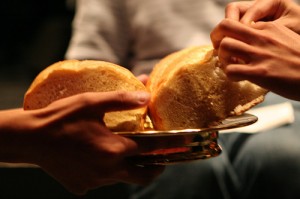
Why do our Lord’s Supper observances on Sunday mornings tend to be quiet, solemn ceremonies marked by individual introspection and feelings of sadness and guilt? Why aren’t our communal meals with our God and one another characterized by interactive expressions of uncontained celebration and overflowing joy?

Have you tried singing upbeat, uptempo songs of praise and thanksgiving as you gather around the table? Instead of burying your nose in your Bible, have you ever tried sharing that special passage with the person seated next to you? A neighborly “clink” of your cups with the people on your pew and a shared “Thank you, Lord!” can express that much-needed communal joy in a simple, yet powerful, way. Try something. Try anything. I just urge you to stop “doing” the Lord’s Supper by yourself in that room full of Christian brothers and sisters and stop being so sad about it.

The Lord’s meal is shared on Sunday, not Friday! He’s not on the cross anymore, praise God! The tomb is empty, hallelujah! The Lord Jesus Christ has paid for your sins and mine! We stand today — right now and forever more! — in a righteous relationship with the Almighty Creator of Heaven and Earth! He has removed our sins. He doesn’t remember them or hold them against us! It’s as if we’ve been perfect from day one! Because of what Christ already did at the cross and what the Holy Spirit already did at the garden tomb, we belong to God! It is finished! We are his people and he is our God!

Seriously. How in the world are we able to eat the bread and drink the cup without breaking out into huge grins?

~~~~~~~~~~~~~~~~~~~~~~~~~

I’ve updated the “Around the Table” page with tonight’s lesson outline and handouts. As you’ve already gathered, the focus tonight is on the presence of God and the joy of his people at the meal. Click on the green “Around the Table” tab in the upper right hand corner of this page to access these class materials and to find the assignment for next week’s session.

Peace,

Allan

« Older posts Newer posts »