Category: Worship (Page 12 of 27)

Spiritual Worship

“Therefore, I urge you brothers, in view of God’s mercy, to offer your bodies as living sacrifices, holy and pleasing to God — this is your spiritual act of worship.” ~Romans 12:1

Think very carefully about the times you have completely abandoned yourself into some act of service for others in the name of Jesus. Think about the times you’ve totally given yourself to God in some act of kindness or mercy.

Think about the joy you feel as you mentor that young mother at CareNet or as you walk a family of five through the pantry at Green Tag. Think about the way you experience the mercy of God as you hand a new toy to a seven-year-old girl who’s never had one before.

Think about the new life you feel as you pray with your Small Group, the way you bond with your Lord and your Christian brothers and sisters and the ones for whom you pray.

Think about sacking groceries at Loaves and Fishes, visiting a friend about to go into surgery at the hospital, delivering a casserole to the family who just lost a loved one. Remember the fullness of life you discovered in that offering. Remember how it feels to put to death your own needs and fears and find a source of peaceful and joyful existence in God. It’s unexplainable.

Scripture calls us to remember those times and to be even more willing to make that total offering, that holy sacrifice, over and over again. That is our act of worship. It’s our act of service that, by the grace of God, he makes holy and pleasing.

Think about those times. Remember and repeat. And find real joy and peace in your Lord.

Peace,

Allan

When The Sermon’s Over

If my honeymoon here at Central is supposed to last one year — I’m not assuming anything here; it may last another two or three years or, without my knowledge, it may have ended months ago — then I’ve got only about six more weeks of this wonderful bliss. So, please indulge me with your love and grace and allow me to encourage you in a way that, I hope, provokes some honest self assessment and reflection.

It ain’t over when the sermon is over.

In fact, I would argue — get ready, I’m about to! — that the best and most important part of our Sunday morning assemblies occurs after the sermon is finished. Church is not over when the sermon is over; it’s just getting started. If you’re heading for the doors and out into the parking lot the moment I close my Bible, you’re missing out on the best stuff that happens during our assemblies. If the last thing you see or hear, experience or participate in, during our weekly gatherings in that worship center is my voice, here’s what you’re missing.

1) Self-Reflection – the song that we sing together right after the sermon is chosen in order to promote some healthy and much needed self-assessment. The song is connected to the just-presented Word in a way that should lead to personal and congregational reflection. It’s hard enough in this noisy world with our hectic pace and our short attention spans to find time to reflect on God’s Word and our response to it. Whether you hit the parking lot one minute after the sermon’s done or 30-minutes later, the honest truth is that, by that time, you’ve already forgotten every bit of it. You’re on to the next thing. What sermon? What Word of God? We believe that the Word preached has a life-transforming power. We believe that God’s Spirit uses that Word to change us, to shape us, to form us more into the image of Christ. Those moments immediately following the proclamation of that Word are much better spent thinking and reflecting, meditating and contemplating application, than in gathering up purses and papers and rushing up the aisles. What’s the hurry?

2) Baptisms – yes, it still happens occasionally. Somebody will be so moved by the proclaimed Word of God, he will walk down to the front of the worship center right after the sermon and be baptized on the spot. A previously unsaved child of God will declare her allegiance to her Creator, submit fully to the Lordship of our Christ, participate in the death and burial and resurrection of Jesus, and be delivered from her sins into eternal life in glory. Why would you want to miss that? It’s the thing we teach and preach, it’s the thing we uphold as vital to salvation, it’s the very thing we’ve fought to defend. It’s baptism! It’s the chance to witness up close and personal our Almighty God snatching an eternal soul from the clutches of Satan and redirecting him or her to heaven. It’s the opportunity to physically watch God keep his centuries-old promises. It’s a holy occasion to participate in God’s salvation, to witness a birth, to be present when a child of God is reclaimed and restored to righteousness. Why in the world would you miss that in order to get to Arby’s or to the lake fifteen minutes earlier? To me, it’s like a football player who has given his life to football saying “no, thank you” to starting at quarterback in the Super Bowl in order to go home and watch a hair-clip infomercial on a 13-inch black-and-white TV. It’s that crazy.

3) Bearing Burdens – two or three times a month, it seems, somebody in our church family or somebody from the Amarillo community is taking that time right after the sermon to ask our church for their prayers. A brother in Christ comes down to the front to confess sin and ask forgiveness; a sister comes to reveal her broken heart over a family matter; or, as was the case this past Sunday, three ladies from the downtown women’s abuse center come forward and beg us to pray for God’s mercy and strength. To me, this is our fully-involved God saying to us, “You want to be more like Christ? You want to become more like my Son? Here, minister to these hurting people.” Encouraging the downtrodden, giving strength to the weak, forgiving the sinner, loving the unlovable — these are all very Christ-like things to do. Jesus lives to intercede for us; interceding on behalf of others makes us more like him. Bearing the burdens of others is about as Christ-like as it gets. It’s incomprehensible that while your brother is mustering up all the courage in his body and soul and mind to walk down that aisle to throw himself upon the mercy of God and his church, you’re skipping up the opposite direction to get to the ballgame or to your enchiladas and rice. With only a little prompting, forty or fifty people got out of their seats to embrace those three women Sunday, to put their arms around them and pray with them as they bared their hearts to God and to us. I praise God for that physical, tangible, see-able outpouring of his grace. It was the best thing, the most powerful thing, that’s happened in our worship center in months. I pray you didn’t miss it because you were in a hurry to mow your lawn.

4) Exhortation – at the end of every assembly, one of our shepherds stands up to bless us. One of our elders, one of our spiritual fathers (to use a New Testament term), reads to us from the Holy Word of God. He challenges us to live in the coming week for Christ. He blesses us. And he prays for us. I don’t understand why anybody would walk out on that. You know it’s coming. We do it every week. One of the men this church family has ordained as the most Christ-like among us, one of the men we’ve said we will follow because he is so obviously following our Lord, one of the men we believe God has placed among us to shepherd us is going to get up and bless us! He’s going to read Holy Scripture to us! He’s going to pray! It’s incredibly important. It’s huge. I can’t understand why anybody would walk out on that blessing.

It ain’t over when the sermon is over. Usually it’s just getting started, the best part of our Christian assemblies together is still to come. God still has plenty of work to do — on you, on me, on our church. I lovingly encourage you to stick around.

Peace,

Allan

Cheering the Runners

“Let us consider how we may spur one another on… let us encourage one another.” ~Hebrews 10:24-25

Our summer Wednesday nights at Central are intentionally focused on getting our church family together; on breaking down the barriers between generations and zip codes; on putting away the distinctions; on bringing together all ages, races, cultures, economic groups, and social classes to celebrate the divinely-ordained diversity with which we’re blessed in this body of Christians. And this week’s version of Running the Race — we called it “Cheer the Runners: Encouraging One Another” — surpassed by far our expectations.

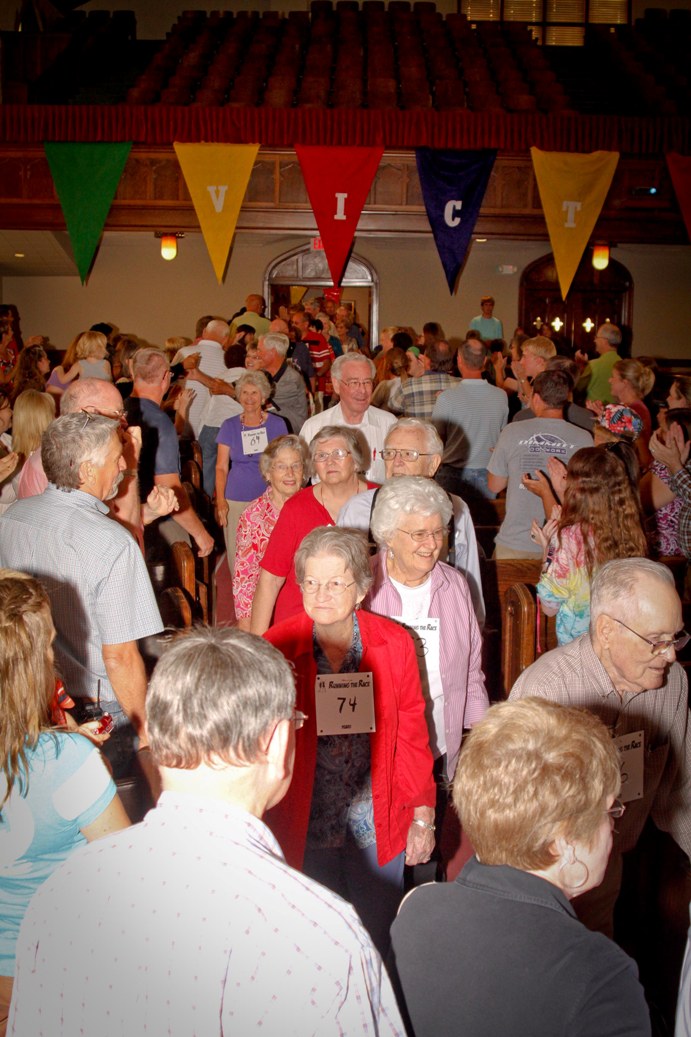
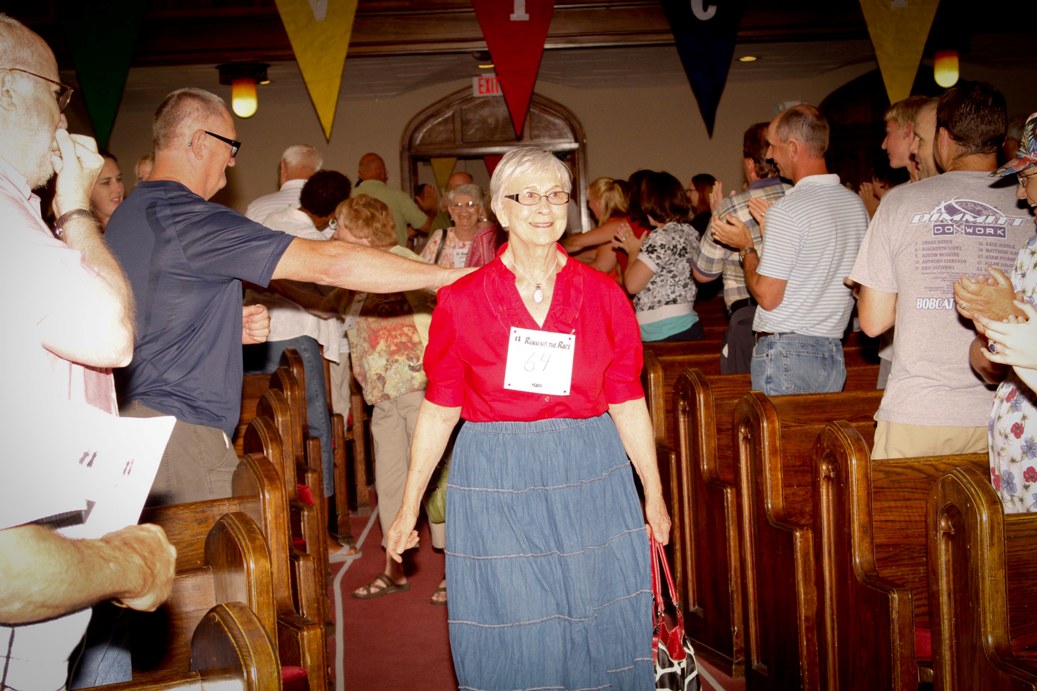
For the evening meal, we asked everyone in our church family who was baptized 50 years ago or more not to wait in line to serve themselves, but to sit down at the designated tables so the rest of the congregation could serve them. And we did. We served up tons of brisket and potato casserole and strawberry shortcake. And after we all ate together, we sent these older saints into the foyer of our chapel. While the rest of us gathered in the pews, our older brothers and sisters were outfitted behind the foyer’s closed doors with “runners tags,” big numbers to wear on their chests declaring how many years they’ve each been running the race. Meanwhile, I prepped those of us waiting in the chapel for what would come next.

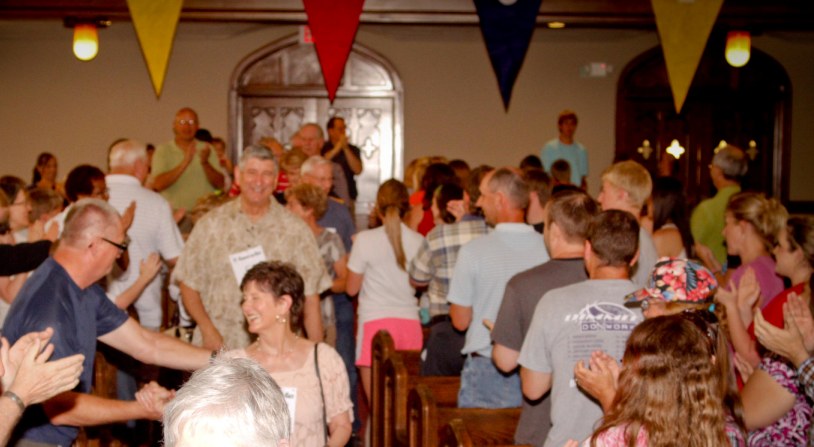
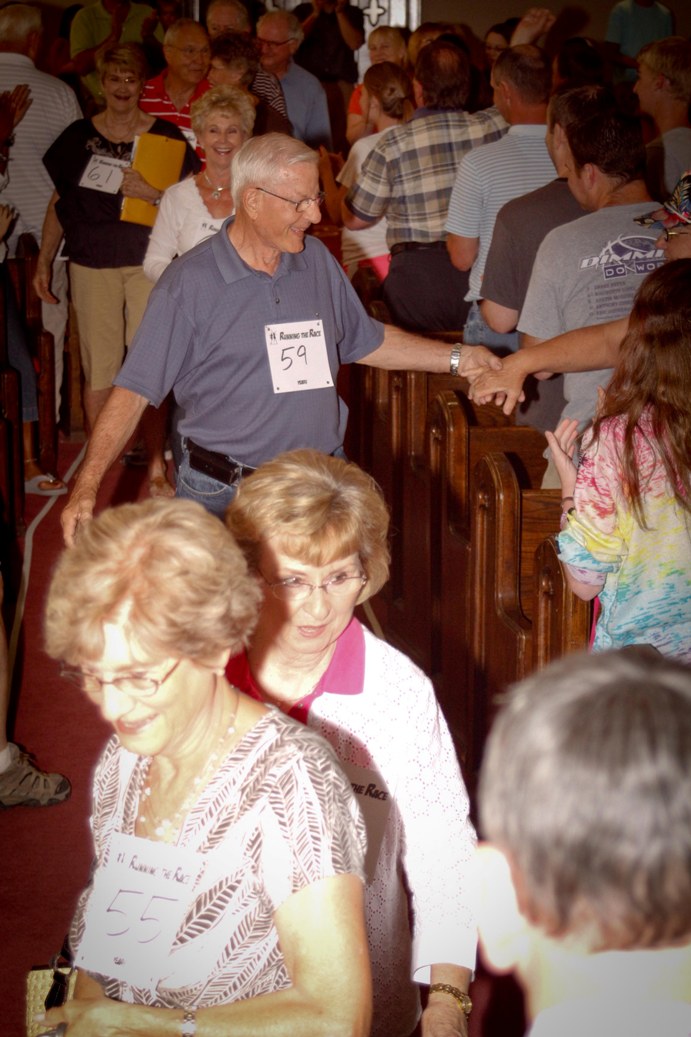
Johnny led us in the singing of Come, Thou Almighty King and then Greg opened up the back doors and here they came! Right down the long south aisle of our 83-year-old chapel. 60-year-Christians! 70-year-disciples! A couple of 74 and 73 year followers of our Christ! And we let them have it! A standing ovation. Clapping. Cheering. Whistling. Stomping. High fives and hugs. Salutes and pats on the back. Yelling. Hollering. Smiling. Laughing. Nearly 70 of our dearest, sweetest brothers and sisters entering our place of worship to such a roaring welcome. Three hundred more of us cheering them on!

It took a little longer than I thought it might. But if it had lasted three hours, I’m convinced we would have kept clapping and whistling. And everybody in the room would have kept smiling.

Once these dear saints got grouped up at the front of the chapel, we sang to them:

“We love you with the love of the Lord. We see in you the glory of our King. We love you with the love of the Lord.”

And then we all sat down together and raised the roof in beautiful song, praising God and encouraging one another.

Next, we ran around with a couple of handheld microphones and asked these older members to fill in the blanks: My favorite thing about Central is __________. I once was __________, but now I’m __________. I’m encouraged when I see younger people __________. They really opened up with us. They shared their hearts and their emotions. They shared with us their joys and sorrows, their laughter and their tears. More than a few of them expressed gratitude for having once been uncertain about their eternal salvation, but now being completely confident in the promises of our God. A lot of them spoke of their admiration for our elders and ministers. There were many comments about the faithfulness of this church. There were several observations regarding the blessing of so many young families and children in our congregation.

And then we younger ones blessed our older ones one more time: We love you because __________. Again, we heard over and over the common themes of faithfulness and love. We’ve watched them run the race. We’ve watched them endure and persevere in faith. And we’ve felt their great love for us. A lot of people in that room have been blessed by the faith and love of these older saints for their entire lives. And I pray we were able to return some of that encouragement and strength Wednesday night.

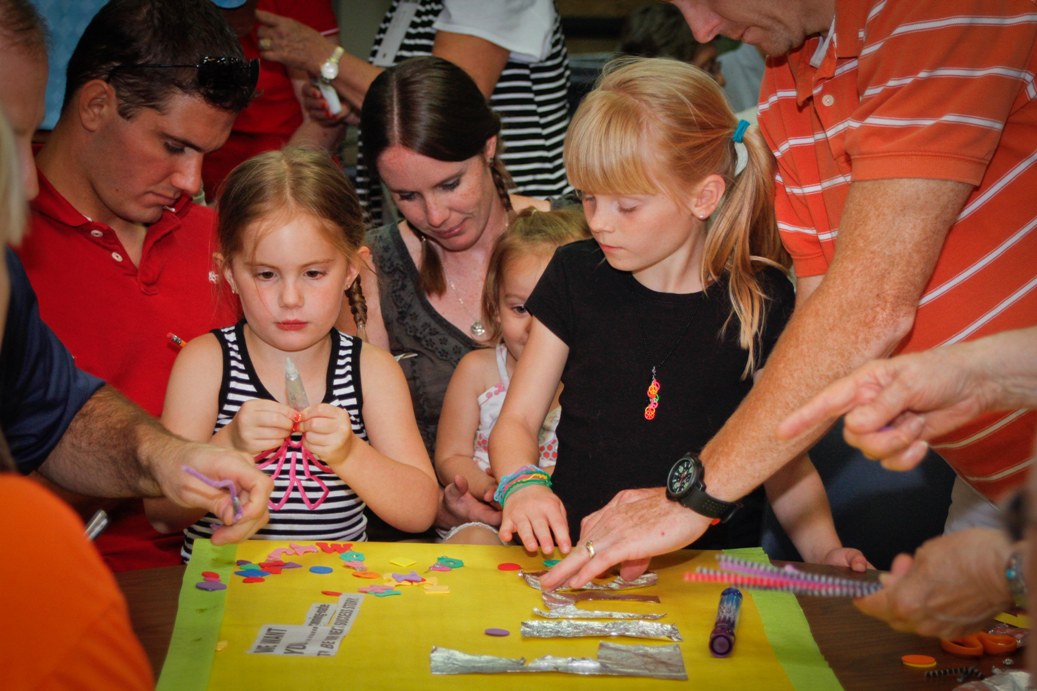
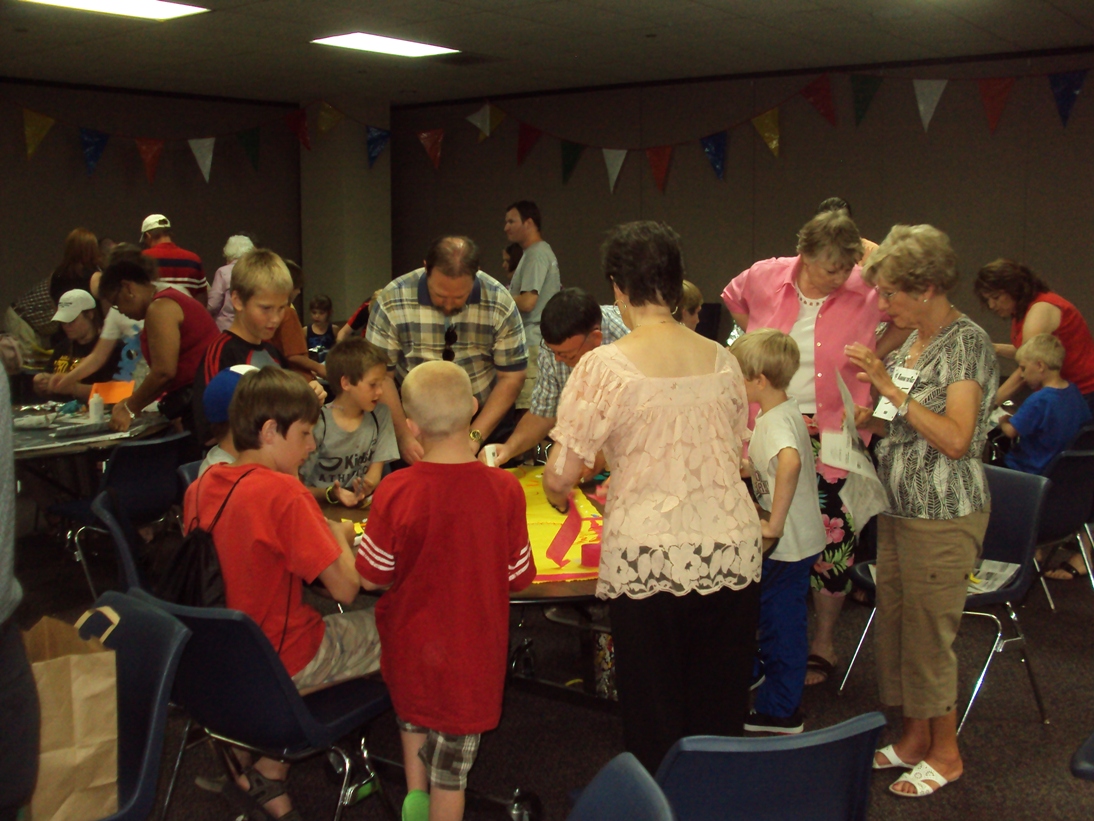
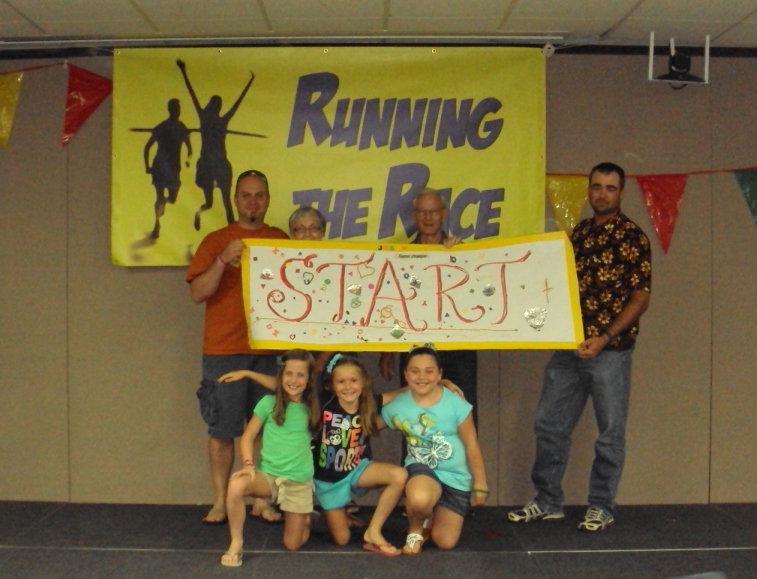
Later, Mary had us all divided up — intergenerationally, of course! — into 20 groups to create and decorate Running the Race banners, using only the random supplies and following the specific directions provided at each of the decorating tables. It was quite a deal. Young and old, black and white, rich and poor, older saints and brand new Christians, all working together on these little projects and then, with great pride, displaying their banners and posing for the “team pictures.”

It was an extraordinary night. I believe every person who participated Wednesday came away with a strong sense of truly belonging to something huge, something bigger than ourselves, something eternal. I think we also got a real reading on the faithfulness of our God. He really is still alive and still very powerful; he really is still saving people and still bringing his people together to work and worship and, together, change the world. And I believe we got a little glimpse of heaven Wednesday night. We experienced a little taste of the one people around that one table celebrating together our salvation from God in Christ.

We’re doing a church-wide tailgate party on July 11 and prayer-walking our neighborhoods on July 18. Can it get any better?

Truly we are surrounded by a great cloud of witnesses. Let us run with perseverance the race marked out for us. Let us fix our eyes on Jesus. Let us not grow weary or lose heart. And may we consider how we may spur one another on.

Peace,

Allan

Change Without Chaos

Leroy Garrett’s “What Must the Church of Christ Do to Be Saved?”  wraps up with two chapters that more or less summarize his thoughts. He spent most of the first 18 essays discussing specific changes in attitude, changes in practice, changes even in belief that we must make as a faith community if we’re to have any impact for Christ in our rapidly changing world. His 19th chapter, which we are considering together today, exhorts church leaders to make these changes carefully:

Effect purposeful and meaningful change, free of undue disruption and chaos.

[The Church of Christ] must become a changing church. I am not calling for change simply for the sake of change. The change must be positive and creative, displacing attitudes and methods that are no longer effective. The change must be in keeping with the mind of Christ, free of gimmickry, pride, and competitiveness. And it must be change without chaos, not unduly disruptive and threatening. It must be a balanced change that shows respect for the traditions of the past, the demands of the present, and the possibilities of the future.

God’s Church is always changing, right? Isn’t it? If your congregation is not changing, it’s not growing. Growth requires change. By definition growth means change. You can’t grow without change; it’s physically and spiritually impossible. Spiritual growth, numerical growth, physical growth — it all demands change.

Scripture commands us to be constantly changing.

“Not that I have already obtained all this, or have already been made perfect, but I press on…” ~Philippians 3:12

“Forgetting what is behind and straining toward what is ahead, I press on…” ~Philippians 3:15

“…attaining to the whole measure of the fullness of Christ.” ~Ephesians 4:13

“Make every effort to add to your faith…” ~2 Peter 1:5

I  believe our Lord is calling us to always attain to the ideal, to always strain toward bringing the Holy Kingdom of God in its fullness into our world, to practice the righteous will of God here on earth just as it is in heaven. Knowing it won’t be accomplished fully until our Christ returns, knowing we will suffer many setbacks and disappointments, knowing his Church will never be perfect until that day of glory, we strive, we press on, we attain, we add. We change. We evolve. We grow. We push. We move.

Just holding our own is a sin. Just maintaining your church community is wrong. Our Lord did not come to earth to live and suffer and die so we could maintain. Jesus isn’t calling anybody to be middle of the road. He’s calling us to grow. To mature in Christ-likeness. To change.

Here at Central, I’m proud to say we have bought into this biblical concept of change. I’m honored to serve with a group of shepherds and ministers who obsess over passionate and corporate desires to become more like Jesus. It’s thrilling. And it honors our God who calls us to be a sign of change, a sign of salvation to the world.

Our vision and mission statements present discipleship as an active, verb-driven way of life. In fact, everything we do at Central stems from our commitment to discipleship. That’s the main number one thing. We take the call to be more like Jesus seriously. And we understand it requires constant change. If Christ is to be formed in us, we’ll have to change. If we’re to have the same attitude as that of Christ Jesus, we’re going to have to change. So we do.

It means partnering with the local non-denominational church and the Assembly of God congregation in a food pantry network for the needy in our downtown community. It means our elders praying with the Disciples of Christ elders. It means working with, not against, multi-denominational evangelism efforts like the Franklin Graham crusades and city prayer breakfasts. It means hosting nurse pinnings and GED graduations and hospice rose ceremonies and marriage enrichment seminars in our building. And, yes, while we’re committed to partnering with God in reconciling all of creation back to him, we still struggle with the nuts and bolts. We still wrestle with it. Growth is difficult.

We play the piano as we worship with our Loaves and Fishes outreach crowd, we run videos in our Sunday assemblies that contain guitars and drums, and we host Christian concerts without compromising our commitment to a cappella one bit. But it’s difficult. We equip and empower our sisters at Central to make announcements and to read Scripture in our Sunday assemblies, to actively participate in the leadership of our church life. But it’s not without its occasional heartburn. We’re wrestling with it. We’re trying.

To be disciples of Jesus means that we put the needs of our community ahead of our own. We must place the needs of the lost ahead of our own traditions and comfort zones. We have to consider the needs of the needy to be more important than our own preferences. And it’s hard. We’re committed to it. But it’s hard.

To do all this without chaos we must lay the proper groundwork for change. We must not surprise people with changes, especially in worship, leading them to respond with, “What’s next!?” We must “talk out” new ideas and methods, involving the entire congregation, before they are tried. And it must not be done at all until the right climate is created and there is general agreement. This can never be realized until the leadership takes the initiative and works for change. Those with objections are to be treated with forebearance. It is to be pointed out to them that they do not have to have their way, and that it becomes a Christian to be yielding. When such ones cannot adjust to changes that are deemed necessary for the good of the church as a whole, the congregation will have to allow such ones to go elsewhere, always of course with a love that is slow to let loose.

My advice would be to always ask the right questions when grappling with difficult decisions. “Will this decision make this congregation look more like what it’ll look like in heaven?” “Will this choice make us more like Jesus or less?” “Is this a selfless move or a selfish move?” “Does this change expand the borders of the Kingdom or restrict them?” “Are more people going to be welcomed to the table with this move or fewer?” “Is this a sacrificial thing to do or not?” “Are we following the difficult path of Christ or the broader way of the world?” “Will this communicate to the world an accurate portrait of the Gospel?”

And know that growth — spiritual growth, numerical growth, physical growth, God-commanded growth — requires change.

Peace,

Allan

Recover the Small Groups Dynamic

Most baseball experts and historians today are debating the place in baseball lore of Josh Hamilton’s Tuesday night in Baltimore. The Rangers slugger hit four home runs against the O’s last night, drove in eight runs, hit for a total of 18 bases, and mixed in a double for good measure. He went five-for-five with no outs as Texas racked up its 20th win of the year and reclaimed the best record in the major leagues. Sports Illustrated’s Cliff Corcoran has written an excellent article that details Josh’s night and compares it with every other four homerun performance in baseball history. Click here to read Corcoran’s case for Hamilton’s heroics to be classified as the second best hitter’s night ever.

~~~~~~~~~~~~~

In the 16th chapter of Leroy Garrett’s “What Must the Church of Christ Do to Be Saved?” he presses for more imagination, more risk, more innovation, more change in the way we are the Church. He complains, perhaps a bit too harshly, about our “boring, lifeless, gloomy” worship assemblies and, by implication, blames our declining numbers on our lack of joy and excitement. By pointing right at our Sunday assemblies right at the beginning of the chapter, Garrett probably causes the reader to focus on the wrong thing and actually miss his main point. I think Garrett’s main objective is to encourage joyful and exciting shifts in the ways we are church, not in the ways we do worship services. Although, the two paragraphs following his initial indictment certainly speak to all of our church life, not just what we do together on Sunday mornings:

At the heart of our problem is that we are caught in the trappings of our own institutionalism — or churchism might be the word. We have expensive edifices to pay for and to maintain, staffs to support, programs to fund. Our Achilles heel is the System. The System resists change, except occasional cosmetic change. Nothing real or substantial. The System demands conformity, and it is uneasy with thinking people around, especially a thinking preacher or a preacher that says something.

The System must maintain the status quo, and it must preserve itself at all cost. This is why it seeks to keep everyone satisfied by reacting rather than acting. And most significantly, the System is tied to the building. Regular church attendance, along with generous giving, is the essence of “faithfulness.”

This brings me to the one thing above most everything else that we must do to be saved. We must recover — or is it discover? — the great lost secret of primitive Christianity. That secret was the dynamic of joyous, Spirit-filled gatherings in homes.

Garrett is definitely speaking my language when he’s talking small groups.

If our salvation is tied directly to the Holy Spirit working in our lives to transform us more and more into the image of Christ — and it is! — churches should be in the business of teaching this transformation. This imitating Christ and becoming more like Christ should drive everything we do as a church. We should be all about planning the settings and fostering the atmospheres for this transformation to more easily and quickly take place. Where in your church do you and other members become more like Jesus? What program or setting in your church encourages self-sacrifice, considering the needs of others more important than your own, true community and fellowship, compassion and love and service? Which program or setting fosters Christian family where honesty and transparency are the norm and where burdens are shared? Which setting communicates accountability to one another, mutual responsibilities to one another, where we all rejoice and mourn with one another as equal members of the Lord’s Body? Which program more accurately reflects the gospel image of one people around the one table, fellowshiping with one another and with our Lord? It’s our small groups!

This kind of relationship and fellowship doesn’t happen in our ordered Sunday morning worship assemblies where, for the most part, we sit in neat rows and stare at the backs of each other’s heads while focusing our attention on one screen or one speaker. There’s more fellowship happening when you pass a hot dog to a stranger at a baseball game than when you pass the blood of Jesus to your brother in Christ at most Sunday morning gatherings. It doesn’t happen in our Bible classes either, not like it happens in smaller groups in our homes.

I’ll never get to know you — to really know you — if I never share a meal with you or spend time with you in your home. It’s in your home where I read the cartoons on your refrigerator and see the pictures of your children in the hall. You’ll never be completely honest with me and I’ll never be totally transparent with you until we get to know and trust one another. I can pray for you in Bible class when you add your name to the list. But I can’t really bear your burdens for you — with you — until I experience them with you together in our homes.

There’s more freedom to be spontaneous in our living rooms where the order of worship isn’t printed and distributed beforehand and the PowerPoint slides aren’t already in order. There’s more opportunity for Christian hospitality and serving one another where meals are shared and chores are assigned and kids are corralled. There’s more time for true testimony, more allowance for joyful laughter and even making fun of ourselves, and more room for tough questions and even periods of doubt.

These small groups are also ideal for friendship evangelism. Outsiders can often be introduced to spiritual things in the informal atmosphere of a private home rather than in a church setting. The joy and spontaneity of the home gatherings can also transfer to some degree to the public assemblies if only we will be less rigid. When are services are revved up and there is “a sweet spirit that fills this place” we will be more inclined to share it with others. Who wants to invite a friend to a boring service?

I’m a huge believer in regular small groups. I think our small groups do more for actual Christian transformation than our Sunday morning worship assemblies and our Bible classes combined. Yes, small groups are hard. They’re time-consuming. They’re energy-draining. They require a pouring out of oneself for the sake of others. Small groups demand personal sacrifice for the benefit of the whole. They call for commitment; they command sharing; they impose honesty and accountability. Small groups demand that we model compassion, that we forgive, and that we love. Does that sound like a Savior you know?

Peace,

Allan

Not the First Century Church

In Leroy Garrett’s “What Must the Church of Christ Do to Be Saved?”  the author makes twenty suggestions for our faith heritage if we are to remain a viable voice for the Kingdom in our increasingly post-modern, post-denominational, post-Christian world. The numbers don’t lie. We’re losing our people left and right. And some things need to change. As Churches of Christ, some things we have refused to change over the years are now coming to roost. It can no longer be ignored.

Garrett’s eleventh suggestion is that we shed ourselves of the tremendous and unnecessary burden of trying to become an exact replica of the Church of the New Testament. Not only does Garrett say it could never be accomplished; it should never be tried.

Recognize that we can’t be a first century church.

Garrett writes that a lot of our people have for decades understood the Churches of Christ to be a complete restoration of the New Testament Church in name, in belief and practice, in leadership structure and worship. Frankly, while being raised in and by the Church of Christ I, too, was taught this very idea.

It is a fiction grounded on false assumptions, such as the church of the apostles having a particular name, which it did not, and that it had a uniform organization and clearly-defined “acts” of worship, which it did not.

There is no ground for supposing that God ever intended for his Church in each succeeding century over the past 2,000 years to be a first century church, even if it were possible, which it isn’t. The evidence rather suggests that God calls us to do for our generation what the primitive church did for its generation. Nothing in Scripture indicates that the earliest congregations were intended to be models for all time to come or even in their own time for that matter. The facts of history, culture, and civilization demand that the Church of Christ of the second century would be a second century church and that the church of the sixteenth century would be a sixteenth century church. Each generation of Christians is to serve its own time, drawing upon both Holy Scripture and the experience of the Church (tradition) for its direction.

A lot of this, of course, is predicated upon the ways we view and interpret the Bible. Those who see the Scriptures as a rule book and a list of guidelines and commands to follow in order to be “right” with God will seek those patterns and regulations and strive to be “right.” Those who understand the Scriptures to be the Spirit-inspired accounts of real people being impacted by a real God and the very real ways it’s all worked out in real life will look for something else. In considering church beliefs and practices, structure and worship, those brothers and sisters look for whether those things are in tune with God’s Spirit, whether they genuinely reflect the Gospel, and whether they bring glory to God.

Instead of searching the Bible and asking the question, “Is this what the first church did?” we should be asking, “Is this consistent with the person of Jesus?” The “pattern” for the Church — and this “pattern” will never change — is the person of Christ Jesus, our risen Lord. It’s his image we see in the mirror. It’s his likeness into which we are being transformed by God’s Holy Spirit. It’s his death, burial, and resurrection that should be modeled and proclaimed and upheld in every one of our beliefs and practices. The Good News should be the lens through which we view our church beliefs and practices. Jesus’ sacrificial service should be the spirit with which we enter every elders meeting and committee hearing. Our faith is in a person, not a policy; the Church is built on a relationship, not regulations.

No one congregation in the New Testament therefore can be viewed as our pattern, nor all of them together, but out of their experiences, their strengths and weaknesses, we learn how to be his Church.

Peace,

Allan

« Older posts Newer posts »