Category: Worship (Page 10 of 27)

Let’s Astonish the World

What a tremendous response! What a terrific reaction to what our God revealed to us at Central this past Sunday! And, my, how it continues even now into the middle of the week! The emails and texts that began pouring in during lunchtime Sunday are still being received today in a fairly steady stream. There’s an enthusiasm over what we’ve discovered together as a church family. There’s an overwhelming resolve to jump wholeheartedly into what our God has put in front of us. There’s a continual hum, a buzz, a current of Holy Spirit energy that’s tangible in this place. It’s real. You can feel it. We’ve tapped in to something here. Maybe… God’s holy will?

Allow me to share with you in this space today the heart of the message we heard together Sunday from God’s Word. Tomorrow, my plan is to share some of the response to the message in an effort to further process what happened Sunday.

The lesson Sunday came from the last part of Jesus’ prayer in John 17, his plea for unity among all future believers. It served as the culmination of our sermon series on this powerful prayer. And it provided the theological base for our “4 Amarillo” partnership with First Baptist, First Presbyterian, and Polk Street Methodist.

My prayer, Jesus says, is that all of them may be one. May they be brought to complete unity. It’s this unity, this uncompromising love and acceptance we have for all baptized Christian believers that will prove to the world Jesus really is who he says he is and who we say he is. Our unflinching dedication to love and defend all Christians, to worship and serve with all Christians, will astonish the world.

Well, Allan, not all people who’ve been baptized, right? I mean, a lot of people are baptized in different ways than we are, and for different reasons. We can’t worship with and have fellowship with all Christians.

That’s why the church is not astonishing the world.

Christ’s prayer is for unity. Christ’s will is for complete unity among all his followers today. So, let’s go there.

If God accepts someone, I must also accept them, too, right? I can’t be a sterner judge than the perfect judge, can I? Nobody would say, “Well, I know that God accepts this woman as a full child of his, I know she’s probably saved, but she doesn’t meet all of my standards in the things she believes and the way she worships, so I’m not going to accept her.” Nobody would say that. We must fellowship everyone who has fellowship with God. We must fellowship everyone who is saved. All the saved.

So… who are the saved?

There was a time when we would say everyone who hears, believes, repents, confesses, and is baptized is saved. OK, for the sake of this discussion, let’s go with that. The next question is, “He who hears what?”

“The Gospel!”

“She who believes what?”

“The Gospel!”

“Whoever repents and confesses and is baptized by what or through what or into what?”

“The Gospel!”

Right. That means the next question is… what is the Gospel?

That Jesus Christ is the Son of the living God, that he alone is Lord, and that we are saved by faith in him. You might check out 1 Corinthians 15:1-8 or several other places in Scripture where Paul sums up the Gospel. It seems pretty clear that it’s about declaring Jesus as Lord and as the only way to the Father and submitting to his lordship in baptism and in a new way of life. We’ve never required anything else. The Church has never asked for another confession. We’ve never asked anybody their position on women’s roles or children’s worship before they’re baptized. We don’t put a teenager in the water and catalog all his views and opinions on instrumental worship before he’s saved. (Unfortunately, some of us do that about a month later.) That stuff is not Gospel. Paul says it’s nothing but Christ and him crucified.

Romans 15:7 says we are to accept one another as Christ accepted us. We are to receive others by the same standards we were received at our baptisms. You know, your acceptance by God is a gift. That fact that Christ Jesus has accepted you is pure grace. The imperative for us is to extend that same gift, to show that same grace, to all others who have received it from our Lord.

Well, what about the Christian who disagrees with me on divorce and remarriage, or on the age of the earth? What about the Christian who doesn’t see church names or the Lord’s Supper the way I do? What about our discord over steeples or shaped notes?

In Romans 14-15, the issues are eating mean versus vegetables and the observance of holy days. And Paul knows what’s right and wrong. He knows the correct answer. There is a right and wrong on these matters. But Paul says, in Christ Jesus, it doesn’t matter. You don’t believe me? Read Romans 14:1-15:7.

Now, here’s where it gets us. You ready?

Do you believe that you are perfect? Do you believe you have God’s will completely and perfectly figured out? That you are living exactly right, that you believe everything exactly right, that your worship is exactly right according to God’s plans? Do you think you know everything and do everything perfectly? No? That’s what I thought. Then what in the world saves you? What covers you in your innocent mistakes? What saves you in your accidental misunderstandings and your sincere misinterpretations? Why, it’s God’s grace, of course. His matchless grace.

Do you believe that the Churches of Christ are perfect? Do you think that the CofCs  have everything totally figured out? That we are worshiping exactly right, that our leadership structures are completely lined up with God’s intent, that we have all of God’s will entirely mapped out and expressed perfectly? No? That’s what I thought. Then what in the world saves us? What covers us in our innocent mistakes? What saves us in our accidental misunderstandings and our sincere misinterpretations? Why, God’s grace. Yes, his wonderful grace.

You think there’s any chance at all the Methodists might be doing something right according to the will of God that we’re not? You think the Presbyterians might possibly have something figured out that we don’t? What if the Baptists’ understandings of something in the Bible are richer and fuller than ours? What if another group’s practice is more in line with God’s will than ours? Is it even possible? Yes, of course. Then, what covers us in our innocent mistakes and accidental misunderstandings and sincere misinterpretations? Grace. Yeah, I know.

Now, let’s assume that we have it right on the Lord’s Supper and the Methodists have it wrong. Let’s pretend that we’re right about baptism and a plurality of elders and the Presbyterians and Baptists are wrong. Does the grace of God not cover them completely in their innocent mistakes and accidental misunderstandings and sincere misinterpretations? Are they any less saved?

But they’re wrong and we’re right!

So you get God’s grace where you lack understanding but they don’t? You get the grace of God in your misinterpretations of God’s will but they don’t? Why? Because you try harder? Because we’re more sincere? Because, somehow, we deserve it?

Whoa.

The unbelieving world looks at that and says, “No, thanks.” And I don’t blame them. A religion as visibly divided as ours does not reflect the truth. It reflects our fallen world, not the glory of our God.

Our Christian unity will have an eternal impact on our world. But the world has to see it. Our unity, which already exists as a gift from God, must be visible. It must be practiced and experienced. When it is, the world will believe.

A Methodist preacher, a Church of Christ preacher, a Baptist preacher and a Presbyterian preacher all walk in to a bar is the first line of a bad joke. The Methodist church, the Church of Christ, the Baptist and Presbyterian churches all putting aside their differences to worship and serve together for the sake of the city is a serious and everlasting testimony to the love and power of God! Our “4 Amarillo” efforts are a witness to the world that this is for real! That Christ Jesus is our King! That the world really is changing! That hearts are being melted and people are being transformed! That barriers are being destroyed and walls are coming down! That the devil has been defeated and the Kingdom of God is here!

Peace,

Allan

That All of Them May Be One

“…that all of them may be one, Father… that the world may believe.” ~John 17:21

Jesus concludes his beautiful prayer on that last night with his followers by asking our God to unite all future believers, to unite his Church of future disciples, with the same unity that’s shared between the Father and Son. This harmony for which our Lord prays is explicitly explained as a critical component in evangelism. To Jesus and to the Kingdom of God, Christian unity is a big deal.

“May they be brought to complete unity to let the world know that you sent me.” ~John 17:23

This unity, however, is not something for which we must work. Christian unity is not a thing we create or foster or manufacture. We don’t plan for and structure for Christian unity. We can’t do anything to cause it. It’s a gracious gift from God. Christian unity is already the eternal reality. It’s just a matter of whether we recognize it or not. It’s a matter of whether we choose to live into it or not.

“I have given them the glory that you gave me, that they may be one as we are one.” ~John 17:22

Today, we celebrate our unity with all Christians everywhere, particularly our commonality with our brothers and sisters at First Baptist, First Presbyterian, and Polk Street Methodist. Today, we practice that unity by cooperating with these churches as one big Christian family to offer supplies for our downtown area elementary schools. Today, we experience our unity with all believers throughout the ages at the meal around our Lord’s table. Then tonight we gather at Southwest Church of Christ to praise our God together in the spirit of unity we share within our own faith tradition.

May our God be glorified as together we live into and through his abundant gifts of unity, grace, and peace.

Allan

The Called Out

Happy Sunday from Santiago, Chile! This is the weekly anniversary of the day our God’s Holy Spirit brought out crucified King out of the tomb and made him Lord over all forever and ever. This is the day God’s ekklesia, his Church, his “called out” people assemble in joyful celebration of that great victory. We sing songs of loudest praise; we raise our voices and our hearts in grateful prayers of thanksgiving and adoration; we come together around a common table to share a common meal in the name and in the manner of our Savior who has reconciled us to our God and to one another forever.

We do it in Amarillo, in Santiago, and in Kharkov, Ukraine. We do it in Fort Worth, in Kilgore, and in La Paz, Bolivia. God’s people do this every Sunday in Austin and Oklahoma City, Sao Paulo and Sydney, Tokyo and Bangkok. For two thousand years now, ever since our Christ walked out of that garden tomb and ate dinner with his disciples, God’s children have come together every Sunday to celebrate that great victory over sin and death.

Today is that day.

While we miss our friends and family at Central, we take great joy in knowing that we are communing with them in spirit and in truth around our Lord’s table this morning.

Happy Sunday!

Allan

We Belong To The Lord

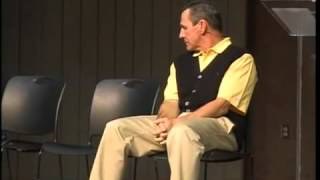
I want to continue our important discussion here regarding the silence of Scripture and its place in our American Restoration Movement history and current beliefs and practices. As it relates to the maddening question of whether biblical silence on a particular issue is prohibitive or permissive, please check out this video clip from a Rick Atchley sermon illustration. I quoted one of my favorite Rick Atchley lines in Monday’s post, and a friend reminded me this morning of Rick’s “chair illustration.” I’ve seen Rick do this at least a couple of times. It’s a beautifully simple and strikingly clear demonstration of the absurdity of our traditional approach to the silence in Scripture. And it inarguably proves that this default approach actually prevents any type of Christian unity among our churches; it actually leads to and fosters ugly and sinful divisions.

When you have more time, you might also check out this recent 26-minute presentation by my brilliant brother, Dr. Keith Stanglin, on the fourth and fifth propositions of Thomas Campbell’s Declaration and Address. Keith argues that Campbell’s document, which most consider as the foundational document for the Restoration Movement and Churches of Christ, fundamentally rejects both the Old Testament and church history as formative and informative for our congregations. Keith makes a compelling case for paying careful attention to all of church history as we prayerfully make decisions for our own churches and denominations today. The lecture is in two parts on YouTube: click here for part one and click here for part two. (Thank you, Keith, for pointing out that the use of unleavened bread for communion is a tenth century innovation of the western church.) After watching Keith, you’ll understand why I always say I got the looks and he got the brains.

While I’ve got you here, I’ll direct you to my great friend Jim Martin’s post, written for Dan Bouchelle’s blog, on why he continues to preach.

~~~~~~~~~~

Paul’s thoughts in Romans 14:1-15:7 are summed up in a couple of places in that passage. In 14:17 he claims that “the Kingdom of God is not a matter of eating and drinking, but of righteousness, peace, and joy in the Holy Spirit.” Later, in 14:22, Paul commands “whatever you believe about these things keep between yourself and God.” The conclusion must be that it’s OK to have strong opinions and beliefs about certain things as they relate to Christ Jesus and his Kingdom, but that those opinions and practices must never be bound on other Christians.

But what about “salvation issues?” Oh, I can hear it now. In fact, I hear it quite often. What about matters of doctrine? What about the important things?

Yeah, that’s where it gets touchy. Because if two Christians are arguing about something and the argument and the feelings are such that it’s dividing them and threatening to divide their church, then, of course, one or both of them believe with all their heart that it’s a doctrinal or salvation issue. But, Paul says, that’s OK, too.

“One man considers one day more sacred than another; another man considers every day alike. Each one should be fully convinced in his own mind. He who regards one day as special, does so to the Lord. He who eats meat, does to the Lord, for he gives thanks to God; and he who abstains does so to the Lord and gives thanks to God. For none of us lives to himself alone and none of us dies to himself alone. If we live, we live to the Lord; and if we die, we die to the Lord. So, whether we live or die, we belong to the Lord.” ~Romans 14:5-8

Each of us should be fully convinced in our minds that what we’re doing is the right thing to do in the eyes of God. Yes. But don’t bind that on another brother who doesn’t feel the same way. If he practices something different, Paul assumes you’re both doing it to the Lord, before the Lord, in the presence of the Lord, to the glory of the Lord, and with a clear conscience. We assume that my sister with a different belief or a different practice is not believing or practicing arbitrarily. She’s doing it with careful study and reflection and prayer. And she’s fully convinced in her mind that she’s doing the right thing. So, everything’s fine.

But, somebody will still say, “What if we’re talking about a salvation issue?”

What in the world is a ‘salvation issue?’ Will somebody please tell me what a ‘salvation issue’ is? We get into discussions about ‘salvation issues’ and we start ranking things in order of importance to God, in terms of what’s going to save us or condemn us. And we’ll talk about baptism and church and the authority of Scripture and worship styles, but we’ll never talk about helping the poor or being kind to your enemy. Scripture says those are actually the heavier issues. They’re all salvation issues! Everything we do is a salvation issue! That’s why the heart is the most important thing. The attitude is the most important matter. For the Kingdom of God is not a matter of eating and drinking…

Paul is calling for unity in spirit, not unity in opinion, not unity in practice, not even unity in belief. And he’s dealing with what at that time in that church were huge issues. Unity comes with where your heart is, what’s your motivation, what drives you, who you are thinking about.

Paul clearly identifies himself as one of the “strong” Christians. But, again, it’s interesting to me that he doesn’t say the “weak” need to change their minds or their opinions or practices. His prayer is not that all the Christians in Rome come to the same opinions on these disputable matters. No. He’s praying that they may possess a unity of spirit that transcends their differences.

Peace,

Allan

The Silence of Scripture

When our Restoration Movement divided between Disciples of Christ and Churches of Christ at the turn of the 20th century, it was largely a result of two different interpretations of silence in Scripture. As we’ve already seen, those opposed to the use of instrumental music during congregational worship reasoned that, since the Bible didn’t specifically authorize it, it was not allowed. There were no New Testament examples, so it couldn’t be practiced. On the other hand, proponents of pianos and organs declared that silence in the Bible permitted the use of instruments — Scripture didn’t specifically prohibit or condemn it. Since there was no biblical command against it, it was OK to practice it.

The same arguments regarding the interpretation of biblical silence were used for and against the Missionary Society, for and against located preachers, for and against open and closed communion. Is scriptural silence on a particular issue prohibitive or permissive? Does silence allow or condemn? I’m afraid we still run into forms of this debate almost every day. And we ought not.

When Alexander Campbell said, “Speak where the Bible speaks and be silent where the Bible is silent,” he didn’t mean that the lack of a clear biblical directive should embolden us to scream and yell and assert our own opinions about that silence and loudly and aggressively and divisively bind those opinions on others. He meant that we could all form our own thoughts and opinions — and they could be very strong opinions and passionately held — and then keep them to ourselves. Being “silent where the Bible is silent” means, in the words of the apostle Paul, “whatever you believe about these things keep between yourself and God” (Romans 14:22).

In my view, a reading of Romans 14:1-15:7 would convict any Christian of binding his opinions on anybody.

Paul says very plainly that we have “strong” Christians and “weak” Christians. His words, not mine. The weak Christians are vegetarians; the strong believers enjoy a good steak. The weak brothers keep all the Jewish holy days; the strong brothers don’t. The weak Christians are developing all kinds of elaborate worship and lifestyle theologies and drawing lines in the sand over what’s right and what’s wrong; the strong Christians don’t have very many lines and they’re not as concerned about which worship and lifestyle practices are right or wrong. The weak are criticizing the strong for being spiritually insensitive; the strong are looking down on the weak for being spiritually immature and inferior. The strong proclaim freedom in Christ; the weak say that doesn’t mean anything goes. The weak tell the strong, “You’re wrong!” The strong tell the weak, “Grow up!”

Paul commands both of these groups of disciples not to look down on anybody. Nobody is to condemn anybody. For God has accepted him. Accepted whom? This brother or sister or this group of brothers and sisters who disagree with you on your church tradition. This other Christian or group of Christians who don’t see eye to eye with you on your disputable matter. You’re not his master, Paul says. Christ Jesus as Lord is his master. Not you. Whether this other guy stands or falls is up to the Lord. Whether he’s right or wrong is up to God, not you.

And then Paul goes ahead and makes the judgment, he makes the call. “He will stand!” Whether he agrees with you or not or whether you’re both on the same page or not, Paul says this guy will stand because he’s in Christ. So, you accept him because Jesus accepts him. Christ died for him, Paul reminds.

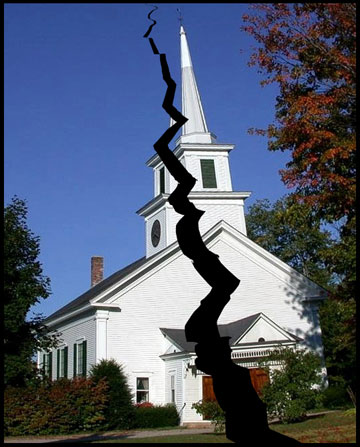
Why do we have such a hard time with this? Is it because there might not actually be a “right way” or a “wrong way” to do a lot of the things we do in the name of Jesus, and we can’t stand it? Could it be that if we disagree with someone over a church matter or a biblical interpretation, one of us just has to be right and one of us just has to be wrong? How else would you explain our two thousand year history of dividing and dividing and then dividing even our divisions over trivial matters such as worship practices and leadership structures, days of the week and food and drink, baptism methods and signs on the front of the church? How else would you explain Paul’s clear command to be silent about such disagreements and never to label or divide over them? And our clear disregard and disobedience to that command?

You know, in this same Romans 14 passage, Paul doesn’t tell the weak Christians to change their minds about their immature beliefs. He does not tell them to change their practices which, again, he considers “weak.” In fact, he tells them not to change a thing. Why is that? Is it because, again, there might not actually be a “right way” or a “wrong way” to do a lot of the things we do in the name of Jesus?

“Whatever you believe about these things keep between yourself and God.” ~Romans 14:22

“Speak where the Bible speaks and be silent where the Bible is silent.” ~Alexander Campbell

Peace,

Allan

He Did It Again

Our God revealed himself to us again yesterday. His children were gathered in his presence in a building on South Monroe in Amarillo, and he showed himself to us in a powerful way. Again.

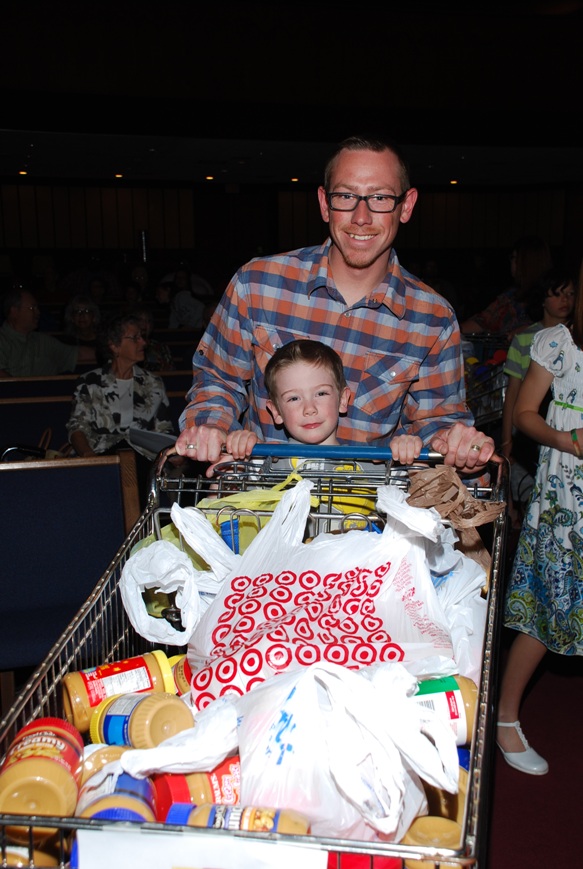
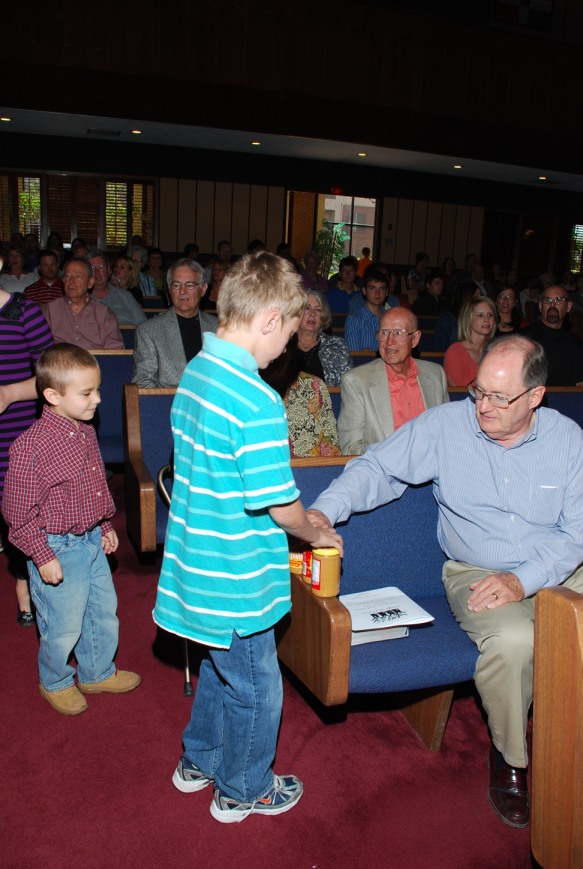
Our God showed us that he is the Father of the weak, the Defender of the helpless, in providing 607 jars of peanut butter for our Snack Pak program for Bivins Elementary School. We saw his glory reflected in the faces of our own young children as they scurried about the packed worship center, collecting the jars, passing the jars, chasing and dropping the jars, which will be used to feed at-risk students and kids living in poverty in our city.

Our God showed us that he is the Savior of the World in showering Great Cities Missions with more than $75,000 for the training and sending of missionaries and planting of churches in Latin America. We saw his glory reflected in the grinning faces of the GCM board members and Central missions committee members scattered all over our worship center.

Our God showed us that he is the Creator and Sustainer of the Universe in supplying through his faithful servants here $55,000 to begin the new permanent Alara school building in Kenya. Our God calls things that are not as though they are. He is faithful to finish what he starts. And we saw his glory reflected yesterday in the great generosity of Jack and Barbara Vincent.

Our God also showed us that he is a patient God, gracious and compassionate, abounding in love and faithfulness, forgiving wickedness, rebellion, and sin. When Kimberly Vasquez was baptized into Christ yesterday, we saw his eternal glory reflected in her face. And we all joined the angels in heaven rejoicing.

Our God is not an audience when his people gather to worship him. He is active, very active, in ministering to us, comforting us, encouraging us, inspiring us. He is present in every song, he is there in every prayer, he eats and drinks with us at his table, and he is working in every handshake and hug. Our God is revealing himself to us, he is transforming us more into the image of his Son, and he is giving us little glimpses of his Kingdom come in all of its fullness and glory.

Thank you for bringing the peanut butter. Thank you for clapping for Jack and Barbara. Thank you for cheering so wildly for Kimberly. And thank you for coming to our worship assemblies every Sunday morning expecting our God to do something big. Again.

Peace,

Allan

« Older posts Newer posts »