Category: Romans (Page 18 of 28)

We Belong To The Lord

I want to continue our important discussion here regarding the silence of Scripture and its place in our American Restoration Movement history and current beliefs and practices. As it relates to the maddening question of whether biblical silence on a particular issue is prohibitive or permissive, please check out this video clip from a Rick Atchley sermon illustration. I quoted one of my favorite Rick Atchley lines in Monday’s post, and a friend reminded me this morning of Rick’s “chair illustration.” I’ve seen Rick do this at least a couple of times. It’s a beautifully simple and strikingly clear demonstration of the absurdity of our traditional approach to the silence in Scripture. And it inarguably proves that this default approach actually prevents any type of Christian unity among our churches; it actually leads to and fosters ugly and sinful divisions.

When you have more time, you might also check out this recent 26-minute presentation by my brilliant brother, Dr. Keith Stanglin, on the fourth and fifth propositions of Thomas Campbell’s Declaration and Address. Keith argues that Campbell’s document, which most consider as the foundational document for the Restoration Movement and Churches of Christ, fundamentally rejects both the Old Testament and church history as formative and informative for our congregations. Keith makes a compelling case for paying careful attention to all of church history as we prayerfully make decisions for our own churches and denominations today. The lecture is in two parts on YouTube: click here for part one and click here for part two. (Thank you, Keith, for pointing out that the use of unleavened bread for communion is a tenth century innovation of the western church.) After watching Keith, you’ll understand why I always say I got the looks and he got the brains.

While I’ve got you here, I’ll direct you to my great friend Jim Martin’s post, written for Dan Bouchelle’s blog, on why he continues to preach.

~~~~~~~~~~

Paul’s thoughts in Romans 14:1-15:7 are summed up in a couple of places in that passage. In 14:17 he claims that “the Kingdom of God is not a matter of eating and drinking, but of righteousness, peace, and joy in the Holy Spirit.” Later, in 14:22, Paul commands “whatever you believe about these things keep between yourself and God.” The conclusion must be that it’s OK to have strong opinions and beliefs about certain things as they relate to Christ Jesus and his Kingdom, but that those opinions and practices must never be bound on other Christians.

But what about “salvation issues?” Oh, I can hear it now. In fact, I hear it quite often. What about matters of doctrine? What about the important things?

Yeah, that’s where it gets touchy. Because if two Christians are arguing about something and the argument and the feelings are such that it’s dividing them and threatening to divide their church, then, of course, one or both of them believe with all their heart that it’s a doctrinal or salvation issue. But, Paul says, that’s OK, too.

“One man considers one day more sacred than another; another man considers every day alike. Each one should be fully convinced in his own mind. He who regards one day as special, does so to the Lord. He who eats meat, does to the Lord, for he gives thanks to God; and he who abstains does so to the Lord and gives thanks to God. For none of us lives to himself alone and none of us dies to himself alone. If we live, we live to the Lord; and if we die, we die to the Lord. So, whether we live or die, we belong to the Lord.” ~Romans 14:5-8

Each of us should be fully convinced in our minds that what we’re doing is the right thing to do in the eyes of God. Yes. But don’t bind that on another brother who doesn’t feel the same way. If he practices something different, Paul assumes you’re both doing it to the Lord, before the Lord, in the presence of the Lord, to the glory of the Lord, and with a clear conscience. We assume that my sister with a different belief or a different practice is not believing or practicing arbitrarily. She’s doing it with careful study and reflection and prayer. And she’s fully convinced in her mind that she’s doing the right thing. So, everything’s fine.

But, somebody will still say, “What if we’re talking about a salvation issue?”

What in the world is a ‘salvation issue?’ Will somebody please tell me what a ‘salvation issue’ is? We get into discussions about ‘salvation issues’ and we start ranking things in order of importance to God, in terms of what’s going to save us or condemn us. And we’ll talk about baptism and church and the authority of Scripture and worship styles, but we’ll never talk about helping the poor or being kind to your enemy. Scripture says those are actually the heavier issues. They’re all salvation issues! Everything we do is a salvation issue! That’s why the heart is the most important thing. The attitude is the most important matter. For the Kingdom of God is not a matter of eating and drinking…

Paul is calling for unity in spirit, not unity in opinion, not unity in practice, not even unity in belief. And he’s dealing with what at that time in that church were huge issues. Unity comes with where your heart is, what’s your motivation, what drives you, who you are thinking about.

Paul clearly identifies himself as one of the “strong” Christians. But, again, it’s interesting to me that he doesn’t say the “weak” need to change their minds or their opinions or practices. His prayer is not that all the Christians in Rome come to the same opinions on these disputable matters. No. He’s praying that they may possess a unity of spirit that transcends their differences.

Peace,

Allan

The Silence of Scripture

When our Restoration Movement divided between Disciples of Christ and Churches of Christ at the turn of the 20th century, it was largely a result of two different interpretations of silence in Scripture. As we’ve already seen, those opposed to the use of instrumental music during congregational worship reasoned that, since the Bible didn’t specifically authorize it, it was not allowed. There were no New Testament examples, so it couldn’t be practiced. On the other hand, proponents of pianos and organs declared that silence in the Bible permitted the use of instruments — Scripture didn’t specifically prohibit or condemn it. Since there was no biblical command against it, it was OK to practice it.

The same arguments regarding the interpretation of biblical silence were used for and against the Missionary Society, for and against located preachers, for and against open and closed communion. Is scriptural silence on a particular issue prohibitive or permissive? Does silence allow or condemn? I’m afraid we still run into forms of this debate almost every day. And we ought not.

When Alexander Campbell said, “Speak where the Bible speaks and be silent where the Bible is silent,” he didn’t mean that the lack of a clear biblical directive should embolden us to scream and yell and assert our own opinions about that silence and loudly and aggressively and divisively bind those opinions on others. He meant that we could all form our own thoughts and opinions — and they could be very strong opinions and passionately held — and then keep them to ourselves. Being “silent where the Bible is silent” means, in the words of the apostle Paul, “whatever you believe about these things keep between yourself and God” (Romans 14:22).

In my view, a reading of Romans 14:1-15:7 would convict any Christian of binding his opinions on anybody.

Paul says very plainly that we have “strong” Christians and “weak” Christians. His words, not mine. The weak Christians are vegetarians; the strong believers enjoy a good steak. The weak brothers keep all the Jewish holy days; the strong brothers don’t. The weak Christians are developing all kinds of elaborate worship and lifestyle theologies and drawing lines in the sand over what’s right and what’s wrong; the strong Christians don’t have very many lines and they’re not as concerned about which worship and lifestyle practices are right or wrong. The weak are criticizing the strong for being spiritually insensitive; the strong are looking down on the weak for being spiritually immature and inferior. The strong proclaim freedom in Christ; the weak say that doesn’t mean anything goes. The weak tell the strong, “You’re wrong!” The strong tell the weak, “Grow up!”

Paul commands both of these groups of disciples not to look down on anybody. Nobody is to condemn anybody. For God has accepted him. Accepted whom? This brother or sister or this group of brothers and sisters who disagree with you on your church tradition. This other Christian or group of Christians who don’t see eye to eye with you on your disputable matter. You’re not his master, Paul says. Christ Jesus as Lord is his master. Not you. Whether this other guy stands or falls is up to the Lord. Whether he’s right or wrong is up to God, not you.

And then Paul goes ahead and makes the judgment, he makes the call. “He will stand!” Whether he agrees with you or not or whether you’re both on the same page or not, Paul says this guy will stand because he’s in Christ. So, you accept him because Jesus accepts him. Christ died for him, Paul reminds.

Why do we have such a hard time with this? Is it because there might not actually be a “right way” or a “wrong way” to do a lot of the things we do in the name of Jesus, and we can’t stand it? Could it be that if we disagree with someone over a church matter or a biblical interpretation, one of us just has to be right and one of us just has to be wrong? How else would you explain our two thousand year history of dividing and dividing and then dividing even our divisions over trivial matters such as worship practices and leadership structures, days of the week and food and drink, baptism methods and signs on the front of the church? How else would you explain Paul’s clear command to be silent about such disagreements and never to label or divide over them? And our clear disregard and disobedience to that command?

You know, in this same Romans 14 passage, Paul doesn’t tell the weak Christians to change their minds about their immature beliefs. He does not tell them to change their practices which, again, he considers “weak.” In fact, he tells them not to change a thing. Why is that? Is it because, again, there might not actually be a “right way” or a “wrong way” to do a lot of the things we do in the name of Jesus?

“Whatever you believe about these things keep between yourself and God.” ~Romans 14:22

“Speak where the Bible speaks and be silent where the Bible is silent.” ~Alexander Campbell

Peace,

Allan

Life Together: Last Thing

Why devote our lives to one another in brotherly love? Why sacrifice for and serve one another in genuine Christian community? What’s the result of living our lives together the way Scripture calls us to? Does it matter whether we go through life as an individual follower of Jesus or as a fully involved member of a Jesus-following church?

Yeah, it matters a lot.

One, it brings glory and praise to God. Paul says we should accept one another just as Christ accepted us in order to bring praise to God (Romans 15;7). Loving and serving one another in Jesus’ name makes God’s love complete. The Christ himself says the selfless deeds done for others in his name causes the world to praise our heavenly Father. He tells his disciples in John 13 that if you love one another as I have loved you, everybody will know you’re mine. Everyone will know this is real. Our Christian fellowship marked by genuine love and service fulfills the very reason God created us and sent his Son here to save us.

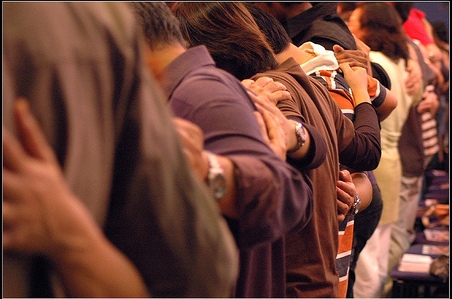
It also reveals God’s power. Our God is strong when we’re weak; his power is made perfect in our weakness. And the more we open up with one another, the more of our lives we share with one another, the stronger and more powerful our God becomes. The sharing of our struggles and our weaknesses, the mutual bearing of one another’s burdens, opens our eyes to see more clearly what God is doing. I’d like us to demonstrate more of that even in our Sunday morning worship assemblies. The open and honest sharing of our lives and our struggles together should be a regular thing, not a rare thing. When somebody walks to the front to confess a sin or to repent from a wrong or to ask for prayers, there should be 20 or 30 brothers and sisters rushing to the front to be with him. Dozens of brothers and sisters should meet him or her right there on the spot, ready and eager to hug him and pray with him and confess with him, to encourage him and support him and lift him up. Our Christian community, our church, should be the safe place, not the last place, to share our struggles.

And we might say, but what will the visitors think? If we start doing this every Sunday, what will the visitors think?

Are you kidding me?!? Our God is at his strongest and most obvious in the humble recognition of our weakness. God works amazing wonders when we declare our dependence on him instead of ourselves. What will the visitor think? The visitor thinks, “Hey, I can really fit in with this church. These people have lots of problems, but they have God. And they have each other. They’re not pretending. They’re not playing. They’re not just doing church, they are being church.”

And that’s powerful.

Lastly, our Christian lives together, loving and serving each other in Christian community, is part of the salvation process. It’s part of what Paul calls “being saved.” We selflessly love and serve, we bear one another’s burdens the way Jesus does, and our thoughts become words. Our words become actions. Our actions turn into habits. Our habits become our character. And our character becomes our destiny. Life together is a significant part of being transformed into the image of our Savior. The more we serve, the more like Jesus we become. The more we love, the more burdens we bear, the more we consider the needs of others more important than our own, the more like our Lord we become. That’s sanctification. That’s preparation for living forever in the face-to-face presence of God. And that’s our salvation.

Again, our Christian friendships should be treasured, never assumed. Our time together should be cherished, never avoided. Opportunities to be together should be seized, never scorned.

Peace,

Allan

Life Together: Why?

We’re going to keep at it for a couple of days here on Christian commmunity. You know, we say the word “fellowship” today and we immediately think about a big bucket of fried chicken and a green bean casserole. And hopefully somebody brought banana pudding. But in the Bible “fellowship” is much more than just a meal. “Fellowship” is everything! Koininea means sharing. It’s not something you do every fifth Sunday with a crockpot. It’s something you do every single day. Sharing each other’s blessings and each other’s burdens as we grow together and glorify the Lord. This fellowship of the saints is not some ideal that we’re trying to realize; it’s a reality created by God in Christ in which we’re called to participate.

Why? Why love each other? Why serve one another? What’s our motivation? Why would we be so concerned about this?

Well, it’s nothing we have to guess at. It’s spelled out very clearly in all the Christian letters. Our life together reflects God’s work through Christ. It imitates God in Christ. It lives into and embodies what our God is all about.

Paul begins his community directives portion of Romans 12 with “in view of God’s mercy.” Or, in other words, because God has been so merciful to us, we should love and honor and serve one another. In Ephesians 4, Paul tells us to be kind and compassionate to one another, forgiving each other just as in Christ God forgave us. In Ephesians 5, he directs us to submit to one another out of reverance for Christ. Colossians 3 tells us to bear with each other and forgive one another just as the Lord forgave us. On and on it goes. 1 Thessalonians 5. Hebrews 10. 1 Peter 1. What God in Christ has done for us and with us, we in turn do for and with others in Christian community.

God’s perfect love and sacrifice is fulfilled, it’s made complete, Scripture says, when we love each other with that same love. I forgive you because God forgives me. I serve you because God serves me. I give you what I have because God gives everything he has to me. I’m patient with you, I’m generous to you, I’m kind and gentle and compassionate with you because my heavenly Father is all those things to me. I submit to you because Jesus submitted to the whole world on a cross. I love and forgive my enemies because while I was God’s enemy, he put his only Son on a tree to save me.

That’s why we die to each other. We put to death our own selfish ambitions and vain conceits, we bury our own interests because of all the ways our God in Christ does that for us.

We know what it’s like to be stuck in sin. We know the misery. As C. S. Lewis describes in Screwtape, we know what it’s like to be trapped by the devil, to be drowning in sin, to have “an ever increasing desire for an ever diminishing pleasure.” We know what it’s like. I know what it’s like. And God through Christ saved me. He loves me and rescues me. I know what it’s like.

Why love and serve one another in Christian community?

Because I once was lost, but now I’m found; I was blind, but now I see.

~~~~~~~~~~~~~~~~~~~~~~~~~~

Vickie dominated our second annual Central Staff Bowl Challenge, leading it almost from start to finish with an uncanny knack for picking all the right games and avoiding all the upsets. Down the stretch Vickie correctly picked eleven of the last fourteen college bowl games, maintaining the impressive lead she built before Christmas by picking the first six games in a row. On the far extreme other end of things, Connie finished dead last. And it wasn’t even close. For those of you who are really interested (sickos!), Hannah finished in second place (blame it on Baylor), Mary and Matthew and I competed for the top spot right into the final week, but our point values were a bit misplaced. Greg and Elaine and George all suffered very disappointing finishes in the middle of the pack. Gail was frustrated to be really bad, but not bad enough to compete for the last place prize. Adam made all his picks while driving his family from Houston to Amarillo at 3:00 in the morning; and it showed. Mark thought picking all the games A-B, A-B, A-B right down the column would be interesting; it wasn’t. Tanner and Kevin were the closest to Connie at the bottom of the pile but, in reality, she was never seriously challenged. Vickie has bragging rights for the next year and she and Connie both get a free lunch when our church staff celebrates the end of the football season and the beginning of the NHL season (what?) at the end of the month.

No sooner had the BCS Championship Game been decided last night (that was like about four minutes into the first quarter; what happened, I was watching the championship and an OU game broke out?!?) when the church staff moved on to the next big contest. With our own sister Mary about to drop anchor with the fourth little McNeil, we’ve all placed our bets on the day Mary dominos, the exact time she gives birth, and the gender of the little tot. This is such a competitive group; I love it! Guesses range from this Saturday (does Hannah have some inside, sister-in-law scoop?) all the way to January 23. I’m pulling for a girl at 10:15 Sunday morning January 20.

Peace,

Allan

Through Water to Salvation

“…this water symbolizes baptism that now saves you.” ~1 Peter 3:21

In recalling to his readers how Noah and his family were “saved through water,” the apostle Peter points us to Christian baptism that, in the same way, saves us. Peter’s clear, succint statement is astounding. For a lot of people, it’s scandalous. Peter tells us that baptism has a salvation function.

Paul draws the same conclusion as he looks back on the one foundational and identifying event for Israel: the exodus and the crossing of the Red Sea (1 Corinthians 10:1-4). He sees what happened in Exodus 14 as a baptism “into Moses” and compares it to our baptisms “into Christ” (Romans 6:3, Galatians 3:27). Paul wants us to understand our baptisms as a comparable moment of deliverance and redemption.

Baptism, just like the flood and the Red Sea crossing, is a saving event. Just as God saved Noah through cleansing the old world with water, so God saves us from our old lives through baptism. Just as God delivered Israel by using water to destroy their enemies, Pharaoh and his army, he delivers us by using water to eradicate our enemies of sin and death. Noah and Israel both pass through the waters into a new world, a new creation. Christians pass through the waters of baptism into a new world, eternal life with the Father through the death and resurrection of the Son.

It’s a divine gift. It’s a sacrament of God’s grace. It’s a salvation experience. In baptism our God redeems us, gives us a new identity, and frees us from slavery to sin and death. And it shapes who we are and how think and act as a people of God.

“We were therefore buried with him through baptism into death in order that, just as Christ was raised from the dead through the glory of the Father, we too may live a new life.” ~Romans 6:4

~~~~~~~~~~

What a marvelous joy to welcome into our home overnight Friday our great friends David and Olivia Nelson and their sons, Caleb and Seth. The Nelsons timed their furlough in the States from their missionary lives in Ukraine to coincide with the birth of Seth last month in Lubbock. David and Olivia figured one boy born in Kharkov in Hospital 17 was enough. So we were very blessed that they took a long, winding route from Lubbock to Fort Worth, through Amarillo, to spend almost 24 hours with us last weekend.

After answering several questions Friday night from servers and other customers at Blue Sky about David’s accent, we stayed up way too late passing Seth around, drinking egg nog and Dr Pepper (no kafir, David)  and playing our favorite, Phase 10. Caleb entertained us the next morning by splashing through his pancake breakfast. And then we spent a good long while with our Father in prayer, thanking him for the awesome privilege of serving him in his Kingdom together on opposite ends of his world.

The Nelsons are in Fort Worth now for another month, reconnecting with the church family at Legacy, stocking up on picante sauce and Jello-O and other stuff they can’t get in Ukraine, and being reminded of how much they are truly love and appreciated and admired by everyone who knows them.

I praise our God for the ways he works through and with David and Olivia. I thank him for our rich friendship and partnership in the Gospel. And I acknowledge gratefully that I’m a much better Christian, a more faithful follower of our King, because I know them.

Peace,

Allan

In Line with Kingdom Priorities

I won’t use those self check-out counters at Wal-Mart or Home Depot. I’d rather stand in line for ten minutes and talk to a real person at the register and even real people in line with me than swipe a card and punch a few buttons and have no human interaction with anybody. My kids say it’s because I’m old. I tell them, no, it’s more important to interact with people than to be in such a hurry.

I can’t show God’s love and grace to a machine. I can’t smile at a machine or talk to a machine (I suppose I could, but I’d probably get arrested). If a machine miscalculates my change or forgets to give me a receipt, my attempts at a Christ-like patient and pleasant attitude will have no impact on a machine. I can’t talk to a machine about the pictures of its grandchildren on its apron. A machine will never ask me about my empty tomb T-shirt or where I go to church.

Our time and technology — calendars, clocks, computers — are increasingly robbing us of more and more human interaction. This frantically hurried culture is chipping away at Scripture’s contention that we are not a collection of individuals but, rather, a Body with each member belonging to all the others.

We invest our lives in one another. We commit ourselves to one another. It happens at weddings and funerals. It happens at ballgames and graduations and potlucks.

“Share with God’s people who are in need. Practice hospitality… Rejoice with those who rejoice; mourn with those who mourn.” ~Romans 12:13-15

I can’t rejoice with you unless I know what you’re rejoicing about. I can’t mourn with you unless I know why you’re mourning. That’s where the time investment and the sharing come in. That’s where loving human interaction with one another should take the priority over our busy schedules.

Today, make that phone call you’ve been putting off. Tonight, reconnect with that family member or neighbor you’ve been too busy to visit. And ask the cashier about her grandkids.

~~~~~~~~~~~~~


Congratulations to Central’s own Ellie Cornett and Logan Brittain! Man, we’ve got some really talented kids at this place! Ellie just won the Class 2A State Cross Country Championship as a member of the Bushland High School Lady Falcons. It’s the first ever state title for Bushland. And Ellie’s got a great shot at repeating next year as a Senior. And Logan has just made it official, signing with the University of Texas Longhorns as a Class 4A High Jump Champion from Randall High. As a Senior this year, Logan also stars as a wide receiver and defensive back with the Raiders playoffs-bound football team and as the starting point guard for Randall’s basketball team. Congratulations to these great kids and their wonderful families. We’re very proud of these two.

Peace,

Allan

« Older posts Newer posts »