Category: Matthew (Page 15 of 24)

For These Brothers of Mine

You’ve read Matthew 25, right? It’s the separation of the sheep and goats, the familiar vision Jesus gives all of us of that last day of judgment and glory. We wonder about that last day, don’t we? I was certain that last Friday, December 21, was not going to be the last day. (Of course, when I got my copy of Aerosmith’s new album last week and discovered that Steven Tyler had done a duet with Carrie Underwood — on an Aerosmith album!! — I began to worry. I can’t think of a more disturbing sign of the end times tribulation than that.) But we do know that last day is coming. And we do know Christ Jesus, our King, is going to judge us. He’s going to separate those who denied him as Lord from those who faithfully submitted to his Lordship. That’s what he says in Matthew 25:

“When the Son of Man comes in his glory, and all the angels with him, he will sit on his throne in heavenly glory. All the nations will be gathered before him, and he will separate the people one from another as a shepherd separates the sheep from the goats. He will put the sheep on his right and the goats on his left. Then the King will say to those on his right, ‘Come, you who are blessed by my Father; take your inheritance, the Kingdom prepared for you since the creation of the world. For I needed songs, and you sang them to me acappella; I needed a communion meal, and you ate it every Sunday; I needed a church, and you built a huge building with the right name on the sign; I needed correct doctrine, and you preached harshly worded sermons and wrote scathing articles; I needed distinctions, and you drew rigid lines of fellowship; I needed strict obedience to laws which never came out of my mouth, and you vigorously kept them and enforced them on others.'”

No! God forbid!

As Joe Malone used to exclaim, “Shades of reason, neighbor!” That’s not what it says. Praise God, that’s not what it says!

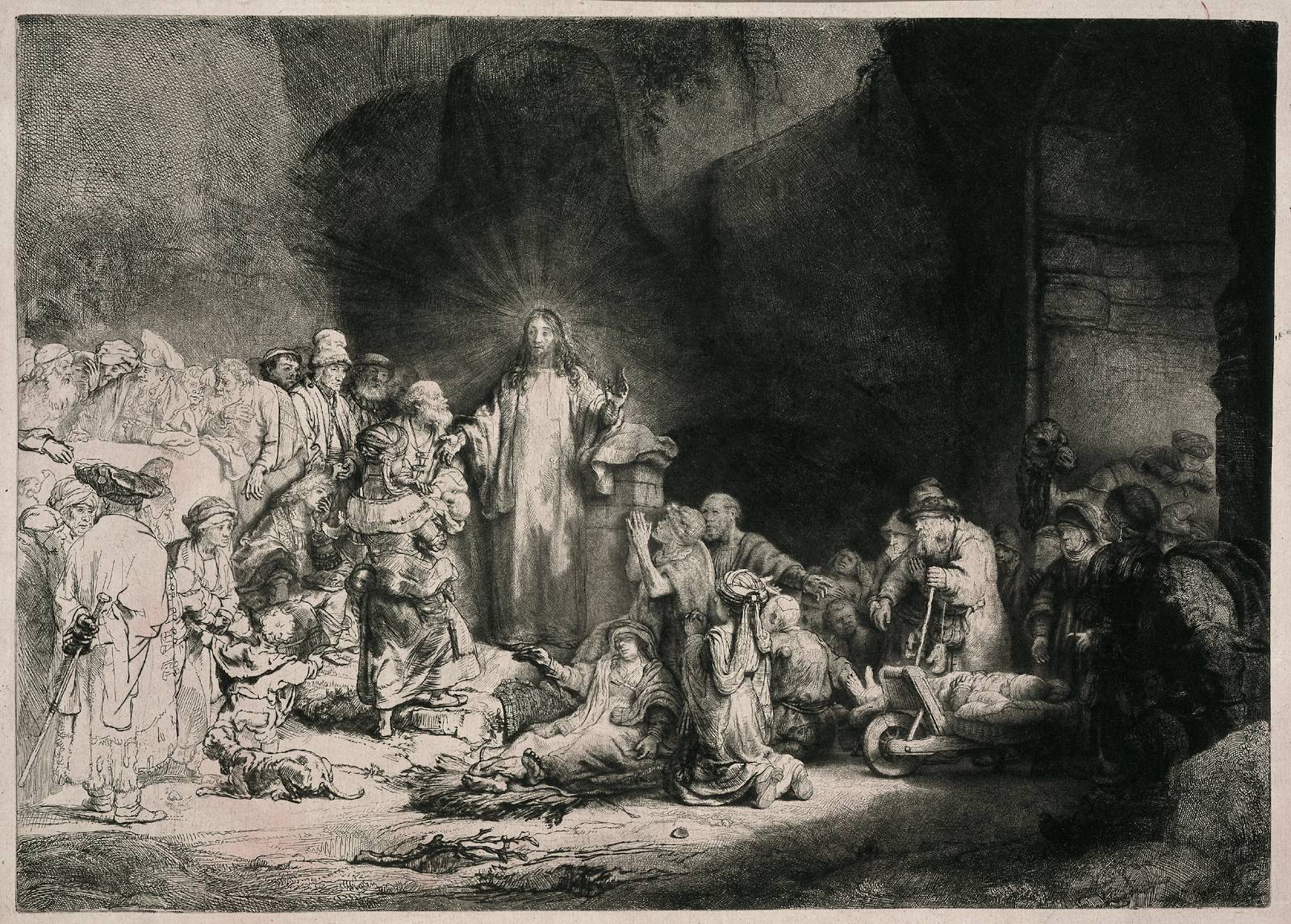
“For I was hungry, and you gave me something to eat; I was thirsty, and you gave me something to drink; I was a stranger, and you invited me in; I needed clothes, and you clothed me; I was sick, and you looked after me; I was in prison, and you came to visit me.”

The ones who are blessed by the Father, the ones who will receive the inheritance, the ones for whom the Kingdom is prepared are those of us who reflect the glory of God. Those of us who show grace and compassion, love and faithfulness, patience and mercy and forgiveness.

Our Lord pulls no punches when he declares with divine authority that justice and mercy and faithfulness are more at the heart of what it means to belong to God than tithing. He does not apologize one bit when he condemns the religious elite for saying all their prayers correctly, but then foreclosing on the widow’s house. Our King desires mercy, not sacrifice. It’s always been that way.

Your practices don’t matter if you don’t show grace and compassion. It doesn’t matter how often or how seldom you take communion if you’re not demonstrating love and faithfulness and forgiveness in your dealings with people. You can sing the songs and say the prayers perfectly right, but if your attitude is not Christ-like, if you’re heart is not being transformed more into the shape of Jesus’ heart, if you’re not reflecting God’s eternal qualities in the ways you interact with people, it’s meaningless.

“The King will reply, ‘I tell you the truth, whatever you did for one of the least of these brothers of mine, you did for me.'”

Our God has revealed himself to us. He’s told us who he is in beautiful words and in mighty deeds. Our God is compassionate beyond measure. His grace is given freely and abundantly. His patience means he will never give up. His love is limitless, no boundaries; his faithfulness is uncompromising, it’s forever. His forgiveness is complete. Total. It’s done.

We are blessed. So very blessed. Praise him. And may our lives increasingly reflect his glory.

Peace,

Allan

Win Them By Our Life

“Let us astound them by our way of life. For this is the main battle, the unanswerable argument, the argument from actions. For though we give ten thousand precepts of philosophy in words, if we do not exhibit a better life than theirs, the gain is nothing. For it is not what is said that draws their attention, but their inquiry is always what we do. Let us win them therefore by our life.”

~John Chrysostom, Homily on 1 Corinthians, 4th century AD

Why do we still mostly understand Church not as an every day, every hour Kingdom of Priests to the world, but in terms of what we do together inside our church buildings on Sunday mornings? We judge the faithfulness or worth of a congregation in terms of its structures. What’s the organization of the church? What’s the name of the church? How do they worship? The structures are almost always our starting point. So when we attempt to reform or revive or rejuvenate a church, what we normally do is go to the Bible to try to get the structures right.

I don’t know if getting the structures right is what God has in mind for his treasured possession. Is that God’s mission in the world?

I mean, what happens when all the structures are perfectly right but there’s no serious engagement with one another or with the world? If doing worship correctly or organizing the leadership chain properly takes the place of living justly, loving mercy, and walking humbly with God, are we honoring our Father who calls us his priests to the world?

When the church becomes more a set of structures and less a way of life in the world, our focus can become obsessively inward. We think of church life as an end in itself rather than something to be lived and given for the sake of others. We like our church, we’re comfortable in our church, we don’t want anybody to mess up our church or change it in any way. We can be very easily distracted by our own church life.

“Now a church came up to Jesus and asked, ‘Teacher, what good thing must I do to get eternal life?’
‘Why do you ask me about what is good?’ Jesus replied. ‘There is only One who is good. If you want to enter life, obey the commandments.”
‘Which ones?’ the man inquired.
Jesus replied, ‘Do not murder, do not commit adultery, do not steal, do not give false testimony, honor your father and mother, and love your neighbor as yourself.’
‘All these I have kept,’ the church said. ‘What do I still lack?’
Jesus answered, ‘If you want to be complete, go, sell your possessions and give to the poor. Then come, follow me.’
When the church heard this, it went away sad, because it had great wealth.”

Is it possible for a church to do all the right things and still lack the one thing it needs? Is it possible for the church to be so consumed with its own life that it fails to care for the world around it? Is it possible for a church to retreat so deeply into its own righteousness that it can’t hear the cries of a lost world?

The call to follow our King requires a giving up of our own lives. Jesus did not die for his Church so we could preserve our lives and cater to our own needs. Never! God forbid! In the name and manner of Jesus we are to spend our lives for the sake of the world. The Church, just exactly like its Lord, is being sent into the world not to be served, but to serve and to give its life for the sake of others.

Peace,

Allan

Stand in the Grace of God

We’re working through Leroy Garrett’s book “What Must the Church of Christ Do to Be Saved?” We’re losing members and congregations at a steady rate in this country. Some would say we’re losing, or have already lost, a great deal of credibility. As a denomination (just wanted to see if you’re paying attention) there are some changes we need to make if we’re going to remain a viable partner in the Kingdom of God. Garrett’s fourteenth suggestion is a call for all our congregations to not just believe in the grace of God, but act on it. Live it!

Stand in the grace of God.

Every member of the Church of Christ believes in the grace of God. They would all readily acknowledge that we are saved by the grace of God and not by our own works. No one among us has the slightest interest in minimizing the significance of the grace of God. However, we must stand in the grace of God, and not simply believe in it. The Church of Christ has a head knowledge of grace, but at the gut level it does not, generally, know the grace of God. It is like living in a house wired for electricity and not being plugged into the power. This is why we’re not going anywhere, we’re not plugged in.

When we consider what grace does for people, we do not appear to have “seen the grace of God,” to quote Acts 11:23, even though we believe it is around. Grace makes believers more and more like Christ, but we are not known for our Christlikeness. Grace causes them to exult in their blessings, filling them with joy, good humor, and laughter; but we are not known for those qualities. Grace makes people gracious, less critical, more tolerant and more accepting; but is this where we are? Grace is never what one deserves, but is this what we have emphasized? Grace is God’s free gift, unconditionally bestowed, no strings attached; but haven’t we attached strings?

By now you’ve noticed a couple of fairly prominent themes in Garrett’s writings: Christian unity and grace. Our misunderstandings and misapplications of both have certainly stunted our growth as a Christian movement and greatly stifled our salvation impact in God’s world.

We have such a hard time realizing that God’s gift of grace is absolutely free, that it’s completely undeserved and totally unearned. We have traditionally understood the grace of God as his gift that makes up the difference as, or after, we travel the road to eternal life. We do the good works, we pray the right prayers, we worship in the correct manner, we get baptized by the proper method, we set everything up in our churches according to the Scriptural pattern, and God’s grace closes the gap to get us to heaven. We have lived by a “God helps those who help themselves” mentality, which, by the way, goes wholly counter to everything we read in the Bible. Scripture makes it clear that “God helps those who can’t do a crying thing for themselves.” But we don’t accept that. Or, at least, we’re not living like we do.

The proper view of God’s grace will, as Garrett observes, transform us into a more Christ-like people. We will act more like our Father when we finally realize what our Father has done for us. Jesus says we are to love one another as God has loved us. That means loving one another even when everybody around you is at their most unlovable. Our Lord tells us to forgive as God forgave us. That means forgiving everybody of everything. Everybody. Everything. Forgive. Forgive. Forgive. And Scripture says we are to accept one another as God in Christ accepted us. That means we accept each other — yes, we accept all other Christians; those within and those outside our Churches of Christ — who don’t have every single thing completely figured out.

Jesus told the parable about the servant who was forgiven by his master of his great debt and then refused to forgive a fellow servant of his tiny debt, abusing that fellow servant and throwing him in jail. And we’ve been guilty of the same thing. We’ve imagined grace as something that covers us in our sins, but not in our Scriptural interpretations and doctrinal understandings. Grace covers us for things we might do out in the world, but it’s not enough to take care of us if we get something wrong in the Church. We’re not totally saved; we’re just barely saved, maybe. And everybody else is in a lot more trouble than we are!

I hold to the principle of lex orandi, lex credendi: the way we worship is the way we believe. If we view our Father as a tight fisted tyrant who’s keeping track of every single misstep, as a God who’s looking to judge and condemn, as a Lord who delights in watching us sweat it out, then that’s how we’re going to behave, too. If we view him that way and worship him that way, looking over our shoulders to make sure we’re doing everything exactly right so we can get to heaven, we’re going to treat other people the way we think God is treating us. That is not Good News. It’s not salvation.

When we “stand” in the grace of God, trusting in his goodness and mercy, then love, joy, and peace will flood our hearts. We will then be a more gracious people, magnanimous, full of life and enthusiasm, eager to praise God for his great mercy. We will take ourselves less seriously and be able to laugh at our foibles. We will not be so uptight, we’ll quit worrying, be less critical of others, more accepting, more forgiving.

Peace,

Allan

The Leader as Servant

“The Son of Man did not come to be served, but to serve and to give his life as a ransom for many.” ~Matthew 20:28

It is always essential that we love what we are doing. If we don’t love what we’re doing, we’re not going to be very good at it for very long. And we won’t last. The body and the mind and the sense have to all be totally into it. the intellect can’t do much without the aid of the heart and the liver and all the limbs. And vice versa. We have to love what we are doing with all of everything we have. Everything we are.

This is not untrue for those of us in spiritual leadership roles. We must love what we are doing, regardless of the level of difficulty which sometimes reaches “eleven” on a scale of one-to-ten. And we must do it with hearty abandon. The desire to be a leader has to burn like a fire in our bellies. Obviously, that desire to be a leader can’t get the job done alone. There are definitely other conditions and disciplines involved. But unless you truly desire to be a leader, you won’t be. You might wear the title and occupy the office, but you won’t fill the role.

Today, I’m still riding a wave of energy and enthusiasm that built up inside me during our elders/ministers retreat this past weekend. Our positive and productive time together has everything to do with a group of spiritual shepherds who are truly seeking God and wonderful ministers who are serious about following Christ and a gracious Father who continues to bless me far beyond what I could ever deserve. I’m going to reflect more in this space about those powerful 24 hours. Later.

For now, I’m still processing through Leading the Congregation and the four interior attitudes of the leader as presented by Norman Shawchuck and Roger Heuser.

Yes, it takes great desire. We talked about that Friday night. But that desire must be correctly placed. Your desire to serve others must be greater than your desire to lead. As with our risen Lord, leadership is a means of serving. Serving others comes first and then results in Christian leadership. Robert Greenleaf says, “Being a servant leader begins with the natural feeling that one wants to serve, to serve first. Then conscious choice brings one to aspire to lead. That perhaps is sharply different from one who is a leader first, perhaps because of the need to assuage an unusual power drive or to acquire material possessions. For such, it will be a latter choice to serve… The leader-first and the servant-first are two extreme types.”

What’s the difference between leader-first and servant first? Maybe it’s in making sure other people’s highest priority needs are met. The best test, and certainly a most difficult one to administer, in determining one’s own servant-first leadership is to ask, “Are those I’m serving really growing as persons? Do they, while I’m serving them, become healthier, wiser, freer, more likely themselves to become servants?”

Choosing to be a servant-first leader in our materialistic and power-grabbing society is always difficult since it runs counter to the values of leadership for the sake of power and position and wealth. To become a servant leader, we have to lead in a way that reflects what we see in our God.

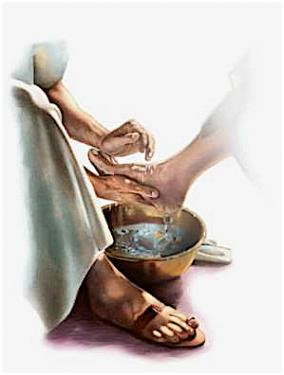
“That God is beautiful is no secret. It is written on every flower, on the sea, and in the mountains. That God is immense is not secret. All you have to do is look at the unniverse. What is the secret? Here it is: God is a crucified God. God is the one who allows himself to be defeated, God is the God who has revealed himself in the poor. God is the God who has washed me feet, God is Jesus of Nazareth. We are not accustomed to a God like this.”

Peace,

Allan

The Leader as Pauper

I’m re-reading several parts of Norman Shawchuck and Roger Heuser’s book, Leading the Congregation, in advance of our elders / ministers retreat this weekend. I’m especially interested in chapter two: The Interior Attitudes of the Leader. A couple of days ago, I wrote a little bit about childlikeness in our spiritual leaders. Today, let’s consider the church leader as a pauper. A poor person.

“Blessed are the poor in spirit, for theirs is the Kingdom of Heaven.” ~Matthew 5:3

This is the first of the Beatitudes, those ideas and promises at the beginning of Jesus’ “Sermon on the Mount” that are intended to shape our thoughts and lives. Bonhoeffer says it’s not the actual poverty that is the virtue — there’s nothing good about being poor. Instead, it’s the willingness to be poor, it’s the desire to follow Christ at the risk of becoming poor, it’s embracing the call of Jesus knowing that you may very well lose everything. I’m obviously paraphrasing here. But, that’s the virtue. That’s the blessing.

Shawchuck and Heuser put another twist on it. They say that church leaders go into their roles, they accept their mantels of leadership, from a position of poverty. We know that when it comes to leading God’s people, we have nothing. We’re wholly inadequate. We can’t do this; and we know it. Inherent in our call to ministry is the realization that we are not by nature equipped to bear this burden of leadership that God has dropped in our laps. We always embrace our calling as paupers.

Now, personally, this one’s easy for me. I feel completely inadequate every single time I jump in the pulpit to preach. I’m terrified every single Sunday morning. Scared to death. The words of God are too powerful for me. Knowledge of him and his great love for us is too lofty for me to attain. I rarely ever feel like I’ve done our holy God justice. In the words of Augustine, I am saddened that my tongue cannot live up to my heart.

I’m not smart enough to teach these classes I’m supposed to teach. I’m not trained to counsel these brothers and sisters in Christ through their marital problems and addictions and depression. I’m not equipped at all to visit with parents who just lost their teenage daughter to cancer. I’m not able to adequately lead this church staff. I’m not prepared for any of this.

I know what that means to entirely lean on God for my ministry. It’s his; it’s not mine. I couldn’t even begin to do any of this without his power, his strength, his pushing and guiding and equipping. I have no competence on my own; it all belongs to and comes from God. I get that part of it. I understand fully that the apostle is staring right at me when he says, “Consider your own call… not many were wise by human standards, not many were powerful, not many were of noble birth (sorry, dad). But God chose what is foolish… what is weak. God chose what is low and despised in the world” (1 Corinthians 1:26-31).

Humility? Yeah, I guess. It’s the same; but different.

The authors move on to say that being a pauper, being poor in spirit as a church leader, means to actually desire this poor position. To be a faithful leader of God’s people means, in their view, to seek this poverty. Because that’s what our Lord did.

“It is hard to desire littleness and nothingness, obscurity and benign respect, in a world obsessed with possessions and positions. It is hard to choose a pauper’s station when everyone around us is scrambling for upward mobility. The temptation that afflicts us as leaders is not that of monetary wealth. Only a fool would choose a profession in the church if the goal were to become rich. Indeed, the ‘to be rich’ temptations among most clergy are not for money but for admiration, respect, adulation, prestige, and power. These are the riches that must be guarded against, if ever we are to experience the freedom of being poor in spirit. God means this poverty as a gift and blessing, not as a practical joke upon those whom God has chosen as leaders in the church.”

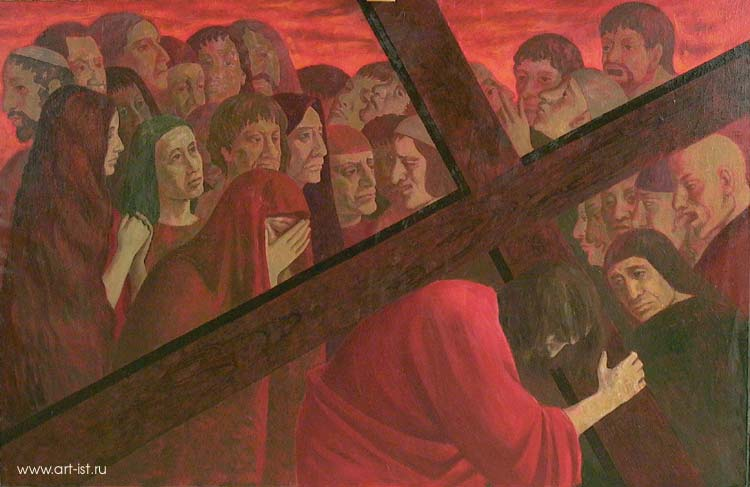
Downward mobility. (Did Nouwen coin that term?) The way of the cross is downward mobility. We empty ourselves of all desire for gain — monetary or otherwise — just like Jesus in order to take on the role of a lowly servant. Like our Lord, we move down to the bottom of the ladder, down the depth chart, giving up all power and position and prestige to seek the good of others.

This world draws hard lines between the winners and losers. We label everything as failure or success. No middle ground. What a difference is God’s way for us! His Word came down to us and lived among us in order to serve us. He became poor so that we, through his poverty, might become rich.

Bishop Walpole is credited with saying to a friend who was considering a call to ministry, “If you are uncertain of which two paths to take, choose the one on which the shadow of the cross falls.” That’s the way and the spirit of poverty, to which our Christ calls every Christian leader.

Peace,

Allan

The Leader as a Little Child

While preparing for our upcoming elders/ministers retreat, I’ve read and re-read several parts of Leading the Congregation by Norman Shawchuck and Roger Heuser. I’m particularly interested in chapter two: The Interior Attitudes of the Leader. I’d like to take the next few days exploring their ideas and reflecting out loud here on what it means for me, personally, and for our churches.

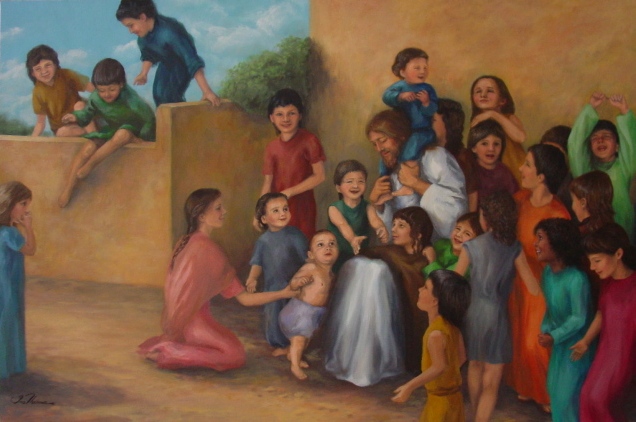
“Truly I tell you, unless you change and become like little children, you will never enter the Kingdom of Heaven. Whoever becomes humble like this child is the greatest in the Kingdom of Heaven.” ~Matthew 18:3-4

Shawchuck and Heuser claim the first and foremost quality of religious or church leadership is childlikeness. The disciples were sincere when they asked their Lord who would be the greatest when the Kingdom was finally realized. Their teaching and learning had, for generations, conditioned them to expect a hierarchy within this new Kingdom structure. The hearts of these disciples were filled with ambition; they wanted a Kingdom that would bring them privilege and honor.

In actuality, Jesus came to usher in an eternal Kingdom in which there is no hierarchy and no superiority. No chain of command, no flow chart, no levels of authority or power. And I’ve got to think this not only surprised the apostles, it probably disappointed them, too. They asked Jesus all the time about their particular ranking in the system. “Who’s the greatest? Who’s going to be in charge?” They couldn’t stop talking about it even during the meal that last night in the upper room. It was there that Jesus proclaimed “You are not to be like that! Instead, the greatest among you should be like the youngest, and the one who rules like the one who serves… I am among you as one who serves” (Luke 22:25-28)

They asked the same question over and over again. And every single time Jesus gave them the same answer: The greatest will be as the youngest, and the leader as a servant.

Shawchuck and Heuser say that childlikeness as the model for church leadership should be received as good news, not bad news. It simply means leading the congregation with an attitude similar to a child’s: “…one who opens the self to this reality as a gift, and one who lives and ministers as the least in service to all. This is childlike spirituality and authentic leadership within the Kingdom.”

Just like the aspiring disciples, I sometimes take myself way too seriously. Honestly, I have a real tendency to be devastated by the slightest criticism. I worry if people aren’t taking me as seriously as I think they should. Are they listening to me? Are they taking my suggestions and advice? Are they paying attention to me? Do they like me? Am I important here? That’s insecurity, I guess. It’s definitely not humility or Christlikeness. It exposes a preoccupation with myself and my own status over the needs of the ones to whom God calls me to minister. It’s silly and shallow. Rather immature.

Just the opposite of the childlikeness Christ envisions for his church leaders.

Children take their play seriously, but not themselves. They are transparent without shame. God wants us all to be like youngsters.

Michael Quoist, in his book Prayers for Life, speaks for God on this subject:

I don’t like old people unless they are still children.
I want only children in my Kingdom.
Youngsters — twisted, humped, wrinkled, white-bearded — all kinds of youngsters, but youngsters.
I like children because my likeness has not yet been dulled in them.
They have not botched my likeness.
I like them because they are still growing, they are still improving.
They are on the road, they are on their way.
But with grown-ups there is nothing to expect anymore.
They will no longer grow, no longer improve.
They have come to a full stop.
It is disastrous — grown-ups think they have arrived.

Jesus calls us as church leaders to childlikeness so we will learn to let God carry us as we lead; to let God teach us what we need to learn. All our skills and talents and abilities, all our plans and visions and dreams, none of it really matters. The plan is in our Father’s hand. And we (I) need to run to him like a little child; seeking his love and approval; living to please him not others; giving to serve others, never myself.

Peace,

Allan

« Older posts Newer posts »