Category: Mark (Page 9 of 15)

Speaking Community

With great power the apostles continued to testify to the Resurrection of the Lord Jesus!” ~Acts 4:33

In Matthew 28, Jesus meets the women outside the empty tomb and says, “Go and tell my brothers!” Scripture says the women “ran to tell the disciples.” In Mark 16, the angel inside the tomb says, “Go and tell!” The risen Lord eats with his disciples that night and says, “Go into all the world and preach the good news to all creation!” Verse 20 says, “The disciples went out and preached everywhere, and the Lord worked with them.” Same thing in Luke 24. “When they came back from the tomb, they told all these things to the Eleven and to all the others.” When the two disciples met Jesus on the road to Emmaus, “they told what had happened.” While Jesus shares a meal with his followers that night he says, “The Christ will suffer and rise from the dead on the third day, and repentance and forgiveness of sins will be preached in his name to all nations.”

Sure enough, the resurrection community can’t keep their mouths shut. In the earliest days of the Church, according to Acts, everybody was talking. Peter and John get thrown in jail for talking about the resurrection and protest to the authorities, “We cannot help speaking about what we have seen and heard!”

When we are truly raised with Christ to walk in newness of eternal life, when we are formed and shaped by the Resurrection of Jesus, how are we not going to talk about it? The Resurrection community proclaims the good news of the resurrection and reign and return of our Lord. We can’t help it.

I would add that followers of Jesus are all about life, not death; we’re a people of hope, not despair; we’re a community of light, not darkness. And when we speak, our words should give resurrection life to others. Our speech should breathe new life into others.

In Colossians, Paul is talking about formation by resurrection when he says, “Let your conversation be always full of grace.” We’re told in Ephesians 4 to speak the truth in love. In Acts 20, we’re told that everywhere Paul went he spoke words of encouragement.

All the words that come out of our mouths should be words that restore and renew, never words that tear down or destroy. When we speak, our words should point others to the resurrection life that’s forming us.

Peace,

Allan

Good Reminders

The Gospel accounts of the resurrection of Jesus tell us that those who experienced the empty tomb up close and personal responded with wonder and amazement. Matthew says the women at the dug-out tomb were afraid. Mark says they were alarmed or astonished. The women are also described as bewildered and trembling. Other translations say they were stunned. The women in Luke’s version were “wondering” about the empty tomb. After Peter looks inside the empty grave, he, too, is said to be in wonder. With each of the Easter stories, the sense of resurrection wonder or mystery is building. It accumulates. So far, not one person who witnessed the empty tomb has been able to make sense of it. Not even those who encountered the risen Lord have it figured out.

And these are good reminders for us today.

The Resurrection confused everybody. At the time it happened, nobody could explain it. It’s obvious that those closest to the event had no idea what had happened or why. And that’s a good reminder for us. That we don’t always have God’s plan figured out. We don’t always know what God is doing. Or when he’s doing it. Or why. And that disorients us. But it’s OK.

Nobody had prepared for the Resurrection. Those women were going to the tomb that morning with burial spices to anoint a dead body. They weren’t bringing Jesus a fresh set of clothes and a toothbrush. When he shows up for dinner with the disciples that evening, they have to scramble to find a chair and an extra place setting. Peter’s wife pulls her husband aside and says, “You didn’t tell me your boss was coming!” Of course not; he didn’t know! None of them had prepared. And that’s a good reminder for us. We’re all beginners in this resurrection business. There aren’t any experts. We don’t control what God is doing. And that unsettles us. But it’s OK.

In the Resurrection stories, the marginal people are the main players. It’s the women. In this patriarchal society, these women had no rights, no status, no standing in the community. Especially Mary Magdalene. She had been possessed by seven demons before she met Jesus which might mean she had been living a reprehensibly horrible moral life or perhaps she was mentally ill. Either way, this lady lived on the edges of her community. She didn’t fit in. But she’s the only name we read in all four Gospel accounts of the Resurrection. And that’s a good reminder for us. That we don’t ever judge or rule out anybody we think might be beyond the reach of Resurrection. More than likely, it’ll be the ones we least expect who wind up at the very front of what God’s doing. And that surprises us. But it’s OK.

Some of the most exciting words in all of Scripture are when God says, “Behold! I am doing a new thing!” God is always doing new things. And it’s exciting. Right now, today, our God is doing new things in your church, new things in your city, new things — maybe unforeseen things — between people in different Christian denominations. God is speaking in new ways. He’s moving in new ways. He’s drawing men and women to himself in brand new and surprising ways. Things are changing.

And that can be disorienting. Unsettling. Scary. Because we don’t do well with change. We’re not always real good with new. But we have the Spirit of our risen Lord within us. Christ Jesus inside us gives us the power and the peace to embrace the mystery and the wonder of what God is doing; to not just accept it with our heads, but to jump into it with our hearts; to let God in Christ have his way with us; to fully submit to what we may not fully understand. Not just to be OK with it, but to rejoice in it.

Peace,

Allan

Hearing God at Central

“He who has ears to hear, let him hear!” ~Mark 4:9

Our God is a God who speaks. Our God is not silent. That truth that our God is a talking God is what differentiates him from all other gods, it’s what separates Christianity from all other religions. Our God has a voice and he uses it. Our God creates us to hear his voice, he indwells his children by his Holy Spirit in order to communicate directly to us. But we rarely tune him in. In a world growing louder and noisier with distraction and static, we are increasingly unable and, maybe, unwilling to hear the voice of God. Or, possibly, we’re just not trained and equipped.

“Whether you turn to the right or to the left, your ears will hear a voice behind you saying, ‘This is the way; walk in it.'” ~Isaiah 30:21

As children of God and followers of his Christ, we need to improve our hearing. We need to grow in our capacities to hear the voice of our God. We need to diligently work to eliminate the barriers to our hearing so that our Father’s merciful encouragement and direction can come through loud and clear.

We’ve just concluded a six-weeks study here at Central on “Hearing God.” Yes, I admit, I stole most of the ideas from a three-session series Rick Atchley presented at several conferences a little over a year ago. The main point during the study here was that our relationship with God is intended to be a dynamic, personal, intimate, two-way relationship. It’s not a monologue in which we’re the only ones doing the talking; it’s a dialogue in which God talks back! And it was good for us. It was good for the preacher and for the congregation.

As part of the series, we handed out a few hundred blank canvases and asked our church family to illustrate what “Hearing God” means to them. As the art projects came in, we displayed them on the walls inside our worship center as a continual reminder that we each experience the voice of God in different ways. It’s different; but it’s real. Very real.

Our Worship Minister, Kevin Schaffer, made an excellent slide show presentation that highlights each of the paintings. And we shared it with our church family on the last Sunday of the series. You can see the video by clicking here to get to our church website and scrolling down that home page to the “Hearing God” video. It’s about five-and-a-half minutes and well worth your time. It’s an excellent video and, again, highlights the varied ways we all hear the voice of our God.

“My sheep listen to my voice; I know them, and they follow me.” ~John 10:27


God wants us to hear him in order to know him. He longs for an intimate and dynamic relationship with his children. Let’s commit together to continuing our practices of listening for his voice, of being still and tuning in to the many ways he communicates with us, and responding to his loving guidance in trusting obedience.

Peace,

Allan

In Solidarity with Sinners

Most disciples of Jesus would profess that churches are called to make a public witness to Christian faith. But it seems that more and more of us disagree with what that witness should look like and how it should function. What does it mean for the Church to testify to the truth of Christ Jesus?

I’ve recently come across a review of a yet-to-be-released work by Jennifer McBride called The Church for the World: A Theology of Public Witness. McBride is a theologian and author who teaches at Wartburg College in Iowa. The review and an accompanying interview with McBride are in the December issue of Christian Century. But — D’oh! — I can’t link you to them because the articles are only available online if you’re a subscriber. I’m intrigued by the interview, written and conducted by David Heim. And I’d like to spend this space this week breaking it down. Yes, I’ve ordered the book. So, there may be more of this coming in a couple of weeks.

In response to Heim’s first question, asking the author to elaborate on an assertion that Christian public witness has gone bad in the United States, McBride says:

“The main problem is that Christian presence in public life tends to be triumphalistic. The purpose of Christian witness is to point to Jesus and the reign of God he embodies, but a triumphal presence actually contradicts Jesus’ way of being in the world as depicted in the Gospels.

The triumphal character of Christian witness has contributed a good deal to how polarized our society and churches have become. Christians so thoroughly disagree about war, sexuality, ecological care, immigration and other issues that we wind up on opposing sides of the political spectrum. This is cause for great concern, because partisan politics ends up defining what is Christian; it shapes the way we think and speak about public issues.”

I’ve wondered a lot about this in the past dozen years or so. The Church that I see and experience in the heart of the Bible Belt in the Southwest United States has become so politically juiced that it’s become difficult to think or speak theologically if one Christian’s understandings of Gospel oppose another Christian’s understandings of country or patriotism. Have you noticed? Some Christians will unapologetically claim that one cannot be a true disciple of Christ if she belongs to a certain political party or adheres to a certain political belief. Farther along, and worse, in my judgment, is the way the Church’s identity has been compromised by our embracing the world’s politics. We have become so entangled in the sheets and blankets of the dirty bedrooms of American politics that we are labeled as “right wing” or “conservative” or “Republican” by outsiders we’re trying to convert to Christ. Non-Christians are attaching to the Church the same corruption, deceit, ethics, and behaviors that characterize the worst kinds of politicians. “Tea Party” and “Christian” are becoming synonymous in our culture. And we have only ourselves to blame.

Who do we think we are, seeking or claiming some kind of privileged status in the government or in American society at large? What makes us believe it’s good to force others — by boycott, insult, petition, million-dollar campaigns, attack ads, holier-than-thou attitudes, pamphlets, protests — to live by the same standards we profess as Christians? Why are we so surprised that the more the Church gets caught up in this world’s politics, the more noise we make about legislation and ethics, the louder we claim to have all the answers for how everybody in the world should live, the less and less interested the world is in Christians? Is it really any wonder that society is hostile to us?

You’ve noticed, right? Generally speaking, Christians are now portrayed by the media and understood by the culture as angry, anti-abortion, anti-homosexual, shove-it-down-your-throat, power-hungry, politicos. It wasn’t too long ago we were merely thought to be irrelevant. Too nice. Too naive. Now it’s become just the opposite. Pay attention to our general attitudes. Notice the worldly lengths to which we’ll go in order to get our way. Christian prayer has to be mandated in the public schools, but not Muslim prayer. Christian marriage has to be recognized as legal, but not homosexual marriage. The Ten Commandments must be displayed on the courthouse wall, but not the tenets of Buddha. Christian churches should be exempt from local and state taxes, but not a mosque. Really? Should the Church of Jesus Christ be seeking or claiming some kind of privileged status in government? Should Christians receive more and better benefits from the world’s governments than anybody else? On what basis? At what cost?

We are setting ourselves over and above others, claiming by our words and actions to know more and to be better than everybody else, in direct contradiction to the way our Lord lives on earth. More from McBride:

“We tend to think that as the sinless one, Jesus distinguished himself from sinners by setting himself up as a model of ethical perfection. But Jesus was in solidarity with sinners in at least three main ways that define his person and work.

First, as God incarnate, he assumed sinful flesh, as Paul says in Romans 8:3. He took on human nature’s damaged state and through his body became intimately acquainted with the complexity and messiness of fallen existence.

Second, he begins his public ministry by being baptized with sinners in response to John the Baptist’s call to repent and in this way ‘numbers himself with the transgressors’ (to use Isaiah’s language about the suffering servant).

Third, and finally, refusing to be called good (Mark 10:18), he instead accepts responsibility for sin as a convicted criminal on the cross. Throughout his ministry Jesus denies any claim about his own moral righteousness and instead actively accepts responsibility for the world’s sin and suffers on the cross out of love for fellow human beings.”

What would it look like for the Church to be in solidarity with sinners? To identify with sinners? To be one with sinners? To recognize every day our own sinfulness in the presence of sinners? To sympathize with, to minister with, to be seen with, to learn with, to walk alongside sinners? What would that look like? How would that improve our Christian witness? In what ways would it transform us more into the image of our Lord? How might it change the world?

Seems to me, it’s got a much greater chance of making an impression than another angry ad or fiery Facebook post.

Peace,

Allan

Around the Table: Part 6

“This is my blood of the covenant which is poured out for many.” ~Mark 14:24

There was a definite Passover context in the city, in the room, and around the table when Jesus celebrated the feast with his disciples on the night he was betrayed. Jesus and his closest followers had gathered to remember God’s great acts of redemption, specifically the deliverance of his people from bondage in Egypt. They gathered to sing the Psalms of divine rescue that recount those mighty deeds. They gathered to celebrate that past with great joy and to eagerly anticipate a future fulfillment when all of God’s people would be brought together around the banquet table in the Promised Land.

But Jesus takes this centuries-old covenant meal and gives it new meaning.

First, he ties it to the original covenant meal as recorded in Exodus 24 by quoting Moses. As Moses cleanses the people with the sprinkled blood, he says, “This is the blood of the covenant.” As Jesus shares this Passover meal with his disciples, he quotes Moses, but adds an all-important word to the well-rehearsed line, “This is my blood of the covenant.” Instead of the blood of the lamb(s) removing the sins of the people, the blood of Jesus, the perfect Lamb, will now be poured out for the forgiveness of all sin for all time. Jesus redefines the ultimate meaning of the meal. He is the sacrifice, he is the One being given as atonement for the sins of God’s people. Same covenant; different terms.

Secondly, he tells the disciples to “do this in remembrance of me (Luke 22:19).” Do what? Why, eat this meal, of course. The word “this” should not be understood as exclusively referring to the bread and/or the cup. Those are only two elements of what we know was always a full-blown, full-course celebratory meal. When the children are instructed in Exodus 12 and 13 to ask about the Passover feast — “What does this mean?” — the answer is a liturgical way to tell the story, to pass the faith on to the next generation: “I do this because of what the Lord did for me.” If Jesus and his apostles are good Jews — and they were — and if they were following the prescribed liturgy — and we have no reason to doubt otherwise — Jesus would be explaining the significance of the whole meal, the whole setting, all the elements from the bread to the vegetables to the lamb and the wine and dessert. And all the songs and prayers that went with it. Jesus was telling his disciples and us to eat the meal — the whole meal — in memory of him. At Passover, we remembered God’s redemption work in Egypt, at the Red Sea, and his faithfulness through the wilderness to the Promised Land. At this new covenant meal, we remember now the Gospel events regarding our Savior: his birth, life, teachings, healings, death, and resurrection.

Third, Jesus institutes the new way of understanding religious meals by pointing forward to the ultimate fulfillment around the wedding feast in heaven. The original instructions in Exodus 12 regarding the Passover include the command to observe the feast “when you enter the new land.” Built into the meal is an anticipation that this isn’t going to be the last time we do this. There will come a time when we do this in much better circumstances. Same with our communion meals today. Jesus, on that last night, apparently went out of his way to let his disciples know he would celebrate this meal with them again at the coming of the Kingdom of God. Next thing you know, there they are on Resurrection evening, eating and drinking with their Lord. And, there they are in Acts, eating and drinking together, by the power of the Spirit, with the risen Savior. While sharing the meal today, we understand this isn’t going to be the last time. In fact, we eagerly anticipate eating the supper with Jesus in the new heavens and the new earth with all the saints of all time.

So, there is certainly a past, present, and future element present every time we eat and drink together in remembrance of Jesus. We remember the earthly life and ministry of Jesus. We rejoice in the forgiveness and reconciliation achieved for us at the cross. We renew our end of the covenant, pledging anew our loyalty to Christ. We experience his presence at the table where he acts as host and servant. We celebrate the fellowship we enjoy with our Lord and with one another. And we look forward to that great eternal wedding feast on that one glorious day.

Same covenant. The promises of God didn’t change. He didn’t alter at all what he always promised us from the very beginning. The terms of the deal are what changed. Jesus is the difference. He has fulfilled all righteousness for us. And we celebrate with great joy every time we eat and drink with one another in his holy name.

Peace,

Allan

Around the Table: Part 4

Have you ever wondered how the Church’s practice of the Lord’s Supper actually began? There’s no right or wrong answer to the question; the Scriptures don’t give us a time and a place or a lined-out history of communion practice among members of the early Church. But think about that just for a second. I believe the New Testament is full of communion references. I think we see Lord’s Supper practices both assumed and described in lots of places other than the obvious ones in 1 Corinthians and Acts. But how did it begin? Who organized the orchestrated the first official Lord’s Supper?

Consider that on Resurrection Day — Easter Sunday, the actual day of Christ’s coming back to life and walking out of that garden tomb — Jesus appears to his disciples and eats a meal with them. It’s the first time they see the risen Lord. At dinner time. Sunday night. And he joins them and eats with them. At dinner time. On Resurrection Day. Sunday night.

On Resurrection Day, Jesus sees his disciples for the first time and eats with them: “Jesus appeared to the Eleven as they were eating” (Mark 16:14), “They gave him a piece of broiled fish, and he took it and ate it in their presence” (Luke 24:41-43), and “On the evening of that first day of the week, when the disciples were together…” (John 20:19)

These disciples experienced the real presence of the resurrected Christ at meal time on Sunday: “Jesus appeared to the Eleven as they were eating” (Mark 16:14), “Jesus himself stood among them” (Luke 24:36), “Jesus came and stood among them” (John 20:19).
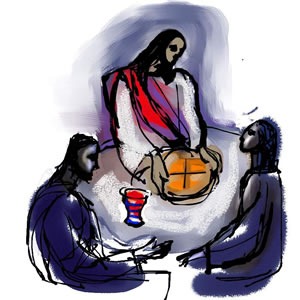
These disciples experienced the realities of the risen Lord at this Sunday evening supper; their eyes were opened and they understood. In Mark’s account, Jesus rebukes his disciples for not believing he’s been raised. But he speaks to them at the meal, he commands and commissions them to preach the good news, and they are empowered to preach “everywhere.” Luke tells us that the disciples look at the wounds in Jesus’ hands and feet during this dinner, they touch the Lord and eat with him, and they confirm that he is indeed not a spirit or a ghost. “Then he opened their minds so they could understand…” (Luke 24:45). Jesus teaches them at the table, commands and commissions them, empowers and reassures them. In the fourth Gospel, after seeing his hands and his side, the disciples “were overjoyed when they saw the Lord” (John 20:20). A very similar Resurrection Day meal experience occurred with the two disciples on the road to Emmaus (Luke24:13-35).

Remember, too, that Thomas was not there for that first post-resurrection meal with the Lord. He missed small groups that night. But he heard about what had happened (John 20:24) and made sure he was present for that next Sunday night (John 20:26). Thomas was there early for that next Sunday gathering. The Cowboys were down by four with six minutes to play, but Thomas still got there early. He pulled up to the driveway at 5:45, ready to go. And, sure enough, as the disciples were eating their meal on that second Sunday, the Lord showed up (John 20:26) and revealed himself to Thomas in the same ways he had opened the eyes of the other disciples the Sunday night before.

So, my question is this: What do you think happened on that third Sunday?

Again, there’s no right or wrong answer. There’s nothing in the Scriptures to tell us what happened on that next Sunday night. But my assumption is that the disciples got together for a meal, expecting to see Jesus. Again. Expecting to eat with Jesus. Again. Anticipating another wonderful dinner with their risen Lord with all the food and drink, fellowship and communion, teachings and commissionings that go with it. And it only makes sense that these dinners would continue every Sunday night with the hope of seeing the Christ. It makes sense that, early on, most disciples had heard the amazing stories about that Resurrection Day meals; they each knew somebody or knew of somebody who had eaten with Jesus on a Sunday after his resurrection. So those Sunday dinners became a very natural way to remember the Lord, to anticipate the Lord’s coming, to celebrate the resurrection of Jesus.

If this is true — nobody has been able to convince me otherwise; in fact, nobody’s even tried — this makes the Lord’s Supper of the early Church a resurrection meal, not a funeral meal. It’s a meal that remembers his resurrection, not his death. It’s a meal that celebrates eternal life, not one that memorializes a temporary demise. Most scholars agree:

“It appears likely that the idea of the Resurrection of Christ was associated, in the minds of the disciples, with the recollection of one or more meals taken with their Master during the period from Easter to Pentecost. And when later these same disciples met to eat together, the recollection of the other meals during which the Risen One appeared to them for the first time must naturally have been very vivid to them. We can now understand why the Christian community in the Apostolic Age celebrated its meals ‘with joy.’ The certainty of the resurrection was the essential religious motive of the primitive Lord’s Supper.” ~Oscar Cullmann, Essays on the Lord’s Supper, 1958.

“The first day of the week, as resurrection day and as the day that Jesus ate with his disciples, became designated as the day when disciples would gather weekly to break bread together.” ~John Mark Hicks, Come to the Table, 2002.

“By eating and drinking with the disciples between Easter and the Ascension, Jesus demonstrates at least three things: he has been raised bodily; he resumes full communion with people who have forsaken him and despaired of the salvation they hoped he would bring; and he equips them to be trustworthy witnesses to his resurrection and to new life, to the life that he has brought to sinners such as they are.” ~Markus Barth, Rediscovering the Lord’s Supper, 1988.

“The promise of Luke 22:16, 18 is fulfilled: Jesus is risen; he is alive and now abides with his people. Therefore, we come to the table in joy, because Jesus is risen. Nowhere is this joy celebrated more appropriately than when believers have fellowship at a meal. Throughout Luke and Acts, meals function as an expression of the joy of the Kingdom of God, where the Lordship of Jesus shines forth in clarity.” ~Allan McNicol, Preparing for the Lord’s Supper, 2007.

We share the Lord’s Supper on Sundays, not Fridays. At the table, our risen Lord joins us and eats with us as we celebrate his resurrection, not his death. We eat and drink with one another and with the Christ with gladness and joy, not sadness and grief. Sunday is resurrection day and the Lord’s Supper is a resurrection meal.

Now, how do we better practice this?

Peace,

Allan

« Older posts Newer posts »