Author: Allan (Page 460 of 493)

Astonishing Faith

“When Jesus heard this, he was astonished and said to those following him, “I tell you the truth, I have not found anyone in Israel with such great faith.” ~Matthew 8:10

You think God’s ever astonished by your faith? You think you’ve ever prayed a prayer to God and, as soon as it’s over, he jumps up and says, “Whoa! We haven’t seen faith like that in years!” And God gets on the intercom system there in heaven and says, “Wow! Y’all won’t believe the faith of this guy down there!”

You think God’s ever been astounded by your great faith?

The kind of faith that astonishes Jesus is a humble and complete dependence on God. And I wonder about our complete dependence. I wonder about mine.

I wonder how much different it was 2000 years ago. When fever was a disease and not a symptom. Before modern medicine, what was it like to pray for healing? When forecasting the weather meant reading the calf liver or Grandpa’s arthritic knees. Before meteorology, what was it like to pray for rain? Before cropdusters and insecticides and fertilizers and refrigerators and Wal-Mart SuperStores, what was it like to pray for food? You know what I mean? Forget 2000 years ago. What about 60 or 70 years ago? What was it like to pray?

As technology changes, does our dependence on God change? Is it that the more we know about our world the less we depend on our God? I’m not sure. But let’s think about it.

Pray for rain? Well, I’ve seen the doppler radar and the skyview atmospheric predictor and the seven-day forecast. It’s going to rain Tuesday. Or, the next chance for precipitation won’t be for another couple of weeks. See. We need God for some things. But we know if it’s supposed to rain or not.

Pray for food? Is there anybody reading this blog who hasn’t eaten today? Anybody who’s not going to eat tomorrow? Is there anyone reading this who doesn’t have every single thing he needs to get through tonight and on in to tomorrow? We depend on God for some things. But there’s milk and meat in the fridge and the pantry’s full and I get paid on Friday.

Pray for healing? But I’ve seen the MRI. We have the X-Rays and the CT-scan. We’ve consulted with the doctors and been to two specialists. We know what’s going to happen. So, I’ll pray for the doctors. God bless the doctors. Help them to do what they can. Help them to find the problem. Help them to cure the disease. Help the surgery to be a success. We’re praying for the middle man! Ever read of anybody in Scripture praying for the middle man? It’s not the middle man! It’s God! God is the one who heals!

Yeah, but again, we’ve seen the test results. We’ve heard the doctors. It doesn’t look good. So we pray for healing and say, “If it’s your will…”

And I know we’re supposed to pray for God’s will. Of course we pray for God’s will. But never when praying for God’s will is our “out” or our excuse when the doctors say there’s not much hope: “If it’s your will…even though I’m not expecting it to be your will because the doctors have already said it’s not.”

I’m just curious. Before the days of X-Rays and MRIs and CT-scans, did we couch our prayers for healing with “if it’s your will”? Were our prayers different when we weren’t sure of the problems and weren’t already certain of the outcome? Was our dependence on God more and our dependence on ourselves and others less back then? Is there a problem?

God says through Isaiah, “I made you. I will carry you. Even to your old age and gray hairs, I am he who will sustain you.”

The Centurion calls Jesus “Lord.” Just say the word, he exclaims, and I know my servant will be healed.

Complete dependence. Total humility. Astonishing faith.

Peace,

Allan

Getting My Goat

CasperWarning to preachers: Be very careful with what you say in the pulpit!

Note to self: Be very, very, very, very, very, very careful with what you say in the pulpit!

One of the many things I love about our church family at Legacy is the sense of humor here. Everyone—especially here in the office—seems to be equally as comfortable on the giving and receiving end of good natured barbs and ribbing. I found myself on the butt end of it this morning. And I’m not certain yet as to the individuals who actually instigated it. But, I’ve got a general idea. And, rest assured, the revenge plotting has begun.

In our push up to Missions Sunday on March 30, we’ve been asking a few of our missionaries to address the assembly the past couple of Sunday mornings. Yesterday I had asked Salvador Cariaga, our main man in Cebu, Philippines, to speak for five or six minutes in the middle of our sermon about being God’s fellow workers. Salvador passionately spoke to us about the preacher-training and the church-planting that’s taking place in the Philippines. And he mentioned that they’re giving goats to the new preachers and to the churches there with the aim of becoming self-sufficient. They can give a preacher there one pregnant female goat and within a few months turn it into a real money-maker. After Salvador sat down and I got back up to finish our sermon, I noticed Jack Roseberry, one of our elders, sitting in the back. And I flippantly said, “Jack, don’t get any ideas. I don’t want a goat.”

I got the obligatory laughter I wanted and proceeded to finish the lesson.

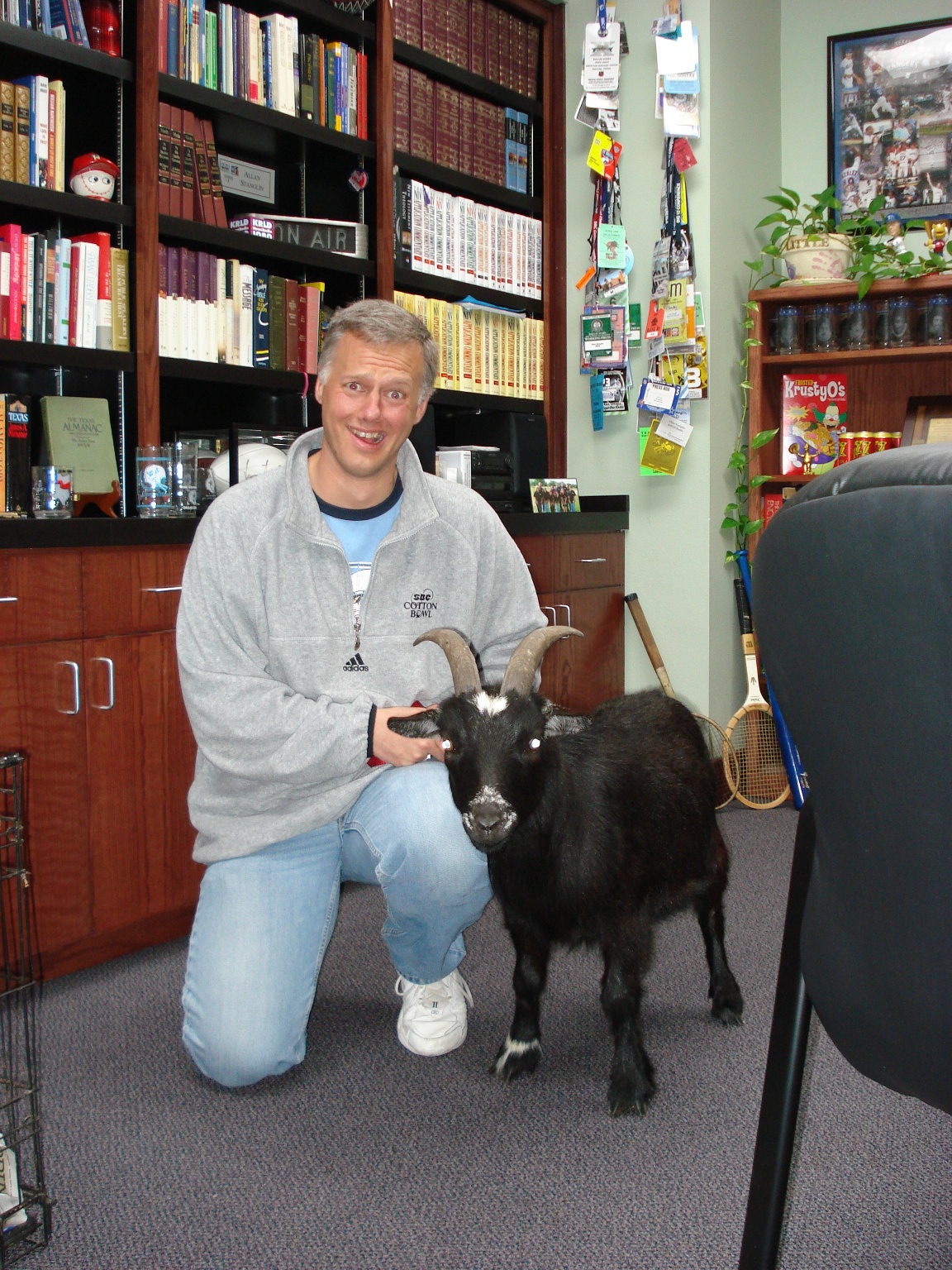
At 11:00 this morning, Jack and Kent and Barbara McAlister and Bette Lowry and John and Betty Royse and Chris Courtney and several others paraded right into the offices with a giant metal cage containing a large goat and a sign that said, “To Allan Stanglin, C/O Legacy Church of Christ, Here’s Your Goat!”

Jack said the goal is to have a self-sufficient preacher.

PokeyEverybody was having their laughs and taking their pictures. I mentioned goat fajitas in connection with our Wednesday night dinners. I threatened to leave it tied up to a tree outside to meet the coyotes later this evening. But I was getting more than a little nervous. They kept telling me it really was my goat. Jack teaches one of our Sunday morning Bible classes and they had taken up a collection following my comments, jumped on line, and found this goat in Azle for about $30. And they kept saying, “It’s a gift. It’s yours. We really did buy it for you.” I don’t even let the secretaries’ dogs come into my office. And now I’ve got this huge goat! And I’m out of candle!

The goat did relieve itself at one point. Thankfully it was on the tile in the kitchen, not on the carpet in my office. Still, I’m sure we’ve violated several health and safety codes.UnsuccessfulHandoff

Carrie-Anne happened to show up to make some copies for school tomorrow. She was less than thrilled with the prospect of loading that thing up in the van and taking it home.

But I couldn’t get anybody to admit that it was all a big joke and that they really had a place for the goat. For 45-minutes this morning I wasn’t 100% sure it wasn’t really my responsibility. I spent most of that time preparing in my mind how I was going to ask Vic Akers to take it for me.

Finally, Barbara confessed that she was taking it back to their place. They had gotten my goat. Figuratively and literally.

Next Sunday I’m telling the congregation I don’t want a new truck.

~~~~~~~~~~~~~~~~~~~~~~~~~~~~~~~~~~~~~~~~~~~~~~~~~~~~~~~~~~~~~~~~~~~~~~~~~~~~~~~~~~~~~~

Regarding yesterday’s sermon, a couple of you have asked for a copy of the passage I read from Eugene Peterson’s Working the Angles. I used a couple of paragraphs from the beginning of his book to describe the Church when, instead of looking at what God is doing in the world and jumping in to join him in that work, we decide what we want to do and ask God to join us. We ask God to bless us in our works even if those works have very little or anything to do with God’s eternal work of salvation.

Written from a Presbyterian point of view, the passage is critical of pastors. In our Church of Christ heritage, I would apply it to preachers and elders and anybody who’s a leader in the Lord’s Body. And I’d apply it seriously. Here it is:

“It is bitterly disappointing to enter a room full of pastors whom you have every reason to expect share the quest and commitments of pastoral work and find within ten minutes that they most definitely do not. They talk of images and statistics. They drop names. They discuss influence and status. Matters of God and the soul and Scripture are not grist for their mills.

The pastors of America have metamorphosed into a company of shopkeepers, and the shops they keep are churches. They are preoccupied with shopkeepers’ concerns—how to keep the customers happy, how to lure customers away from competitors down the street, how to package the good so that the customers will lay out more money.

Some of them are very good shopkeepers. They attract a lot of customers, pull in great sums of money, develop splendid reputations. Yet it is still shopkeeping; religious shopkeeping, to be sure, but shopkeeping all the same. They’re concerned with image and standing, with what they can measure, with what produces successful church-building programs and impressive attendance charts. The marketing strategies of the fast-food franchise occupy the waking minds of these entrepreneurs; while asleep they dream of the kind of success that will get the attention of journalists.”

And the CareerBuilders.com TV commercial I referenced? I used it to illustrate how sometimes the Church can be like the monkeys swinging on the light fixtures; that just because we’re Christians and children of God in a Christian Church that belongs to God doesn’t always necessarily mean we’re doing the work of God. Here’s the commercial I had in mind.

~~~~~~~~~~~~~~~~~~~~~~~~~~~~~~~~~~~~~~~~~~~~~~~~~~~~~~~~~~~~~~~~~~~~~~~~~~~~~~~~~~~~~

Jack, I don’t want a clothing allowance.

~~~~~~~~~~~~~~~~~~~~~~~~~~~~~~~~~~~~~~~~~~~~~~~~~~~~~~~~~~~~~~~~~~~~~~~~~~~~~~~~~~~~~~

PopeI need to reverse a position I took out on the flag football field Saturday morning. Darryn Pope, needing some support and encouragement following the last of his three wide-open drops of certain touchdown tosses, asked if Jesus would have dropped those passes. I immediately said, “Yes. Jesus would have dropped passes. Of course Jesus would have dropped passes. Jesus was human.”

Upon further reflection, I must correct that opinion. Darryn’s drops were so bad they were sinful. And the Scriptures are clear that Jesus was without sin. So, Darryn, no. Sorry. Jesus would never, ever, have dropped those passes.

~~~~~~~~~~~~~~~~~~~~~~~~~~~~~~~~~~~~~~~~~~~~~~~~~~~~~~~~~~~~~~~~~~~~~~~~~~~~~~~~~~~~~~

I’m out tomorrow. Jim Martin, a long-time family friend and the preaching minister at the Crestview Church of Christ in Waco, has invited me to a preacher’s forum at their building all day Tuesday. Jim and I ran into each other a couple of years ago at the Austin Grad Sermon Seminar and promised to keep in touch. His blog, A Place For The God-Hungry, is a weekly source of encouragement to me.

There will be a dozen or so preachers at this event tomorrow. And we’re not really sure what we’re going to do or what’s going to result. I do know it’ll be a time of mutual encouragement, and that’ll be enough for me. Plus, I’ll be the only one there with a goat story.

~~~~~~~~~~~~~~~~~~~~~~~~~~~~~~~~~~~~~~~~~~~~~~~~~~~~~~~~~~~~~~~~~~~~~~~~~~~~~~~~~~~~~

Jack, I don’t want Cowboys season tickets. Or a suite at the Rangers game.

~~~~~~~~~~~~~~~~~~~~~~~~~~~~~~~~~~~~~~~~~~~~~~~~~~~~~~~~~~~~~~~~~~~~~~~~~~~~~~~~~~~~~~

BarelyDrewIronNice free throw, Kidd!

Peace,

Allan

God Bless Texas

TexasIndependenceDay172 years ago Sunday, 48 delegates from the 48 territories of Texas gathered for a convention at Washington-on-the-Brazos to sign a Declaration of Independence. Santa Anna’s Mexican army had over 180 Texans trapped in the Alamo. But with the signing of this document, Texas was on its way to becoming “a free, Sovereign, and independent republic, fully invested with all the rights and attributes which properly belong to independent nations.”

 The Texas Declaration is filled with a lot of the same language found in the United States Declaration of Independence, written 60 years earlier. It contains statements about the function and responsibility of government, passages regarding the rights of human beings, and a list of grievances. The Mexican Constitution of 1824 stands at the crux of the matter:

TheRepublicOf“The Mexican government, by its colonization laws, invited and induced the Anglo-American population of Texas to colonize its wilderness under the pledged faith of a written consitution, that they should continue to enjoy that constitutional liberty and republican government to which they had been habituated in the land of their birth, the United States of America. In this expectation, they have been cruelly disappointed, inasmuch as the Mexican nation has acquiesced in the late changes made in the government by General Antonio Lopez de Santa Anna, who having overturned the constitution of his country, now offers us the cruel alternative, either to abandon our homes, acquired by so many privations, or submit to the most intolerable of all tryanny, the combined despotism of the sword and the priesthood.”

Like the U.S. Declaration, the Texas document stated religious persecution in the list of grievances. Right in the middle of a TexasFlaglist that includes the imprisonment of Stephen F. Austin, the lack of a public education system, no representation in the government, violence against their businesses, and “inciting the merciless savage, with the tomahawk and scalping knife, to massacre the inhabitants of our defenseless frontiers,” the delegates declared worship of God as at least part of their motivation for rebelling against Mexico:

“It (Mexican nation) denies us the right of worshipping the Almighty according to the dictates of our own conscience, by the support of a national religion, calculated to promote the temporal interest of its human functionaries, rather than the glory of the true and living God.”

Finally, the delegates concluded the Declaration with a magnificent charge to freedom:

“We, therefore, the delegates with plenary powers of the people of Texas, in solemn convention assembled, appealing to a candid world for the necessities of our condition, do hereby resolve and declare, that our political connection with the Mexican nation has forever ended, and that the people of Texas do now constitute a free, Sovereign, and independent republic, and are fully invested with all the rights and attributes which properly belong to independent nations; and, conscious of the rectitude of our intentions, we fearlessly and confidently commit the issue to the decision of the Supreme arbiter of the destinies of nations.”

FlyingFlagA wise man once said never ask a man where he’s from. If he’s from Texas, he’ll tell you. If he’s not, there’s no sense in embarassing him.

Happy Texas Independence Day!

Allan

Mashed Potatoes

MashedPotatoesTerry Rush is one of my spiritual heroes. And he probably doesn’t even know it. His passion for the Christ and his compassion for God’s people hit me like a freight train every time I hear him speak, every time we share a quick little two minute conversation or email, both times I’ve sat with him and other preachers in his study at the Memorial Road church in Tulsa, and every single time I read his blog. I want to share with you today something Terry wrote on his blog, Morning Rush,  yesterday regarding the Church of God as a sacrificial Body of believers, a truly selfless family bent on doing this thing together.

Enjoy:

“I may be off an author or two but I think it was Juan Carlos Ortiz who wrote a book in the 70s discussing unity. He pointed out boiled potatoes in one bowl does not equal unity just because they are all together. Mashed potatoes is unity. He went on to explain: boiled ones are still individuals simply at the same location. The mashed are blended in with all others to serve one purpose as a unit.

Boiled? These members are in but not committed. They are in the church for their welfare, but not in it for the sake of the body. There is a thin line which calls for personal examination. Are we in the church for experiencing what makes me happy or to extend the body of Christ to the current and the next generations? Are we in it because our kids like it and need it or because God has burdened our hearts to live for Him? Are we in it to give us something good to do or to show mercy and love to a rude society? Are we boiled or mashed?

If boiled we find it easier to pick up our blankets and toys and find a new picnic. If mashed we find we can’t breathe without the body of Christ…He is our total life. What makes a boiled potato a mashed one? Beaters. Jesus asked us to face the beaters every day…..take up your beaters and follow me….he said, sorta. Each congregation is so much healthier mashed. There is found complete harmony. Only boiled? Oh, we may sit in the same bowl but we aren’t in it for the others. While we may sit together, we are still in this for self.

Take up your beaters. Let us submit to the beatings we take realizing we are simply in the wonderful kingdom process of God growing His people into one selfless body.”

Just 27 more days until the Tulsa Workshop!

Peace,

Allan

Finish Strong

“Keep watch, because you do not know the day or the hour.” ~Matthew 25:13

FinishStrongWe generally focus on the differences between the ten virgins in Jesus’ story in Matthew 25. Afterall, five were wise and five were foolish. Five packed extra oil and five didn’t. But have you ever examined their similarities? Upon close inspection, these ten women are all exactly alike. They’re the same.

They’re all virgins. Completely pure. Unstained. Totally cleansed. All ten virgins are righteous. They’ve all ten been invited by the bridegroom to the feast. There are no party-crashers here. All ten are on the list. They’ve all accepted the invitation. They’re all planning to attend the wedding. They’re all looking forward to the bridegroom’s coming. They all have lamps. They all have oil. They’re all drowsy. They all fall asleep. They’re also completely alike in their knowledge and their ignorance. They all ten know the bridegroom is coming. And they all ten have absolutely no idea when.

So what makes the wise virgins wise and the foolish virgins foolish? The wise girls had prepared for an extended wait. The foolish girls hadn’t even considered that possibility.

Please understand: if the bridegroom had come at 9:30pm instead of midnight, they’d all ten be in. Have you ever considered that? If the bridegroom shows up just a couple of hours earlier, the foolish virgins are in just like the wise. Those five girls were lost when the bridegroom delayed his coming.

It’s all about being steadfast and finishing the race. Jesus had been warning about it all through chapter 24. Verse 13, he who stands firm to the end will be saved. Verse 42, keep watch because you do not know. Verse 44, be ready, because he’ll come when you don’t expect it.

Be ready. Stand firm. Be prepared. Pack the extra oil. Because we don’t know. You might have 20 more years or you might have 20 more minutes. But we’re called as disciples of Christ to live our lives—every moment to the very end—in a continual state of preparedness. Readiness.

What does that look like?

We are ready to meet Jesus when our relationships with God and with others are what they should be. We are ready when, at any moment of our day, whether in the privacy of our own homes, out in public with friends and co-workers, or in the deep recesses of our minds, we are not ashamed to have the Lord meet us. When we’re living the way our God calls us to live, we’re ready. We’re prepared.

It’s a race. It’s a marathon. And the call is to finish it. Finish it. Don’t quit. It doesn’t matter how you start. It doesn’t matter how many times you’ve stumbled. It doesn’t matter that you’re in last place and you’ve been lapped six times. All that matters is that you finish.

The New York Giants started the season 0-2.

“Let us throw off everything that hinders and the sin that so easily entangles, and let us run with perseverance the race marked out for us. Let us fix our eyes on Jesus, the author and perfecter of our faith…so that you will not grow weary and lose heart.” ~Hebrews 12:1-3

Peace,

Allan

Building Faith At Home

Jason and Kipi have been on me for some time to read Mark Holmen’s latest work, Building Faith at Home. The premise of the book is that what we as followers of Jesus do in our homes is much more important to passing on the Christian faith than what we do in our churches. And I believe that with all my heart. Amen. The focus and the attention and the emphasis we place on what we do together during our weekly assemblies is not just overshadowing what parents should be doing with their kids at home, it’s in some ways undermining it. And until we begin again to live our lives of faith in front of our children and with our children, what we’re doing in our churches isn’t really helping. We’re raising generations of kids now—I’d say even people my age and younger, maybe beginning with the first generation to be raised with a Youth Minister—who are sold on church programs and faithful to church activities but who have no real depth of commitment to our God in Christ Jesus.

I believe all that. I see the impact of it everyday. It’s evident in the things we talk about and argue about and the choices we make within our own congregation here at Legacy.

And as I cracked open Building Faith at Home for the first time Saturday night, I was struck by the statistics Holmen uses to back up what we’ve suspected all along.

*Since 1991, the population in the U.S. has grown by 15% but the number of adults who don’t attend church has increased 92%, from 39-million to 75-million.

*In 1990, 86.2% of Americans claimed to be Christian. Today that number is less than 75%. It’s going down by nearly a full percentage point per year. It that trend continues, non-Christians will outnumber Christians in this country by the year 2042.

*Search Institute conducted a survey of more than 11,000 young people from 561 congregations across six different Christian denominations. Keep in mind, these are all church kids! According to their responses: only 12% of youth have a regular dialogue with their mothers on faith issues; only 5% have a regular faith dialogue with their fathers; only 9% of youth experience regular reading of the Bible and devotions at home; and only 12% of youth have ever experienced a faith-based service event with a parent.

*In Transforming Children into Spiritual Champions, George Barna claims “fewer than ten percent of parents who regularly attend church with their kids read the Bible together, pray together (other than at meal times), or participate in an act of service as a family unit. Even fewer families—1 out of every 20—have any type of worship experience together with their kids other than while they are at church.”

It seems that religious life in the home is just about nonexistent. It’s nearly extinct.

And the Church is called to teach our families how to share their faith, how to live their faith, how to exhibit their faith with each other.

I’m only halfway through Holmen’s book. And it’s pretty good. He gives very practical ideas for helping parents and kids grow and mature their faith at home. And I think we can very easily implement a lot of those things here at Legacy. It’s not so much overhauling what we do, it’s just looking at what we do through a different lens. It’ll require only some minor, yet critical, tweaking and adjusting as we encourage families to worship together and study together in their homes.

I especially appreciate Holmen’s emphasis throughout this first part of his book on involving all the different generations in our churches with each other in faith-building exercises. So much, if not most, of what we do as a congregation is segregated by age-group. Bible classes, retreats, fellowships, even our Small Groups are mostly divided along generational lines. And that’s not healthy for anybody. A truly healthy church will be intergenerational almost everywhere. Having young marrieds without children and parents of teenagers and empty-nesters and 85-year-old widows in the same classes and groups and pews and small groups should be the norm, not the exception. So when Holmen mentions baby blessings and involving much more of the whole church family in those ceremonies, I think we can apply baptisms along the same lines, much like what we did with the Dennis grandkids on Sunday. When new members come to the church I’m trying to involve the whole church family in vowing publicly to love them and take care of them and work with them as we follow Jesus. Weddings and funerals, high school and college graduations, anniversaries and other rites of passage should be celebrated by the whole church family together.

But everything we do should be geared toward getting our members to actually live out their faith in their homes with their spouses and kids and cousins and grandchildren.

Read a Bible story to your kids tonight. Pray with your spouse tonight. Plan to do something together as a family that will serve someone else.

Peace,

Allan

« Older posts Newer posts »