Author: Allan (Page 336 of 492)

Listen to Barton Stone

As we review and reflect together on Leroy Garrett’s book, “What Must the Church of Christ Do to Be Saved?” we arrive today at the author’s 17th suggestion for avoiding “obscurantism, obsolescence, and irrelevance” in this increasingly post-denominational, post-Christian world. In order for us to remain a viable voice for Christ, in order to retain any credibility as a faithful witness to his redemption work, Garrett says we must appeal to the wisdom and insights of those who went before us.

Heed the principles set forth by Barton W. Stone.

Alexander Campbell’s group of restoration churches and the restoration churches that followed the teachings of Stone realized fairly early on that they had enough in common by the blood of Christ and by their devotion to our Lord’s plea for the unity of all God’s children that they should join together as one movement. So these Churches of Christ, Christian Churches, and Disciples of Christ Churches — nobody was worried about the actual name of the congregations at this early point — officially came together to worship, to work, and to spread the Good News. It eventually became known as the Stone-Campbell Movement. And it was during this time of coming together, in 1832, in the midst of the drama and trauma of the official union, that Stone wrote his “An Address to the Churches of Christ.” Stone’s purpose in writing this document was to head off at the pass a few problems that were already impacting this infant coalition of congregations. And Garrett says we should look back to that document for wisdom as we deal with our own doctrinal and unity differences today.

Early on in the Address [Stone] warned against unwritten creeds, which he considered more dangerous than written ones. The purpose of both, he noted, “is to exclude from fellowship the man who dissents from them.” He observes that there are those who clamor against (written) creeds and yet have creeds (unwritten) of their own, and they are as intolerant toward those who dissent from their creeds as those who make written creeds are toward their dissenters.

What pain we would have avoided had the wisdom of this pioneer reached our ears. With ne’er a (written) creed in sight we have been creed-makers, and, like Stone said, we have used them to draw lines on each other and to exclude one another from fellowship. We have made creeds of our opinions, whether in reference to theories like millennialism, questions such as marriage and divorce, or methods like instrumental music or Sunday schools. It is of course appropriate for each of us to follow his own conviction in reference to any of these, but it is not all right to make a creed out of them. Creed-making makes parties, whether they be written or unwritten creeds, and that is what lies behind all our divisions.

Garrett points to Stone’s conviction that the gift of God’s Holy Spirit is “the crowning blessing of all blessings” and the most important part of being a Christian. Stone wrote that the gift of the Spirit is “more necessary” than faith, reformation, and immersion. And he did not emphasize the importance of a particular method of baptism. It’s easy enough to admit that both of these ideas seem to fly in the face of where we are now as Churches of Christ. Honestly, we probably under-emphasize the Holy Spirit and over-emphasize the method of baptism.

But that’s probably OK. The point Stone was trying to make then and that Garrett is trying to make now is that Christians may differ on any number of things without dividing. Stone and Campbell managed it quite well for more than two generations.

[Stone] referred to two differences  between their churches at this time, which troubled people on both sides. The Campbell people placed greater emphasis upon immersion for remission of sins than the Stone churches, and the Campbell churches broke bread every first day while the Stone people didn’t.

This diversity of doctrine and practice led Stone to emphasize what had characterized the Movement from the outset: “We who profess to stand upon the Bible alone, and contend that opinions of truth should not be made terms of fellowship — shall we be intolerant towards each other because we may differ in our opinions? Forbid it, Heaven!”

Here Stone is telling us what we must do to be saved. We must cease and desist from making our own interpretation of what we believe to be truth (an opinion, Stone calls it) a test of fellowshipo. And he says this includes such matters as the design of baptism and the frequency of the Lord’s Supper.

Stone went on to say what should be proclaimed in every Church of Christ in the land today: “If you think your brother in error, labor in the spirit of love and meekness to convince him; but imposing zeal against him will only harden him against any good impression you would make. It will probably stir up strife and ultimately destroy love, the bond of union.”

We must repent of our ugly, sectarian past and resolve to follow Stone’s  advice when he went on to say in his Address to us, the Churches of Christ: “A little longer forbearance with each others’ weakness, and truth will triumph!”

I would personally point to Romans 14:1-15:7 here to remind you of the Biblical foundation for everything Stone wrote on the matter of differing opinions and unity and everything Garrett writes against imposing on other Christians the lines we draw for ourselves. But there’s no need. You already know what the passage says, right?

Peace,

Allan

Recover the Small Groups Dynamic

Most baseball experts and historians today are debating the place in baseball lore of Josh Hamilton’s Tuesday night in Baltimore. The Rangers slugger hit four home runs against the O’s last night, drove in eight runs, hit for a total of 18 bases, and mixed in a double for good measure. He went five-for-five with no outs as Texas racked up its 20th win of the year and reclaimed the best record in the major leagues. Sports Illustrated’s Cliff Corcoran has written an excellent article that details Josh’s night and compares it with every other four homerun performance in baseball history. Click here to read Corcoran’s case for Hamilton’s heroics to be classified as the second best hitter’s night ever.

~~~~~~~~~~~~~

In the 16th chapter of Leroy Garrett’s “What Must the Church of Christ Do to Be Saved?” he presses for more imagination, more risk, more innovation, more change in the way we are the Church. He complains, perhaps a bit too harshly, about our “boring, lifeless, gloomy” worship assemblies and, by implication, blames our declining numbers on our lack of joy and excitement. By pointing right at our Sunday assemblies right at the beginning of the chapter, Garrett probably causes the reader to focus on the wrong thing and actually miss his main point. I think Garrett’s main objective is to encourage joyful and exciting shifts in the ways we are church, not in the ways we do worship services. Although, the two paragraphs following his initial indictment certainly speak to all of our church life, not just what we do together on Sunday mornings:

At the heart of our problem is that we are caught in the trappings of our own institutionalism — or churchism might be the word. We have expensive edifices to pay for and to maintain, staffs to support, programs to fund. Our Achilles heel is the System. The System resists change, except occasional cosmetic change. Nothing real or substantial. The System demands conformity, and it is uneasy with thinking people around, especially a thinking preacher or a preacher that says something.

The System must maintain the status quo, and it must preserve itself at all cost. This is why it seeks to keep everyone satisfied by reacting rather than acting. And most significantly, the System is tied to the building. Regular church attendance, along with generous giving, is the essence of “faithfulness.”

This brings me to the one thing above most everything else that we must do to be saved. We must recover — or is it discover? — the great lost secret of primitive Christianity. That secret was the dynamic of joyous, Spirit-filled gatherings in homes.

Garrett is definitely speaking my language when he’s talking small groups.

If our salvation is tied directly to the Holy Spirit working in our lives to transform us more and more into the image of Christ — and it is! — churches should be in the business of teaching this transformation. This imitating Christ and becoming more like Christ should drive everything we do as a church. We should be all about planning the settings and fostering the atmospheres for this transformation to more easily and quickly take place. Where in your church do you and other members become more like Jesus? What program or setting in your church encourages self-sacrifice, considering the needs of others more important than your own, true community and fellowship, compassion and love and service? Which program or setting fosters Christian family where honesty and transparency are the norm and where burdens are shared? Which setting communicates accountability to one another, mutual responsibilities to one another, where we all rejoice and mourn with one another as equal members of the Lord’s Body? Which program more accurately reflects the gospel image of one people around the one table, fellowshiping with one another and with our Lord? It’s our small groups!

This kind of relationship and fellowship doesn’t happen in our ordered Sunday morning worship assemblies where, for the most part, we sit in neat rows and stare at the backs of each other’s heads while focusing our attention on one screen or one speaker. There’s more fellowship happening when you pass a hot dog to a stranger at a baseball game than when you pass the blood of Jesus to your brother in Christ at most Sunday morning gatherings. It doesn’t happen in our Bible classes either, not like it happens in smaller groups in our homes.

I’ll never get to know you — to really know you — if I never share a meal with you or spend time with you in your home. It’s in your home where I read the cartoons on your refrigerator and see the pictures of your children in the hall. You’ll never be completely honest with me and I’ll never be totally transparent with you until we get to know and trust one another. I can pray for you in Bible class when you add your name to the list. But I can’t really bear your burdens for you — with you — until I experience them with you together in our homes.

There’s more freedom to be spontaneous in our living rooms where the order of worship isn’t printed and distributed beforehand and the PowerPoint slides aren’t already in order. There’s more opportunity for Christian hospitality and serving one another where meals are shared and chores are assigned and kids are corralled. There’s more time for true testimony, more allowance for joyful laughter and even making fun of ourselves, and more room for tough questions and even periods of doubt.

These small groups are also ideal for friendship evangelism. Outsiders can often be introduced to spiritual things in the informal atmosphere of a private home rather than in a church setting. The joy and spontaneity of the home gatherings can also transfer to some degree to the public assemblies if only we will be less rigid. When are services are revved up and there is “a sweet spirit that fills this place” we will be more inclined to share it with others. Who wants to invite a friend to a boring service?

I’m a huge believer in regular small groups. I think our small groups do more for actual Christian transformation than our Sunday morning worship assemblies and our Bible classes combined. Yes, small groups are hard. They’re time-consuming. They’re energy-draining. They require a pouring out of oneself for the sake of others. Small groups demand personal sacrifice for the benefit of the whole. They call for commitment; they command sharing; they impose honesty and accountability. Small groups demand that we model compassion, that we forgive, and that we love. Does that sound like a Savior you know?

Peace,

Allan

Discover the Good News

We’re exploring chapter by chapter Leroy Garrett’s “What Must the Church of Christ Do to Be Saved?”  In our increasingly post-denominational, post-Christian world, Garrett writes that we must make some significant changes if we are to remain a truly viable tool for God. The fifteenth of those suggestions is to center and focus our preaching and teaching and living on salvation from God in Christ, not on church ordinances and church histories and church rules.

Discover the Good in the Good News

Garrett points to the New Testament sermons of Peter and Paul and observes that they were centered on Christ and him crucified. They were all about God’s grace and his free gift of eternal life in the risen Jesus. New Testament sermons are about God’s great love as it’s revealed in the life, death, and resurrection of his Holy Son. That’s the Gospel! That’s the Good News! Jesus died for the sins of the world to redeem the world back into a righteous relationship with God!

Garrett says it’s wrong to preach sermons about baptism for seven straight nights and then call it a Gospel Meeting. But that’s what we’ve done.

Recent studies by some of our own scholars reveal that there has not been much good news in what we have called “gospel preaching.” In a 1988 article in the Gospel Advocate, F. W. Mattox explains that Church of Christ preachers have left it to “denominational preachers” to preach grace, faith, and the atonement while they “went about straightening out their misunderstandings of the place, action, and order of faith, repentance, and baptism in obtaining church membership.” Mattox notes that while others preached the atonement of Christ but not baptism, we preached baptism but not the atonement of Christ.

Garrett cites a study conducted by Bill Love in which Restoration Movement sermons from the early 1800s through the 1950s were analyzed for content. Compared to the 33 sermons found in the New Testament in which all 33 centered on the atoning death and resurrection of Jesus, our own Church of Christ sermons are embarrassingly weak. Love found the cross and empty tomb mentioned in only 25-percent of the hundreds of sermons he studied.

According to Love, 56% of the sermons during the Stone and Campbell generation contained the Gospel. But that number falls to 23% during the G. C. Brewer and Foy Wallace era. In the first two generations, before the Churches of Christ became a separate group, preachers referred to the cross an average of 52% of the time. Since then, the rate falls to 25%. Love’s conclusion is that “our focus moved from Christ crucified to his church, a subtle but destructive shift. Once our sickness took hold, we grew weaker and weaker, more and more anemic. Without the gospel, we lost the source of our faith.”

Yes, I’m afraid we have been guilty of diligently studying the Scriptures and believing that by them we have eternal life. At some point, sooner not later, we need to start preaching and teaching again that salvation is not found in the Bible, it’s found in the One to whom the Bible points. Forgiveness and reconciliation and eternal life are not found in the church, but in the One the church worships and serves. We’ve been guilty of maintaining a religion when we should have been maintaining a relationship with the Savior of the world.

More to Garrett’s point, he closes this chapter by claiming there are two “gospels” we can preach:

We can tell the world it is lost and must repent to be saved. Or we can tell the world what the Bible says, that just as in Adam all died so in Christ are all made alive, that all people are saved, so one only needs to accept the free gift. We can look at the world and say every one is lost except those the Bible says will be saved, or we can look at the world and say every one is saved except those the Bible says will be lost. Which is good news: You are lost, therefore repent; or You are saved, won’t you accept it?

The Church of Christ has had it backwards and has consequently preached bad news. We have preached that every one is lost, while the Bible teaches that every one is saved. Every one is saved except those who refuse the free gift.

Let’s preach the glorious good news. God has saved you through Christ, taking away all your sins. Won’t you accept it through faith and baptism?

Peace,

Allan

I Been Hyp-NO-tized!

Moving our oldest daughter to a new city and a new high school two weeks before the start of her senior year was the most difficult of many difficult parts of our decision to relocate our preaching ministry to Amarillo. We agonized over that part of it. We prayed about it and discussed at length the dozens of pros and cons. We were told the Huddles here at Central would help.

As it turns out, the Huddle leaders for this senior class, Jason and Kasey Love, have been a gracious answer to our prayers.

Jason and Kasey contacted us the week it was announced that we were moving to Amarillo to talk to us about Whitney. Within a week of our arrival here, Carrie-Anne and I were eating lunch with Jason and Kasey at Jorge’s. They promised us they would welcome Whitney into this already well-established group with open arms. And they did. Whitney spent every Wednesday night and countless Sunday afternoons at Jason and Kasey’s. Praying and singing with these twelve other seniors; playing and laughing, eating and sharing, watching movies and decorating brooms, studying and growing together in the name and the manner of our Lord. Jason and Kasey loved Whitney like they had known her for ten years. And, certainly because of their great leadership, the other kids in the group did, too.

Taylor and Barrett trash talked sports with her. Alyssa and Kristel cared for her. They all treated Whitney like one of their own. And before too long, she was.

It meant so much to her mom and me to listen to Whitney during our Senior Sunday ceremonies yesterday here at Central thanking her youth ministers, thanking her fellow classmates, thanking other individuals in our church family for loving her and supporting her in this transition. She thanked us, too. But her words for Adam and Missy and Tanner and Jason and Kasey seemed to matter more. It meant so much for Kasey to meet Whitney at the podium, to hug her like she did, to grab her hand, and speak those precious words of blessing to our first born. It meant the world for Kasey to read those jewels from Psalm 9 to my daughter in front of our whole church family:

“The Lord is a refuge for the oppressed,
a stronghold in times of trouble.
Those who know your name will trust in you,
for you, Lord, have never forsaken those who seek you.”

Thank you, Jason and Kasey, for the love you gave to Whitney. Thank you for sharing your house and your food and your sweet kids with our daughter. Thank you for pouring your lives into her, for selflessly giving your time and energy to her, for showing her what it looks like to consider the needs of others more important than your own. Thank you for being that answer to a parent’s prayers for his girl.

~~~~~~~~~~~~~~~~~~

Last night’s Senior Banquet was the perfect ending to a wonderful day. As is the tradition here at Central, each senior’s family decorates that honoree’s table for the dinner. So, Carrie-Anne and Valerie went all out with an over-the-top Texas Rangers theme complete with Rangers balloons, Rangers pennants, Rangers plates and napkins, and Rangers tickets for placecards. There were baseballs in a vase and boxes of Cracker Jack at our table, bags of peanuts and popcorn, little miniature apple pies, and even two bowls of Carrie-Anne’s famous Oreo balls decorated like baseballs. Thanks to Greg, we didn’t take any of the Oreo balls home.

What a night! We took such delight in meeting and getting to know everybody’s parents and grandparents and close friends. All of the tables were decorated magnificently. The brisket dinner was delicious. The service provided by the high school Juniors and their parents was excellent. The slide show was hilarious (and informative). And the entertainment was a roar.

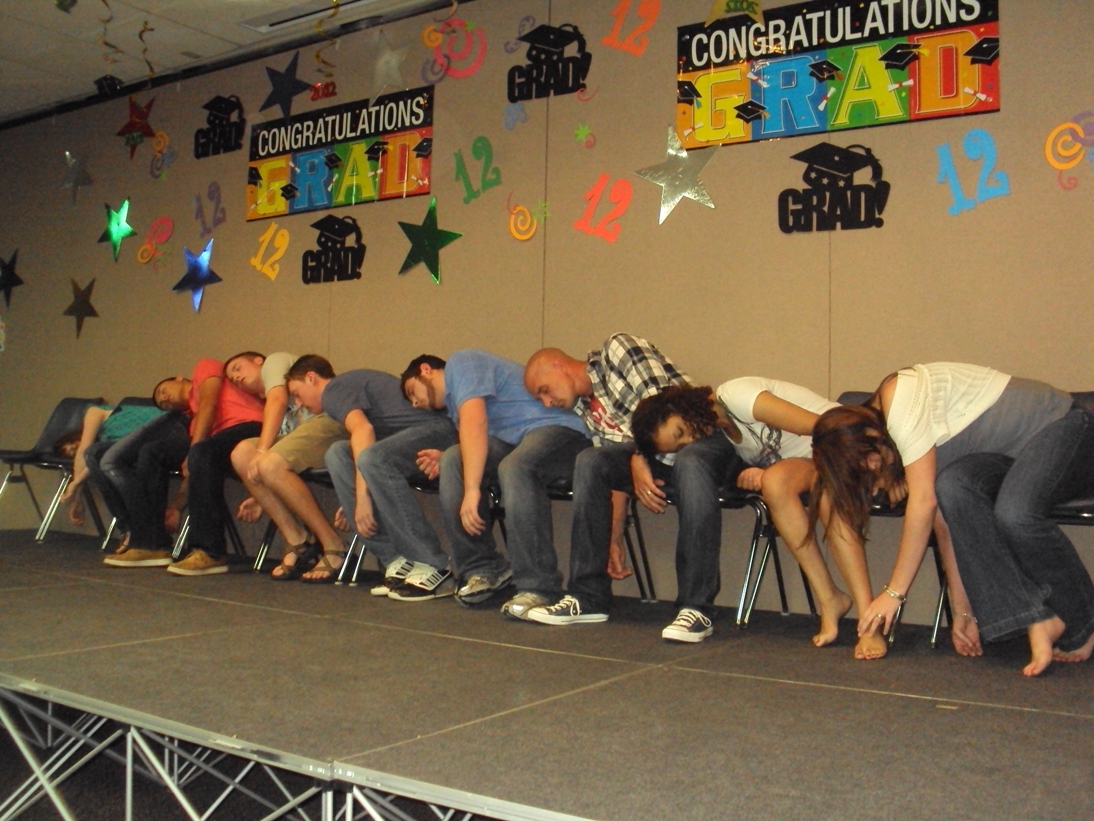
The hired hypnotist cast his spell on Jason and Kasey and six of our seniors. And for almost two hours they entertained us in ways that they can’t ever understand, even after they watch all the video. Corbin falling flat on the floor before the hypnotist was even two minutes into his act. Barrett prancing around a little too naturally as Lady GaGa. Taylor milking that imaginary cow like there was no tomorrow. Jason almost breaking through the stage while he “played the drums.” Kasey forgetting her own name. Aaren jumping out of her chair. It was unforgettably funny and indescribably strange. My head ached from trying to figure it out while my stomach and my face hurt from laughing so hard.

Thank you to Tanner and Adam and Elaine and all the parents and volunteers who gave the Central seniors and their families an incredible day. We’re so blessed to be here with you. So very blessed.

Peace,

Allan

Senior Moment

Tomorrow is Senior Day at Central. My fifth one as a preacher. My first as a dad of one of the Seniors. Everything we do together as a church family will carry some added significance because Whitney’s baby pictures will be in the slide show. Whitney’s words will be in the video. The shepherds will hand our Whitney a new Bible and then pray for her. It’ll have some additional impact for me, Whitney’s dad.

Let’s not forget that you don’t have to be a mom or a dad or a grandparent of one of the Seniors for it to be special. It’s special because Whitney is your kid, too. In fact, all thirteen of our Central Seniors belong to you. And to me.

As a body of believers, as a family of God, our Senior Sunday is one of the ways we publicly acknowledge God’s proprietership, his ownership, of our kids. Our children should be taught that they belong to God. We should treat them like they belong to God. Because they do.

The Church, God’s community of faith, is built child by child. The Kingdom of God is established child by child. Our children are precious and priceless treasures. And the Son of God tells us he doesn’t want one — not one! — to be lost. With that in mind, we teach our children. We encourage and challenge, love and support our children.

At the Central Church of Christ, we’re raising kids. We’re not raising immaculate buildings and well-oiled programs. We’re not raising perfect worship services and effective curricula. Not money. Not comfort levels. Not statistics. We’re raising kids. We’re passing our faith to the children our Lord has entrusted to us. We’re shaping them through a context of love and grace, encouragement and respect.

As our thirteen high school Seniors prepare to graduate and rapidly move on to the next chapters of their young lives, it is imperative that we, their community of faith in Christ, be there tomorrow to encourage them. It’s important that we show them by our actions that we really mean what we say with our mouths.

When Jesus sent out his apostles, he did so with much cheering and encouraging. “You can do it!” he said. “Get out there and be great! Go out there and turn the world upside down! Go boldly and change everything!”

“And remember, you didn’t choose me; I chose you!”

God has chosen these thirteen. He has gifted them and chosen them to represent him and his Kingdom wherever they go. He’s ordained them as his children to partner with him in redeeming the world. He really believes in them. Let’s make sure we’re all present and focused tomorrow to show our high school Seniors that we believe in them, too.

Peace,

Allan

Stand in the Grace of God

We’re working through Leroy Garrett’s book “What Must the Church of Christ Do to Be Saved?” We’re losing members and congregations at a steady rate in this country. Some would say we’re losing, or have already lost, a great deal of credibility. As a denomination (just wanted to see if you’re paying attention) there are some changes we need to make if we’re going to remain a viable partner in the Kingdom of God. Garrett’s fourteenth suggestion is a call for all our congregations to not just believe in the grace of God, but act on it. Live it!

Stand in the grace of God.

Every member of the Church of Christ believes in the grace of God. They would all readily acknowledge that we are saved by the grace of God and not by our own works. No one among us has the slightest interest in minimizing the significance of the grace of God. However, we must stand in the grace of God, and not simply believe in it. The Church of Christ has a head knowledge of grace, but at the gut level it does not, generally, know the grace of God. It is like living in a house wired for electricity and not being plugged into the power. This is why we’re not going anywhere, we’re not plugged in.

When we consider what grace does for people, we do not appear to have “seen the grace of God,” to quote Acts 11:23, even though we believe it is around. Grace makes believers more and more like Christ, but we are not known for our Christlikeness. Grace causes them to exult in their blessings, filling them with joy, good humor, and laughter; but we are not known for those qualities. Grace makes people gracious, less critical, more tolerant and more accepting; but is this where we are? Grace is never what one deserves, but is this what we have emphasized? Grace is God’s free gift, unconditionally bestowed, no strings attached; but haven’t we attached strings?

By now you’ve noticed a couple of fairly prominent themes in Garrett’s writings: Christian unity and grace. Our misunderstandings and misapplications of both have certainly stunted our growth as a Christian movement and greatly stifled our salvation impact in God’s world.

We have such a hard time realizing that God’s gift of grace is absolutely free, that it’s completely undeserved and totally unearned. We have traditionally understood the grace of God as his gift that makes up the difference as, or after, we travel the road to eternal life. We do the good works, we pray the right prayers, we worship in the correct manner, we get baptized by the proper method, we set everything up in our churches according to the Scriptural pattern, and God’s grace closes the gap to get us to heaven. We have lived by a “God helps those who help themselves” mentality, which, by the way, goes wholly counter to everything we read in the Bible. Scripture makes it clear that “God helps those who can’t do a crying thing for themselves.” But we don’t accept that. Or, at least, we’re not living like we do.

The proper view of God’s grace will, as Garrett observes, transform us into a more Christ-like people. We will act more like our Father when we finally realize what our Father has done for us. Jesus says we are to love one another as God has loved us. That means loving one another even when everybody around you is at their most unlovable. Our Lord tells us to forgive as God forgave us. That means forgiving everybody of everything. Everybody. Everything. Forgive. Forgive. Forgive. And Scripture says we are to accept one another as God in Christ accepted us. That means we accept each other — yes, we accept all other Christians; those within and those outside our Churches of Christ — who don’t have every single thing completely figured out.

Jesus told the parable about the servant who was forgiven by his master of his great debt and then refused to forgive a fellow servant of his tiny debt, abusing that fellow servant and throwing him in jail. And we’ve been guilty of the same thing. We’ve imagined grace as something that covers us in our sins, but not in our Scriptural interpretations and doctrinal understandings. Grace covers us for things we might do out in the world, but it’s not enough to take care of us if we get something wrong in the Church. We’re not totally saved; we’re just barely saved, maybe. And everybody else is in a lot more trouble than we are!

I hold to the principle of lex orandi, lex credendi: the way we worship is the way we believe. If we view our Father as a tight fisted tyrant who’s keeping track of every single misstep, as a God who’s looking to judge and condemn, as a Lord who delights in watching us sweat it out, then that’s how we’re going to behave, too. If we view him that way and worship him that way, looking over our shoulders to make sure we’re doing everything exactly right so we can get to heaven, we’re going to treat other people the way we think God is treating us. That is not Good News. It’s not salvation.

When we “stand” in the grace of God, trusting in his goodness and mercy, then love, joy, and peace will flood our hearts. We will then be a more gracious people, magnanimous, full of life and enthusiasm, eager to praise God for his great mercy. We will take ourselves less seriously and be able to laugh at our foibles. We will not be so uptight, we’ll quit worrying, be less critical of others, more accepting, more forgiving.

Peace,

Allan

« Older posts Newer posts »