Author: Allan (Page 194 of 492)

Undefeated

First Place Texas Rangers.

I have only a few more hours to write those four words together in  the same sentence. As of this posting, Texas is undefeated and in first place. But they open up the season against the World Champion Astros at 2:30 this afternoon.

My assumption is that whether Cole Hamels has a great outing today or not, the Astros will outscore the Rangers and the tone will be set for another 90-loss season. While Houston and the rest of the A.L. West were adding Gold Glovers and Silver Sluggers to their lineups over the winter, the Rangers were signing Bartolo Colon and Tim Lincecum. Seriously! Bartolo Colon is 85-years-old and 340-pounds and he’s our number two starter! Lincecum hasn’t thrown a good major league pitch in three years. He made one minor league start for us and wound up on the DL with that bad hip.

It’s going to be a long, hard season.

But today is Opening Day. It’s baseball time in Texas. And a bad day at the ballpark is better than a good day almost anywhere else.

Peace,

Allan

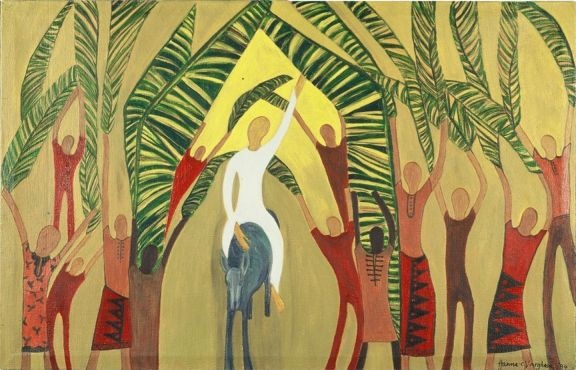
On a Donkey

“See, your King comes to you, gentle and riding on a donkey.” ~Matthew 19:5

In some ways, and maybe in ways we don’t fully understand, we act like Jesus is going to serve our national or political or economic hopes and dreams. We wave our palm branches and behave like Jesus has come to establish a really great worldly kingdom that reflects all my beliefs and convictions.

Several years ago a gay lobbyist in the Presbyterian church  was fighting for the ordination of gay priests. And this was his main argument: Jesus loved everyone and today he would stand with the gay community, affirming its rights in society and the church; anyone who does not stand with us stands against Jesus.

My blood boils when I hear stuff like that: the use of a political movement or a political agenda to judge another’s discipleship to Jesus. Now, it’s really easy to use that illustration and condemn it as a sinful misuse of the name of our Lord and the Kingdom of God. But can we consider for just a minute how we might do the same things?

All Christians have to vote Republican because Jesus is against the gay marriage position of the Democrats.
All Christians have to vote Democrat because Jesus is against the war policies of the Republicans.
No, the Church has to support Republicans because of Jesus’ teachings on the abortion issue.
No, the Church has to support Democrats because of Jesus’ teachings on the gap between the rich and poor.

If we’re going to think and talk like this, we may as well pull the palm branches out and start waving them. This kind of thinking and acting and talking forces God’s people to choose between the lesser of two worldly evils. Jesus did not come so we could create a better version of the kingdom of the world, he came so we could be part of an entirely new and eternal Kingdom of God. Jesus is not a way for us to get our way nationally or politically or socially or economically. He won’t be used that way.

The Holy One who comes to Jerusalem comes as the King of the entire world and he suffers and dies for all people. His people are not tied to any one nation. His love and salvation reaches beyond all borders of nation and language, culture and race.

Jesus is not going to be President of the USA. One, he’s not running. Two, you wouldn’t vote for him if he did.

Think about Jesus’ platform. Sell all that you have and give to the poor. Love your enemies. If Jesus had bumper stickers on the back of his donkey, they would say, “Be Last!” “Vote for Me and Die!”

Jesus doesn’t come with T-shirts and stickers and buttons and a hundred million dollar campaign. He doesn’t save the world with armies and markets and policies. He saves the world through sacrificial love and suffering and service and grace.

He rules with a towel, not a sword.

And when we finally decide to follow him, we find ourselves descending to greatness. It’s a Kingdom of downward mobility, where those who give up their lives find them. Where the last are first. Where those who die, live forever.

Peace,

Allan

Core Scripture

Our elders and ministers here at Central have carefully and prayerfully selected ten passages of Scripture we believe are core passages, foundational words that are intended by God to shape us. These are Bible passages that speak to the nature of our God and his work for us in Jesus Christ. They declare the truth of the Gospel. They remind us how to live in light of that Good News. They help us keep The Story straight.

And they form us.

These are formational passages that, when they get inside us, when they become a part of who we are, will shape us more into the image of God’s Son.

We’re going to read these passages each Sunday, week after week. We want to hear them again and again when we’re together. We want these verses to be familiar, to be highly valued, to be embedded deep into our souls.

We’re not going to be afraid of repetition; in fact, we’re going to embrace it. We want to be shaped into a certain kind of people. Forming Gospel habits works. Repetition works. Here are the passages:

Deuteronomy 6:4-9
Philippians 2:1-11
1 John 4:7-12
Mark 8:34-38
Exodus 34:5-7b
Colossians 3:12-15
Romans 8:28, 31b-35, 37-39
Revelation 21:1-7
Micah 6:6-8
Ephesians 3:14-21

May God bless the reading of his Word.

Peace,

Allan

Back to Chicago

I feel the tears well up inside my eyes when I walk into my room after dinner. It’s Sunday night. The evening meal is over. The introductions have concluded. And it’s about to get real. I know my duplicitous life and my sins and I’m going to have to say out loud to our God why I’m here.

I had the same feeling during the evening prayers with the larger group. I can’t read the first couple of prayers through the tears. The candle. The liturgy. The knowledge that I must face our Lord. Will he receive me? Does he still want me? Will he accept me and work on me?

I’ve been made to acknowledge the burdens I carry. I’ve also been made to recognize my fears heading into this retreat and this two-year commitment. Out loud. I’ve named them. Here we go.

So I pour myself into the process. I give it my all. I’m journaling in my room, but realizing ten minutes into the exercise that I’m writing only about the things my three companions and I have experienced together on the trip. Lunch at the Lucky Monk. Something funny Mike said. Something weird on the plane. I’m probably stalling, avoiding the hard work God would rather be doing in me. I’m praying Psalm 32 and Psalm 100. I’m doing what I’m supposed to be doing. But I can’t get still.

Until Monday afternoon in the chapel. Thank you, Lord.

A little over an hour by myself in that beautiful chapel and God revealed to me why I’m here. He gave me a peace, he washed me in a comfort, he blessed me by reminding me that I belong to him and he loves me deeply and he wants to change me. He wants me to live in him and rely on him alone.

Heal me. Fix me, Father. Give me peace in my ministry. Give me peace with myself as a minister of the Gospel. Reconcile all the spiritual and existential issues between my head and my heart. Heal me, Lord. Fix me.

Unsurprisingly, since my first Transforming Community retreat in Chicago, my life with Christ has been up-and-down. I’ve engaged / revived a couple of new practices and begun a couple of new rhythms to help me maintain some semblance of what I experienced in Chicago. Those exercises are keeping me aware of the presence of God throughout the day. And it’s good. But I feel I have a long way to go. I always have.

I know that I need continual transformation in my life. I know I need to pay constant attention to it. I also know that I cannot transform myself. Only God by his grace and the power of his Spirit can make me into the man of the Lord he wants me to be. And I welcome it. I’m committed to making space for it.

I’m reading all the books, I’m making the retreats, I’m writing the papers, and doing all the assignments with the view that God is hard at work on me. Some of this is going to stretch me, some of this will make me uncomfortable, but I’m convinced that God has been preparing me for years for this experience.

He’ll talk to me if I’ll just listen. He’ll heal me if I’ll just sit still. He’ll transform me if I’ll just trust.

See you Wednesday.

Peace,

Allan

Expressing the Gospel

If the table is the place to experience the real presence of Christ and the real fellowship and community we have together with God’s people — if the purpose of communion is, well, communion — then the way we do it matters. The form of the Lord’s Meal serves the function. In fact, I’ll suggest the form is the function. In many ways, the medium is the message.

You wouldn’t raise money to fight the sexual exploitation of women by having a car wash at Hooter’s. You can’t hold a Weight Watcher’s meeting at Furr’s Cafeteria. We don’t ask people to pay for Financial Peace University with a credit card. That defeats the purpose. The form matters.

That’s what’s wrong with the Lord’s Supper in Corinth. That’s what the apostle Paul is so concerned about: the form, the way they were eating the meal. The form of their meal was working against the purpose of the meal. In fact, Paul tells these Christians, the way you’re eating it, it’s not the Lord’s Supper at all.

“When you come together, it is not the Lord’s Supper you eat, for each one eats his own supper without waiting for anyone else.” ~1 Corinthians 11:20-21

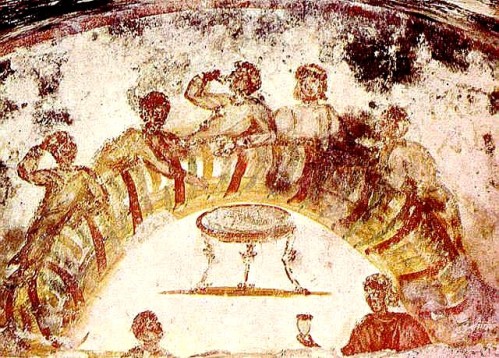
It’s important to remember that the Church’s Lord’s Supper started out as a full meal. For almost the first 300-years, the Lord’s Supper was a potluck. The Greek word “dipenon” is translated as dinner, feast, meal, banquet, main meal. It most commonly refers to the main evening meal. And, according to Paul, if the church eats the meal one way, it’s the Lord’s Supper; if you eat it another way, it’s your own supper.

So, what’s the problem Paul’s trying to correct? What are these Christians doing wrong?

“When you come together, it is not the Lord’s Supper you eat, for each one eats his own supper without waiting for anyone else. One remains hungry, another gets drunk. Don’t you have homes to eat and drink in? Or do you despise the Church of God and humiliate those who have nothing? What shall I say to you? Shall I praise you for this? Certainly not!” ~1 Corinthians 11:20-22

The problem at this church was the breakdown of community during the Lord’s Supper. You’re not waiting for others, you’re not sharing your food with others, people are going hungry, people are being humiliated. The rich Christians are getting stuffed and drunk while the poor Christians are starving and being singled out as not belonging. People are going back for seconds before others have been through the line once. They’re saving seats. Members are on one side of the room and visitors are on the other. New members are eating by themselves. Division. Selfishness.

Even if they had no idea what the Lord’s Supper is all about, common courtesy demands they refrain from getting stuffed and drunk while their brothers and sisters are hungry. But their meal was being shaped by culture instead of Christ. The Gospel is all about breaking down barriers and uniting together in holy community. Only thinking about yourself, only worrying about your own needs at the Lord’s Supper denies the Gospel the Lord’s Supper is intended to demonstrate. Paul says it makes a mockery of God’s Church.

So, that’s the problem. What’s the corrective? How does he fix it? By pointing to Jesus. He reminds them of Jesus.

“For I received from the Lord what I also passed on to you: The Lord Jesus, on the night he was betrayed, took bread, and when he had given thanks, he broke it and said, ‘This is my body, which is for you; do this in remembrance of me.’ In the same way, after supper he took the cup, saying, ‘This cup is the new covenant in my blood; do this, whenever you drink it, in remembrance of me.’  ~1 Corinthians 11:23-25

The table is shaped by the salvation work of Jesus. The Church’s Meal reflects and demonstrates the Gospel values of sacrifice and service. The Lord’s Supper expresses the way of Jesus: selflessness, giving to others, considering the needs of others more important than our own.

“For whenever you eat this bread and drink this cup, you proclaim the Lord’s death until he comes.” ~1 Corinthians 11:26

The Lord’s death broke down all the barriers between us and God and between us and each other. The Lord’s death unites all God’s people together. Around the table on Sundays and anytime we eat and drink together in his name, we’re proclaiming and practicing all the salvation things Jesus died for. The meal proclaims everything that was accomplished at the cross: acceptance, fellowship, unity, forgiveness, peace, love.

And when Paul uses the term “Lord” and when he says “until he comes,” he’s reminding us that Jesus is alive and he’s coming back! And until he comes, we express and experience the realities of our salvation with him and one another in holy community around his table. How we eat the Lord’s Supper matters.

Peace,

Allan

Experiencing the Gospel

Some of us say the communion meal is the most important part of our Sunday assemblies. That’s the whole reason we come together. In fact, some people leave church right after the Lord’s Supper: the crumb, the sip, we’re good, I’m gone! Our actions betray us: We take communion to the hospitals and preside over a lady in a wheelchair breaking a cracker while three men stand by and watch. Our language betrays us: We say we offer the Lord’s Supper on Sunday nights or in our small groups to people “who need it.”

The Lord’s Supper is not a binding duty or a mechanical ritual. It’s not a box to check or a magic pill to swallow. It’s about love and unity and fellowship.

We’ve done everything we can to mess it up. For several centuries now the Church has gone to great lengths to make the meal as private and personal and individual as possible. The joyful communal meal of the early Church has become a crumb of cracker and a sip of juice in quiet, somber, introspective, individual bubbles: “Don’t distract me!” We’ve removed ourselves from the transforming character of the meal.

If the Gospel is that by the death and resurrection of Jesus we can be totally forgiven of our sins and be completely cleansed and pure and can come right into the very presence of God; if the Good News is that we can have a holy and righteous relationship with God and one another; if the Gospel is that we are united with Christ and united with one another in Christ, where do we experience that? How does that become real for us? How do we feel it and know it’s true?

At the table. We experience the Gospel at the table.

Let’s remember our big picture understandings of the communion meal. The Lord’s Supper is eating and drinking a celebration meal with God. Remember, that’s God’s goal. That’s what God is after, it’s what all of salvation history is about: God eating and drinking with us. Because sharing a meal together means there’s relationship. You’ve got things in common. No barriers. There’s acceptance and understanding and trust and friendship around the table. When we’re all dipping our chips into the same bowl of salsa, all the walls are down. There’s community. That’s what God wants with us.

What makes the communion meal a sacrament is that by God’s Holy Spirit, we actually are participating in the reality it represents. We are literally eating with Jesus. Somehow, mysteriously, he meets us at the table and eats with us. All of us.

The table is where we experience what it means to be saved. The oneness, the forgiveness, the community, the relationship, the unity, the acceptance, the fellowship, the common ground. The blood of Christ is what makes us righteous and clean. And the Bible says in 1 Corinthians 10 that when we drink the cup together, we participate in those benefits. Eating the bread together is a communion or a sharing in the unity we have in Christ. We are the body of Christ together. And we experience that around our Lord’s Table.

The people of Israel eat the sacrifices and so receive the benefits of forgiveness and community that’s achieved at the altar. We eat the meal and receive the gifts of forgiveness and community that are achieved at the cross.

By faith, our baptisms make us one people in Christ. No divisions, no differences, no distinctions — we are one body in Christ. And we experience that around the table. The peace, the reconciliation, the community with God and one another.

You want to feel like you really belong? You sit down to a meal with your family.

Peace,

Allan

« Older posts Newer posts »