Page 328 of 493

A Matter of Life and Death

(Commenting on this post automatically enters you into the drawing for all the books we’re giving away in conjunction with this blog’s upcoming 1,000th article. Scroll way down to the posts on September 20 and 21 for details.)

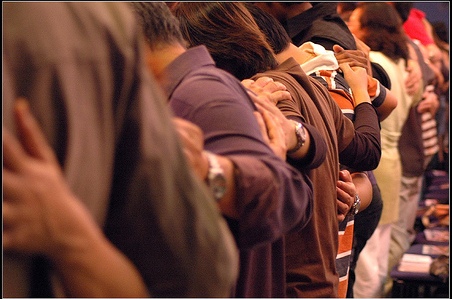
While studying this week for our sermon on obedience to Christ’s commands (John 15:10-14, “Obey My Commands”), I’ve come across the text of a sermon from Ephesians 5:21ff preached by William Willimon on the topic of submission. While discussing how the world has subtly attacked the Christian doctrine of submission and declared war on our lives of obedience, Willimon speaks about the importance of our Sunday morning worship gatherings. He calls our worship assemblies “a matter of life and death.”

A couple of years ago, I was invited to preach in the congregation where a friend of mine serves. The congregation is located in the heart of one of our great cities. The congregation is entirely black people who live in the tenement houses in that part of the city. I arrived at eleven o’clock, expecting to participate in about an hour of worship. But I did not rise to preach until nearly twelve-thirty. There were hymns and gospel songs, a great deal of speaking, hand-clapping, singing. We did not have the benediction until nearly one-fifteen. I was exhausted.

“Why do black people stay in church so long?” I asked my friend as we went out to lunch. “Our worship never lasts much over an hour.”

He smiled. Then he explained, “Unemployment runs nearly 50 percent here. For our youth, the unemployment rate is much higher. That means that, when our people go about during the week, everything they see, everything they hear tells them, ‘You are a failure. You are nobody. You are nothing because you do not have a good job, you do not have a fine car, you have no money.’

“So I must gather them here, once a week, and get their heads straight. I get them together, here, in the church, and through the hymns, the prayers, the preaching say, ‘That is a lie. You are somebody. You are royalty! God has bought you with a price and he loves you as his Chosen People!’

“It takes me so long to get them straight because the world perverts them so terribly.”

Paganism is the air we breathe in this current world; consumerism is the water we drink; individualism and imperialism are the oxymoronic values that shape us. These things capture us, they convert our kids, they subvert us Christians. We live in a hostile place for discipleship. That’s what makes our congregations, our communities of faith, and our appointed times of corporate worship, a matter of life and death.

We must regularly speak together about God in a world that lives as if there is no God. We must talk to one another as beloved brothers and sisters in a world which encourages us to live as strangers. We must pray to God to give us what we can’t have by our own efforts in a world that teaches us we are self-sufficient and all-powerful. What we do together on Sundays matters a great deal.

Peace,

Allan

Love Trumps All

(Posting a comment on this blog still qualifies you for the books to be given away later this month. Just click on the “comments” line in the upper right hand corner of the post. Scroll down — way down — to the September 20 & 21 posts for more details on the drawing.)

We spend a lot of our time and energy in God’s Church, it seems, on things that don’t really matter at all. Special meetings are called in the church foyer and around the church library conference table to discuss and decide critical matters of corporate worship and important points of Christian doctrine and pressing items regarding belief and/or practice and/or politics. We spend a lot of time and energy on all that. Way too much time and energy.

We spend a lot of our time and energy in God’s Church, it seems, complaining about things that don’t really matter at all. Concerned members question the order of service, worried ministers dispute the makeup of a committee, discontented congregants accuse others of straying from the path, uneasy elders lament the fading away of old leadership structures. We spend a lot of time and energy on that. Way too much time and energy.

We level charges and voice complaints, we fire off emails and whisper in the halls. There’s way too much of this going on in Christ’s Body. Too much.

We’ve lost our focus on Christ’s command, our Lord’s singular command, the most important command that outweighs them all.

“Love each other as I have loved you.”

While attempting to settle disputes between Christian brothers and sisters over gender issues and economic segregation and spiritual snobbery, the apostle Paul tells the Corinthian church that love trumps everything. Everything!

In 1 Corinthians 13, Paul makes it crystal clear that love is the question and the answer; it’s the beginning and the end; it’s the end-all, be-all to everything that might possibly harm or divide the community of faith.

All the preaching, all the prophesying, all the giving, all the good works are worthless — they have absolutely no value — if there’s not any love. Love is more important than faith. Love is more important than hope. I don’t know if we’ve ever really read that the way Paul wrote it. Love is more important than Christian faith. Seriously.

So, if love is really more important than faith and hope, if love is really more important than good preaching and good works — and it is — then love is more important than everything. Love trumps our worship assemblies and our worship styles. Love is bigger than our business meetings and church budgets. Love is more critical to life in Christ than any of our rules or doctrines. Love is bigger and more important than any issue that could ever possibly divide us.

And, if that’s true, why aren’t we as committed to loving each other as we are to our doctrines and practices?

We must place unconditional, God-ordained love in the supreme position of our hearts and minds in God’s Church. All our time and energy, all our strength and resources, should go first and forever toward loving each other. Then, as has been my experience and as is the teachings of our Lord, all that other stuff takes care of itself. Love trumps all.

Peace,

Allan

Devoted in Love

(Commenting on this or any post since September 20 will automatically enter you into the drawing for the books to be given away in conjunction with this blog’s upcoming 1,000th post. See the September 20 and September 21 posts for details.)

“Love must be sincere. Hate what is evil; cling to what is good. Be devoted to one another in brotherly love.” ~Romans 12:9-10

Sincere love is difficult. Devotion based on brotherly love isn’t easy. It demands that we detest what is evil in our friend’s lifestyle or attitudes. We “love the sinner but hate the sin.” Our love for the person committing the wrong is real, not pretended in any way; but in sincere love we must abhor the evil that can only cause him or her harm.

God’s love is like that.

God loves us so much that he accepts us just the way we are; but he loves us too much to let us stay that way.

God certainly loves us without any phoniness and with total acceptance, but he cannot stand anything in us that is contrary to his will. Our Father is continuously working to purge the evil from us and transform us by the renewing of our minds into the image of his great Son.

And we see and relate to our Christian brothers and sisters the same way. We would never watch our brother drink a glass full of deadly poison while we casually sip an iced tea. We would knock the cup out of his hands to save him. We would not allow a friend to step into the path of an on-coming bus while we stayed safely on the sidewalk. We would push or drag her out of harm’s way. Even though our brother might not understand at the time or our friend might think we’re meddling. Sincere love — loving devotion — means sincerely caring and acting for their eternal interests.

It means making the phone call. It means doing the lunch. It means having that talk you’ve been meaning to have for months. It won’t be easy. But it’s a vital part of living together in Christ’s community.

Peace,

Allan

The Least Important Person

(Commenting on this post automatically enters you into the drawing for the books to be given away in conjunction with this blog’s upcoming 1,000 post. Check out the details a few posts back.)

“My command is this: Love each other as I have loved you.” ~John 15:12
“This is my command: Love each other.” ~John 15:17

What distinguishes the love of Christ and marks the love of all disciples of Jesus is the willingness — no, the eagerness! — to condescend to meet the needs of others. Those being transformed by the Spirit into the image of our Savior are those who consistently imitate him by considering the needs of others more important than their own. They consider others better than themselves. They seek the interests of others ahead of their own. They are the ones who make themselves less important in order to show compassion to those around them.

Our Lord gave us the illustration for such an attitude. When he washed his followers’ feet around the dinner table on that last night, he provided the perfect example of sacrificial love. He showed them “the full extent of his love” and then commanded them to “do as I have done for you.”

What’s astounding is that Christ Jesus, the Holy One of Israel, the promised Messiah and Savior of the World, stooped down to make himself the least important person in the room.

“You call me ‘Teacher’ and ‘Lord,’ and rightly so, for that is what I am. Now that I, your Lord and Teacher, have washed your feet, you should wash one another’s feet.” ~John13:13-14

There is no job beneath our dignity, there is no task beneath our pay grade, there is no calling that is under our position or status. Would it shock everybody in your office if they saw you taking out the trash? Would it be a huge surprise to your wife if she heard you loading the dishwasher? Would your neighbors gasp in disbelief if you swept up all the gunk in the alleys around everybody’s dumpsters? Would your children faint if you turned off your TV show to play a game with them? In the manner of our Lord, we are commanded to stoop, to condescend, to continually seek new ways to become the least important person in the room.

~~~~~~~~~~~~~~~~~~~

 Now that the NFL lockout of the regular referees is over, we can look back and laugh at the miscues and botched calls, the uncertainties and the chaos that was life with replacements. We can giggle at the punny headlines of the past three days such as “FAIL MARY!” and “The Inaccurate Reception.” The funniest line I heard was on ESPN when on Tuesday one of the studio hosts noted that Russell Wilson was the first quarterback in history to throw a game-winning interception. The lockout provided plenty of fodder for late night talk show hosts and editorial cartoonists.

The greater tragedy during the past three weeks, though, has been overlooked. Something far worse has occured in the NFL that’s been overshadowed by the referee lockout and ignored by the national media. It’s brought untold shame and ridicule to a once proud franchise and threatens to undermine the integrity of the entire league. I’m talking, of course, about Jerry Wayne’s new Papa John’s pizza commercial in which the owner of the Cowboys actually raps!

Words can’s describe the embarrassment I felt for the Cowboys, the NFL, the city of Dallas, and the whole great state of Texas upon seeing this commercial for the first time Monday night. It’s humiliating. Jethro rapping and rhyming and shucking and jiving right there in bold HD, jumping up and down stadium staircases, gesturing awkwardly with his hands, striking hilariously defiant poses, selling pizza and Pepsi. That’s the owner and general manager of the Cowboys.

“Yo! It lights me up like a roman candle! Toppings and flavor almost too good to handle!”

Note to Roger Goodell: now that you’ve got the regular refs back to work, please assess some fines and penalties against Jerry Wayne for actions detrimental to the league.

Peace,

Allan

Our Living God

(Posting a comment on this article automatically enters you into the drawing for the books to be given away in conjunction with this blog’s upcoming 1,000th post. See the details in a couple of posts back.)

“It is a violation of our rationalistic orientation to imagine the living God.” ~Walter Brueggemann, at the ACU Summit

God is forever changing. He is always surprising, always shocking. Always doing what we least expect at the very moment we think we’ve got him figured out. And we don’t like that. I think if we’re honest, we have to admit that, at the very least, we’re not comfortable with it. We like to think we know what God thinks and what he’s going to do in every circumstance. We like to think that if we study the Bible enough and talk about God enough and pray to him enough, we’ll know him. And knowing him, we mean having him figured out.

Good luck with that.

Our God changes his mind. Our God changes himself. Our holy Father repents and recants. He wrestles with his own feelings and emotions and goes back and forth all the time.

No?

Walter Brueggemann reminded us last week in Abilene that our God cut off his covenant people in Hosea (“You are not my people, and I am not your God” Hosea 1:9) and then after declaring all the ways they had sinned and all the ways he was going to abandon them, he changes his mind (“I will say to those called ‘Not my people,’ ‘You are my people’; and they will say, ‘You are my God'” Hosea 2:23).

Following the Golden Calf incident, God promises to destroy his people. He tells Moses he’s going to start all over. He promises. Then, Moses talks him out of it. Moses presents a logical argument — what will the nations say? they’ll call you a weak and/or evil God! — and the Lord says, “Yeah, you’re right.” And he changes his mind. He forgives their sins and renews the covenant.

Over and over again in the prophets, God is said to “repent,” the Hebrew word shuv. He changes his mind. Jeremiah couldn’t be more clear that our God acts and reacts, he promises and then goes back on his promises, in response to current circumstances. He responds to the cries of his people. He’s moved by the plight of his children.

“If at any time I announce that a nation or kingdom is to be uprooted, torn down and destroyed, and if that nation I warned repents of its evil, then I will relent (repent) and not inflict on it the disaster I had planned. And if at another time I announce that a nation or kingdom is to be built up and planted, and if it does evil in my sight and does not obey me, then I will reconsider (repent) the good I had intended to do for it” (Jeremiah 18:7-10).

Our God is a free agent. He is a living, moving, active God with a free will to do as he pleases. And we can’t always figure him out. He doesn’t have to answer to us or our finite ideas about him. There’s no way for us to get a firm handle on him. He says as much to Moses: “I will have mercy on whom I will have mercy, I will have compassion on whom I will have compassion” (Exodus 33:19). Forget about trying to understand it. You can’t.

Thankfully, God has revealed his eternal glory to us, his everlasting nature. He is a kind and compassionate God, slow to anger, abounding in love and faithfulness, forgiving sin… (Exodus 34:6-7) Moses and the prophets all appeal to this creedal statement when they’re attempting to change God’s mind or when they’re seeking comfort and confidence in the middle of horrible circumstances. But the other part of that statement, “Yet he does not leave the guilty unpunished; he punishes the children and their children for the sin of the fathers to the third and fourth generation” (Exodus 34:7) gives us the problem. God’s going to do his thing in his own time. And it’s nearly always a surprise.

I think we need to embrace the hard-to-pin-down characteristics of our Father. I believe we should be shaped by the knowledge that our God is always changing his mind. The idea of a God who never changes will set us up for bitter disappointment when that God allows something to happen or causes something to happen that doesn’t fit with our hard and fast theological suppositions about him. What do we do then? And if God never changes, doesn’t that lead us to believe that we, too, should never change? If God never changes throughout all eternity, that might validate the life of a Christian who never changes. Some Christians never grow. They never change their minds. You know Christians like this; you may be a Christian like this. I’ve heard some Christians actually brag that they’ve never changed their minds about anything in Scripture. It’s all so clear to them — their understanding of God, their knowledge of his will and his ways, their church practices and Christian convictions — that changing their minds about anything has become a sign of weakness or of little faith.

Our God is changing his mind all the time. He’s open to it. He doesn’t apologize for it. We can deny it, we can be afraid of it, or we can embrace it as part of a real and dynamic relationship with a real and dynamic Father in Heaven.

Peace,

Allan

Love Completed

(Posting a comment on this article automatically enters you into the drawing for the books to be given away in conjunction with this blog’s upcoming 1,000th post. See the past couple of posts for details.)

“My command is this: Love each other as I have loved you.” ~John 15:12

Jesus doesn’t say I’ll love you if you treat me right or I’ll love you if you straighten up. Jesus’ love isn’t conditioned by right behavior or a good performance. It’s not based on anybody’s I.Q. or money or skin color or clothes or bloodline or reputation. Jesus’ love says I’ll die for you while you’re my enemy. I’ll serve you while you’re still a sinner. I’ll give my life for you while you only look after yourself.

I’ll do this, Jesus says, because I love you so much. But that’s not where this love of Christ ends.

This love that starts with the Creator of Heaven and Earth flows to his Son, the Holy One of Israel. Jesus then takes that love and showers it on us. And he tells us to receive his divine love in order to show it to one another. This heavenly love is completed, it’s fulfilled, only when we give it to others. God’s love was never, ever intended to be finished in merely saving you.

“Whoever lives in love lives in God, and God in him. In this way, love is made complete among us.” ~1 John 4:16-17

We are the last link in this cosmic chain. This love of God in Christ finishes its course through his people. This is why we sacrifice for one another. We serve each other and consider the needs of others more important than our own. This is the reason we die to ourselves and for one another every day.

God’s love is not finished, it’s not accomplished all, until we take seriously this singular command of our Lord: Love each other. This love of Christ that we receive and selflessly pass on proves that we are children of God. It brings eternal glory to our Father. And it changes the world.

Peace,

Allan

« Older posts Newer posts »