Page 318 of 497

Declaration and Address

“Yu Are Kidding Me!”

Go ahead and submit your best Skip Bayless headline for last night’s near-no-no-perfecto for Rangers pitcher Yu Darvish. He was unbelievable in Houston last night, coming within one out from only the second perfect game in franchise history. In the months leading up to Yu’s major league debut last season, we were all told that he had command of five different pitches. It seemed like hyperbole back then. Last night, it was reality. Yu did whatever he wanted to last night, mixing 94-mph heaters and 76-mph breakers with curves and sliders and another weird off-speed thing I’m not sure what to call. The Astros didn’t have a chance. Yu fanned fourteen, he was only hit hard twice that I saw, and he showed almost no emotion or effort in the process. He was cruising with just one out to go — two down, bottom of the ninth — when the Astros number nine batter in the lineup, a shortstop who spells his first name wrong, smashed the first pitch right back through the five hole. Base hit. Ruined the perfect game. Ruined the no-hitter. Darvish came within two inches of blocking the liner between his legs, but the bid for perfection was over.

Darvish is good. Oh, my word, he’s good and he’s fun to watch. He’ll be on again this coming Sunday night on national TV against Josh Hamilton and the Halos. He may never get that close again to a no-hitter. Or he may wind up throwing three or four in his career; right now he looks that good. Either way, just like last night, if and when it happens, Whitney and I will be hanging together on every pitch.

~~~~~~~~~~~~~~

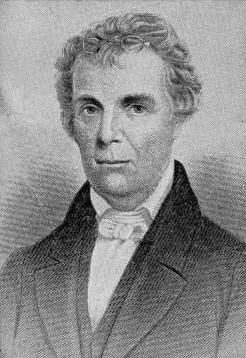
Our Sunday morning adult Bible classes here at Central are discussing Holloway and Foster’s “Renewing God’s People: A Concise History of Churches of Christ.” Chapter four introduces us to Thomas and Alexander Campbell, a father and son team of Scottish Presbyterian ministers who sailed to America in 1807-1809 with hopes of restoring God’s Church. Like Barton Stone, they longed for Christian unity. They despised denominational labels and divisive creeds. They viewed the different Christian sects as abominations and affronts to the true Gospel of Christ.

Upon arriving in Pennsylvania, Thomas was assigned to preach at a church in the western part of the state and promptly got in trouble with the board for allowing Presbyterians of every stripe to participate in communion. Old Light Presbyterian, New Light Presbyterian, Anti-Burgher Presbyterian, Seceder Presbyterian — it didn’t matter to Campbell. He opened up communion to everybody at his church and wound up being forced out by the synod.
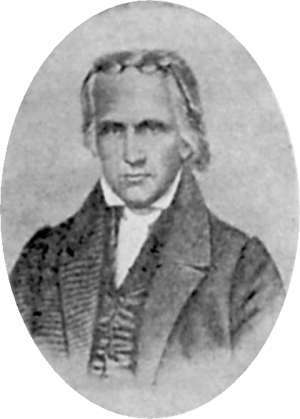
Campbell began an inter-denominational Bible study group that grew into what they called the Christian Association of Washington, Pennsylvania. They were committed to Christian unity, to renouncing all man-made creeds and following the Bible only, and to abolishing all distinctions between denominations. In 1809, the group commissioned Campbell to write a document outlining the purpose of their organization and its plan for unity among all Christians. So he penned the Declaration and Address, the most widely known of our Church of Christ founding documents.

Doug Foster has re-written the document’s thirteen propositions into today’s contemporary English, which makes navigating the text a little easier. You can find it by clicking here.

It would be really easy to write a different blog post for each of the thirteen statements. They are that rich, that good. I may do that someday. For our purposes today, allow me to hit just a few highlights.

Definition of God’s Church -Proposition One attempts to lay the ground rules for determining who’s in and who’s out. According to this opening idea, the Church is made up of everyone “who has faith in Christ and is trying to follow him in the ways God’s Spirit in scripture has told us, and who others can see are being transformed into his likeness by the way they act.” Notice, there are only two or three requirements Campbell says are necessary to being considered a member of Jesus’ Church. If one puts his faith for salvation in God through Christ, is actively submitting to the Lordship of Jesus and following him, and is obviously bearing Holy Spirit fruit, he’s in! Proposition Eight restates the idea in a little different wording, reminding that “having an understanding of every Christian truth is not a requirement to be a Christian, a part of God’s Church… All a person needs to know to be a part of Christ’s Church is that they are lost and that salvation is through Christ. When they confess that they believe in Christ and that they want to obey him fully according to his word — nothing else can be required.” Similarly, Proposition Nine identifies brothers and sisters in Christ as those who “confess belief in Christ and commit to obey him and who show the reality of their commitments by the way they live.”

Christian Unity – Proposition Two admits that it’s impossible for all Christians all over the world to physically worship and serve together, so there have to be local groups of disciples in a variety of different cultures and contexts. “These groups will not all look think, or act alike,” Campbell writes, “yet they are all part of Christ’s Church and ought to recognize it. They must accept and embrace each other just as Christ has accepted each one of us.” How do you achieve Christian unity? How do you bring people together who don’t believe or practice their Christianity exactly alike? Campbell says by obeying the “Rule of Christ.” These Christians from different backgrounds, in different places, with different ideas and practices should be “willing to give themselves for those Christ died to redeem.”

Against Division – The strongest language in the Declaration and Address comes in Proposition Ten which prohibits the dividing of Christ’s Church into denominations: “Division among Christians is a sickening evil, filled with many evils. It is anti-Christian because it destroys the visible unity of the Body of Christ. It is as if Christ were cutting off parts of himself and throwing them away from the rest of his body! What a ludicrous picture! Division is anti-scriptural, since Christ himself specifically prohibited it, making it a direct violation of Christ’s will. It is anti-natural, because it makes Christians condemn, hate, and oppose one another — people who are actually obligated in the strongest way to love each other as sisters and brothers, just like Christ loved them. In other words, division repudiates everything Christianity is supposed to stand for.” The following proposition claims that divisions and corruptions in the church are a result of neglect or a misunderstanding of God’s will that we have the mind of Christ and be transformed into his holy image. A secondary reason is that some Christians assume they are right in their beliefs and practices and try to “impose their conclusions on others as terms of recognition and fellowship.”

Interpreting the Bible – Another major theme running through the Declaration and Address is the correct way to read and interpret the Bible. Campbell upholds both the Old and New Testaments as essential parts of God’s holy Word and the only authority over God’s Church. Therefore, Proposition Three maintains “nothing should be required to recognize, fellowship, embrace, work, worship, and be fully and visibly united with all Christians that is not specifically made a requirement by God in the Word.” But he makes it very clear that, as a friend of mine once said, “The Bible is not a cook book of recipes, it’s a description of a great feast.” In Proposition Four, Campbell states that the “Bible is not primarily a constitution that functions as a legal document to consult in legal disputes. It is, instead, the sword of the Spirit; it is a place where we encounter God’s Spirit and are transformed increasingly into the likeness of Christ.” So, “The Bible does not spell out in detail everything Christians are supposed to think, do, or be — that is just not the nature of Scripture,” according to Proposition Five. “When there are specific actions Christians are told to take, there is almost never a set of detailed requirements for how to do it.”

It’s a powerful document. Strong. Rich. Inspiring. The American Restoration Movement, of which Churches of Christ are a part, is founded on this document. I hope someday to have a really nice copy of these thirteen propositions, in their original 19th century language, framed and on display in a prominent place in our church building. We need to be reading these things. We need to be compelled all over again by the same passions for Christian unity for the sake of the world that drove our ancestors. We need to repent of the evil divisions among Christian denominations that have proclaimed a most anti-Christian message to the world for centuries. We need to pray for a revived interest in the unity of all disciples for the everlasting purposes of the Kingdom of God. And we need to work — man, we need to work — to sacrifice and serve, to accept and forgive, to tear down walls and break down barriers between us so the world will finally see that our Prince of Peace really is who he claims to be.

Peace,

Allan
Easter Again

Yesterday was Easter and, yeah, it was a great day here at Central. Tammi Carter submitted to the Lordship of Jesus by participating in his death, burial, and resurrection in baptism. It reminded each of us of our own Christian baptisms and our own resurrections. Our kids showed us the hand motions to “Lord, I Lift Your Name on High” with great energy and enthusiasm, reminding us how blessed we are to be in a church family with five full generations. Kevin’s choir — ranging in age from Morgan and Hannah to Bob and Vernon — expressed our faith powerfully. There were 860 of us in the worship center singing songs together about  eternal life in Christ Jesus. We read from the Scriptures that proclaim the truth of his resurrection. We celebrated this new life together around our risen Lord’s table.

Yesterday was Easter and, yeah, it was a great day here at Central.

But today is also resurrection day for followers of Jesus. So is tomorrow. And the day after that. See, Easter impacts every one of us from here on out. Every day. We are all living resurrection lives. We are all guaranteed to be raised with Christ on that last day. So we are all empowered by those promises to live boldly and courageously for Jesus. Every day. Because of the Resurrection, we can take bolder risks in evangelizing our neighborhoods. We can take bolder risks in ministering to the homeless and hungry, bolder risks in loving our enemies and forgiving those who hurt us. Because of the Resurrection, we can take bolder risks in protecting the helpless and defending the weak.

The Resurrection of Jesus compels us to say ‘yes’ to bigger Gospel dreams and to say ‘no’ to the status quo. The Resurrection shakes us and moves us to say ‘yes’ to bolder Gospel actions and to say ‘no’ to maintaining the same old thing. We can risk anything and give up everything in denying self and sacrificing self, knowing that the salvation of the world and the salvation of my body and soul is in the powerful and loving hands of our God who promises and delivers the Resurrection!

~~~~~~~~~~~~~~~~

My great friend David Byrnes texted me during the first inning of last night’s Rangers-Astros opener: “Quite literally minutes after my bracket breathed its last, the Rangers season started. There’s an Easter analogy in there somewhere.”

About six innings later, he texted back: “Of course, the analogy isn’t as effective without a ‘W.’ And it cannot involve Lyle Lovett in any way.”

Yuk. It looked like the Rangers were just going through the motions in a meaningless exhibition game last night, not snorting fire to atone for last season’s collapse by ripping apart the Double-A Astros. Good gravy. Matt Harrison got roughed up pretty good by a team that’s lost more than a hundred games in each of the past two seasons and has a combined payroll of slightly less than half of Tony Romo’s guaranteed money. The offense couldn’t get on base. The defense was booting balls all over the field. The only guy who looked to be in mid-season form was Derek Lowe who entered with the Rangers clawing back to cut the deficit to 4-2 and immediately gave up a three-run homer to a former pitcher.

The Rangers play the Lastros 18 times this season. The winner of the AL West will be the team that beats Houston 15 times. Tuesday night is a “must-win.”

~~~~~~~~~~~~~~~~~~

It’s come down to two people in our office tournament brackets here at the church. If Syracuse wins their next two games and takes the national championship, then George is our overall winner. If anything else happens — anything else at all — then Allyson enjoys her one shining moment as our staff bracket champ.

As for the last place lunch, it has already been decided. Despite Gail’s blank spaces and her prediction that Gonzaga would beat Gonzaga to advance to the Final Four and then receive a ‘bye’ to reach the title game, Connie has locked up the lowest point total. Connie! I know! It’s remarkable, really, that Connie correctly picked 18 of the first 32 games and then only picked six more right the rest of the way. She didn’t land a single team in the Elite Eight, but she has landed another free lunch.

Peace,

Allan

Sunday

“Brothers, I can tell you confidently that the patriarch David died and was buried, and his tomb is here to this day. But he was a prophet and knew that God had promised him on oath that he would place one of his descendants on his throne. Seeing what was ahead, he spoke of the resurrection of the Christ, that he was not abandoned to the grave, nor did his body see decay. God has raised this Jesus to life, and we are all witnesses of the fact. Exalted to the right hand of God, he has received from the Father the promised Holy Spirit and has poured out what you now see and hear…

Therefore, let all Israel be assured of this: God has made this Jesus, whom you crucified, both Lord and Christ!”

~Acts 2:29-36

May God’s people today proclaim and rejoice in the earth-shattering, history-altering, mind-blowing truth of the Resurrection.

Peace,

Allan

Let Us Walk Through the Door

I’ve been in a really confessional mood this week. So indulge me one more time: I’ve almost got this Sunday’s sermon finished, and it’s not that great.

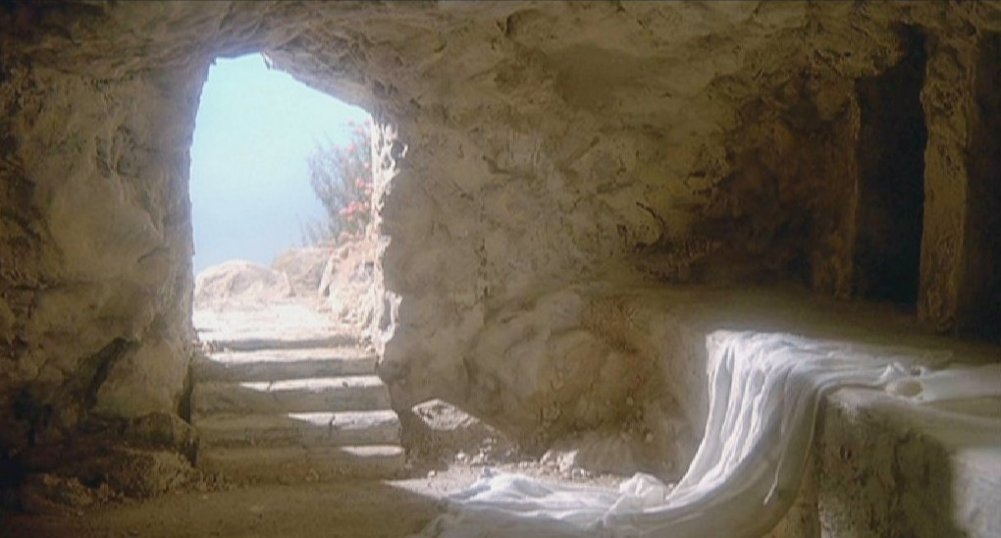
The Easter sermon is the hardest one to write. It’s nearly impossible. And I struggle with it every year. It’s not for lack of effort. I began planning this year’s Easter sermon way back in the fall when Bill Humble was taking us through the seven churches of Asia on Wednesday nights. He used racks and racks of pictures and slides from his numerous trips to those ancient sites to capture our imaginations as he taught us. And it occurred to me then that, if I showed you pictures from my tour of the traditional site of Jesus’ tomb in Jerusalem, I could stir you to experience the thrill of the Resurrection that I experienced. But it’s not working like I thought it would. The pictures are great. They’re spectacular. Powerful. But my words… my words are not enough. Not even close.

Reinhold Niebuhr is quoted as saying that he would always attend a “high” church on Easter Sunday where there would be great music but very little preaching. In his estimation, “No preacher is up to the task on Easter.” I think he’s probably right.

John Updike’s poem “Seven Stanzas at Easter” beautifully and perfectly identifies the cause of every preacher’s frustration leading up to Resurrection Sunday. One of the lines is: “Let us not mock God with metaphor, / analogy, sidestepping transcendence… / let us walk through the door.”

Yes, it is a waste of time to try to explain the Resurrection. Some things can’t be reduced to an explanation and are greatly diminished in the process of trying. The task on Easter is proclamation, not explanation. On Easter, the preacher should only offer an invitation to “walk through the door” into a brand new world where the ultimate reality isn’t death, but everlasting life in the One who brought our Lord out of the grave. Accept it in all of its mystery and wonder. Rejoice in the powerful love and gracious blessing we experience at the empty tomb. Proclaim the Resurrection, don’t explain it. Proclaim it. That’s what the apostles did. And that’s what I’ll attempt to do this Sunday.

Peace,

Allan

Pray More and Dispute Less

Last week’s Tulsa Workshop (excellent, as always!) has put me a little behind on tracking in this space with our adult Bible classes here at Central as we study together “Renewing God’s People.” I’ll try to get caught up here before the weekend hits.

Chapter three of Doug Foster’s concise history of the Churches of Christ, Renewing God’s People, introduces us to Barton W. Stone, a co-founder of what has been called by historians the Stone-Campbell Movement or the American Restoration Movement. Stone was a college-educated Presbyterian minister who, in August 1801, participated with other Presbyterian, Baptist, and Methodist preachers in the largest and most famous camp meeting revival in American history. The success of the Cane Ridge Revival added fuel to the restoration fires of the time and influenced Stone to withdraw from the Transylvania Presbytery to begin the non-denominational Springfield Presbytery. It was an effort to promote Christian unity, to tear down the denominational walls that divide disciples of Jesus, to faithfully express the Gospel as it’s described in Ephesians 4: “There is one body and one Spirit — just as you were called to one hope when you were called — one Lord, one faith, one baptism…”

But after just a few months, it became apparent to Stone and his colleagues that their Springfield Presbytery was just another sectarian division among many. It was working against the Christian unity they so strongly desired. So they broke it up. And the document that proclaimed the dissolution of their organization became one of the two most important founding documents for Churches of Christ. The opening lines of The Last Will and Testament of the Springfield Presbytery quoted from Ephesians four and declared that they would “sink into union with the Body of Christ at large.” They renounced all denominational names of distinction; no more Baptists or Reverends, no more Presbyterians or Fathers. They called for a return to the Bible as the only authority for Christians and God’s Church, “the only sure guide to heaven.” The document affirms the autonomy of each congregation of Christian believers, liberating all churches to “adopt the law of the Spirit of life in Christ Jesus.” They claim that no governing body has the authority to decide anything for a group of churches, that “our power of making laws for the government of the church, and executing them by delegated authority, forever cease.”

Above all, Stone used the document to call for the unity of all Christian believers. “We will,” he writes, “that preachers and people cultivate a spirit of mutual forebearance; pray more and dispute less.”

Pray more and dispute less.

Sigh.

I’m convinced that one reason we in Churches of Christ got so far off track with the initial and Holy Spirit-inspired vision of Christian unity is that we so horribly distorted that Ephesians 4 passage that’s quoted in Stone’s Last Will and Testament. Consider…

I belong to a 750-member congregation in Amarillo; my parents belong to a 400-member congregation in East Texas; my friends David and Olivia belong to a twelve-member congregation that meets in their apartment in Kharkov, Ukraine; my friends Rick & Jaime Atchley belong to a 4,000-member congregation in Fort Worth; my friends Alaor and Miriam belong to a 90-member congregation in Sao Paulo, Brazil. Many, many different expressions of the one church. Those different expressions don’t diminish the truth of “one church” or “one body.”

I was baptized at eleven years old in a heated baptistry in a church building in Dallas; others are baptized as teenagers in a freezing creek at Camp Blue Haven; others are baptized at the age of 80 in crowded apartment bathtubs in Beijing; others are baptized in swimming pools. Many, many different expressions of one baptism. Those different expressions don’t diminish the truth of “one baptism.”

Most Sundays I eat a cracker crumb and sip some grape juice while sitting in a pew and call it communion. Most Sunday nights, I break off a huge chunk of bread and chug a big swig of juice around my kitchen table with our small group and call it communion. During a flu outbreak or a bird virus scare, we’ll eat little pre-broken chicklet-size pieces of cracker. Tortillas at a camp out in Colorado. Peta or flat bread in Peru. Many, many expressions of our Lord’s one meal. Those different expressions don’t diminish the truth of the one Lord’s Supper.

So, when did we start reading Ephesians 4:3-6 like this: “There is one expression of the body and one expression of the Spirit… one expression of faith, one expression of baptism?” And when did we start ripping this foundational passage completely away from its powerful context of unity? When did we start ignoring the opening lines: “Be completely humble and gentle; be patient, bearing with one another in love?”

Is our mighty God, who is One, not the God and Father of all this? Is he not over all this? And through all this? And in all this?

Yes, there is only one baptism; and God is over it, not you. Yes, there is only one Church; and God is in charge of it, not you. Yes, there really is only one faith; and our God is delighted that there are so many different expressions of that faith out there. Barton Stone called on all Christians to see the big picture of God’s eternal Kingdom, to see the beauty of divinely-ordained diversity, to experience the power of his love that destroys all the barriers that separate his children. The only way Stone believed we would ever get close to realizing it this side of glory would be to pray more and dispute less.

Peace,

Allan

Stay Put

Every now and then I’ll let my guard down and turn this space into a self-therapy session that I like to think reads more like serious reflection. I know it doesn’t; I just like to tell myself it does. Sometimes, honestly, my writing here is only for me. It helps me process. It helps me think. It helps me articulate better what I want to say to you or to God’s Church later. I’m OK with that. I’ve stated from the very beginning that one of the purposes of this blog is to help me wrestle and think out loud. Those of you who know me and who read this regularly are already aware of that. Those of you who are kind of new here: You’ve been warned.

Yesterday’s reflection here got me thinking about the little book by Mitch Albom, Have a Little Faith. It’s a true story in the style of Tuesdays with Morrie about the author’s faithful visits with his rabbi, Albert Lewis. Until his death about five years ago, the old man had been Albom’s rabbi since his birth. Albom has only been an official member of one synagogue his whole life, and Lewis his life-long spiritual director. For his first 50 years on this earth, Albom only had one rabbi. And the book, given to me as a gift by Steve Rogers last winter, explores the great beauty and depths of a long and faithful relationship between a pastor and his congregation.

I started the book at about 6:30 one evening last December because it looked like a quick and easy read that would serve as a departure from my normal reading. Something I wouldn’t have to think too seriously about, maybe find some good illustration ideas, but that’s it. No, it wasn’t like that at all. The book actually drove me straight to the floor of my bedroom to God in prayer, confessing, begging, promising, thanking; and then it kept me awake for a while. Way to go, Steve. Thanks a lot.

I finished the book at just before 10:00 that night. I don’t think I ever looked up. And by the time I was done, I was a weeping wreck. I seriously could not stop crying. The story put me to shame for all my failures as a pastor/preacher/leader in God’s Church. I’m not sure why yet — I’m still working on it, and may be for a while — but I really felt ashamed at my own efforts to be a Gospel preacher both at Legacy and now here at Central. At the same time, the book inspired me to be better. To try harder. It moved me to do more, to take more time with people, to pay attention more, to be less anxious, to live with more and more Christian integrity.

The guy in the story was faithful to his work and stayed put. That’s Steve’s way of saying it: “the guy was faithful to the Lord and to his congregation by being the same guy everywhere he went and he stayed put.” Yeah. As we discussed here yesterday, there’s something powerful, very powerful in staying at one church. I think I sometimes struggle a little with the fact that I left Legacy after less than five years. Sometimes I feel like I quit on them, bailed on them. I preached funerals and weddings, baptized their kids and did FaithBuilders with their families, lived and died in small groups, wrestled and fought over worship practices and outreach efforts. And then I left. True, I could not continue in my role there, no way. But I sometimes feel bad for leaving. Like I failed there. I worked through some of this with Tim and Gary coming back from ElderLink. But it weighs on me sometimes. And it smashed me like a two-by-four in the throat as I read the book.

I’ve reassured myself that, for lots of young people here at Central, I can still be that preacher they’ve known their whole lives. I can still do those faithful longevity things that I, too, think are so important. And I want to. I really do.

I, too, want to be a better leader. My faults are many. I’m pretty sure my heart is right most of the time, but I’ve got such a long, long way to go.

I highly recommend the book. It’ll move you to thanksgiving and praise of our God who uses holy and sacred relationships over time to redeem this broken world. It’ll force you to evaluate your own relationships within God’s Church. And it’ll compel you to try harder. And to stay put.

Peace,

Allan

« Older posts Newer posts »