Category: Worship (Page 15 of 28)

Audience of One?

We must get out of our minds the warped idea that our corporate worship assemblies are human performances for our Creator. We must rid our brains of the distorted notion that our Father sits back on Sunday mornings to soak up our praise as we sing and pray, that he just watches and smiles as we commune around his table. We should work to remove from our vocabulary the damaging phrase “audience of one.”

Ever since the emergence of sin and death stained our God’s perfect creation, he has sought to redeem that creation by dwelling with them, by being fully present with them. The Hebrew Scriptures tell us the Father dwelt in the temple in Israel. John says the Son dwelt with us in the flesh. Paul says the Spirit dwells inside redeemed saints. And we know from Revelation that the mission of the Triune God is to live with his people, for his people to be in his holy presence, for ever and ever.

This is what happens when we assemble.

As children of God and followers of Jesus, our Christian gatherings take place in the presence of the Father, in the name of the Son, and by the power of the Holy Spirit. When we come together we draw near to God, we enjoy his presence with us. The writer of Hebrews says our assemblies are done in the presence of God. It’s God with us. Us with God. A mutual, communal event. Our assemblies are sacramental events, sacramental encounters with the true and living God.

Our God is active during our worship. He is working. Working. Working. He is placing his holy Word exactly where it needs to go; convicting, challenging, encouraging, motivating, comforting. He is giving us the hearts and the breath to sing songs of praise to him and edification to one another. He is inspiring us with the right sentences and paragraphs. He is changing us in the meal. He is shaping us through prayer. His Spirit groans with us. His Son intercedes for us. He is mediating his grace in the water and the bread and the wine. He makes our meager and shallow offerings worthy of his eternal glory. He is present in every handshake and hug. God is moving and doing. He is removing scales from our eyes in worship. He is revealing himself to us in brand new ways. He is reminding us of his wondrous love and matchless grace. He serves us and eats with us at the table. He molds us and forms us more and more into the perfect image of his Son.

Our Father is no audience during our worship. He is the instigator, the inviter, the host, the blesser, the giver, the sustainer, and the finisher.

There is no audience in worship. There is holy community and redemption. There is salvation work. There is God with us. But no audience.

Peace,

Allan

P.S. This is my first P.S. in almost five years of regular blogging: YOU are definitely not the audience in worship, either. I know you already know that. But it probably still needs to be said.

The Prayer of the Fellowship

If I were Skip Bayless, I would have headlined today’s post:

“Rain-gers Cruz to Detroit with 2-0 Lead!” 

I received the news of Nellie’s 11th inning drive via David Byrnes’ iPhone during Valerie’s choir performance at Amarillo High School. The Rangers won it right in the middle of Jubilate Deo. It means sing with joy to the Lord. And we did.

~~~~~~~~~~~~~

Yesterday’s post about our congregational prayer for Judy has pushed me even farther in reflecting on the importance of public prayer. So many times our hurried efforts at the pulpit or, worse, our rambling ruminations and repetition betray a careless attitude toward this sacred activity among the saints in the presence of God on his holy ground. Congregational prayer is never to be entered into lightly. It is serious. It’s heavy. It requires forethought and preparation. And it demands relationship. You really can’t pray appropriately for your brother unless you really know your brother.

Dietrich Bonhoeffer says as much in Life Together. And I agree.

“The prayer in the common devotion should be the prayer of the fellowship and not that of the individual who is praying. It is his responsibility to pray for the fellowship. So he will have to share the daily life of the fellowship; he must know the cares, the needs, the joys and thanksgivings, the petitions and hopes of the others. Their work and everything they bring with them must not be unknown to him. He prays as a brother among brothers. It will require practice and watchfulness, if he is not to confuse his own heart with the heart of the fellowship, if he is really to be guided solely by his responsibility to pray for the fellowship.”

If you’re asking people to lead prayers in your assemblies, please don’t wait until the day before to make that call. Give them several days, maybe a full week or more, to pray and prepare and practice for this awesome task. And if you’re leading these public prayers on behalf of an entire group of Christian brothers and sisters, by all means please take great care in the things you say and the ways you say them. Pray about it first, just between you and God; you’re going to need his help. Prepare the congregational prayer in advance; write down the words. Practice it; know what you’re going to say when you dare to address the Creator of Heaven and Earth.

Above all, remember that you are praying on behalf of the group. And that sanctifies you. It transforms you. Because when you intercede for others before the throne of God and focus more on their needs than your own, you are being like our Christ who always lives to intercede for us.

Peace,

Allan

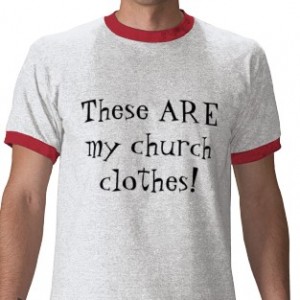
Church Clothes

I vividly remember as a young teenager, after spending a Sunday afternoon at my friend Todd’s house, showing up to church that evening in blue jeans, a Huey Lewis and the News concert T-shirt, tennis shoes, and extra-wide sweat bands on my wrists. Upon entering the half-empty/half-full worship center I was notified that I was on the list of those who were supposed to serve communion. (This was back in the day when, if you weren’t at church that morning, we made you raise your hand or stand and the rest of us watched you commune. By yourself.) So, I stood up there, feet shoulder-width apart, hands firmly clasped in front, praying and passing the Body and Blood of Christ.

And, man, I got it when we got home. I was not wearing church clothes! I was waiting on the Lord’s Table and not wearing church clothes!

Of course, I know now what I did not know then. In all actuality, I was wearing my church clothes. You are right now wearing your church clothes. The place where you are sitting or standing right now is holy ground.

Scripture holds that everything — absolutely everything — takes place on holy ground. God has something to say about every aspect of our lives: the way we feel and act in the so-called privacy of our own hearts and homes, the way we make and spend our money, the politics we embrace, the entertainment we enjoy, the wars we fight, the tragedies we endure, the people we know. Nothing is hidden from the sight of our God. And nothing is exempt from his rule. The ground is holy, the folks are holy, the words we speak are holy.

“Holy, holy, holy is the Lord God Almighty; the whole earth is full of his glory!”

Not just in the worship center on Sunday morning, but everywhere you walk is holy ground. Everywhere you go is a sacred place. Everybody you meet is a holy opportunity. Everything you do is a sacred activity. Everything you wear is church clothes!

It’s all governed and ruled by God and set apart by him and acknowledged by his children as holy and set apart for his divine and eternal purposes. All of it.

“As God has said, ‘I will live with them and walk among them, and I will be their God, and they will be my people…’ Since we have these promises, dear friends, let us purify ourselves from everything that contaminates body and spirit, perfecting holiness out of reverence for God.” ~2 Corinthians 6:16, 7:1

~~~~~~~~~~~~~~~~~~~

The Texas Rangers are smoking hot heading into their second straight postseason. While clinching the title in the AL West, the Rangers won six in a row, ten of their last eleven, 14 of their last 16, swept the Halos, and notched a club record 96 victories. The only team hotter in the American League is the Tampa Bay Rays.

Come 4:00 tomorrow afternoon, I will be planted on the microfiber couch, in front of the tube, with Whitney, some ice-cold DDP, an ample supply of chips and hot sauce, and enough popcorn to make Orville Redenbacher blush. You can text me tomorrow afternoon after 4:00. But don’t call.

This is the most complete Rangers team ever assembled. Kinsler and Napoli are smashing the ball. Josh and Beltre are clutch. Michael Young is MVP-calibar. Ceej and Holland and Harrison are in a groove. Feliz has found his stuff. And Mike Adams is this year’s Cliff Lee.

Rangers in four.

Allan

Holy Worship

Our God shows his glory to Moses in a burning bush in the middle of the desert. God reveals his holiness to Isaiah in a throneroom vision in the middle of a desecrated temple. God shows his glory to John in a similar vision in the middle of a prison island. In the midst of national trial and personal hardship, God reveals himself to be the One in charge. He is holy and righteous and sovereign. He is surrounded by eternal beings. The air is filled with holy songs. The Creator of Heaven and Earth is revealed to be almighty and everlasting, faithful and good. Very good.

And these scenes show us very clearly that the only appropriate response to these visions of God’s glory and holiness is worship. The creatures who see the glory of God, the heavenly beings who witness the greatness of God, they give him never-ending praise and worship. And we are invited by Holy Scripture to join in.

We cast our crowns daily before our God. No reservations. No holding back. We give our God everything we have and we submit fully to his holy authority. We recognize our own unworthiness in his gracious presence. And we fall to our knees in gratitude and thanksgiving. We remember who he is, what he has done, what he promises to do, and how truly worthy he is of our praise.

Holy worship. Today. Every day. Not just on Sunday.

“I urge you, brothers, in view of God’s mercy, to offer your bodies as living sacrifices, holy and pleasing to God — this is your spiritual act of worship.” ~Romans 12:1

Peace,

Allan

Upholding the Ideal

Our holy Scriptures are full of lofty ideals. We listen to Jesus say, “Love your enemies,” and we realize, “Wait a second, I don’t even like my friends!” Give to everyone who asks. Never lust. Always forgive. Rejoice in persecution. Put the needs of others ahead of your own. Our Lord calls for a single-minded fidelity to following him without reservation. And it’s demanding. Impossibly so. Yes, the Holy Spirit of God empowers us to do what Christ is calling us to do. But we don’t always do it. We mess up. We sin. We fall.

To borrow from Yancey, I find that, personally, I talk and write about spiritual disciplines far better than I practice them.

How about you?

Yeah, I know.

But we keep trying, right?

We never put our feet on the floor in the morning and allow that, “I’m human so I’m going to sin today. There’s no way I’m going to be perfect today. I’m going to mess up. I’m human.” No! God forbid! We strive with everything in our power and by the strength of the Spirit to pledge that, today, I’m going to be like my Lord! We don’t ever give in to the world’s conclusion that we cannot possibly be like Christ. We keep trying.

Scripture paints a beautiful picture of the Kingdom of God and the coming wedding feast of the Lamb. It’s a gathering of “every tribe and language and people and nation.” We find “the poor, the crippled, the blind and the lame” around the table. Paul makes it clear that, in Christ, there is “neither Jew nor Greek, slave nor free, male nor female.”

I believe the very core of the Gospel of Jesus is that our Christ died and rose again in order to destroy completely and eternally all the barriers that exist between God and man and man and one another. Social distinctions. Cultural differences. Language obstacles. Socio-economic disparity. Zip codes and tax brackets. None of these things register as even a blip on our fellowship radar. These differences don’t even exist in Christ.

But we have black churches. And white churches. And hispanic churches. And rich churches. And poor churches. And somehow we’ve fooled ourselves into thinking that’s OK. We have begun to believe the lie that church has always been this way and it will always be this way. The cultural differences are too great. The language difficulties are too much. We’ve tried to integrate, we’ve tried to come together, but it’s just never worked. And it never will work.

So, why try?

Because there is honor in the trying. Trying is an act of faith. Our Father wants us to engage that struggle and try. He wants us to try.

Scripture gives us a crystal-clear mandate. It tells us in no uncertain terms that the table of Christ and the house of God is to be enjoyed by all. Together. United as one. Everybody equal. Everybody just as wretched and lost and condemned to death without Jesus and everybody just as holy and saved and righteous because of Jesus. Together. We uphold the ideals we find in Scripture. We lift up those ideals and we try with everything we have to bring heaven to earth, to practice God’s will on earth just as it is in heaven.

And we slip. And we fall. And fail. And do really stupid things. But we never give up. We never give in to the world’s conclusions that division along racial and economic and language lines is necessary. We keep trying. And we trust that Jesus, our King, is watching even as we are “straining at the oars.” He’s interceding for us as he watches. And he’s proud of us. He’s pleased with us as we keep trying.

Peace,

Allan

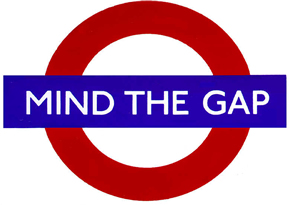
Mind the Gap

During our 26 hours in London last summer on our return home from Kharkov, Ukraine, Carrie-Anne and I became quite comfortable riding the underground trains. Everything was clearly labeled, simple to find, not that big of a deal at all. I found myself especially intrigued by the “Mind the Gap” signs that were everywhere: in the stations, at the ticket counters, along the turnstiles, in the que, and even on the trains themselves. “Mind the Gap.” The friendly female voice on the recorded information messages reminded us at every stop to “mind the gap.”

See, there’s a gap between the train platform and the train itself. It’s no more than three or four inches across. It’s nothing really. I don’t think I ever would have noticed if it hadn’t been pointed out to me. Sometimes there’s a two or three inch difference in height, too, where the platform and the train come together. And, apparently, people were tripping on the gap and hurting themselves. So, a public service announcement program was born.

“Mind the Gap.” T-shirts. Billboards. Signs. Coffee mugs and computer mouse pads. “Mind the Gap.” Pay attention to the gap. Don’t forget the gap. Watch out for the gap. Don’t trip up on the gap.

There’s a gap between what we’re attempting to do in corporate worship each Sunday morning and what we’re actually doing. There’s a serious difference between who we are and who God is. When we gather to worship, there’s a canyon of contrast, a black hole of incongruity when it comes to what we think we’re doing and what’s actually taking place.

For a couple of weeks now, Kevin (Central’s amazing worship minister) and I have been planning my first Sunday. We’re less than two weeks away. We’re planning the songs. We’re planning the Scripture readings. We’re planning the prayers. The order. The communion service. The elders’ charge to me as the new preacher here. The appreciation we plan to show the search committee. We want it to be perfect. We want it to flow seamlessly. We want everything to work. We pray over it. We worry about it. We work it and re-work it together. Song and sermon and prayer and holy communion. God must be glorified and his children must be inspired. Song and prayer and sermon and communion. Do it again. We must take our people straight to his throne. We must pour ourselves out to our Father. Song and prayer, Word and table.

Even as we meticulously plan, I’m mindful of the gap.

What must our worship efforts look like to our holy God? Are they pitiful? Misguided? Sad? Shallow? Tragically funny? Do we miss the point entirely?

Annie Dillard wrote, “In two thousand years, we have not worked out the kinks. We positively glorify them. Week after week we witness the same miracle: that God is so mighty he can stifle his own laughter.”

I am always mindful of the gap. As I prepare sermons and dare to speak a Word from God to his people, I think about the gap. As I attempt to tie our table time directly to that Word each Sunday with a neatly composed prayer or a perfectly placed passage of Scripture, I remember the gap.

It’s there. I’m aware of it. But because of God’s matchless grace, I will not be tripped up by it. I won’t let it stop me from doing my best to please him and to encourage his people. Our Father smiles at our best and honest efforts, no matter how eternally foolish they may ultimately be. Mind the gap, yes. Be aware of it. But do not allow it to be a hurdle or a barrier between us and God. His patience is unlimited. His grace is beyond measure. His love for us is too great to adequately describe. And it renders the gap powerless against us.

Peace,

Allan

« Older posts Newer posts »