Category: Prayer (Page 29 of 30)

Leading Public Prayer

I promised you Wednesday the second half of that 1942 George Buttrick essay on prayer, the section that deals specifically with the wording of public prayers in the assembly. Buttrick was an English-born Congregational preacher who served nearly 30 years as pastor of New York’s Madison Avenue Presbyterian Church. He also served as Preacher to the University at Harvard. Here it is:

“With what burden and awe we should prepare the prayers for public worship! Therein is the grievous failure, not to say disgrace, of Protestantism. ‘Brother So-and-so will lead us in prayer’; whereupon Brother So-and-so, in too many instances, offers God a slipshodness and a jumble, sometimes almost a brash irreverence, and has the temerity to call it prayer. Where public prayer is undisciplined, corporate public worship decays.

There is necessary preparation both of the pray-er and the prayer. What are its steps?

The minister and the congregation should explore the wealth of prayers, ‘free’ and liturgical, offered through the years. Wisdom was not born with us. There are collects of St. Chrysostom which are the perfect bloom of devotion. They cannot be touched without being spoiled. They can only be prayed, in gratitude for men who pray for us better than we pray for ourselves.

Furthermore, prayers should spring from prior inquiry. What are the blessings for which we should praise God? What are the sins which should find corporate confession? What are the conflicts and sorrows that should be upborne in corporate intercession? As that last question is asked the compassionate minister will see the faces of his people and the tragic need of the world until intercession then and there interrupts his ponderings.

Then the minister must plan and write prayers as rigorously as sermons. The language should be wrought. God may be pleased with a clumsy prayer, but not when the clumsiness comes with sloth or a casual mind. The planning of a prayer should be deliberate and clearly drawn. Later, in public utterance, the prayer may break its bounds to ‘take heaven by storm,’ but only if the bounds have first been set. How can petition and intercession be real unless it is specific and ordered?

The needs of the Church are many and urgent. But they might all be met by the leaven of genuine corporate prayer.”

Peace,

Allan

The Greater Work

“Corporate prayer is the heart of corporate worship.” ~George A. Buttrick, 1942

In preparing for tonight’s Oasis class—our focus this evening is on the many forms of prayer in the Bible and their use, or lack thereof, in today’s Christian assemblies—I came across a little essay from George Buttrick on public prayer. I’m going to break it up into two parts. Buttrick addresses the “how to” when it comes to leading a public prayer in the assembly. And I’ll give you that part tomorrow. Today, the big picture of why prayer is the central aspect of our congregational worship.

TheGreaterWork“Ritual is not central; for, however necessary and vital, it is still ritual. Scripture is not central; for, however indispensable and radiant, it is still Scripture—that which is written, the record not the experience, the very Word but not the Presence. Preaching is not central; for preaching, however inevitable and kindling, is still preaching—the heralding, not the very Lord. Friedrich Heiler was rightly written: ‘Not speech about God, but speech to God, not the preaching of the revelation of God, but direct intercourse with God is, strictly speaking, the worship of God.’

When the rite is made central, prayer may become an incantation. When the book is made central, prayer may become an appendage of scribal interpretations. When preaching is made central, prayer may become only an introduction and conclusion to the sermon. The heart of religion is in prayer—the uplifting of human hands, the speaking of human lips, the expecting waiting of human silence—in direct communion with the Eternal. Prayer must go through the rite, Scripture, symbolism, and sermon, as light through a window.”

In 1895, E. M. Bounds wrote, “Prayer does not prepare us for greater works, it is the greater work.”

We pray because God invites us to pray. He desires that we speak to him, that we bring him our praise and thanksgiving, our confession of sin and our hurts, and our petitions for others and ourselves—everything that concerns us. And the more we pray, the closer we become to God. In prayer, in real prayer, we begin to talk like God talks. We begin to think like God thinks. We desire the things he desires, we love the things he loves, we want the things he wants. We begin to see things from God’s point of view when we earnestly pray.

Peace,

Allan

Prayer, Momentum, & Once More on the Incarnation

“Seek the Lord while he may be found; call on him while he is near. Let the wicked forsake his way and the evil man his thoughts. Let him turn to the Lord and he will have mercy on him, and to our God for he will freely pardon.” ~Isaiah 55:6-7.

PrayerThe disciples asked Jesus in Luke 11 to teach them how to pray. They want to be like him in every way. So they want to pray just like him, too. They want to identify with their rabbi and to be identified with their rabbi by praying like him. So Jesus gives them the basics as far as the words go and then he tells them a story so they don’t lose the big picture.

The parable of the persistent friend. It’s midnight, the guy’s in bed, his whole family’s asleep. He doesn’t want to get up and get his friend the bread he needs to feed his surprise guest. In fact, he tells the neighbor at the door it’s not going to happen.

“Hey, it’s late! We’re all in bed! The kids are going to school in the morning! I’ve got an early meeting at work! Buzz off!”

In Jesus’ story, the man does get up and give his neighbor the bread he desperately needs. But not because he wants to. He does it, Jesus says, because of the friend’s boldness or persistence. And I’ve heard this story traditionally interpreted like this: keep praying. Even if God says ‘no,’ keep praying. He’ll give in eventually if you keep praying. Keep bugging him. He’ll change his mind. He doesn’t want to give you this thing you’re asking, but he will if you just keep knocking.

For that to make sense, God has to be the guy in the bed. For that interpretation to hang with the story, the guy in bed is God. The guy in bed. The guy who’s already turned out all the lights. The guy who’s locked his door. The guy who’s only thinking of himself. The selfish guy who doesn’t want to get up from under the covers and give his neighbor what he needs. That guy represents God?

No way.

If Jesus had put God in this story, all the lights would be on in the house. All the doors and windows would be wide open. There would be huge search lights criss-crossing the sky and giant neon billboards with flashing arrows pointing to the house saying, “Get your bread right here! Get as much bread as you want right here! And it’s free!” You couldn’t even get to the door to knock because the man would be out in the street looking for you and running to meet you and give you the bread before you could even ask.

The guy in the bed is not God. The guy in the bed is the opposite of God. And there’s the point. There’s the teaching of Jesus. He’s drawing a stark contrast. He’s not making a comparison. Jesus says here’s a man who will eventually get out of bed and give bread to his neighbor, if not because they’re friends, then certainly out of a sense of duty or honor or hospitality. You fathers, if your child asks you for something he really needs, you’re not going to give him something that would hurt him. So if this reluctant sleepy guy and you imperfect human dads know how to provide good gifts, why would you ever assume that God doesn’t? Our God is definitely more kind and generous and loving and giving than any man, regardless of how decent or good that man may be.

Jesus’ point in telling the story in Luke 11 is that our God is never reluctant to help. We ask God knowing he’ll honor our requests. We seek God knowing we’ll find him. We knock on God’s door knowing he’ll give us what we need.

“This is the confidence we have in approaching God: that if we ask anything according to his will, he hears us. And if we know that he hears us — whatever we ask — we know that we have what we asked of him.” ~1 John 5:14-15

~~~~~~~~~~~~~~~~~~~~~~~~~~~~~~~~~~~~~~~~~~~~~~~~~~~~~~~~~~~~~~~~~~~~~~~~~~~~~~~~~~~~~~

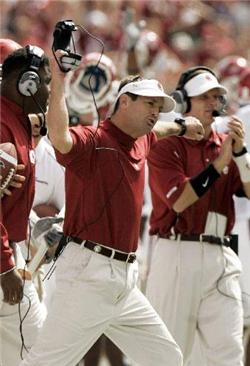
FootballWith 6:23 to play in the third quarter of last night’s Fiesta Bowl, Oklahoma scored a touchdown to pull to within five points of West Virginia. By this point the Mountaineers had proven clearly that they were the faster, more athletic, more explosive team. And by kicking an extra point, the Sooners would only be down by four with some real positive momentum. Maybe even some potentially game-changing momentum.

But Bob Stoops decided to go for two. The pass was incomplete. And OU trailed by five. Not only that, but instead of feeling good about a success, the team felt bad about a failure. Instead of West Virginia feeling negatively about their failure in giving up a touchdown on a long drive, they felt positively about their success in stopping the two-point play.

Momentum is huge. The psychology of what happens in the course of a football game and how it all shifts back and forth at a moment’s notice is generally tied to turnovers and failed two-point conversions.

And then, to defy logic even further, Stoops calls for an onside kick. Halfway through the third quarter. West Virginia recovers at the OU 39 yard line and goes on to score three of the game’s next four touchdowns to salt it away.

It was like Stoops thought he was playing OSU or something.

If I were the owner or GM or AD of a football team, I would put it in my coach’s contract that he could never, ever, go for two before the start of the fourth quarter. Period. No exceptions. I don’t care how far we’re down or how lousy our kicker. Going for two, going against the percentages, unnecessarily risking that precious momentum, it doesn’t add up. It’s never worth it.

Someday we’ll discuss “the chart.”

~~~~~~~~~~~~~~~~~~~~~~~~~~~~~~~~~~~~~~~~~~~~~~~~~~~~~~~~~~~~~~~~~~~~~~~~~~~~~~~~~~~~~~

IncarnationFinally, my good friend Todd Lewis, down in Marble Falls, sent me a Christmas article he wrote last month exploring the ways the Christmas season produces cheer even in the midst of war, disease, and crime. His words go right to the heart of what we preached here at Legacy for the past three weeks, how we see ourselves in the infant Jesus — God’s intentions in creating us, our own potential, our high calling. Click here, Observations on Christmas Cheer, to read Todd’s excellent article.

Peace,

Allan

In The Garden

GardenOfGethsemaneRemember Mel Gibson’s movie, The Passion? Powerful film. When that movie came out three or four years ago, a lot of the debate centered around the question of just how faithful it was to the Gospels. True, there was a lot of artistic license flexed by the movie makers. But I feel that most, if not all, of it was theologically sound.

Remember the garden scene? In that movie, Jesus was not praying alone under the olive trees at Gethsemane. Not totally. The snake was OliveTreesAtGardenOfGethsemanethere. The serpent of old, the devil, was slithering around the garden while Jesus was asking God to take away the cup of suffering and the task of the cross. And the mood isn’t so somber and tragic when you see the snake. Suddenly the scene is injected with vigor and power as we realize the cosmic battle that’s taking place in this olive grove. And the scene climaxes with Jesus simultaneously saying, “Not my will, but yours be done,” and standing up and crushing the head of the serpent with his foot.

What was really happening in the garden? The night Jesus was betrayed and the whole plan was beginning to unfold, what was really going on?

Crushing the head of the snake is a clear reference back to Genesis 3:15, a verse the Church has held forever as a messianic prophesy of God’s ultimate defeat of Satan.

But it takes us back to that very first garden, the Garden of Eden. In that first garden the first Adam, the first man, fails his God. Not only is he not talking to his Father, he’s ultimately listening to the devil. Adam, rejecting the will of God, looks upon the tree and disobeys. As a result, God removes man from the garden. And even though he lives a very long time, Adam ultimately dies because sin and death have now entered the world.

Now at Gethsemane we see the second Adam, the last Adam, Jesus. He, too, is in a garden. He’s in a garden and contemplating a tree: the tree of crucifixion right before him. And Satan was there, too. He was there at the beginning of Jesus’ ministry, don’t you think he was there at the end? I can hear him.

“Save yourself! You don’t have to do this! You’re the Son of God! Call down your angels! Make yourself King!”

He’d said it all before.

But unlike the first Adam, this second Adam is listening to his Father, not the devil. He obeys the will of his God who tells him he must partake of the tree. And as a result, Jesus is removed from the garden; not by God, but by man. Jesus dies within 24 hours. But ultimately his life returns anew because salvation and reconciliation and everlasting life have now entered the world.

Through his decision he agonizingly confirms again in the garden, Jesus forever becomes our path back to our Father’s garden, the one we were removed from so long ago. Praise God for the Savior’s love. And for his obedience to our God’s will.

~~~~~~~~~~~~~~~~~~~~~~~~~~~~~~~~~~~~~~~~~~~~~~~~~~~~~~~~~~~~~~~~~~~~~~~~~~~~~~~~~~~~~~

He proudly wears his Marion Barber jersey to church functions. His sweet daughter is an answer to my family’s prayers. He’s an open and honest man with a unique perspective. My conversations with him, in person and via email, about our God and his church or football, always stretch me and give me appreciated insight. And now Mel Williams has joined the blogging community. Check out Mel’s brand new blog, Simple Man Walking, by clicking here.

Peace,

Allan

Living in Answered Prayer

When the brook at Kerith dried up, Elijah found himself in the middle of the desert, in the middle of a 3-1/2 year drought, in the middle of a 3-1/2 year famine, #1 on the state’s most wanted list, hiding from a queen who was killing men just like him all over the region, and without anything to drink.

As scared as he might have been, Elijah was living right in the middle of his own answered prayer.

Elijah had prayed that it would not rain. He had agonized over the sin of God’s people for so long that he prayed for God to punish his people, to bring them to repentance. James says Elijah prayed earnestly that it might not rain. And as a result of his own prayers, here was Elijah, about to die in the desert.

Has that ever happened to you?

“Lord, make me a godly man. Please make me a woman after your own heart.” But in your mind, you’re thinking, “Don’t let it hurt.”

“God, make me stable and longsuffering and gracious and patient. But don’t take away any of my luxuries.”

“Lord, please make me strong. Increase my faith. But don’t let me suffer.”

Maturity in faith requires sacrifice and suffering. Growing in God is all about suffering. Physical pain. Emotional pain. How else would we ever learn to live by faith?

~~~~~~~~~~~~~~~~~~~~~~~~~~~~~~~~~~~~~~~~~~~~~~~~~~~~~~~~~~~~~~~~~~~~~~~~~~~~~~~~~~~~~~

What a fantastic kick-off to VBS last night with the opening presentation of “Elijah: On Fire for the Lord” and the big dinner. Of course, the entire 45-minute production began with Elijah’s dramatic announcement that there would be no rain or dew at the word of the Lord and centered on the subsequent drought and famine. And at the exact point Mason Scott (Elisha, the narrator) was detailing to the audience the impact of the drought, how there would be “no rain, not one single deop of moisture anywhere in the entire land,” there came a huge cloudburst right on top of the Legacy church building. The rain came in torrents, pounding the metal roof above our heads just as Mason was saying “no rain anywhere.”

It was a beautiful moment, one that was appreciated by the entire cast and every member of the audience. It reminds us that as much as we plan and prepare and go over and over again every little tiny detail of OUR plans, they’re all at the mercy of GOD’s plans.

~~~~~~~~~~~~~~~~~~~~~~~~~~~~~~~~~~~~~~~~~~~~~~~~~~~~~~~~~~~~~~~~~~~~~~~~~~~~~~~~~~~~~~

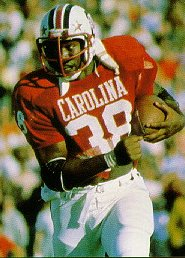
GeorgeRogersThere are 38 days left until football season. And our football player today is one of the best college running backs ever. He didn’t pan out so well in the NFL. But George Rogers was amazing at South Carolina from 1977-80. He was a two-time All-America back who rushed for over a hundred yards in 27 of his 46 career games, including the last 22 in a row. With a deadly combination of power and speed, he won the Heisman Trophy in 1980 by leading the nation in rushing in with 1,894 yards.

Rogers was the overall number one pick of the New Orleans Saints in 1980. But he only lasted four years there and another three with the Redskins before he was done. He did win a ring with the ‘Skins in Super Bowl XXII. But George Rogers makes the list because of what he did as a Gamecock. Next to Herschel Walker, in my lifetime, I can’t think of a better running back in the SEC.

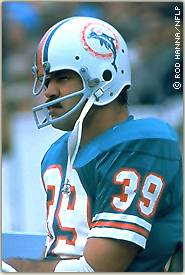
Catching up from yesterday, #39 in my countdown to football season is Dolphins fullback Larry Csonka. He was Miami’s LarryCsonkatop pick out of Syracuse in 1968 and he’s actually still the Dolphins’ all-time leading rusher with 6,737 yards. He averaged 4.5 bruising yards per carry in Miami, ballooning that average to 6.7 yards per carry in three Super Bowls. Csonka won the MVP award in Super Bowl VIII with 145 yards and two touchdowns.

Csonka wound up his career with the Memphis Southmen of the old World Football League and the New York Giants.

 ~~~~~~~~~~~~~~~~~~~~~~~~~~~~~~~~~~~~~~~~~~~~~~~~~~~~~~~~~~~~~~~~

Jesse Villareal and Karrie Graves and several other of our singles at Legacy are heading down to Marble Falls on August 2 to help clean out houses and clean up debris left over from the flooding of last month. What a wonderful gesture! I don’t know if they’re going to have four or five total make the trip or 40 or 50. They’re just putting it together. But what a wonderful way to show our love and concern for our brothers and sisters in Christ there in that terrific congregation in that beautiful city. I’m so grateful for Jesse and Karrie and for their hearts of love and service to God’s people in the Kingdom. Greg Neill and the folks at the Marble Falls Church will house and feed our singles (and anyone else who wants to take the trip) while they work in the community there for those three days. And then they’ll worship with the Marble Falls congregation Sunday morning.

Thank you. May we all be encouraged by the love of Christ and by the power of our God and his grace as it’s displayed in the lives of our people here.

Peace,

Allan

The Angle of Prayer

Eugene Peterson’s Working the Angles: The Shape of Pastoral Integrity holds up prayer, Scripture, and spiritual direction as the three foundational elements to Christian ministry, specifically for “located preachers.” Without continual daily attention to these three very private acts, the preacher’s ministry is shallow and shadow—of this world, not of Heaven.

On the subject of prayer, Peterson articulates the problem for, not just preachers but, all of us. Busyness. We have too much going on. Too many projects, too many phone calls, too many meetings, too many interruptions, too many school and athletic events, and way too much to do even in our leisure time. It’s endemic to our culture in the United States. As preachers, we live right in the middle of two different sets of demands that seem to cancel each other out: we must respond in love and kindness to the demands of the people around us, demands that “refuse to stay within the confines of regular business hours and always exceed our capacity to meet them all” and at the same time we must respond with reverent prayer to the demands of God for our attention, “to listen to him, to take him seriously in the actual circumstances of this calendar day, at this street address, and not bluff our way through by adopting a professionalized role.”

The only kind of prayer and prayer life that is appropriate as a response to our loving Father is the kind of prayer that is only entered into slowly and deliberately, the kind of prayer that takes time. It’s not prayer-on-the-go or prayer-by-request. It means entering large blocks of quiet time with my God where “wonder and adoration have space to develop.”

Is that even possible for an American preacher today?

It has to be.

You know yourself from teaching and from personal experience that seasons of deep meaningful prayer, communion with your God, sharing and listening and speaking with your Father, are always the times in your life of revival and rejuvenation. Empowerment and encouragement. There is certainly room for those on-the-go prayers. Praying in the truck rolling down Airport Freeway or over your Big Mac at MickeyD’s is honored by God. But without intentional chunks of prayer time each day—set-aside time to bask alone in the presence of the Father—our families and our churches suffer. My wife and my three daughters suffer when I neglect prayer. So does the Legacy Church of Christ.

Prayer acknowledges my faith in God to provide all my needs. It recognizes God as the giver of life. And it’s our demanded response to God. He started the conversation. He’s the one who spoke first. Every single thing we say to God in prayer is our response to his initial speaking in our lives.

For the past two years I’ve been involved in a daily Bible reading schedule that includes a Psalm or two every day. And I find myself praying the Psalms. All the time. Just like God’s people have for all time. The Psalms were the prayer book of Israel; they were the prayer book of Jesus; they are the prayer book of the church. At no time in the Hebrew and Christian centuries (except for maybe ours) have the Psalms not been at the very center of all prayer thought and prayer practice. John Calvin said the Psalms are “an anatomy of all the parts of the soul.” Everything that a person can possibly feel, experience, and say is brought into expression before God in the Psalms.

Read the Psalms. Pray the Psalms. Use the language. Use the word-pictures. Use the thoughts in the Psalms to express yourself to God in prayer.

~~~~~~~~~~~~~~~~~~~~~~~~~~~~~~~~~~~~~~~~~~~~~~~~~~~~~~~~~~~~~~~~

It’s very, very quiet in the office today. Lance has a group of middle school students at a camp in Oklahoma City and Jason is on his way to Mississippi on a mission trip with the high schoolers. Suzanne’s on the Mississippi trip, Kipi’s locked in to VBS mode with just 12 days to go, and Bonny’s still putting her office back together after the “Flood of July 2.” After five straight days, the buzz of the fans and the de-humidifiers in the building are gone. And today’s the 4th straight day without any rain at Stanglin Manor. The yards are still soggy. But I got more work done outside Saturday than I’ve done combined since we moved in. Edging the curb and driveway with a weedeater was like digging a trench with a cereal spoon. I battled it for well over an hour. I think it ended in a draw.

~~~~~~~~~~~~~~~~~~~~~~~~~~~~~~~~~~~~~~~~~~~~~~~~~~~~~~~~~~~~~~~~

There are 52 days until football season and my #52 is another Steeler from the ’70s, MikeWebstercenter Mike Webster. He was tough. He played in every single game during his first ten seasons, he started in 150 straight games, and missed only four total in his 16 NFL seasons. He won four Super Bowls with the Steelers and ended his career with the Chiefs.
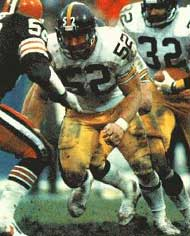
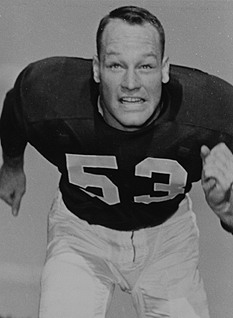
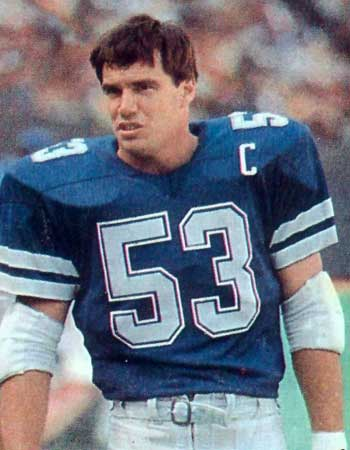
Getting caught up on the countdown from the weekend will be a little more fun. #53 is not Bob Breunig, although he deserves honorable mention. My #53 is a great two-way star for the OU Sooners during the ’50s, linebacker/center Jerry Tubbs. Tubbs never lost a single football game during his three year career at Oklahoma. JerryTubbsHis 31 wins were part of that legendary 47-game winning streak and two national titles from 1954-56. He was an All-America at linebacker, he won the Walter Camp Award, and he actually finished fourth in the Heisman Trophy voting in 1956.
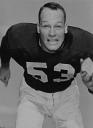
Tubbs was the Chicago Cardinals top pick in the ’57 draft. And he was acquired by the Dallas Cowboys in 1960 during their expansion draft. After he finished playing, Tubbs served as an assistant coach for the Cowboys under Tom Landry for 21 years, an integral part of that run of five Super Bowl appearances in the ’70s. And to top it off, before any of his college and pro success, Tubbs won two Texas State High School Football Championships at Breckenridge.

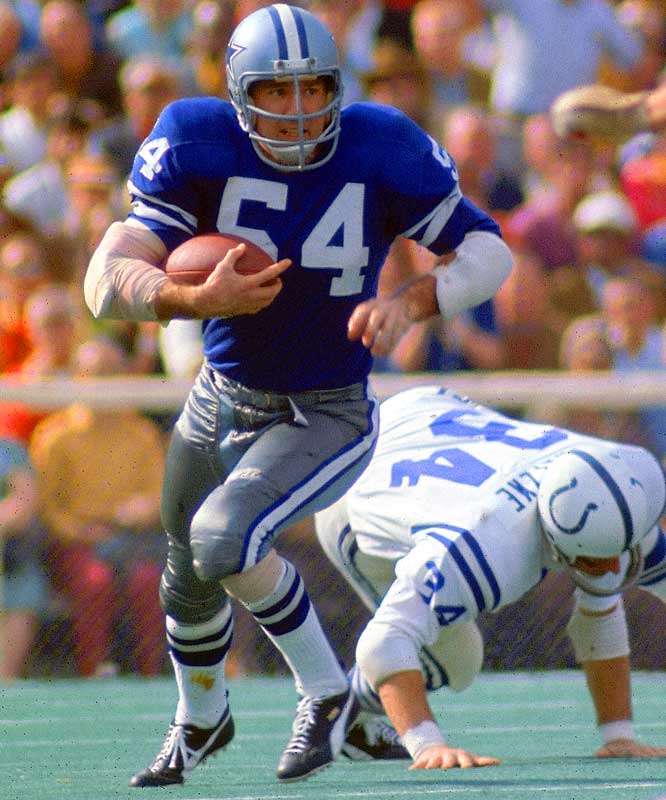
And #54 is also a long-time Dallas Cowboy, linebacker Chuck Howley. He played three seasons for the Bears before coming to Dallas for draft picks in 1961 and played for ChuckHowleyLandry for 13 years. He went to six Pro Bowls and two Super Bowls, losing the heartbreaker in the Blunder Bowl on Jim O’Brien’s field goal and winning big the following year over Miami. Howley was named the MVP of Super Bowl VI, the only MVP ever to be named from the losing team. Landry called Howley “the best linebacker I ever saw.” And that’s good enough for me.
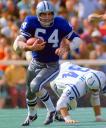
Now, to all you Randy White fans, let me present a technicality. I get the “Manster” and Howley both on my list because Randy White wore the #94 in college at Maryland. One of these days I’m going to list all 99 of the best football players ever on this blog and you’ll see White at #94. We were doing the countdown on 990AM one summer and actually had the equipment manager at Maryland, who was there back when White played, custom make a replica Randy White #94 Terrapin jersey for us. We were doing our show live from some pool hall somewhere in North Dallas and had Randy White there with us live and he gave the jersey away in a drawing.

The other Randy White story involves Carrie-Anne. White was signing autographs at some shoe store or something at a mall in Austin. This was back in 1990 or ’91. We didn’t have kids yet. And White actually stopped C-A and asked her if she wanted his autograph. She replied, “No, not really.” And that floored him. He couldn’t believe it. He asked her two or three more times, “Are you sure you don’t want my autograph?” And she just kept saying, “No, not really, no big deal, no thanks.” It was so funny. It has to be the only time in history a Dallas Cowboys Hall of Famer has ever been rejected like that.

Tomorrow’s #51 requires no explanations. It’s a no-brainer. Automatic. Hands-down. No debate.

Peace,

Allan
« Older posts Newer posts »