Category: Prayer (Page 18 of 30)

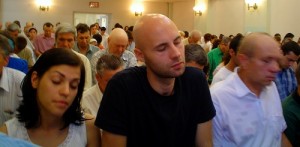
Immersed in Prayer

I’m so blessed to be here at Central. And so privileged to be serving with a group of church elders who rely so much on our heavenly Father and so little on themselves. What a joy!

The shepherds here at Central are an accomplished bunch. Each of them has enjoyed many levels of success in business, in society, in family, and in church life. I’m serving with men who are retired educators, retired TXDOT roadworkers, and retired CPS social workers. Our elders include a dentist, an opthalmologist, and a pharmaceutical salesman who used to play college football and still looks like he could line up against Demarcus Ware. We’ve got a power plant engineer, an oil and gas engineer who’s achieved at the highest levels of the international energy industry, and a man who’s constructed half the big buildings in Amarillo. There’s a commercial real estate leader, a hospice administrator, and a financial planner. These are competent men. Full of brains and brawn, experts in their fields, offices full of awards and trophies and medals. Well respected leaders of commerce and service and trade. Big thinkers, excellent communicators, magnetic personalities.

And you wouldn’t know any of it by walking into one of our elders meetings.

Because they spend so much time praying.

They don’t rely on their own achievements or gifts. They don’t count on their own cunning or craft. They depend wholly on God. Constantly. Consistently.

Three quick examples that have blown me away recently:

Two weeks ago we were in the middle of a question regarding an issue — a policy, really — that had been implemented some time ago but had been put on hold by the preacher search. Two of our shepherds who stood to benefit the most from re-starting the policy had brought it up and requested that we move forward. Following some very brief discussion, it was decided unanimously to get it going again. To which one of those two elders said, “Hey, I really appreciate the vote; thank you so much for the decision. But, can we not implement it just yet? Can we take the next two weeks and just commit to praying about this? I want to make sure this is really God’s will and not just a decision we’ve made tonight based on anything else. Let’s all promise to pray about this for two weeks and then come together on it one more time. If, after two weeks of prayer, nothing’s changed, then let’s move forward with our God’s blessing.”

Last night we were in the middle of our budget presentation. It’s a two-million-dollar annual budget. Lots of numbers. Lots of decisions. Lots of ministries and buildings and salaries and maintenance and outreach. Lots of detail. And right in the middle of it, one of our shepherds stopped the whole meeting down. “Hey, guys, we’ve really been blessed here by our God. Over 90% of the pledges for our capital campaign, more than 200-thousand dollars in extra giving for extra ministries that aren’t even in our budget, debt-free with emergency money in reserve. Can we just stop for a minute or two and thank our Father?”

And we did. We stopped everything, put our arms around each other, and prayed. This elder confessed his lack of faith, told God in front of all of us that there was a time when he never would have imagined these kinds of blessings for Central. He begged for forgiveness and then poured out his heart and guts in praise and thanksgiving to the faithful Giver of all good gifts.

And then again, at the end of last night’s meeting, another prayer. Of course. It’s what these guys do. “Lord, empower us and enable us to walk with people, to help people and serve people, who won’t serve us back. To walk with people who may not even love us back.”

Whoa.

My spirit is refreshed to be among so many who won’t hardly make a move without immersing it in prayer. I am re-energized by this faithful focus on the One who is the source of all energy. I’m thrilled with the commitment all around me to be in constant communication with the Originator of all joy. And I’m confident and bold, full of courage and strength, as we all depend so completely on the Father who promises to work everything out to his glory and praise.

Preachers, I beg you to pray. Elders, I beg you to immerse your meetings in prayer. Teachers, small group leaders, deacons and ministry leaders and committee chairs, drown your meetings in prayer. There’s not another thing you can do that can produce more peace and courage around the table than to confess to God in the presence of one another that he alone is the instigator and finisher of all the great works of the Kingdom of Heaven.

Peace,

Allan
At That Time…

“At that time Jesus said, “I praise you, Father, Lord of heaven and earth…” ~Matthew 11:25

The words at the beginning of this passage in Matthew that lead directly to our Lord’s little prayer of thanksgiving refer to that time in Jesus’ life when he’s having to answer questions about his mission and denounce unrepentant cities. John the Baptist is openly questioning the Messiahship of Jesus. His closest family and friends in the fishing villages around Galilee are ignoring his message.

How do you think all this rejection made Jesus feel? How do you think Jesus was doing at that time?

With one word, how would you describe your current situation? Where are you right now? In one word, what’s going on with you at this time?

Content? Frustrated? Happy? Angry? Confused? Overwhelmed? Hectic? Depressed? Worried? Confident? Scared?

Jesus seems pretty confident that his heavenly Father is behind these perceived setbacks and that these disappointments are actually a part of God’s holy will. And he gives thanks. Jesus gives thanks for the problems he’s encountering and praises God for working in them to spread the Word and advance the Kingdom.

The powerful and unstoppable energies of the Kingdom of God are always moving, always growing, always surging just beneath the surface. All around us. Huge rivers of prayer and faith and hope and praise and forgiveness and salvation and rescue and holiness flow right by us every day. In every single nook and cranny, hidden in the shadows, overlooked in the crowds, drowned out sometimes by the noise, are the eternal works of our gracious Redeemer.

So, like our Lord, we give thanks. At that time. At this time. We give thanks.

~~~~~~~~~~~~~~~~~~~~~~~~

Two Sundays ago Kevin Schaffer, our marvelously talented worship minister, stopped us down right in the middle of song to correct our clapping. We were singing “King of Kings.” You know how it goes: King of kings and Lord of lords, glory (CLAP!) Hallelujah. And our congregation was butchering the clapping. We were clapping before the word, during the word, after the word; it was a mess. Near the end of the first stanza, Kevin had had enough and he stopped us.

“We are going to learn how to clap. And we’re going to start with just one. Just one clap. Do it with me…”

And he proceeded to teach us and show us how to clap. It worked really well. Kevin was very patient with us and we all had a good laugh. After we had practiced together for a few minutes, it actually sounded pretty good the second time around. There’s hope here at Central.

I was reminded of that episode by a blog post written by Jon Acuff. It’s called “Clapping Our Hands: A Step-By-Step Guide to the Death of Rhythm.” A dear friend of mine forwarded it to me this morning. Jon hilariously nails the reasons our churches have a hard time clapping during congregational singing and gets inside the minds of the congregants to show us what everybody’s really thinking as the song begins, why the clapping is all over the place, and why it dies out completely before the song’s even over. It’s a quick, light, funny read about why our church clapping sounds like “somebody lit a box of hand firecrackers.” Click here to read it. And try to click on the downbeat, not the upbeat.

Peace,

Allan

Pray for Judy

“Is anyone among you sick? Let them call the elders of the church to pray over them and anoint them with oil in the name of the Lord.” ~James 5:13-15

I’ve sometimes heard about churches and elders who take these words of the New Testament literally. And seriously. I’ve always admired that in a group of church leaders. It’s certainly outside our normal box. It’s stepping away from our cultural comfort zone.  And I’ve been curious. I’ve wondered. What does that look like? How much oil does one use? And where do you buy the oil?

The anointing with oil is certainly a cultural and contextual thing in Scripture. It probably had something to do with perceived medicinal beliefs. It could have even just been superstitious. But I’ve always thought that the wisdom of actually anointing a sick person with oil today is in the human touch it requires. In the closeness it demands. The intimacy and relationship that’s necessary. In other ways — and I hope I’m not stretching this too far — I can see how this anointing with oil can function in a sacramental way. The touch and the oil can certainly represent in a physical way what our God is doing in a way that can’t be seen or smelled. It can point to that healing. It can signify the compassion and care that God feels and the provision and protection he promises.

For a long time I’ve thought it would be good to belong to a church and serve with a group of shepherds who practiced this praying and anointing with oil. And now I do.

Yesterday we prayed with and for Judy Newton.

Judy has been diagnosed with cancerous tumors in her brain. It just happened three weeks ago. The doctors are giving her little hope. Nothing but bad news. She’s endured one surgery and is bracing now for weeks of grueling treatments. She and her husband Lanny are beloved members of this Body of Believers at Central. Their faith is inspiring. Their commitment to God and to one another is powerful. Their belief that he is doing something great with them and through them is real.

But they’re hurting. They’re devastated. They’ve had the rug ripped out from under them and they’re not sure what’s coming next.

Judy and Lanny are in Houston tonight — they flew out early this afternoon — in line for a full week’s worth of tests and evaluations and treatments at M. D. Anderson. And yesterday they asked the elders to pray for Judy and to anoint her with oil.

So we went to her house and prayed. Several of us, a bunch of us, I’m not really sure how many of us, showed up at Lanny and Judy’s house to lift her up to our Father in prayer. Ministers and shepherds and all our spouses.

Tim explained to Judy that we don’t really understand fully the significance behind the oil. But, at the same time, we take it seriously. And literally. He told Judy that there is something to the physical touch that goes along with the prayer. There’s something about faithful obedience. There’s something about symbolizing what God is doing, how he is active, in our prayers. And then he took the oil and gently applied a couple of drops to Judy’s forehead.

And we prayed.

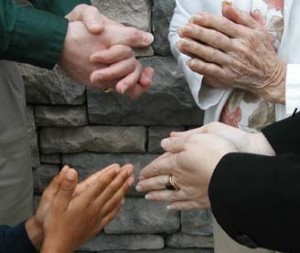
All of us. On our knees. Hands on Judy and Lanny. Arms around one another. With tears and tight throats. Eloquently and, at times, haltingly. At once feeling wholly inadequate for the task and perfectly at peace that God’s Spirit is doing all the work. All of us. Begging God to heal her. Confessing to God that we don’t understand. Wrestling with God. Praising God. On our knees before the Creator of heaven and earth, praying for his daughter Judy.

E. M. Bounds once said that prayer does not prepare us for greater works; it IS the greater work. I believe that. And so does the church family at Central. We believe in the power of prayer. We believe our God hears the faithful cries of his children. And we continue to lift up to him our sweet sister Judy.

I would ask you to please pray for Judy, too. Pray for healing. Pray for comfort and peace. Pray that our God would remove from Judy’s body all the horrible things that would cause her pain and do her harm. Pray that God’s name would be glorified in Lanny and Judy through this dark trial. And pray that our Lord’s holy will be done in her life just as it is in heaven.

Their precious daughter, Aleisha, is updating Judy’s battle every day on a blog. You can get to it by clicking here.

Peace,

Allan

Together in Prayer

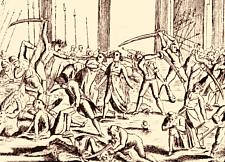
In the first century, Israel was ruled by Rome. The Roman Empire reigned supreme. There were Roman garrisons in every city; there were Roman soldiers on every street. The Jews were allowed their religious laws and festivals, but all under tight Roman restrictions. Upstart priests were arrested; rebels were mercilessly crushed. And groups of God’s people who were known as Zealots began to lash out in anger and violence.

As Roman rule became more oppressive the Zealots stashed their hillside hideouts with swords and spears and daggers. There were secret killings, public assassinations, and bloody revolts. The Zealots were committed to a life of violence against the Roman government. They challenged the presence of Roman soldiers; they provoked the Roman armies. And by July of 67 A.D., the violence escalated to the point that 40,000 Galileans were massacred in the hills outside Nazareth.

Zealots were admired by the Jews for their courage. They were honored by the Jews for their dedication to God’s cause and for standing up for what’s right. Zealots were heroes. And the violence continued to accelerate.

As the land we live in today becomes less Christian — or as the Church becomes more Christian — I believe it’s absolutely realistic for us disciples to be labeled and/or targeted by the government. As time goes on in this country, I think it’s feasible that Christians could come to be associated with dangerous radicals, to be blacklisted, to come under closer government scrutiny, to lose our tax-exempt status, maybe even to be arrested.

So, how do Christians respond?

As the realization sets in that we do not live in a Christian nation, I’m afraid that we Christians are guilty of lashing out in anger and violence. We’re more like the Zealots than we ought to be.

Lengthy petitions. Angry letters to the editor. Hate filled emails that are forwarded and re-forwarded and forwarded again. Malicious videos. Spiteful attitudes. And we fight and we rally and we march. And we target a certain political party and we classify a particular political ideology as evil. And we blast away. Both barrels.

When the government put the screws to God’s people in the first century, the Zealots responded by killing with their swords.

When the government clamps down on God’s people today, I’m afraid we respond by killing with our words.

Our risen Lord Jesus says killing with swords and killing with words is the exact same thing.

In the early days of God’s Church, Peter and John were arrested for preaching and teaching the resurrection of Jesus. They were questioned by the authorities and then ordered to stop speaking in the name of Jesus. 

Upon their release, Peter hurried home to Capernaum where he immediately wrote a scathing letter to the Sanhedrin in which he referred to Caiaphas as a flaming liberal and questioned his citizenship and his sexuality and made copies of the letter for all the apostles.

No.

Peter drew the dagger from his belt, the one he had used in the garden the night Jesus was betrayed and, shouting “Jesus is Lord!” he ran it through Caiaphas, killing him, while John plotted the destruction of the evidence.

No.

“On their release, Peter and John went back to their own people and reported all that the chief priests and elders had said to them. When they heard this, they raised their voices together in prayer to God.” ~Acts 4:23-24

Yes.

May we be a people who never ever lash out against those who oppress us. May we never attempt to injure anyone with swords or with words. And when resistance to the Kingdom and opposition to our Christ gets worse in this land, may we find our strength and our comfort with each other. May we respond to political crisis and government hostility in united, fiery, passionate, intense prayer to our Father. May we be bold to continue preaching and teaching in the name of Christ Jesus, our King. And may our God act in mighty ways to further his Word and advance his eternal Kingdom.

Peace,

Allan

The Prayer of the Fellowship

If I were Skip Bayless, I would have headlined today’s post:

“Rain-gers Cruz to Detroit with 2-0 Lead!” 

I received the news of Nellie’s 11th inning drive via David Byrnes’ iPhone during Valerie’s choir performance at Amarillo High School. The Rangers won it right in the middle of Jubilate Deo. It means sing with joy to the Lord. And we did.

~~~~~~~~~~~~~

Yesterday’s post about our congregational prayer for Judy has pushed me even farther in reflecting on the importance of public prayer. So many times our hurried efforts at the pulpit or, worse, our rambling ruminations and repetition betray a careless attitude toward this sacred activity among the saints in the presence of God on his holy ground. Congregational prayer is never to be entered into lightly. It is serious. It’s heavy. It requires forethought and preparation. And it demands relationship. You really can’t pray appropriately for your brother unless you really know your brother.

Dietrich Bonhoeffer says as much in Life Together. And I agree.

“The prayer in the common devotion should be the prayer of the fellowship and not that of the individual who is praying. It is his responsibility to pray for the fellowship. So he will have to share the daily life of the fellowship; he must know the cares, the needs, the joys and thanksgivings, the petitions and hopes of the others. Their work and everything they bring with them must not be unknown to him. He prays as a brother among brothers. It will require practice and watchfulness, if he is not to confuse his own heart with the heart of the fellowship, if he is really to be guided solely by his responsibility to pray for the fellowship.”

If you’re asking people to lead prayers in your assemblies, please don’t wait until the day before to make that call. Give them several days, maybe a full week or more, to pray and prepare and practice for this awesome task. And if you’re leading these public prayers on behalf of an entire group of Christian brothers and sisters, by all means please take great care in the things you say and the ways you say them. Pray about it first, just between you and God; you’re going to need his help. Prepare the congregational prayer in advance; write down the words. Practice it; know what you’re going to say when you dare to address the Creator of Heaven and Earth.

Above all, remember that you are praying on behalf of the group. And that sanctifies you. It transforms you. Because when you intercede for others before the throne of God and focus more on their needs than your own, you are being like our Christ who always lives to intercede for us.

Peace,

Allan

Homothumadon

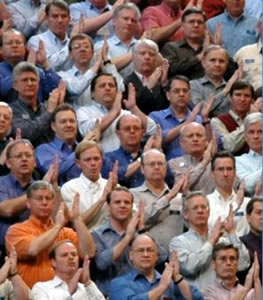
Our church at Central experienced homothumadon here together yesterday morning. Homothumadon is my second favorite Greek word from the New Testament, right behind koinonia. Homothumadon appears throughout the book of Acts to describe a fiery unity. It means passionate togetherness; emotional and active unity; intense and fevered oneness.

We had that here yesterday when we prayed to God together for our dear sister Judy Newton.

I had only anticipated a few of the people sitting around Lanny and Judy would actually gather around her and place their arms around her and hold her hands while we lifted up a congregational prayer on her behalf. She was diagnosed Friday afternoon with a couple of brain lesions in an out-of-the-blue, ambush, rip-the-rug-out-from-under-you, punch to the stomach, what-in-the-world-do-we-do-now kind of way. I was ready to lead that congregational prayer for her yesterday morning, but before I could start, people began getting up and walking over to Lanny and Judy and crowding around her in a spontaneous show of compassion and solidarity.

They came from all over our worship center. Those immediately behind and next to Judy wrapped their arms around her. But then a few people stood up to join them. And then a few more people. They came from a couple of rows over and from clear across the sanctuary. From the front and back and the middle. Young and old. People who’ve known Lanny and Judy for thirty years and people who’ve never met them. Men and women were crawling over people in their own pews to reach Judy. It’s a “preacher’s count,” I acknowledge, but I’m guessing almost a hundred of Judy’s brothers and sisters made their way to be with her during that prayer.

And I was so inspired. Yes, I thought, this is not doing church; this is being church.

As I watched the people stream toward Judy and surround her with love, I also became somewhat intimidated by my pressing task. As I waited and waited and waited while these people kept coming and coming and coming, I began to feel wholly inadequate for wording a prayer that would properly honor these folks, most of whom I still barely know, and these relationships, all of which I haven’t a clue. How could my prayer do it justice? I felt compelled to call on somebody else to lead it. How can my prayer match what I’m seeing?

When I finally started praying, it happened. Homothumadon. Unity in thought. Unity in mind. Unity in purpose. Unity in prayer. I wasn’t the one praying. We were all praying. We were all saying the “amen.” We were all together speaking with groans only the Holy Spirit can communicate to the Father. It was audible. It was genuine. It was together. We were in a fox hole together, as one, lifting this dear sister to the only God who can do anything about her circumstance. We were communicating to the gracious One who is sovereign over pain and disease. We were lifting Judy to the author of life and the destroyer of death. In faith. In desperation. In trust. As one.

We were all blessed by the prayer. Not the words of the prayer which, again, had everything to do with God’s Divine Spirit and nothing to do with me. We were blessed by the unity of the church. I know Lanny and Judy were encouraged and blessed. I know I was inspired. If you were here with us yesterday morning, I know you were moved, too. We all grew together yesterday morning. We matured spiritually as we considered Judy’s needs greater than our own. We grew together as family. And we became more childlike, more Christ like, as we depended solely on God.

E. M. Bounds said prayer does not prepare us for greater works; it is the greater work.

Judy is set for surgery on her brain at 8:00 tomorrow morning, Tuesday October 11.

Pray.

Allan

« Older posts Newer posts »