Category: Jesus (Page 40 of 61)

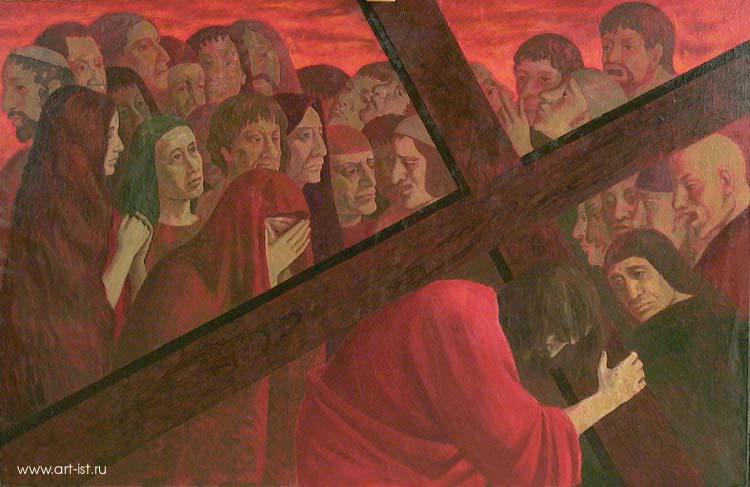
The Anti-Triumphal Entry

March Madness is upon us. I saw a report yesterday that claimed nearly 40-percent of America’s workplaces have some kind of a bracket contest going among employees. I wonder how many churches are involved? I’ve got brackets entered at home against Whitney, here at church with the other ministers and staff, and in an ESPN group of our Central church young families. For the record I’ve got Kentucky, Ohio State, Missouri, and Kansas in the Final Four with the Jayhawks beating Mizzou for the title. Matthew and Greg made fun of my picks this morning. It’s on!

~~~~~~~~~~~~~~

Luke’s portrait of Jesus’ final entry into Jerusalem is striking in its contrasts. The crowd is cheering, but Jesus is crying. The people are shouting and praising; they’re exalting Jesus. But Jesus is crying.

The people believe Jesus has come to purge the nation of their Roman oppressors. They want Jesus to revive the ancient glories of Israel’s heyday under King David. That’s what the people want. And they’re not bashful about it.

“Blessed is the King who comes in the name of the Lord! Hosanna to the Son of David! Blessed is the coming kingdom of our father David! Blessed is the King of Israel!”

Jesus is the only one in this scene who really knows what’s happening. What Jesus is doing as he rides into the holy city is revealing God. What Jesus is doing shows us the heart of God and the plan of God. It shows us what God is all about. This deliberate and determined ride into Jerusalem is an unforgettable statement about the nature of the King and the Kingdom of God. Some people today rejoice in this statement; some people still don’t understand this statement; and some people flat out reject it.

See, Jesus is riding into Jerusalem to die. He’s coming to suffer and die.

This is not like the typical entry into a capitol city of a triumphant king. This is really like the anti-triumphal entry. Jesus does not enter Jerusalem on a white charger or a black horse of war. He rides a lowly beast of burden. He doesn’t carry a bunch of war trophies and a train of captives behind him. In fact, by the end of the week, he’ll be the one led as a captive outside the city gates and killed. Jesus doesn’t share everyone’s hopes and dreams of earthly glory and power. He doesn’t come to establish a kingdom to rival Rome. He comes to suffer. And sacrifice. He comes to die. He comes as a king who will be crowned not with priceless jewels, but with painful thorns. He doesn’t come to sit on a throne, but to hang from a tree. He’s doing the exact opposite of what the people expect out of a king.

Jesus is not a man of chariots and swords; he is the One who brings peace to all nations. His gift is a gift of life, not force or power. The people are expecting a mighty and conquering king; but in Jesus they get a sacrificial servant. And when he doesn’t deliver on their political and economic desires, they kill him.

The people shout, “Hosanna! Save Us!” And when Jesus says, “I will save you, just not in the ways you expect,” they begin to shout, “Crucify him!” When Jesus says, “I am coming to save you in ways that will far surpass in eternal glory anything you or your ancestors ever experienced or even dreamed about with the kingdom of David,” they kill him.

Jesus is not a way for us to get what we want politically or economically or socially or nationally. He didn’t come so we could create a better version of the kingdom of the world. Jesus came so we could be a part of an entirely new and eternal Kingdom of God.

Peace,

Allan

The Leader as Servant

“The Son of Man did not come to be served, but to serve and to give his life as a ransom for many.” ~Matthew 20:28

It is always essential that we love what we are doing. If we don’t love what we’re doing, we’re not going to be very good at it for very long. And we won’t last. The body and the mind and the sense have to all be totally into it. the intellect can’t do much without the aid of the heart and the liver and all the limbs. And vice versa. We have to love what we are doing with all of everything we have. Everything we are.

This is not untrue for those of us in spiritual leadership roles. We must love what we are doing, regardless of the level of difficulty which sometimes reaches “eleven” on a scale of one-to-ten. And we must do it with hearty abandon. The desire to be a leader has to burn like a fire in our bellies. Obviously, that desire to be a leader can’t get the job done alone. There are definitely other conditions and disciplines involved. But unless you truly desire to be a leader, you won’t be. You might wear the title and occupy the office, but you won’t fill the role.

Today, I’m still riding a wave of energy and enthusiasm that built up inside me during our elders/ministers retreat this past weekend. Our positive and productive time together has everything to do with a group of spiritual shepherds who are truly seeking God and wonderful ministers who are serious about following Christ and a gracious Father who continues to bless me far beyond what I could ever deserve. I’m going to reflect more in this space about those powerful 24 hours. Later.

For now, I’m still processing through Leading the Congregation and the four interior attitudes of the leader as presented by Norman Shawchuck and Roger Heuser.

Yes, it takes great desire. We talked about that Friday night. But that desire must be correctly placed. Your desire to serve others must be greater than your desire to lead. As with our risen Lord, leadership is a means of serving. Serving others comes first and then results in Christian leadership. Robert Greenleaf says, “Being a servant leader begins with the natural feeling that one wants to serve, to serve first. Then conscious choice brings one to aspire to lead. That perhaps is sharply different from one who is a leader first, perhaps because of the need to assuage an unusual power drive or to acquire material possessions. For such, it will be a latter choice to serve… The leader-first and the servant-first are two extreme types.”

What’s the difference between leader-first and servant first? Maybe it’s in making sure other people’s highest priority needs are met. The best test, and certainly a most difficult one to administer, in determining one’s own servant-first leadership is to ask, “Are those I’m serving really growing as persons? Do they, while I’m serving them, become healthier, wiser, freer, more likely themselves to become servants?”

Choosing to be a servant-first leader in our materialistic and power-grabbing society is always difficult since it runs counter to the values of leadership for the sake of power and position and wealth. To become a servant leader, we have to lead in a way that reflects what we see in our God.

“That God is beautiful is no secret. It is written on every flower, on the sea, and in the mountains. That God is immense is not secret. All you have to do is look at the unniverse. What is the secret? Here it is: God is a crucified God. God is the one who allows himself to be defeated, God is the God who has revealed himself in the poor. God is the God who has washed me feet, God is Jesus of Nazareth. We are not accustomed to a God like this.”

Peace,

Allan

A Disciple of His

“Everyone wishes very much to be a servant of Christ, but no one wishes to be his follower. No one can love Christ who does not follow the example of his holy life.” ~ Johann Arndt, 1610

“I feel a burning desire to be in everything a complete Christian; and conformed to the blessed image of Jesus Christ.” ~ Jonathan Edwards, 1720

“Whoever wishes to truly understand the words of Christ must try to pattern his whole life on that of Christ.” ~ Thomas a Kempis, 1451

“The object of the Christian religion is to make men and women like Jesus Christ. To the extent that it fails to make us like Christ in our whole character, to that extent it fails to benefit man. The great end to be gained here through the religion he has given us is to make ourselves like him in all that we think, feel, purpose, and do.” ~ David Lipscomb, 1867

“I am again in the pains of childbirth until Christ is formed in you.” ~ Galatians 4:19

I’m captured by the concept of Christ being formed in those of us who are “being saved.” There is no other goal. Giving ourselves completely over to the resurrection of our Savior and the power of that resurrection to save us takes away all of our fears and anxieties about following him. There should be no hesitation. No doubt. We’re not afraid to risk anything because we don’t have anything to risk. We’ve given it all to him. And we trust him to furnish our every need as we become more and more like him.

Rick Ross, the preaching minister at Mesquite at the time, gave me a copy of a discipleship pledge in 2001. He had used it in a sermon on commitment and it really moved me. I’ve kept the copy, fairly tattered now, taped to the top of my desk or tacked to the wall above my computer wherever I’ve been ever since. And I read it everyday. I don’t know who wrote it. I think it was a missionary from maybe nearly a hundred years ago. I think it’s timeless.

I read it to our congregation here at Central this past Sunday. A couple of you have asked for a copy. Here it is:

I am a member of the fellowship of the unashamed.
I have Holy Spirit power.
The die has been cast.
I have stepped over the line.
The decision has been made.
I am a disciple of his.
I won’t look back, slow down, back away, or be still.
My past is redeemed, my present makes sense, my future is secure.
I am finished and done with low living, side walking, small planning, smooth knees, colorless dreams, same visions, mundane talking, cinchy giving, and dwarfed goals.
I no longer need preeminance, prosperity, promotions, position, plaudits, or popularity.
I don’t have to be right, first, tops, recognized, regarded, rewarded, or praised.
I now live by present, lean by faith. walk by patience, lift by prayer and labor power.
My face is set, my gait it fast, my goal is Heaven, my road is narrow, my way is rough, my companions are few, my Guide is reliable, my mission is clear.
I cannot be bought, compromised, lured, manipulated, enticed, or bribed.
I will not flinch in the face of sacrifice, hesitate in the presence of the Adversary, negotiate at the table of the Enemy, ponder at the pool of popularity, or meander in the maze of mediocrity.
I won’t give up, shut up, or let up until I’ve stayed up, prayed up, and preached for the cause of Christ. I am a disciple of his. I must go until he comes, give until I drop, preach until all know, and work until he stops me.
And when he comes back he will have no problem recognizing me.
For I have forgotten all that is in the past, I’m pressing on for the prize, the high calling of my Lord and Savior Jesus Christ.
My colors are clear.
I am a disciple of his.

Peace,

Allan

Packed With Promise

When Jesus looks you in the eye and says, “Follow me,” it’s packed with promise. When the Savior of the World taps you on the shoulder and says, “Do what I do in the ways I do it; follow me,” you must understand that wherever he leads, it’ll be for your own good. His call comes with promises. And his promises always come true.

In Luke chapter five — this is one of my all-time favorite stories about Peter — Jesus calls this first disciple to “put out into deep water and let down the nets for a catch.” And Peter got a huge catch, more fish than his boat could handle. While Peter was up to his hips in flopping fish, while he was scared and disoriented and maybe laughing hysterically, Jesus says to Peter, “Don’t be afraid; from now on you will catch men.” And three thousand people are baptized the first time Peter attempts to preach. Jesus tells Peter he’s got a job for him, and Peter winds up as the cornerstone of God’s eternal Church.

You don’t have to be confident. You don’t even have to be competent to answer the call of Christ. You just have to follow. You just have to be willing to go. The rest is up to Jesus. In fact, it’s all on Jesus.

Jesus is the one who takes the initiative. He calls Peter. He’s the one who changes Peter from the miserable failure of not catching any fish all night to the wild success of all those fresh fish busting Peter’s nets. Jesus is the one who calms Peter in the middle of the chaos and promises him even greater success in matters much more important. Jesus understands the mission, not Peter. Jesus is the one who controls the outcome of the mission, not Peter.

Jesus’ call on your life is packed with his promises.

“Lose your life and I’ll save it. Throw everything away and I’ll give you all things. Be last and I’ll make you first. Serve and suffer in my name and for my cause and I’ll give you eternal glory.”

Don’t you want to go all-out for a Savior like that?

Peace,

Allan

The Leader as a Little Child

While preparing for our upcoming elders/ministers retreat, I’ve read and re-read several parts of Leading the Congregation by Norman Shawchuck and Roger Heuser. I’m particularly interested in chapter two: The Interior Attitudes of the Leader. I’d like to take the next few days exploring their ideas and reflecting out loud here on what it means for me, personally, and for our churches.

“Truly I tell you, unless you change and become like little children, you will never enter the Kingdom of Heaven. Whoever becomes humble like this child is the greatest in the Kingdom of Heaven.” ~Matthew 18:3-4

Shawchuck and Heuser claim the first and foremost quality of religious or church leadership is childlikeness. The disciples were sincere when they asked their Lord who would be the greatest when the Kingdom was finally realized. Their teaching and learning had, for generations, conditioned them to expect a hierarchy within this new Kingdom structure. The hearts of these disciples were filled with ambition; they wanted a Kingdom that would bring them privilege and honor.

In actuality, Jesus came to usher in an eternal Kingdom in which there is no hierarchy and no superiority. No chain of command, no flow chart, no levels of authority or power. And I’ve got to think this not only surprised the apostles, it probably disappointed them, too. They asked Jesus all the time about their particular ranking in the system. “Who’s the greatest? Who’s going to be in charge?” They couldn’t stop talking about it even during the meal that last night in the upper room. It was there that Jesus proclaimed “You are not to be like that! Instead, the greatest among you should be like the youngest, and the one who rules like the one who serves… I am among you as one who serves” (Luke 22:25-28)

They asked the same question over and over again. And every single time Jesus gave them the same answer: The greatest will be as the youngest, and the leader as a servant.

Shawchuck and Heuser say that childlikeness as the model for church leadership should be received as good news, not bad news. It simply means leading the congregation with an attitude similar to a child’s: “…one who opens the self to this reality as a gift, and one who lives and ministers as the least in service to all. This is childlike spirituality and authentic leadership within the Kingdom.”

Just like the aspiring disciples, I sometimes take myself way too seriously. Honestly, I have a real tendency to be devastated by the slightest criticism. I worry if people aren’t taking me as seriously as I think they should. Are they listening to me? Are they taking my suggestions and advice? Are they paying attention to me? Do they like me? Am I important here? That’s insecurity, I guess. It’s definitely not humility or Christlikeness. It exposes a preoccupation with myself and my own status over the needs of the ones to whom God calls me to minister. It’s silly and shallow. Rather immature.

Just the opposite of the childlikeness Christ envisions for his church leaders.

Children take their play seriously, but not themselves. They are transparent without shame. God wants us all to be like youngsters.

Michael Quoist, in his book Prayers for Life, speaks for God on this subject:

I don’t like old people unless they are still children.
I want only children in my Kingdom.
Youngsters — twisted, humped, wrinkled, white-bearded — all kinds of youngsters, but youngsters.
I like children because my likeness has not yet been dulled in them.
They have not botched my likeness.
I like them because they are still growing, they are still improving.
They are on the road, they are on their way.
But with grown-ups there is nothing to expect anymore.
They will no longer grow, no longer improve.
They have come to a full stop.
It is disastrous — grown-ups think they have arrived.

Jesus calls us as church leaders to childlikeness so we will learn to let God carry us as we lead; to let God teach us what we need to learn. All our skills and talents and abilities, all our plans and visions and dreams, none of it really matters. The plan is in our Father’s hand. And we (I) need to run to him like a little child; seeking his love and approval; living to please him not others; giving to serve others, never myself.

Peace,

Allan

Be Careful What You Ask For

“Be careful what you ask for…”

You’ve heard that before, right? Maybe you’ve even said it before. “Be careful what you ask for…”

Why?

“…because you just might get it.”

If my understanding of salvation is correct, God’s Holy Spirit is transforming us, changing us into the image of Christ. “Christ in us” is our hope of glory. We are being transformed “into the image of Christ with ever increasing glory.” Paul calls this “being saved.” It’s a process. It’s a journey. It’s a gradual becoming.

And it involves suffering.

Jesus made it plain: “All men will hate you because of me” (Matthew 10:22).

“If the world hates you, keep in mind that it hated me first” (John 15:18).

Paul knew it, too: “Every one who wants to live a godly life in Christ Jesus will be persecuted” (2 Timothy 3:12).

See, we don’t normally think this way. We preach and teach, we believe and confess that if the whole world acted more like Jesus everybody would love everybody. If we thought and behaved more like our Lord, people would love us and be attracted to us. The Scriptural truth and the ultimate reality is that if we become more like Jesus, people will actually hate us. It’s unavoidable. If you want a safe, untroubled, comfortable life free from danger, then stay away from Jesus! The danger and risk and exposure to suffering increases in proportion to the depth of our relationship with the Christ.

Maybe this is why we sit back and settle for a casual relationship with Christ and just routine religion in the church. It’s safe at most churches. And, the way most of us do it, it’s actually pretty popular to be a Christian and go to church. As long as we’re pursuing the same goals and values and uphold the same ideals as everybody else in the world, even if we put a Christian label on it, the world’s cool with us. As long as our Christianity looks like the American Dream, we’re not going to have many problems.

But Jesus says, “Everyone who is fully trained will be like his teacher” (Luke 6:40).

Our Teacher was mocked and beaten and ridiculed and persecuted and betrayed and murdered. He suffered and sacrificed and bled and died. Do we really want to be like him?

“It has been granted to you on behalf of Christ not only to believe on him but also to suffer for him” (Philippians 1:29).

Peter says we shouldn’t be surprised when it happens. Paul says we should consider it a joy. Scripture upholds that suffering is a gift. Christ gives us a gift — suffering. It’s a blessing. It’s a grace. It’s transformational. It’s life; eternal life. It’s discipleship; being like Jesus. Sanctification; being changed. Salvation; being saved.

Make me a servant; Lord, make me like you.

Be careful what you ask for.

Peace,

Allan

« Older posts Newer posts »