Category: Discipleship (Page 14 of 30)

Delight in the Law of the Lord

“Blessed is the man who does not walk in the counsel of the wicked
or stand in the way of sinners
or sit in the seat of mockers.
But his delight is in the law of the Lord,
and on his law he meditates day and night…
For the Lord watches over the way of the righteous,
but the way of the wicked will perish.”
~Psalm 1

The first psalm asserts that how one responds to Scripture, how a person responds to the revelation of God in Torah, will determine that person’s ultimate destiny. When it comes to the Law of the Lord there are two choices, two paths. Moses gives us two paths in his farewell sermon on the mountain and says, “Choose life.” Jesus gives us two paths in his sermon on the mountain and says, “Choose the straight and narrow.” And the psalmist does a similar thing.

By using both positive and negative examples, the psalm encourages us to adopt the fruitful and satisfying life that’s characterized by complete immersion in God and his Word. So immersed in the Word of God, so focuses on the Law of the Lord, that it shapes and dominates your worldview. This is the way of the righteous. And God watches those who walk in that way. By contrast, the one who does not delight in the Law of the Lord is shaped by the counsel of the wicked. He is formed in the way of sinners. Those who walk in this way will perish.

It’s a choice.

God speaks. God reveals. He calls. God makes his holy character and perfect will known through Torah, and what we do with that word is everything. It’s the difference between growing as a fruitful tree and fading away as useless chaff. It’s the difference between well-watered and well-nourished stability and dry, dusty, windblown impermanence. Two choices: the way of the righteous that God oversees and the way of wickedness that leads to destruction. It’s the wise man and the foolish man building their houses in Matthew 7. The only difference between the two men is attention to and obedience to the teachings of Jesus, hearing the Word of the Lord and putting it into practice.

Our God does not reveal himself to be catalogued and studied; he reveals himself to be followed. Our God does not speak to be heard; he speaks to be obeyed.

You ask your daughter to fold the clean towels and put them away in the cabinet (this is purely a hypothetical situation). You come back in twenty minutes and the towels are still in a wad on the couch and the same daughter is sitting in the same spot watching the same TV, only now she’s eating a Pop Tart. And you say to your daughter, “Did you hear me?!?” By that, you don’t mean, “Did the sound waves caused by the vibrations in my tongue and throat penetrate your ear canals to be carried to your brain where they are deciphered into understandable language?” When you say, “Did you hear me?” you’re actually saying, “Why didn’t you obey me?”

To delight in the Law of the Lord, to meditate on it day and night, is to do it. Hearing is doing. Faith is acting.

The Word of God is powerful. It changes lives. It alters destinies. In 1 Thessalonians, Paul acknowledges the Word of God that “is at work in you.” In 2 Timothy, he claims that Scripture equips a man for every good work. Not doctrinal perfection. Not knowledge about facts and patterns. Paul says it leads to action. Hearing is doing. The righteous one delights in the Law of the Lord and meditates on it day and night not to know more. To become more. We don’t learn or study Scripture as much as we ingest it. We assimilate it. We take it into our lives in such a way that it becomes a part of us and it metabolizes into this fruit: acts of love, cups of cold water, prison and hospital visits, cakes baked, groceries delivered, comfort and encouragement, evangelism and justice.

When Samuel was confronted with God’s voice, he replied, “Speak, for your servant is listening.” James says to not just hear the Word, but to do it.

“I desire to do your will, O my God; your law is within my heart.” ~Psalm 40:8

Peace,

Allan

Don’t Be a Horse

“I will instruct you and teach you in the way you should go;
I will counsel you and watch over you.
Do not be like the horse or the mule, which have no understanding
but must be controlled by bit and bridle or they will not come to you.”
~Psalm 32:9

I won’t be like the horse or the mule. Every day I will come to you, Lord. Every day I will sing to you. I will pray to you. I will listen to you. I will talk to you every day. I will look for you, God. I will obey you. I will submit to you. Lord, I will follow you. I will come to you.

God, in your mercies, give me the power to keep these promises to you.

Your undeserving and grateful servant,

Allan

In Solidarity with Sinners

Most disciples of Jesus would profess that churches are called to make a public witness to Christian faith. But it seems that more and more of us disagree with what that witness should look like and how it should function. What does it mean for the Church to testify to the truth of Christ Jesus?

I’ve recently come across a review of a yet-to-be-released work by Jennifer McBride called The Church for the World: A Theology of Public Witness. McBride is a theologian and author who teaches at Wartburg College in Iowa. The review and an accompanying interview with McBride are in the December issue of Christian Century. But — D’oh! — I can’t link you to them because the articles are only available online if you’re a subscriber. I’m intrigued by the interview, written and conducted by David Heim. And I’d like to spend this space this week breaking it down. Yes, I’ve ordered the book. So, there may be more of this coming in a couple of weeks.

In response to Heim’s first question, asking the author to elaborate on an assertion that Christian public witness has gone bad in the United States, McBride says:

“The main problem is that Christian presence in public life tends to be triumphalistic. The purpose of Christian witness is to point to Jesus and the reign of God he embodies, but a triumphal presence actually contradicts Jesus’ way of being in the world as depicted in the Gospels.

The triumphal character of Christian witness has contributed a good deal to how polarized our society and churches have become. Christians so thoroughly disagree about war, sexuality, ecological care, immigration and other issues that we wind up on opposing sides of the political spectrum. This is cause for great concern, because partisan politics ends up defining what is Christian; it shapes the way we think and speak about public issues.”

I’ve wondered a lot about this in the past dozen years or so. The Church that I see and experience in the heart of the Bible Belt in the Southwest United States has become so politically juiced that it’s become difficult to think or speak theologically if one Christian’s understandings of Gospel oppose another Christian’s understandings of country or patriotism. Have you noticed? Some Christians will unapologetically claim that one cannot be a true disciple of Christ if she belongs to a certain political party or adheres to a certain political belief. Farther along, and worse, in my judgment, is the way the Church’s identity has been compromised by our embracing the world’s politics. We have become so entangled in the sheets and blankets of the dirty bedrooms of American politics that we are labeled as “right wing” or “conservative” or “Republican” by outsiders we’re trying to convert to Christ. Non-Christians are attaching to the Church the same corruption, deceit, ethics, and behaviors that characterize the worst kinds of politicians. “Tea Party” and “Christian” are becoming synonymous in our culture. And we have only ourselves to blame.

Who do we think we are, seeking or claiming some kind of privileged status in the government or in American society at large? What makes us believe it’s good to force others — by boycott, insult, petition, million-dollar campaigns, attack ads, holier-than-thou attitudes, pamphlets, protests — to live by the same standards we profess as Christians? Why are we so surprised that the more the Church gets caught up in this world’s politics, the more noise we make about legislation and ethics, the louder we claim to have all the answers for how everybody in the world should live, the less and less interested the world is in Christians? Is it really any wonder that society is hostile to us?

You’ve noticed, right? Generally speaking, Christians are now portrayed by the media and understood by the culture as angry, anti-abortion, anti-homosexual, shove-it-down-your-throat, power-hungry, politicos. It wasn’t too long ago we were merely thought to be irrelevant. Too nice. Too naive. Now it’s become just the opposite. Pay attention to our general attitudes. Notice the worldly lengths to which we’ll go in order to get our way. Christian prayer has to be mandated in the public schools, but not Muslim prayer. Christian marriage has to be recognized as legal, but not homosexual marriage. The Ten Commandments must be displayed on the courthouse wall, but not the tenets of Buddha. Christian churches should be exempt from local and state taxes, but not a mosque. Really? Should the Church of Jesus Christ be seeking or claiming some kind of privileged status in government? Should Christians receive more and better benefits from the world’s governments than anybody else? On what basis? At what cost?

We are setting ourselves over and above others, claiming by our words and actions to know more and to be better than everybody else, in direct contradiction to the way our Lord lives on earth. More from McBride:

“We tend to think that as the sinless one, Jesus distinguished himself from sinners by setting himself up as a model of ethical perfection. But Jesus was in solidarity with sinners in at least three main ways that define his person and work.

First, as God incarnate, he assumed sinful flesh, as Paul says in Romans 8:3. He took on human nature’s damaged state and through his body became intimately acquainted with the complexity and messiness of fallen existence.

Second, he begins his public ministry by being baptized with sinners in response to John the Baptist’s call to repent and in this way ‘numbers himself with the transgressors’ (to use Isaiah’s language about the suffering servant).

Third, and finally, refusing to be called good (Mark 10:18), he instead accepts responsibility for sin as a convicted criminal on the cross. Throughout his ministry Jesus denies any claim about his own moral righteousness and instead actively accepts responsibility for the world’s sin and suffers on the cross out of love for fellow human beings.”

What would it look like for the Church to be in solidarity with sinners? To identify with sinners? To be one with sinners? To recognize every day our own sinfulness in the presence of sinners? To sympathize with, to minister with, to be seen with, to learn with, to walk alongside sinners? What would that look like? How would that improve our Christian witness? In what ways would it transform us more into the image of our Lord? How might it change the world?

Seems to me, it’s got a much greater chance of making an impression than another angry ad or fiery Facebook post.

Peace,

Allan

Short Cuts and Dead Ends

“Whoever claims to live in him must walk as Jesus did.” ~1 John 2:6

Have you ever cut through a parking lot in an effort to avoid a red light or a traffic jam, to reach your destination a little more quickly, only to find yourself at a dead end or farther away from your objective than you were when you began? It used to happen to me a lot. It still does occasionally. Carrie-Anne just smiles patiently in the seat next to me as I wind my way through a strip center parking lot looking for a way out.

The desert temptations of Jesus show us a picture of the devil, our Adversary, and his method for pushing us to take spiritual shortcuts. Satan is forever attempting to subvert our walk with God by offering us a shorter path, a quicker route. And they always turn into dead ends.

In response to those temptations — Satan uses our culture to lure us down the wrong path every hour of every day — we must rely on our Father and walk the difficult road with him. Anything we do independently of God and his way expresses a lack of connection, a lack of faith.

Jesus never rationalizes his way out of God’s will. He could very easily have thought that God did not want his Son to starve or suffer rejection or die, so why not turn those stones to warm, fluffy loaves of bread? Why not eschew the cross for a more politically relevant and efficient way to win the throne? Why not? The Kingdom was going to belong to him anyway, so what did it matter how it came into his hands? But our Lord never entertained an end-justifies-the-means viewpoint.

Our charge is to follow him, to follow his way, in making sure the shortcuts that inevitably present themselves to us do not in fact reflect a lack of faith. Or any rationalization to avoid Gods’ holy will and very, very different way.

Peace,

Allan

The Time Has Come!

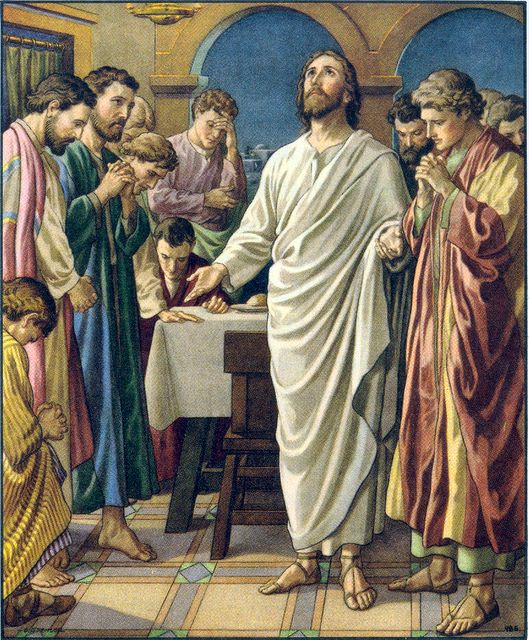
“Father, the time has come. Glorify your Son, that your Son may glorify you.” ~John 17:1

Jesus begins his prayer in John 17 with the words, “The time has come.” And, of course, we know he’s talking about his death. The time has come for Jesus to die, and that’s going to bring glory to God. We wouldn’t think death and glory belong together. We would think death and glory are opposites. We see glory as brightness, not night. We view glory in terms of celebrity, not mockery. Glory to us is fortune and fame, health and wealth, not suffering and death.

Jesus prays that he will be glorified and that, in turn, so will God. Just a few hours later, that prayer is answered. Jesus is dead.

The scandal of our religion is that our King reigns from a cross. Jesus does not destroy all evil and save the world through the exercise of power and control; he does it with supreme humility and selfless sacrifice. He dies. The disciples in the room with his this night will die similar deaths. Those deaths all brought glory to God. Death and dying is our salvation. Death and dying is glory.

We don’t come to the cross of Christ to worship his death or to remember the grisly details of that day. We come to the cross — we’re actually drawn to the cross — to see what it looks like for us to die. People say Jesus died so we don’t have to. No, that’s not right. Jesus died to show us how to. Paul says, “I have been crucified with Christ!” He tells the Corinthians, “I die every day!” He tells us in Colossians 3, “You died and your life is now hidden with Christ!”

God’s Church does not exist to serve itself. It’s not even intended to serve Christ. The Church is established to serve like Christ. To serve with Christ. To serve as Christ. We are instruments of God’s reconciliation of the world through Jesus, so we die every day in order to make the Word of God’s salvation fully known (Colossians 1:24-25). Dying with Jesus reflects our sense of unity with the Son of God. We have been buried with Christ, raised together with Christ, and been given brand new life together in Christ. As the body of Christ, we have a corporate personality. And that personality should be one of daily dying with Jesus for the sake of the world and to the glory of God!

The biggest problem with God’s Church in today’s context is our cowardly retreat from the high demands of the Christian faith. We run from it. We try to hide from it in our church buildings and Bible classes, in our carefully-orchestrated worship services and efficiently-run programs. Chesterton says — and I love this — “Christianity has not been tried and found difficult; it’s been found difficult and never really tried.”

Our setting today is no different from when Jesus was praying with those disciples after that last meal. It’s the same for us today as it was when Paul was writing his letters. The Church of God needs inspiring heroes; we need great daring and risk-taking; we need monumental sacrifice. The time has come for us to die. To die to our own dreams and desires. To die to our own grabs for money and power and control. To die to our own obsessions with recreation and politics and home improvement. To die to our addictions to entertainment and technology and consumerism. The time has come for disciples of the holy Messiah to die.

There’s a small child in your church, there’s a teenager in your neighborhood, who will come alive if you’ll only die for him. There’s an older woman on your street who will be re-born if you’ll just die for her. There’s a divorced dad in your office — you’ll see him in the morning! — who will be filled with resurrection hope if you’ll die for him. There’s a depressed immigrant, an unemployed neighbor, a suicidal senior, a confused girl, a sick soul, an abused woman, a guy on probation, a hungry child, an overworked mom — there are people you know who will live, really live, if you’ll just decide to die.

Peace,

Allan

The Work We’ve Been Given To Do

“Father, the time has come. Glorify your Son, that your Son may glorify you.” ~John 17:1

Jesus begins his very public prayer at the end of that last meal with his disciples acknowledging that the time for him to die, to glorify the Father in a selfless act of unconditional love, was at hand. The hour had come. It was here. It was time. The prayer is certainly set in and around the context of his impending death. But for a brief moment at the beginning of this prayer, Jesus allowed himself room to reflect for a moment on his brief earthly life and ministry.

“I have brought you glory on earth by completing the work you gave me to do. I have revealed you…”

Jesus always told people if you had seen him, you had seen the Father. If you knew Jesus, you knew the Creator of Heaven and Earth. Yes, Jesus revealed God to the world. Jesus reveals God’s glory. Jesus allows us to see God. Jesus allows us to experience God. Jesus’ compassion shows us God’s compassion. Jesus’ mercy shows us God’s mercy. Jesus’ gentleness shows us God’s gentleness. Jesus’ intolerance for religious people who judge others and think they’re better than everybody else shows us God’s holy intolerance for religious arrogance and pride. Jesus’ love and forgiveness shows us God’s great love and forgiveness. Revealing God — this was a large part of the work God had given Jesus to do.

And, to borrow the powerful language from Christ’s prayer, the time has come for the Church of God to do the work God has given us to do. The time has come for us to reveal our God to the world. If we don’t, who will?

This world is full of cops and lawyers and judges and juries who accuse and prosecute and punish. The time has come for God’s people to be the ones who forgive. The world is full of writers and broadcasters and politicians who spread hate and fear in order to divide and conquer. The time has come for Christ’s followers to be the ones who spread love and hope in order to reconcile and restore. The world is full of soldiers and generals and armies and kings who take and kill in the name of country and security. The time has come for Christ’s Church to be the ones who give life, who give resources, who give of themselves, who give and give and give in the name of the One who came not to be served but to serve and to give his life as a ransom for many.

The time has come for us to complete the work we’ve been given to do, to reveal the love and grace of Almighty God to a world that does not know him. If we don’t, who will?

~~~~~~~~~~~~

I’m not playing “Taps” for the Rangers just yet. It’s not completely over. But this team is on life support. They’re barely breathing. The family’s been called in. The grandkids are gathering photos for the slide show. It’s not looking good.

The Rangers have lost four straight and nine of their past eleven games. They have been shut out — zero runs! — in three of their past four games. The Rangers haven’t scored a run in 21 straight innings. They have scored three runs or fewer in twelve of their past fifteen games and hit .177 with runners in scoring position during this same fifteen game stretch, including yesterday’s 0-3 showing in Cleveland. As of this very moment, Texas is six games back of Oakland in the AL West and fourth in the Wild Card standings. Worse than that, yesterday marked the 30th consecutive day the Rangers have not made up ground in the division. They’ve gone a full month now either staying put or losing ground to the A’s.

Yikes!

I’m still convinced that Nelson Cruz will be suspended this coming weekend, probably Friday, for the remainder of the season. So now the Rangers need at least two or three brand new bats, not just one or two. I was hopeful that the Garza signing would spark something in these guys. No, it hasn’t. And I’m afraid Ron Washington’s 45-minute closed door team meeting after yesterday’s embarrassing effort won’t do it either.

We’ll know for certain this time next Monday whether to pull the plug on this team. Texas plays the Angels in a three-game set in Arlington beginning tonight and then go head-to-head with the A’s in Oakland this coming weekend. So, come Monday, we’ll know.

It’s been three or four years since Cowboys pre-season football was more interesting than watching the Rangers.

Crud.

Allan

« Older posts Newer posts »