Category: Confession (Page 3 of 6)

Who Am I?

Who Am I?
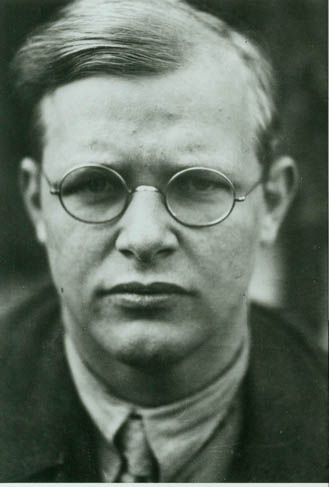
by Dietrich Bonhoeffer, 1944

Who am I? They often tell me
I step from my cell’s confinement
calmly, cheerfully, firmly,
like a Lord from his manor.

Who am I? They often tell me
I speak to my jailers
freely, friendly, firmly,
as though they were mine to command.

Who am I? They also tell me
I bear the days of hardship
unconcerned, amused, proud,
like one accustomed to winning.

Am I then really that which other men tell me?
Or am I only what I myself know of me?
Restless and longing and sick, like a bird in a cage
struggling for breath as though hands were compressing my throat,
yearning for colors, for flowers, for songs of birds,
thirsting for words of kindness, for human company,
quivering with anger at despotism and insults,
anxiously waiting for the next event,
helplessly worrying for friends at an infinite distance,
weary and empty at praying, at thinking, at working,
exhausted, and ready to say farewell to it all.

Who am I? This or the Other?
Am I one person today and tomorrow another?
Am I both at once? A hypocrite before others
and by myself a contemptible, whining weakling?
Or is something within me like a beaten army
fleeing in disorder from a victory already achieved?

Who am I? They mock me, these lonely questions of mine.
Whoever I am, you know me, O God. I am yours!

Good for the Soul

Has it been awhile since you openly and honestly confessed your sins to our Father? When’s the last time you got down on your knees, alone in the presence of our Holy God, and confessed your shortcomings and failures? These days between Ash Wednesday and the first Sunday of Lent are a good time to re-engage this scriptural, historical practice.

Maybe you have a hard time getting started. If so, I would humbly suggest something like this. It’s both a terrible and beautiful experience for me. It’s devastating and liberating. Not easy at all, but needed. Desperately needed.

Block out twenty minutes when you can be totally alone with our Father. Not in the back bedroom of a crowded house, I mean in the back bedroom of an empty house. Totally alone. Nobody around. If you have to go to the shed in the backyard, do it.

Now, physically get down on your knees and physically open your hands with your palms up toward heaven. Now, just sit there in silence for a full five minutes — no cheating! —- in the presence of God. After those five minutes, read one of the penitential psalms to the Father out loud. I’m partial to Psalms 32 and 51, but you could go with Psalm 6, 38, 102, 130, or 143.

At this point, I am acutely aware of the presence of God and my own sinful soul. Like Peter, my first thoughts are, “Get away from me, Lord, I am a sinful man!” My feelings are like those of the prophets who proclaimed their own demise in God’s presence. I am ruined. I am dead. I am not worthy. And then I confess my sins out loud to God. And they are many.

I believe the silence and the physical posture of humility and prayer and the holy words of the psalms work together to prime the pump so that what’s in the deepest part of my soul comes gushing out.  It can’t be stopped. And it needs to come out. I need to be open and honest about my sins with my loving and forgiving Father. I need to experience his forgiveness and his blessing, his pardon and approval.

You do, too.

Whatever it takes. Don’t let Sunday come without spending some time in personal confession with our God.

If you need another suggestion, you might consider the words of this prayer of confession we prayed together with our brothers and sisters at First Presbyterian during yesterday’s Ash Wednesday service:

Holy and merciful God, I confess to you that I have sinned by my own fault in thought, word, and deed by what I have done and by what I have left undone. Have mercy on me, O God, and in your mercy, cleanse me from all unrighteousness. Hear me now, as I continue to confess my sins to you…

Most Christian traditions begin every worship assembly with a time of corporate and personal confession. We don’t. We have to work on it. Now’s a good time.

Peace,

Allan

Faith is Our “Yes” to God

“No matter how many promises God has made, they are ‘Yes’ in Christ. And so through him the ‘Amen’ is spoken by us to the glory of God.” ~2 Corinthians 1:20

amenblackWhen we say “Amen” (this is true, I believe this, may it be so, etc.,) when we believe the promises of God, God is praised because, as the passage continues, he is the One who makes you stand firm in Christ. God has established you securely in his Son. You’re not going anywhere and neither is God. God is given glory because he has anointed you, he has called you out and set you apart to work in you and through you for his salvation purposes. And God is the One who has taken you as his own. He has put his stamp on you, he’s placed his Spirit in your heart to prove that what he has said, he will do. And he’s going to fulfill his promises.

The Bible is not fundamentally about us. Scripture is about God. The Bible is not about me and my present and my future — it’s about what God has done and what he’s doing right now and what he’s going to do tomorrow. When I say “Amen” or “I believe,” I say I trust God and I’m banking my whole life on his holy Word.

“My purpose is that you may be encouraged in heart and united in love, so that you may have the full riches of complete understanding, in order that you may know the mystery of God, namely Christ, in whom are hidden all the treasures of wisdom and knowledge.” ~Colossians 2:2-3

As you reflect on the promises of God and his faithfulness, as you fix your eyes on Jesus and see and experience how God is fulfilling those promises through Christ for you, the more you read it and talk about it and pray it and share it — an “Amen” will start to develop in your heart. An “Amen” will form and grow in your soul. “I believe.” “So be it.”

Think about God’s “Yes,” his “Amen” to us. Spend time with that. And his Spirit will stir up in your heart a responding “Yes,” your own resounding “Amen” to our Lord’s eternal glory and praise.

Peace,

Allan

Confession at the Cross

Beware of exploring the spiritual disciplines. Practicing the traditional disciplines will force you to confront your sins. I know this first hand. Silence before God or a prolonged meditation on a Psalm tends to bring out the honest truth of your relationship with the Father. Fair warning. There’s no hiding it when you’re in that place with our God.

Yesterday at Central, we explored a few of the historic spiritual disciplines together. We began with our middle school and high school students reciting a prayer of invocation written by Walter Brueggemann in 1996 and ended with a benediction penned by John Newton in 1779. We prayed the Lord’s Prayer together at the table and we observed two moments of silence around Psalm 32. And we confessed.

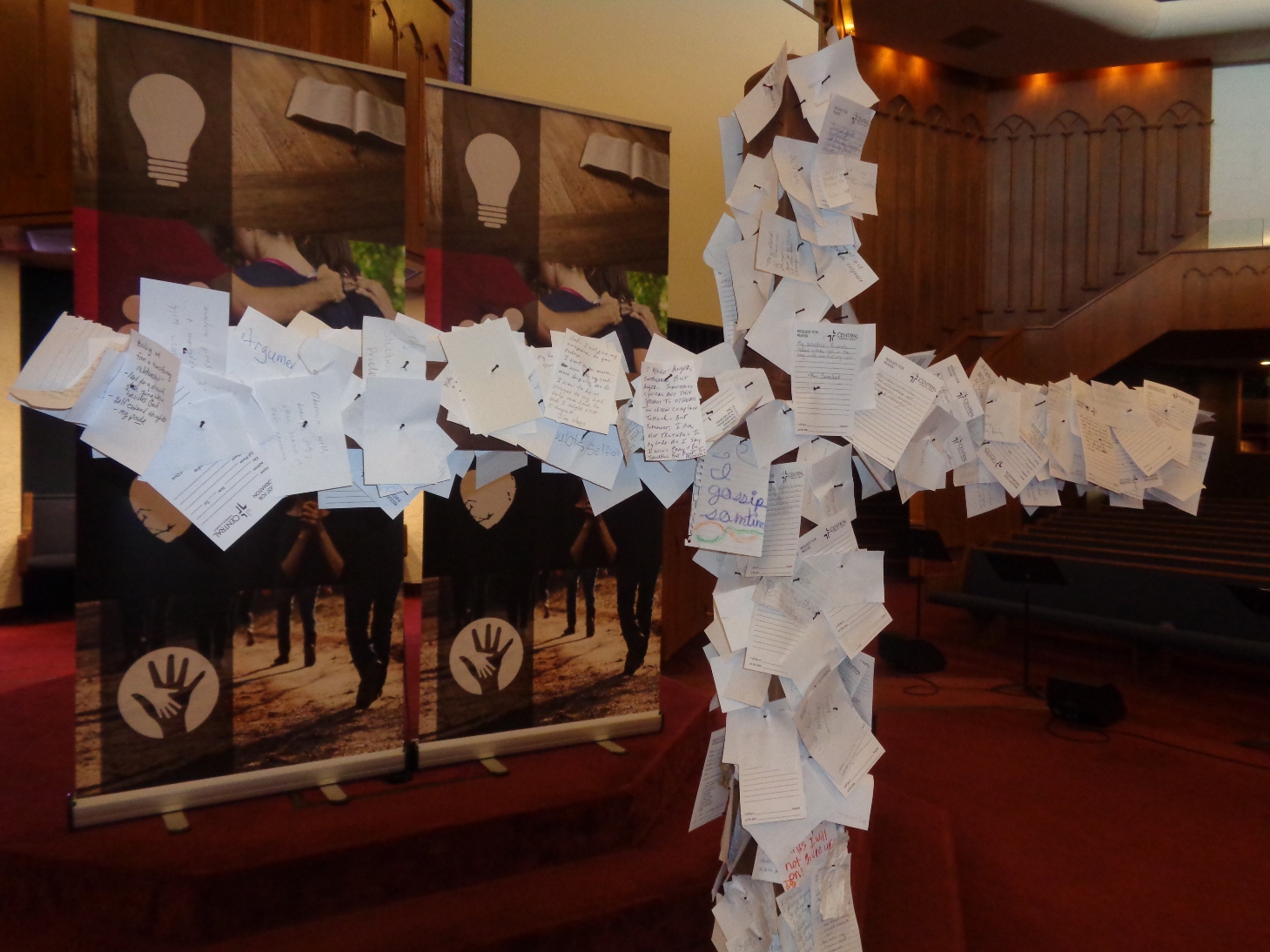
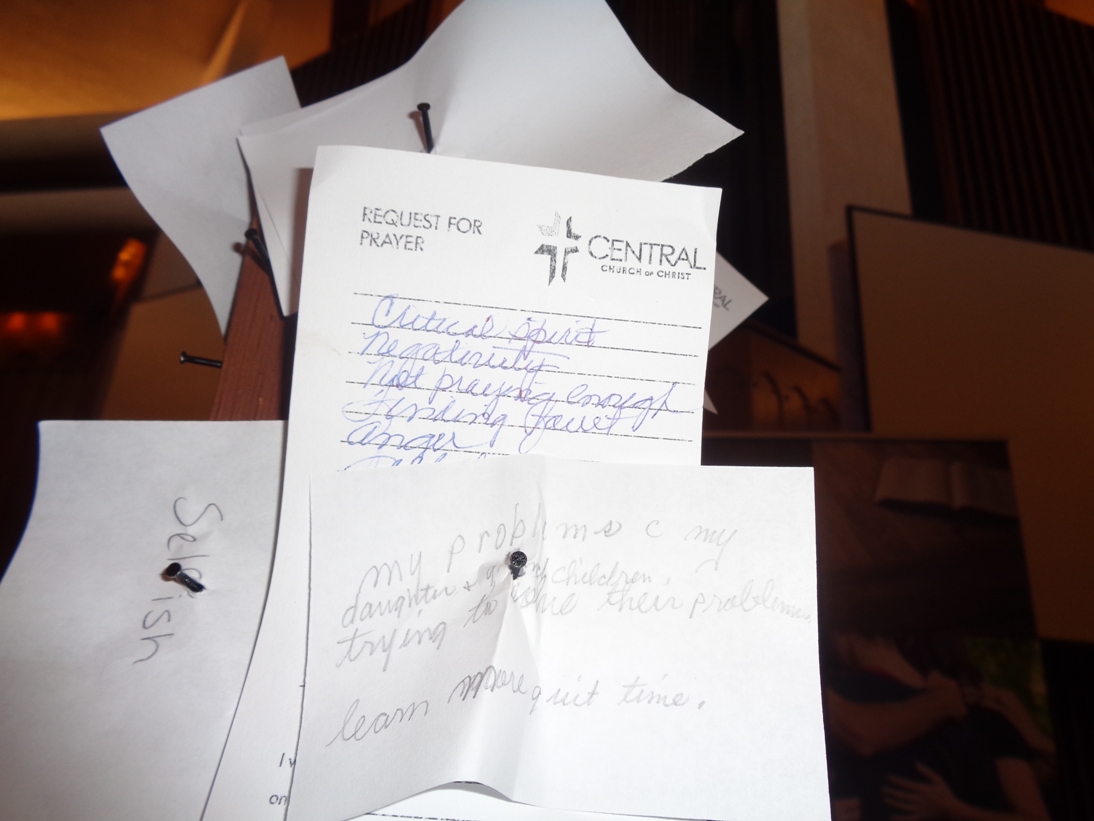
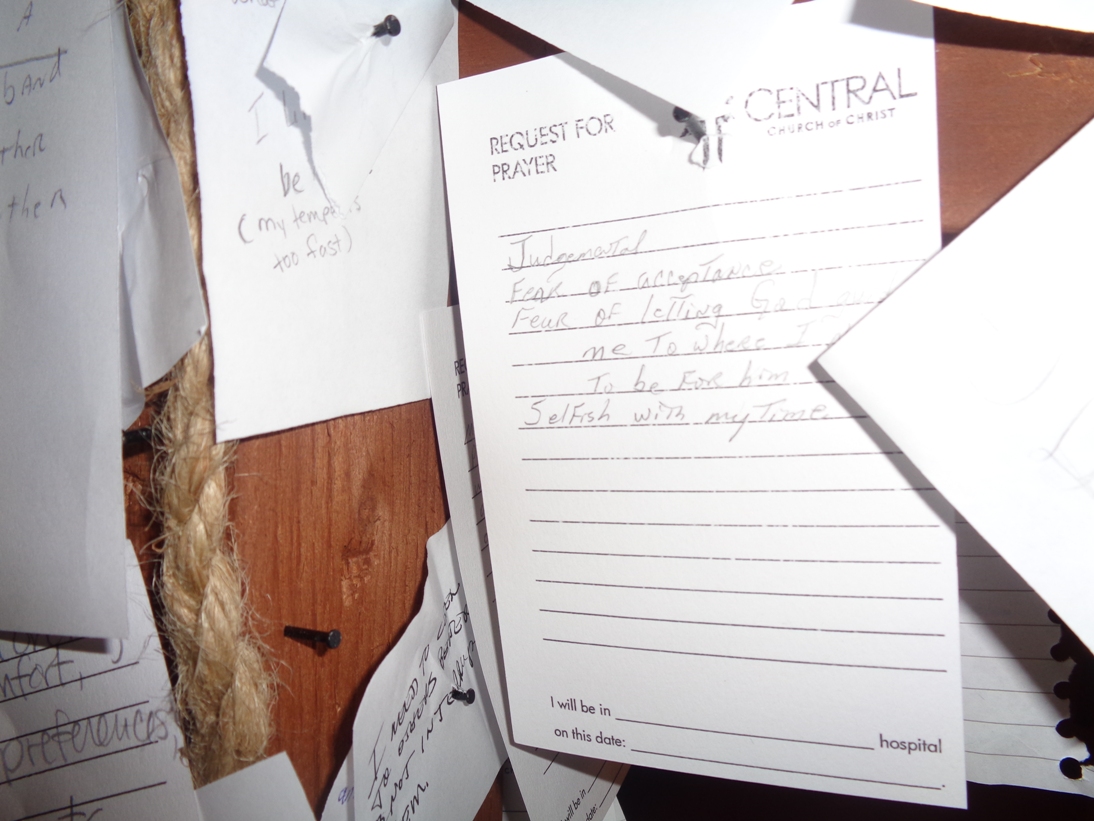
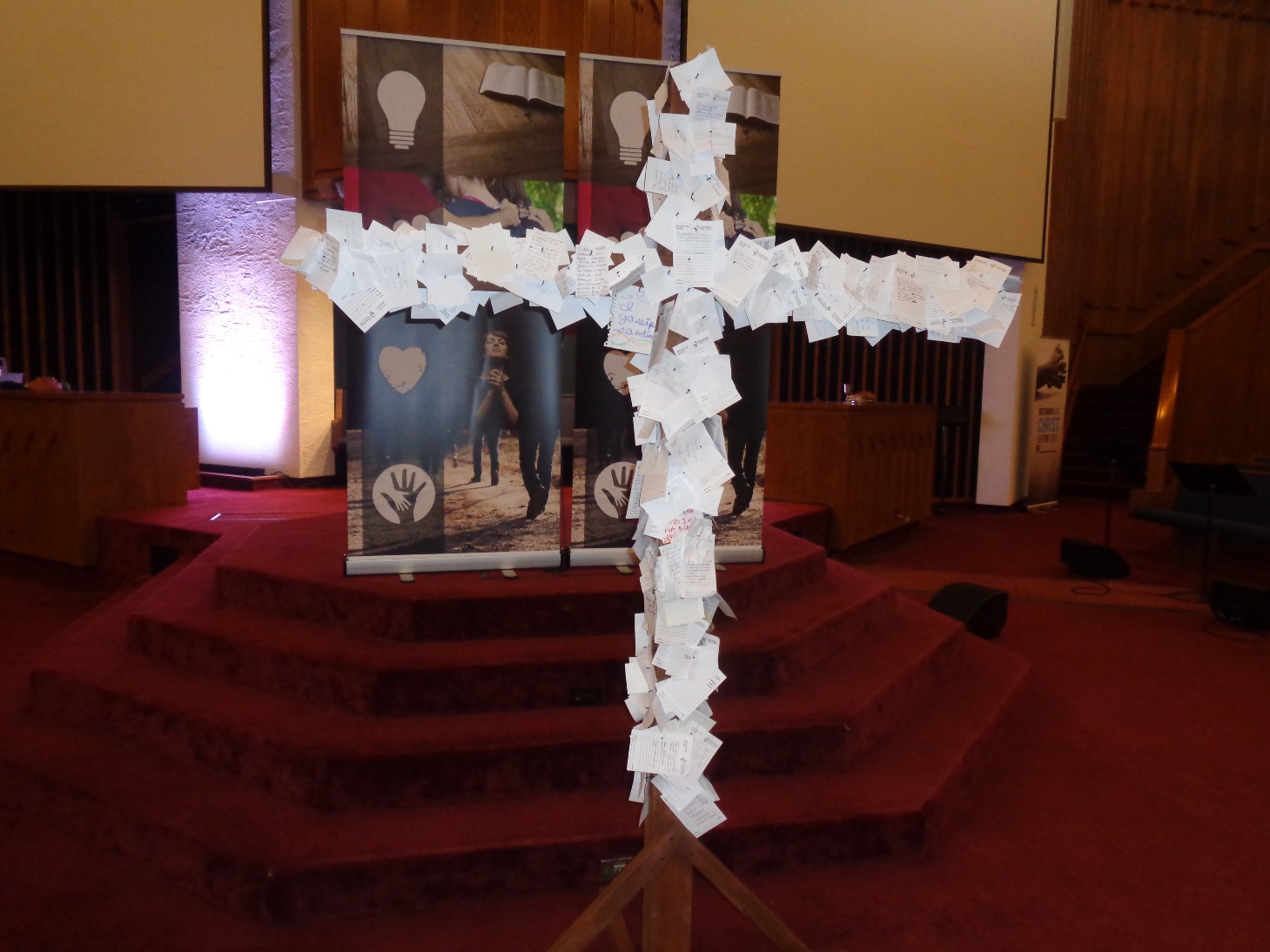
The inner life is about being in a place with God where he can work on you. And as we commit as a church family to pursuing a more holistic discipleship, which includes the traditional disciplines, confession just seemed like a good thing to do. If we’re going to be in that place with God, we’ve got to be up front with him about our sins. So we wrote down on pieces of paper the things that are wrong in our lives that need to be fixed by God, the attitudes of our hearts that need to be redeemed by God, and the situations in our lives that need to be given completely to him. And then we placed them on a large wooden cross at the front of our worship center.


The cross of Christ represents forgiveness and restoration and new life. It stands for a trust in God that he is bringing to completion that thing he has started in us. It reminds us that our Father has promised to make all things right — if things aren’t right in my life, it means that God’s not finished yet, he’s still working. So, after dwelling in Psalm 32 (“I acknowledged my sin to you and did not cover up my iniquity. I said, ‘I will confess my transgressions to the Lord’ – and you forgave the guilt of my sin.”) we brought our sins and our attitudes and our lives to the cross and left them there.

And they’re still in there.


I’ve walked in to our worship center twice already today to spend some time at that cross. I read the confessions, I see the lists of sins and attitudes that plague our people, and I can relate to a bunch of them. Reading the words on that cross today, praying for the people who wrote those words and placed them on the nails on the cross, brings to light sins and attitudes in my own life that I haven’t written down or even acknowledged yet that need to be forgiven and transformed by God.

I don’t ever want us to come into the worship center on a Sunday morning Just As I Am and leave an hour-and-a-half  later Just As I Was. Part of that corporate assembly experience is to be changed by God. Confession is good. Silence is good. Embracing a contemplative posture in the holy presence of God is good. You can’t hide anything when you get into that place with God. And it’s impossible to stay the same.

Peace,

Allan

Returning to the Lord

The first Sunday in January is a good time for a congregation of God’s people to renew our dedication to the Lord. It’s the perfect day to start over, to renew vows, to make fresh commitments. And in Scripture, a lot of the time, when God’s people seek renewed relationship with the Lord, they begin with corporate confession and repentance.

Using biblical texts from 1 Samuel 7, Ezra 9, and Daniel 9, we spent this past Sunday together at Central confessing our corporate sins as a 107-year-old body of believers. We talked about the sins of pride and racism, legalism and sexism, self-reliance and apathy, consumerism, materialism, sectarianism. We haven’t committed all these sins ourselves. Our leadership and our church today are not guilty of all those sins. But in the history of our congregation and in the history of Churches of Christ, we have all been guilty of all of it. Some of these sins we still commit. All of them still impact us to some degree. So, in the manner of God’s people as described in Scripture, we confessed.

One of our shepherds, Tim McMenamy, worded a heart-felt, gut-wrenching prayer of confession from his knees on behalf of the church, recalling the sins of our past and the sins of our present. Another of our elders, Steve Rogers, led a prayer of corporate repentance from his knees, making vows to God on behalf of the congregation that we would renounce the sins of our past and present and seek only the Lord and his ways. And then we offered the church some time to confess their own sins, sins in their families, sins from their distant past, or sins that have them ensnared in the present. Our elders and ministers and our spouses were positioned all around the worship center to graciously receive and pray for our people. We lifted them up to God and begged him to provide his promised forgiveness and righteousness and peace.

It was different. It was very quiet in there. And powerful. Only a few, it appeared, actually took advantage of the opportunity. But those who did experienced those blessings of forgiveness and righteousness and peace.

Immediately after the service concluded, several people came to me to thank me for the special focus of the morning and for the way the assembly had been planned. And I think I must have expressed — non-verbally — some disappointment in the visible response from our congregation during the time of confession and repentance. One of my many, many faults — one I should probably confess regularly before the church — is my sin of impatience. I’m terrible with that. I don’t very much of the time practice what I preach there. And I do a lousy job of hiding it. But, good grief, of all people the preacher should know that God is at work in powerful ways that we don’t always get to see.

And Clay Harper reminded me of that Monday.

Clay called me on the carpet for my disappointment. That’s what good and faithful Christian brothers do; that’s what happens in genuine Christian community. And then he reminded me of the truth I had preached the day before, that God answered the prayers and provided the promised blessings regardless of how engaged the people were in what was happening.

In Samuel, the people approached the prophet looking for ways to fix their relationship with God. They begged him to intercede for them and participated fully as a congregation in the prayers of confession and repentance. In Ezra, the leaders of the people came to the prophet and the people (a lot of them, but maybe not all of them) eventually followed and participated in the confession and repentance, some of them under the threat of loss of their property. In Daniel, it doesn’t look like anybody else is there. The prophet prays confession and repentance to God on behalf of the people, but there’s no indication anybody has any idea he’s doing it.

More than likely, we have people in our church family located at every point on that continuum. From begging to make things right with God and willingly putting away their idols and sins, to almost being forced to confess and repent and reluctantly participating, to not taking part in the exercises at all, we’ve got folks all over the map there. All those different reactions and responses were present in our assembly Sunday.

The good news is that in all three scenarios in Scripture, God answered the prayers immediately, while the prayers were still being prayed, and provided the forgiveness and peace.

In Samuel, while the people are in the middle of confessing and repenting, God answered. God showered his people with victory. He destroyed their enemies right there on the spot and blessed them with peace. Same thing in Daniel. While he was in the middle of his prayer of corporate confession and repentance, God spoke to Daniel about forgiveness of sin, about everlasting righteousness, and peace. In Ezra, God provided his grace immediately and withdrew his anger.

I don’t know where you are with confession and repentance before God. I think if you’ve made some New Year’s resolutions to our Lord, they have to begin with confession and repentance. I don’t know where your church is with that. I don’t know how your elders might feel about corporate confession in a church assembly. I don’t know how many in your family or your congregation would enter in to that kind of exercise willingly, how many would have to be dragged into it kicking and screaming, and how many just wouldn’t participate. I don’t know.

But I do know this: the common thread in all three stories of corporate confession and repentance in Scripture is that God answered. He responded immediately, as soon as the prayers began. He did it consistently then and he’s doing it faithfully right now. Why don’t you and/or your church give it a try?

~~~~~~~~~~~~~~~~~~~~~~~~~
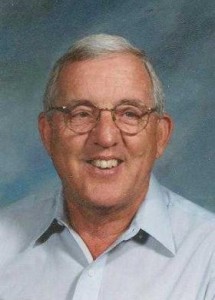
Congratulations to Central’s own Joe Bain who will be inducted tomorrow into the Panhandle Sports Hall of Fame here in Amarillo. Coach Bain was the boys track coach at Amarillo High School for 30 years, winning 15 district championships, including one in his last season in 2006. He also served as a long time assistant coach for the Golden Sandstorm football team under Larry Dippel, coaching the defensive backs in 1992 when the Sandies advanced to the state semi-finals.

Coach Bain poured his heart into hundreds of young men in this region, constantly encouraging them, consistently challenging them to be better, always leading to greatness by the example of his own deep character and integrity. Lots and lots of young men are thanking Coach Bain this week for the tremendous influence of godliness he had on their lives. And at least one older guy who only just met Coach Bain three years ago is thanking him for that same leadership and influence he has on my life right now.

Peace,

Allan
Don’t Be a Horse

“I will instruct you and teach you in the way you should go;
I will counsel you and watch over you.
Do not be like the horse or the mule, which have no understanding
but must be controlled by bit and bridle or they will not come to you.”
~Psalm 32:9

I won’t be like the horse or the mule. Every day I will come to you, Lord. Every day I will sing to you. I will pray to you. I will listen to you. I will talk to you every day. I will look for you, God. I will obey you. I will submit to you. Lord, I will follow you. I will come to you.

God, in your mercies, give me the power to keep these promises to you.

Your undeserving and grateful servant,

Allan

« Older posts Newer posts »