Category: Bible (Page 1 of 10)

Micah 6: Context


“He has showed you, O mortal, what is good. And what does the Lord require of you?
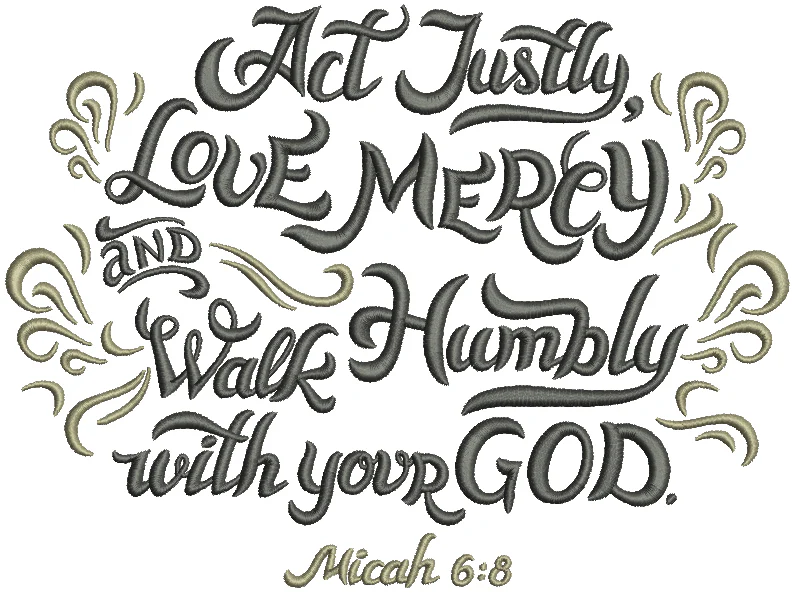
To act justly and to love mercy and to walk humbly with your God.” ~Micah 6:8


I’m going to spend this week posting here about Micah 6:6-8. It’s a core Scripture, a foundational passage that reveals the heart of our God and transforms us for an abundant life in Christ. We know it, we quote it, we memorize it, and we wear it on T-shirts–it’s an important couple of verses. But how deep have we really gone with these holy words?

Let’s go.

Micah is prophesying sometime around the turn of the 7th century BC, and God’s people at this time are very well off. They’re wealthy. Rich. Powerful. And their lifestyle reflected it. What they thought about, what they talked about, and how they behaved was connected to their wealth. You see the evidence throughout Micah. God’s people are eaten up with buying more land, building bigger houses, taking longer vacations, and putting more money in the bank. The next-door-neighbor doesn’t matter. The needy family down the street isn’t important. What matters to God’s people in Micah is selling as much of my product as I can and getting as much for it as I can, even if it means hiding behind some fine print or not telling the whole truth about every detail or every transaction. Doing whatever it takes to keep up with the Bar-Joneses. Or to get ahead.

This attitude, this way of life, started at the top with Israel’s leaders and worked its way down through all the people. Micah is full of the accusations. The judges are taking bribes. The priests are only teaching what the people are paying them to teach. The prophets are only preaching what they’re told to preach, mainly that everything’s great. Everything’s good. The way we’re living, the things we’re doing–everything’s fine.

“If a liar and deceiver comes and says, ‘I will prophesy for you plenty of wine and beer,’ he would be just the prophet for this people!” ~Micah 2:11

In other words, if every time you came to church the preacher said, ‘What we need is more beef fajitas and more Blue Bell ice-cream,” you would love it!

“Her leaders judge for a bribe, her priests teach for a price, and her prophets tell fortunes for money. Yet they lean upon the Lord and say, ‘Is not the Lord among us? No disaster will come upon us.'” ~Micah 3:11

We’re thinking only of ourselves, we’re getting richer and more comfortable while parts of the city are suffering more and more, there are poor people and sick people everywhere we look, but we’re great. Everything’s good.

And the Lord finally says, “Enough!”

“Stand up, plead your case before the mountains; let the hills hear what you have to say. Hear, O mountains, the Lord’s accusation; listen, you everlasting foundations of the earth. For the Lord has a case against his people; he is lodging a charge against Israel.” ~Micah 6:1-2

This is a court case being described here. It’s a jury trial. God is the plaintiff bringing the case against Israel. Micah is the bailiff formally announcing the criminal charges. The mountains and hills are the witnesses–they’ve seen everything–and they’re being called to testify. The covenant has been broken. Next comes the voice of God:

“My people, what have I done to you? How have I burdened you? Answer me. I brought you up out of Egypt and redeemed you from the land of slavery. I sent Moses to lead you, also Aaron and Miriam. My people, remember what Balak king of Moab counseled and what Balaam son of Beor answered. Remember your journey from Shittim to Gilgal, that you may know the righteous acts of the Lord.” ~Micah 6:3-5

God says, What have I done to deserve this? I rescued you from slavery. I’ve blessed you with great leaders. I protected you from evil kings. I brought you over the Jordan River and gave you all this land. Remember?

Now, I’m not sure if the next two verses are the people responding to God, or if it’s Micah quoting what the people have said in the past, or if Micah’s assuming this is what the people will say in response to God. Here it is:

“With what shall I come before the Lord and bow down before the exalted God?” ~Micah 6:6

God’s not happy with us? God says we’re breaking the covenant? He says we’re going to be punished (although I really can’t see that happening because we are his chosen people, after all). God’s reminding us again of all the things he’s done for us? So, how do we make God happy? How do we please God? What’s he looking for out of us?

“Shall I come before him with burnt offerings, with calves a year old? Will the Lord be pleased with thousands of rams, with ten thousand rivers of oil? Shall I offer my firstborn for my transgression, the fruit of my body for the sins of my soul?” ~Micah 6:6-7

If God’s upset with us, we must not be doing worship correctly. We should be more careful with the sacrifices. We should go to church more. We should maybe offer an extra calf or two. We should probably consider Wednesday nights.

When you see a puddle of oil on the driveway under your car, it shouldn’t cause you to change the air freshener hanging on the rear view mirror. If your son is failing all his classes at college, you shouldn’t yell at him for not knowing the words to the school fight song. There’s an old saying about the futility of re-arranging the deck chairs on the Titanic. The silliness of that. The absurdity of completely misreading the whole situation. Jesus calls it straining a gnat while swallowing a camel. And God shuts it down. The Lord, through his prophet Micah says, No, you don’t get it! It’s simple! Look, we’ve been over this for centuries!

“He has showed you, O mortal, what is good. And what does the Lord require of you? To act justly and to love mercy and to walk humbly with your God.” 

Yeah, but where’s the list of things we’re not supposed to do? 

No. Three things. Right here. Act justly, love mercy, walk humbly with God.

But where’s the stuff on how we’re supposed to worship?

No. Three things. Here they are. Act justly, love mercy, walk humbly with God.

Our God has always communicated very clearly since Day One what he wants from us. This has been the deal since the very beginning. These are the things that matter to God. This is the top priority. Three basic foundational things. Act justly, love mercy, walk humbly with God.

Peace,

Allan

Better Bible Reading

I have been asked for help at least five or six times since the New Year began from people who are struggling to maintain consistent and meaningful time in God’s Word. The stories are typical: they start with a plan and quit within a week or two, they don’t have time, they get distracted, they’re not getting anything out of it, it feels too rigid. They want to read their Bibles more and they want to get more out of it; their hearts are all in the right place. But they either have no experience or bad experience with intentional and meaningful Bible reading.

What follows are four personal suggestions for better Bible reading. These are four things that have changed the way I read the Scriptures so that every encounter with God’s Word is significant for my own transformation and mission.

Go Heavy on the Gospels
Some books of the Bible are more important than others. Our Lord Jesus tells us that some of the Bible’s commands are more important than others and that we should pay more attention to what he calls the weightier matters. The Bible is not flat—Obadiah and Song of Solomon are not as important as Luke and Acts–not every book is equal. So, start with the Gospels and lean in. Read through one of the Gospels–I recommend starting with Mark or Luke, but it doesn’t matter–before moving on to another book. And then come right back to another Gospel. You might read Mark, 1 Corinthians, Luke, Acts, Matthew, Exodus, John, James, and then back to Mark. However you choose your texts, my suggestion is to read the Gospels much more than you’re reading all the rest of it combined. Jesus is the holy incarnation of our God, the ultimate revelation of the Father, Jesus is our Lord and our Savior. Your Bible reading will be much more meaningful for you if most of it concerns the life, death, and resurrection of Jesus.

Use the Lectionary
I’ve only been doing this for five years now, but I believe reading with the lectionary is the best way to immerse yourself in the text and the story of God and his people. The lectionary provides daily and weekly readings that follow the Church’s liturgical calendar and include most of the entire Bible in a three-year cycle. Every week gives you an Old Testament text, a Psalm, a Gospel reading, and a passage from a New Testament letter. All four of the readings are connected by week, and each week follows the Church seasons so that you are reading Advent passages in December and Lent / Easter passages in the Spring.

One of the advantages to reading with the lectionary is that you are not choosing your own text; the text was already chosen for you centuries ago. You can pray before, during, and after your reading that God would speak to you exactly what you need to hear, that he would show you exactly what you need to see, knowing that you did not pick the text. Second, the lectionary orients you to the church calendar, to the life, death, and resurrection of Jesus, and to a Christian way of marking seasons and time. It reminds you daily that you belong to a different story and you are practicing a different way of living. And, third, it connects you with all of global Christianity. You are reading and praying the same passages each day as most all Christians all over the world. It reminds you that you belong to something bigger, something eternal. It unifies you with all the saints past, present, and future.

You can find a lectionary anywhere. The Revised Common Lectionary is the one used by the vast majority of mainline Protestant churches. I use one called A Guide to Prayer for Ministers and Other Servants that includes weekly prayers, hymns, and inspirational readings. This is the one the GCR ministry team uses together every morning.

Read Out Loud
A seminary professor told me in 2005 that I should always read the Bible out loud and, by far, it is the one practice that has radically transformed my daily reading the most. The Scriptures were meant to be proclaimed out loud and heard, not read silently to oneself. It’s different when it’s out loud. It’s more real, it’s got more power, it’s physically out there in the air and has to be dealt with. Beyond that, reading out loud ensures that more of you is physically engaged with the text. When you read out loud, your lips and tongue and teeth and throat must coordinate around every syllable; your brain has to cooperate with your emotions and feelings so the words make sense to your ears; and you find that you are paying more attention–you have to pronounce the difficult place name, you can’t just skip it. Don’t ever read the Bible silently to yourself. Always read the text out loud and see if the whole experience isn’t dramatically different.

Never Use an iPhone
Please, do not read the Bible on your phone. When people tell me they are distracted or bored or not getting anything out of their Bible reading, I can safely surmise they are reading the text on their phones. What we’ve known for a couple of decades is now being proven by all the research: screens cause our brains to shift into a zombie mode. Our phones have trained us to mindlessly scroll/swipe through whatever is on our phones and move on and on and on to that next thing on our phones without any impulse to action. You read the words on your phone and then they’re gone, they’ve disappeared, they’re not there anymore, so you don’t deal with them. We’ve been shaped to read and then ignore whatever is on our phones. Almost all of what we read on our phones has no impact on our daily lives, it doesn’t change anything we do or think about for the rest of the day. At some point–and it doesn’t take long–you read your Bible on your phone the exact same way you read an email from work or a news item from Nebraska or a cleaning hack from a corporate sponsored post. Use a Bible, a leather bound Bible with the thin pages that crinkle when you turn them. Do that for a full month and tell me it doesn’t matter.

These are all suggestions that have personally changed my Bible reading for the better. I hope they can help you, too.

Peace,

Allan

Did Jesus Really Say?

Before the main topic of this post, I want to set a pin here to acknowledge Luka Doncic’s first game as a Laker against the Dallas Mavericks last night and lament one more time the indescribably horrible trade that sent the NBA’s most exciting player to L.A. Luka exchanged ear-to-ear grins and extravagant handshakes and hugs with his former Dallas teammates in the moments before the tip and directed at least a couple of hard glares toward the visitors’ bench after hitting a big three and an impossible reverse layup. Luka wound up with a triple-double, of course (19 pts, 15 rbs, 12 assists), and said after the game “I didn’t play great.”

And he’s right. It was a very average game for Luka. Which only emphasizes how truly great he is. Triple-doubles are a given for Luka, the ho-hum result of a merely pedestrian performance.

The most regrettable part of this whole thing is the unforgivable incompetence or inept apathy or both that led to probably the worst trade in professional sports history. It was revealed again last night that Luka never had any intention of leaving Dallas and was completely blown away by the trade. It was obvious last night that he is still in shock, he’s still in a daze. He’s still sad about it.

When asked by reporters last night if the win over the Mavericks can provide some closure for him so he can move on with his career and his life, Luka answered, “No, not really. Closure is going to take a while. This is not ideal. There are lots of emotions. But I’m just taking it little by little. Every day is a little better.”

Luka was 19 when the Mavs drafted him. He just turned 26. In the words of Kyrie Irving, he’s just an innocent kid, a mega-talented innocent kid who is not an American. He’s not from this culture, he’s not grown up with an understanding of these expectations. Sometimes he responded to things that came at him in ways that felt awkward or weird. But that’s on NIco and Kidd and the Mavs. It’s almost like they didn’t try at all. The spin they’re putting out about Luka’s lack of conditioning is a cop-out. Some of it may be true, but you don’t trade a generational talent because he likes an occasional cheeseburger. It’s not like Luka hasn’t made All-NBA five times, had an MVP season last year, and led Dallas to the NBA Finals.

He’s still just a kid. His best years are still ahead of him. This would be like trading Dirk Nowitzki after his sixth year, only worse, because Luka is galaxies ahead of where Dirk was at this stage.

I’ll agree with Dirk who says, “I’ll never be a Lakers fan; but I’ll always be a Luka fan.”

~~~~~~~~~~~~~~~~~~~~~~~~~~

Sometimes I post things here that I had intended to preach on Sunday, but didn’t because of time–things that wound up on the cutting room floor. Here’s a paragraph or two from our sermon Sunday about Peter’s betrayal of Jesus.

In the Garden of Gethsemane on that last night, Peter drew his sword to protect Jesus from the crowd of guards and soldiers who had come to arrest him. Peter struck one of the officials, cutting off his ear. Peter was going for the kill. He wasn’t aiming at Malchus’ ear. He’s not Mike Tyson. He was going for the guy’s throat, he was trying to cut off his head. But Malchus ducked and Peter cut off his ear. And Jesus said, “No. Put your sword away. Violence doesn’t fix anything; it only leads to more violence. If my Kingdom were of this world, then we’d fight. I’d call down twelve thousand angels and we’d wipe these guys out. But we don’t fight. We never use violence. I’m showing you a different way.”

I preached that. I left this next part out because of time. Here it is, directly from my manuscript.

Here’s a sidebar: It’s interesting to me how we’ll argue and debate and get red in the face about the literal details of creation and the literal details of the ark and the flood and we’ll insist on the literal facts about Jonah and the fish and we’ll parse and dissect every syllable of the Greek words in Paul’s letters, but we’re very quick to dismiss the literal words of our Lord Jesus. Jesus gives very direct commands about violence or money or refugees or forgiveness, and we’re like, “He didn’t really mean that literally.” When we do that, we sound just like the devil. “Did Jesus really say…?” We’ll twist Jesus’ words so he doesn’t really mean half of what he says. That’s another sermon. For another day. Probably a guest speaker.

I should have said it. I’m sorry I didn’t. I cut it because the sermon was running long and I didn’t want to distract from or take away from the main points of the lesson. I called it a sidebar when I wrote it, but it started to feel more like a rabbit trail on Friday and Saturday night. So I cut it. I should have said it.

Peace,

Allan

Core Scriptures

We all know that some Bible passages are more important than others.

Oh! Scandalous! What did he say?!

No, you can’t freak out about that.

But all Scripture is the same!

No, it’s not. Not all the verses in the Bible are on the same level. It’s not flat. And we know this. It’s not controversial. We all know this about Scripture.

Our Lord Jesus taught us this. He pointed us to what he calls the weightier matters, the parts of Scripture that are closest to the heart and will of the Father. He clearly believed and taught that some biblical commands are more important than others–he ranked them!

Plus, think about our own experiences within our churches. You probably spend a lot more time in the Gospels than in Haggai. You likely have more Bible classes on Exodus and Acts than you do in Jude. And you don’t think you’re preacher is bad because he hasn’t preached through 2 Thessalonians or Nahum. We all know and practice the fact that some Scripture is more important than others.

So how do we get those Scriptures inside us? How do we make the most important sections of the Bible part of who we are?

Our shepherds and ministers worked together for two months last fall to identify what we are calling our “Core Scriptures.” There are ten of them–the nature of God, his character and his mission, how we’re saved and why, how we treat others, where all this is headed–and we’re going to read one of them every single Sunday during our morning worship assembly. Over and over again, a different core Scripture every week. Regardless of the day’s sermon, the season of the year, or the theme for the week, we’re going to read the next core Scripture. And when we read the tenth one ten Sundays from now, we’re going to start all over at the top of the list and keep going. We’re not going to be afraid of repetition; we’re going to embrace it, because we think it’s critical that we get these foundational, essential passages inside us.

We believe these passages can change us. We believe if we’ll view the whole Bible through the lens of these key verses, we’ll be better interpreters. We believe we’ll have a more perfect understanding of the heart and will of our God and that it’ll lead to more Christ-likeness for our whole congregation.

Here are GCR’s ten “Core Scriptures:”

Matthew 22:37-40
1 John 4:7-12
Romans 8:28, 31b-35, 37-39
Matthew 28:18-20
Exodus 34:5-7a
Ephesians 2:4-10
Colossians 3:12-15
Philippians 2:1-11
Micah 6:6-8
Revelation 21:1-7

These are the passages that just soar. These are the verses that cultivate a love and adoration for God’s Word. Through these Scriptures, we see how large and splendid and magnificent life really is as a beloved child of God, redeemed by the blood of his Son, and restored by the power of his Holy Spirit.

Instead of reading through the whole Bible this year, it might be better to dig into a few core passages and really get them inside your soul. Memorize them, meditate on them, read them and recite them out loud, pray them, journal them, make them a part of who you are. Just try it. And see if you don’t have more strength and stability and better balance. Who you are and everything you do is connected to and extends from your core.

Peace,

Allan

The Bible: Our Transformation

Continuing our conversation on whatever Bible reading plans you have for 2025, and reminding you of this statement concerning what the Bible is and what the Bible does: The Bible is God’s revelation for our transformation. This is what the Bible is and what the Bible is for. We addressed the revelation part of the statement in the last post. Today, let’s tackle the transformation.

“The Word of God is living and active. Sharper than any double-edged sword, it penetrates even to dividing soul and spirit, joints and marrow; it judges the thoughts and attitudes of the heart.” ~Hebrews 4:12

“When you received the Word of God, which you heard from us, you accepted it not as the word of men, but as it actually is, the Word of God, which is at work in you who believe.” ~1 Thessalonians 2:13

The Bible works in us. The holy words of Scripture do something inside us. They give us health and wholeness and life. They give us holiness and wisdom and hope. The words of the Bible are supposed to get inside our souls and shape us; they’re intended by our God to change us into a people who are more and more in tune with the new world he is creating, the salvation he is bringing, and the people he is gathering.

These are formational words. They’re intended to transform our lives, not just stuff more information into our brains. We want the Bible to get into our guts, not just our heads. We want the words of Scripture flowing through our bloodstreams. We want to receive them in a way that changes us and shapes us more into the image of Christ. And that takes a different kind of reading. We’ve got to chew on these words and swallow them. The holy words of Scripture need to become a part of you.

What happens when you eat something? It becomes a part of you. You assimilate it. You are what you eat–that’s exactly right! And we know this, we experience this. If a nursing mother eats fajitas for lunch–with onions, jalapenos, pico de gallo, and salsa–she’s going to be up all night. Not because she’s sick, but because her baby is sick! The fajitas have become a part of her! You are what you put inside you. I look in the mirror and I can see Whataburger and Blue Sky. It’s become part of me. The biggest part.

The words of Scripture are written by the Holy Spirit in a way to get inside us. They’re intended to become a part of us and change us. In Colossians 1, the apostle Paul prays that the Christians there would be filled with the knowledge of God and God’s will “in order that you may live a life worthy of the Lord and may please him in every way: bearing fruit in every good work” (Colossians 1:9-10).

The true test of whether the Bible is in you is seen in your transformed life. Your Christian formation is measured or proven by bearing fruit through your good works as a result of a changing life.

“All Scripture is God-breathed and is useful for teaching, rebuking, correcting, and training in righteousness, so that the child of God may be thoroughly equipped for every good work.” ~2 Timothy 3:16-17

The Bible is not primarily about theological doctrine or the right facts or being more correct. It’s not. The Bible says the Bible is all about changing lives and producing good works. We don’t read the Bible to know more, we read the Bible to do more!

We don’t study the Bible. We don’t learn it. We don’t use the Bible. We eat it. We ingest it. We assimilate it. We take it into our lives in such a way that it metabolizes into acts of love, cups of cold water, hospital and prison visits, casseroles and cakes, comfort and encouragement, evangelism and justice.

So, how do we get the Bible inside us? How do we make the Scriptures a part of who we are?

What about focusing for a full year on just ten core passages? Reading just those ten. Dwelling in them. Praying them. Meditating on them. Memorizing and reciting them. For a full year. More on that tomorrow.

Peace,

Allan

The Bible: God’s Revelation

I want to continue the conversation about our Bible reading plans for 2025 with this statement about what the Bible is and what the Bible does:

The Bible is God’s revelation for our transformation.

Let’s start with revelation. Consider just two key passages that remind us the Bible is a communication from God given to us by God himself.

“When you received the Word of God, which you heard from us, you accepted it not as the word of men, but as it actually is, the Word of God.” ~1 Thessalonians 2:13

“All Scripture is God-breathed.” ~2 Timothy 3:16

The Bible is not just a collection of truths or a set of laws. It is a very complex, multi-faceted thing through which God has spoken, God is still speaking, and God promises to keep on speaking. Our God has not stopped talking. He hasn’t developed laryngitis. He’s not silent. He reveals to us who he is and his character and his will. He personally reveals to us what he is all about and what he is doing in this world all around us. He tells us how and why we were created and what his plans are for us. And the primary way he does that is through the Bible.

So, reading the Bible is everything. It’s life and death, and what you had for breakfast, and what you’re planning to do in April. It’s everything. So, you read the Bible with your whole life, not just with the gray stuff inside your skull.

The Bible is God’s Word straight from God himself. That’s what we believe. So, we know it’s right and we know it’s true. But sometimes we let the right and the true get in the way of our God. The whole Bible is about God–every line, every word. It’s about God. But we lose that sometimes. We’ll read all four chapters of Jonah and then spend eight weeks arguing about and trying to figure out how a man can live inside a whale and, if so, what kind of whale was it? Wait! Jonah is about God, not a whale! We’re missing it!

It’s like the football player who’s so in love with his uniform, he forgets he has a game to play. Or like the college student who finds a wonderful social life, but forgets to study. True, you can’t have Jonah without the whale, you can’t have a football game without the uniform, and college doesn’t really work without a social life. But they’re different things! We can’t miss the point!

The Bible is a revelation from God about God. And this direct revelation from God carries ultimate authority. But it’s not an impersonal authority like a collection of science facts and truth. It’s not a legal authority like volumes of legislation in a law library. It’s not a factual authority like a geometry textbook. It’s not historical authority like an ancient artifact under glass in a museum. The Bible is a personal, relational revelation that carries personal, relational authority. The Bible is God letting us in on something, showing us what it means to live as women and men created by him and in his holy image.

So, how we read it matters. We don’t pick and choose or copy and paste different verses together to win an argument or prove some point. When we open up the Bible, we open up something big, something huge and eternal, something personal from the Creator of Heaven and Earth and the Sustainer of Life. What no eye has seen, what no ear has heard, what no mind has conceived has been revealed to us now by God’s Holy Spirit.

We don’t read the Bible like we read the internet or a cookbook or a James Patterson novel. It’s not a constitution or a rule book or an owner’s manual for life. It’s God’s revelation. How we read it matters.

Peace,

Allan

« Older posts