Author: Allan (Page 468 of 493)

Little Replicas of Himself

Screwtape“One must face the fact that all the talk about His love for men, and His service being perfect freedom, is not (as one would gladly believe) mere propaganda, but an appalling truth. He really does want to fill the universe with a lot of loathsome little replicas of Himself—creatures whose life, on its miniature scale, will be qualitatively like His own, not because He has absorbed them but because their wills freely conform to His.”  ~Screwtape

It’s easy to sense the senior tempter’s frustration in C. S. Lewis’ masterpiece. Screwtape and the other devils in Hell can’t comprehend why in the world God would expend so much energy on loving and caring for all these dispicable humans. Instead of using people and exploiting people and sucking them dry of all energy and life, God nurtures them and provides for them and longs for actual relationship with them. We are God’s children and he wants us to be just like him. But he wants us to make those decisions on our own. He doesn’t “override a human will.” As Screwtape observes about God, “He cannot ravish. He can only woo. For his ignoble idea is to eat the cake and have it; the creatures are to be one with him, but yet themselves; merely to cancel them, or assimilate them, will not serve.” And the devils don’t get it.

In working to conform our wills to our Father’s and in striving to be like him, his perfect son, Jesus, is our example. When we look at Jesus in the flesh, incarnate God, we see what God created when he created us. Or at least we see God’s intent. And we see our own high potential, our high calling.

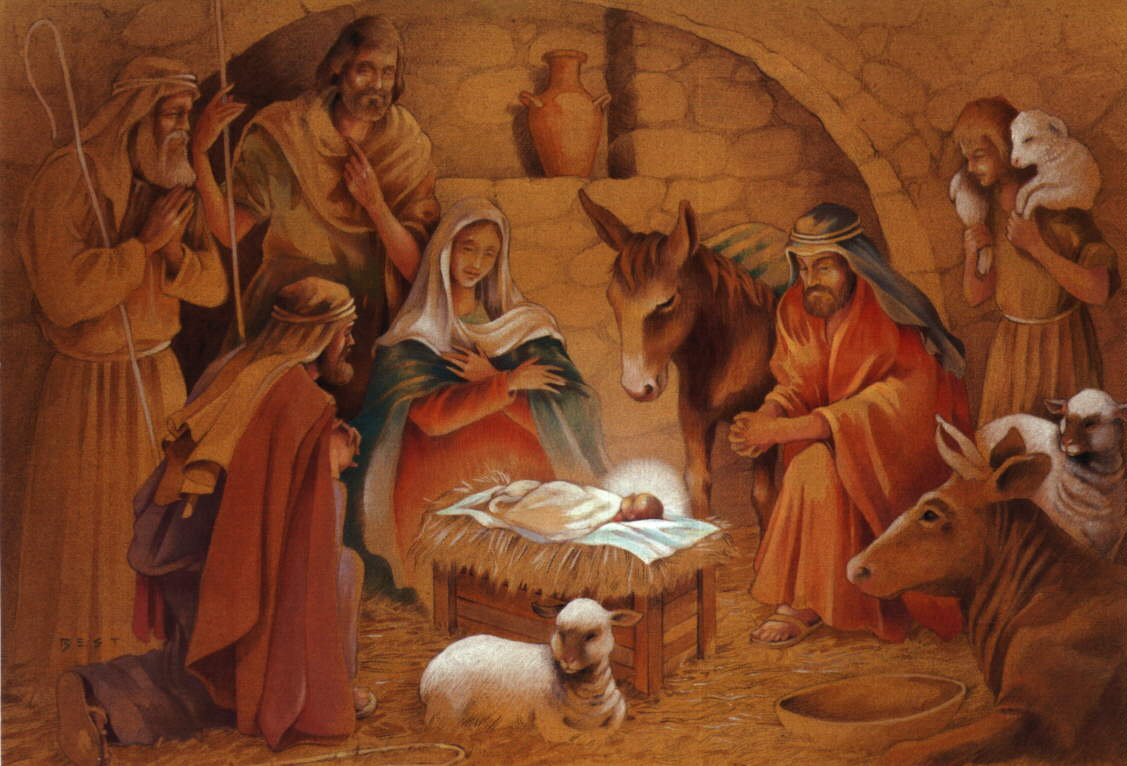
As a baby in the manger in Bethlehem, Jesus is completely helpless, vulnerable, needy, dependent. A newborn baby is the absolute picture of total dependence. And as all the political and religious and military powers in Judea scheme to murder this innocent child, Jesus, as a baby, is completely dependent on his Father to protect him. What chance does Jesus have against the ruthless King Herod and the chief priests? His young peasant mother and his impoverished and unproven dad from the insignificant town of Nazareth are way overmatched. But we see clearly that the Father provides and protects. He thwarts the enemy’s plans. He rescues his child. He carries the child and his parents to a safe place and then destroys the enemies.

Our calling is to be just as dependent on our Father as Jesus was. The life of the Christ is a beautiful portrait of complete surrender to God, from the manger in Bethlehem and the temple courts in Jerusalem to the garden in Gethsemane and the cross at Golgotha. Total surrender. Complete dependence. Confidence that God will deliver. He will save.

“…we, who with unveiled faces all reflect the Lord’s glory, are being transformed into his likeness with ever-increasing glory, which comes from the Lord.”  ~2 Corinthians 3:18

~~~~~~~~~~~~~~~~~~~~~~~~~~~~~~~~~~~~~~~~~~~~~~~~~~~~~~~~~~~~~~~~~~~~~~~~~~~~~

Excellent column by Gene Wojciechowski today asking the same questions I asked last night regarding Roger Clemens telling us he’ll address the steroid and HGH allegations in baseball’s Mitchell Report in “an appropriate way at the appropriate time.” What time could be more appropriate than right now? What way could be more appropriate than a common news conference? Click here to read the column.

Peace,

Allan

Salvation + Creation = Incarnation

I think as children of God we’re usually more concerned with the destination than with the journey. “Heaven holds all to me.” So much so I’m afraid that a lot of the time we separate salvation from creation. Being saved, to a lot of us, means being rescued out of this world. To many Christians, the world and whatever is of the world or in the world is worthless and useless. We don’t care about the world. We’re being delivered from the world.

But the Incarnation drastically alters that viewpoint.

The birth of Jesus, instead of separating salvation and creation, connects salvation and creation. It joins the realities of heaven with the ordinariness of life on earth. It brings together the human and the divine. By becoming one of us, God reaffirms the original goodness and purpose of creation. Our human condition, even with all its flaws and shortcomings, even with all our weaknesses, this world and everything in it is not so sad and worthless that God himself is above becoming flesh. In fact, it’s Jesus taking on our everyday human condition that is the means for our salvation! God reclaims us as his own by becoming one of us.

God created the world and all the people in it. And that world and that people—all of creation—have been groaning, Paul says in Romans 8, as in the pains of childbirth to become what we were truly created to be. We were created to be truly divine children of God, just like Jesus. We look at Jesus, God in flesh, and we see what the Father created when he created us. Or at least we see his intent. We see our potential, our calling.

John writes in the opening lines of his Gospel that when we receive Jesus, when we believe in the name of the Christ, God gives us the right, he gives us the power, he gives the authority to become children of God, “children born not of natural descent, nor of human decision or a husband’s will, but born of God.” Just like Jesus.

Yes, Jesus preached about the Kingdom of Heaven. But all his teachings had to do with how to live here on this earth. How to get along as a child of God here in this world. Here in the middle of God’s creation.

Seeing Jesus as a human helps us understand why God made us. And it empowers us to reclaim that purpose for our own lives. It enables us to live our lives fully here on earth, with each other, in all of our mundane ordinariness, as children of God. Just as he intended from Day One. To live like him.

~~~~~~~~~~~~~~~~~~~~~~~~~~~~~~~~~~~~~~~~~~~~~~~~~~~~~~~~~~~~~~~~~~~~~~~~~~~~~~~~~~~~~~

Whitney experienced her first ever live Mavericks game at the AAC last night, compliments of our good friend and Small Groups Co-Leader, David Glover. (The Mavericks were able to pull out a nail-biter over Orlando, despite the fact that David’s been to two Cowboys games this year: Patriots and Eagles.)

Whit,Garrett,MavsManI love experiencing things through my girls. I’ve attended a couple of hundred Mavericks games through the years—pre-season, regular season, and playoffs. But I saw things from an entirely different perspective last night. Whitney was genuinely thrilled by the things I’ve always taken for granted. The player introductions, the drum line, the T-shirt cannons, Mavs Man, Champ (that thing still looks like a Dragon Tales character, not a horse), chanting “De-Fense” and “Let’s Go, Mavs!” (didn’t they rip that off from the Spurs?), souvenir cups, thundering dunks, a three-on-one break, player interaction on the bench, the guys who continually distribute and clean up all the towels and water bottles, even P. A. announcer Billy Hayes and sideline shill Chris Arnold. Everything that is the spectacle of a Mavericks game. She was completely involved from before the opening tip to well after the final buzzer. She was trying to distract Orlando free throw shooters from our seats, which were not anywhere close to behind the backboard. She yelled throughout the fourth quarter for the Mavericks to “get it to Dirk!” She never sat still. She never stopped screaming. She never stopped laughing. I’m sure right now, even as she’s probably in the middle of some math or social studies class at school, she hasn’t stopped smiling.

And usually I would just sit there.

I saw it differently last night. It was a different game for me last night because I was sitting by Whitney.

And our Savior says unless we become like little children we can’t enter the Kingdom.

May our God grant us the vision, the humility, and the grace to be wowed by his creation and by his goodness and by his blessings. May we pay attention to all that is around us and recognize every bit of it as a wonderful blessing from our Father. And may others experience their daily lives differently as a result of watching us experience ours.

~~~~~~~~~~~~~~~~~~~~~~~~~~~~~~~~~~~~~~~~~~~~~~~~~~~~~~~~~~~~~~~~~~~~~~~~~~~~~~~~~~~~~~

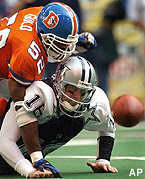
In 2004, Cowboys safety Roy Williams tackled Titans receiver Tyrone Calico from behind by grabbing the back of his shoulder pads and yanking him to the ground. As a result, Calico suffered torn cartilage in his left knee and a sprained ACL in his right knee. That same season Williams took out two Baltimore running backs with the same style of tackle. Jamal Lewis suffered a sprained ankle and Musa Smith a compound fracture of his right tibia. That same season Williams broke the right fibula of then-Eagles receiver Terrell Owens with the same horsecollar tackle. In May 2005, the NFL made that kind of tackle illegal. It was called the Roy Williams Rule.

RoyWilliamsRuleGoing into this past Sunday’s game against the Eagles, Williams had been fined $27,500 by the NFL this year for making two illegal horsecollar tackles. The NFL sent Williams a letter two weeks ago telling him he would be suspended if he did it again. And he did. His tackle on Donovan McNabb is the very reason that style of takedown was outlawed. He was flagged at the time. And last night the league suspended him for one game. Williams can’t practice with the team and he can’t play in what is now a critical game Saturday night in Charlotte. It’ll cost him at least $35,000 in salary. It’ll cost the Cowboys one of their best run-stoppers against a Panthers attack that is running all over opponents.

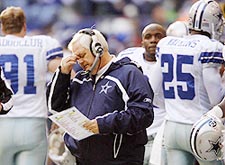
I saw a quote from Wade Phillips this morning claiming that in Sunday’s situation with McNabb, and in all the others this season, grabbing the back of the shoulder pads is the only way Williams can make the tackle.

Isn’t it because Williams is always running behind the ball carrier? None of this would be an issue if he could just get in the proper position.

~~~~~~~~~~~~~~~~~~~~~~~~~~~~~~~~~~~~~~~~~~~~~~~~~~~~~~~~~~~~~~~~~~~~~~~~~~~~~~~~~~~~~~

Are Eagles Defensive Coordinator Jim Johnson and Austin Grad Professor Michael Weed the same person?

 JimJohnson MichaelWeed

Peace,

Allan

Jessica Ono

Tony Romo went to the lockerroom at halftime of yesterday’s loss to the Eagles carrying a quarterback rating that was the same as his jersey number. He finished the game with three interceptions, two fumbles, four sacks, one bruised thumb, and a 22.2 QB rating, the lowest of his brief career. The Cowboys failed to score a touchdown for the first time since November 2004 when a team that finished 6-10 and seemingly started a new quarterback every week lost to the Bengals.

Are you blaming Jessica Simpson?

Is she going to be the Yoko Ono of the Cowboys as I heard someone say this morning? WadePhillips

How much time did Romo have to put in Saturday night and Sunday morning arranging for tickets, transportation, meals, and other stuff related to the game for the Simpson family? Was he trying to show off for his new girlfriend and wound up pressing too hard and blowing it? If he was distracted by her being at the game, what was it specifically?

JessicaSimpsonThe theories are numerous. Did her pink Cowboys jersey offend the football gods? Is spending time with Jessica rubbing off on Romo in a way that’s making him dumber every day? She can’t tell the difference between chicken and tuna. One month with her and he can’t read a tackle-stunt or a corner blitz. Coincidence?

All I know is that the beautiful girl has always brought down the superhero. Everytime a superhero gets in trouble, you can always trace it back to the distraction of a pretty girl. It happened regularly to Indiana Jones. Indy and Superman both spent way too much time and energy trying to rescue the girl who was distracting them from the big picture of what they were supposed to be doing, mainly because she was in the wrong place at the wrong time. In the way. It happened to Batman. It happened to Spiderman. It happened to Frank Drebin.

If it’s not Jessica Simpson, what was it? Romo’s never looked as awful as he looked yesterday. Ryan Leaf never looked as awful as Romo looked yesterday.

There is one other theory out there. And I must give the credit for this one to Norm.

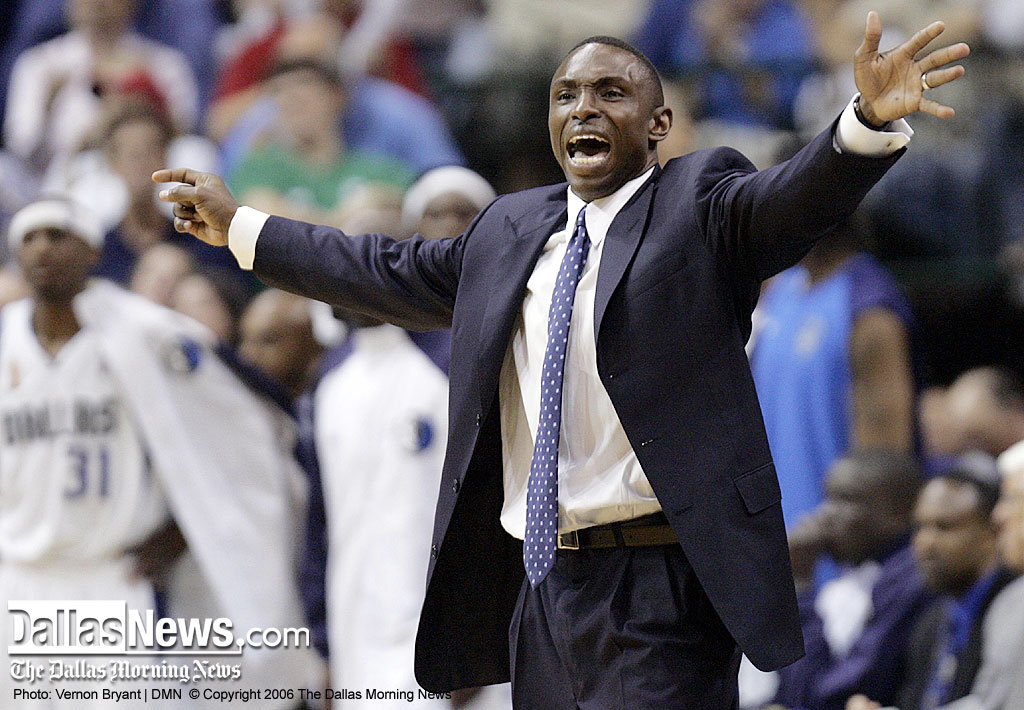
He claims it’s Avery Johnson’s fault.

Avery Johnson, the Dallas Mavericks coach, was also at yesterday’s game, also sitting in a very prominent place at Texas Stadium. And the Cowboys spent all day settling for 3s.

Coincidence?

Peace,

Allan

Be Perfect

“Be perfect, therefore, as your heavenly Father is perfect.” ~Matthew 5:48

In the Sermon on the Mount, Jesus takes six specific commands from God’s Law, corrects the faulty interpretation and selfish external applications, and then points his disciples toward the true nature and true intent of the Law: living selflessly with others in community. God reveals himself to man through the Law. The Law is the perfect reflection of our God. And as we pursue this true intent and motive of the Law, as we strive to emulate our God in the ways we live with each other, we are pursuing that perfection of God. It’s a goal that shapes the disciple’s entire life. It’s the ultimate object of our behavior and our thoughts and our will. We accept nothing less than the perfection of God. We’re always striving toward it.

 OK. We understand all that. We also are assured by Holy Scripture that our perfection is found only in Jesus. We are righteous only through the blood of the Son. All have sinned. None are perfect. It’s only by participating in the salvation work of God through the Christ that I can be viewed as righteous in God’s sight.

OK. We get that, too. But here’s where it gets weird.

1) I’m saved by grace. I know I’m going to sin. I’m human. I can’t not sin. And so I wake up every morning resigned to my fate as a sinner. I’m going to sin before I make it out to my car today. When I go to bed at night, I know I’ve sinned. And I’ll sin again tomorrow. I’m human. But I’m saved. As a natural result, I’m not quite as bothered by my sin as I used to be.

or 2) The Holy Spirit dwells in me. I’ve been changed by God. I’m a new creature. Every sin I commit I do so by my own choice. Nobody’s making me sin. So it’s up to me to be perfect. And I will be. From this point forward I will not sin again. God calls me to be perfect. Paul tells me to stop sinning. And I will. As a natural result, I’m continually disappointed. I’m setting myself up for failure.

I struggle with finding the balance between the two extremes. I believe I’m not alone in that. I try to live it one day at a time, like most of us do. I pray every morning that God will give me the power to remain free from sin all day until my head hits the pillow that night. I am confident in my salvation. But I should be grieved by my sin.

Michael J. Wilkins calls the balance “restful dissatisfaction.” He elaborates in his NIV Application Commentary on Matthew:

 “I rest content with what Christ has done in my life and with the growth that has occurred, yet at the same time I balance that contentment with the desire to move on. At any one point in my life I want to be satisfied with what God has been doing in my life, yet I want to be dissatisfied to the degree that I press on to complete maturity. I accept my imperfection, yet I have the courage to press on to perfection. I rest in the indicative of what God has accomplished in Christ’s work of redemption and regeneration, I rest in the assurance that transformation is, at this very moment, being accomplished, and I rest in the promise that ultimately we will be like him. But I am dissatisfied when I see immaturity or impurity in my heart, mind, and life; I am dissatisfied with the state of this world apart from Christ; I am dissatisfied with loving less than the way Jesus loves.”

Peace,

Allan

A Doctrine of Participation

Incarnation

I’m beginning a three-week sermon series this Sunday on the Incarnation, that wonderful, mysterious miracle of our God becoming flesh and dwelling among us. Fully human and fully divine. God embracing our humanity, submitting to his creation, joining the world in order to save it. Unfathomable. I’ve prayed over and poured through all of the Scriptures. I’ve highlighted all my commentaries. I’ve re-read Unveiling Glory. I’m making a feeble attempt at trying to preach this in terms of 1) God coming into our sinful situation, our messy world, just the way it is, to save all of mankind; 2) God as a human baby showing us our own weakness and dependence and teaching us how to surrender; and 3) God’s call to join him in his salvation work, to imitate him as he partners with his creation to redeem it back to himself.

 I think I could preach for three or four hours on each topic (but I won’t, I can’t) and still just barely scratch the surface of the depth of the theological realities behind the Incarnation. It’s so rich and meaningful. So full of life-affirming truth.

I like this from Kallistos Ware:

“The Incarnation is a doctrine of sharing and participation. Christ shares to the full in what we are, and so he makes it possible for us to share in what he is, in his divine life and glory. He became what we are, so as to make us what he is. Christ enables us to share in the Father’s divine glory. He is the bond and meeting point: because he is a man, he is one with us; because he is God, he is one with the Father. So through and in him we are one with God, and the Father’s glory becomes our glory…the divine likeness that we are called to attain is the likeness of Christ.”

What we see in the watering trough in the stable in Bethlehem is the coming together of heaven and earth. Creator and creation. Holiness and sinfulness. Angels with their beautiful voices and shepherds with their bleating sheep. The aromas of incense and myrh mixing with the stench of livestock and hay. It all converges in that stable. God and man as one.

How am I supposed to tackle all that?

Peace,

Allan

One Book Meme

My great friend out in Fresno, Jim Gardner, tagged me on his blog to answer this survey of questions about books I’ve read, am currently reading, and am planning to read. I’m obliging because I like Jim and his blog, I’ve gained some interesting insights into him looking at his list, and you might be just as curious to see my list as I was to see his. Here goes:

 One book that changed your life: The Witness of Preaching by Thomas G. Long

It was one of the textbooks assigned in my Ministry of Preaching class at Austin Grad. Long’s premise is that the preacher-witness is figuratively sworn in by his congregation to testify each week to what he has seen and heard through his study of God’s Word. The witness preacher is responsible for going to the Scriptures each week on behalf of the congregation and is bound by that arrangement to speak the truth in what he finds. What radically changed my outlook on preaching is Long’s contention that the work of a preacher—his study, his reading, his meditation, his preparation—is really the work of the entire church. The preacher doesn’t confront the people on Sundays, Christ does. The ministry of preaching actually belongs to Christ. It’s only given as a gift to the Church.

One book you’ve read more than once: The Screwtape Letters by C. S. Lewis

I first read this book as a required text in an English class at Oklahoma Christian. And I’m certain I’ve read it at least a dozen times since. Every single one of the tempter’s 31 letters is about me or the church I’m in or the people around me. Every one. It’s so modern and contemporary. Everytime I read it, it seems like it was written just yesterday in the office across the hall. And it hits me everytime like a 2×4 to the face. The book always serves as a real wakeup call to my true motivations. And when I’ve used it in a men’s group, it never ceases to force us to discuss openly the things we normally ignore. I’m in a group of men right now who are going through the book on Tuesday mornings. And there are parts of this thing I’m seeing for the very first time. Again.

One book you would want on a deserted island: Sports Illustrated’s Fifty Years of Great Writing

The book came out three years ago and, while I’ve read it from cover to cover—all 558 pages—I still find myself going back to it and reading a column or two every couple of months. I love the way sports reflects life and vice-versa. And writers who can take a sporting event or a sports personality and draw larger, big-picture conclusions and observations about life are a dying breed. This book contains the best of the best. Award-winning writers from Frank Deford and Dan Jenkins to George Plimpton, Rick Reilly, and John Steinbeck on football, baseball, basketball, hockey, boxing, horseracing, you name it. From the mid 1950s to now. Wonderful stuff.

One book that made you laugh: Open Secrets by Richard Lischer

I read this book almost two years ago (another textbook in my preaching class), before I knew my first ever preaching assignment would be in a large metropolitan church in the suburbs. For all I knew, and exactly what I expected, I’d be in a much smaller church in a much less urban setting. Lischer’s book is an auto-biographical account of his very first preaching assignment, fresh out of divinity school and bursting with enthusiasm, to a very small conservative church in an economicaly-depressed town in southern Illinois. He makes plenty of mistakes at this church. The changes he tries to implement sometimes backfire. He winds up alienating several prominent church leaders. But his heart is good, he’s doing his best, and he learns a valuable lesson from each horrible miscue. It’s very funny. And very insightful. And I’ve realized after six months on the job here at Legacy, people are people, preachers and congregants. I’ve done my best to learn from Lischer’s mistakes. But I’m still making my own.

One book that made you cry: Tending the Heart of Virtue by Vigen Guroian

Another required textbook from Austin Grad, this one in my Christian Ethics class. The author’s premise is that all children are born with a natural desire to draw the distinctions between right and wrong. It’s a gift of grace given to us by God. And parents do more harm than good in teaching our children when we water down those ideals. We seem to be more concerned with teaching tolerance, paralyzed by the fear of labeling anything as absolutely black or white and, instead, painting everything a seemingly harmless shade of gray. We’ve learned somehow to allow our kids to make up their own minds about what is right or wrong for them, or to somehow grow into that knowledge on their own. We want them to develop their own morals or their own standards. And instead of shaping and molding young lives, we’re abandoning them. By ignoring the great themes of love and sin and redemption and moral goodness we are teaching our children that morality is relative to individual desires and personal cultural contexts. Guroian takes ten classic children’s stories that revolve around those great themes. He takes Pinocchio and The Little Mermaid, Bambi and Charlotte’s Web, The Velveteen Rabbit and The Snow Queen, stories we’ve all known since we were kids and stories our kids know by heart, and he draws out those great theological and moral and ethical themes that we sometimes ignore or purposefully bury. Come on, it’s about kids and being a parent. Of course I cried.

One book you wish had been written: Transformed: How the Ninevah Experience Changed My Life by Jonah

One book you are currently reading: The Jesus Way by Eugene Peterson

He’s one of my favorite authors. This is the third book of his spiritual theology series and it deals with “the way” we are to be Christians. He paints, as always, vivid pictures using the lives Abraham, Moses, David, Elijah, and of course, Jesus, to communicate that the “means” (way) are just as important as the “ends.” The way we do things as disciples—in our churches, in our communities, in our families—does matter. There’s a right way and a wrong way. There’s a Jesus way and an anti-Jesus way. I’m about halfway through the book. Peterson is excellent, as always.

One book you’ve been meaning to read: The Body Broken by Jack Reese

It’s been on my shelf for a year. It’s coming up very soon. What to do about our differences in the Body of Christ. How to love and serve Jesus and, at the same time, love and serve one another despite our differences. I’m looking forward to it. I’m also going to read Pastor by William Willimon very soon. It, too, has been on my shelf for over a year. The theology and practice of ordained ministry. Willimon’s one of my favorite authors. His daily blog is excellent. Check it out by clicking here.

~~~~~~~~~~~~~~~~~~~~~~~~~~~~~~~~~~~~~~~~~~~~~~~~~~~~~~~~~~~~~~~~~~~~~~~~~~~~~~~~~~~~~~

I must give you our great news about Whitney. She saw the neuro-opthamologist in Dallas on Friday and, after a series of tests on her eyesight and peripheral vision, we were told that everything was excellent. Her peripheral vision is “excellent” for someone with her optic disc drusen condition. Nothing is deteriorating, as far as they can tell. The doctor was anticipating already starting her on the treatment. But now he’s not because it looks like everything’s staying the same. It’s not worse. Praise God!

We asked him point blank if Whitney would eventually lose her peripheral vision or her eyesight altogether. And he told us his intentions were that she would not lose either. He wants to see her every three months to keep a close handle on things and monitor her situation.

Again, our God is so very, very good. He answers prayers. He provides for his children. And he surrounds us with loving family and friends. Thank each of you so much for your thoughts and prayers on Whitney’s behalf. Thank you. And give our Father all the glory, honor, and praise for working in our daughter’s life.

Peace,

Allan

« Older posts Newer posts »