Author: Allan (Page 434 of 492)

Lex Orandi Lex Credendi

Christological LensThe Latin phrase “lex orandi lex credendi” means, loosely I suppose, “we worship as we believe” and / or “we believe as we worship.” There is a strong, unbreakable relationship between what we believe about our God and the Gospel of Jesus and the manner in which we worship. Christ’s Church has for centuries used this formula in shaping worship liturgies and assembly practices. But the fact is, the formula stands as true whether the Church and its various and scattered congregations recognize it or not.

Think about it.

Is our understanding of the Gospel reflected in the ways we worship? Do the ways we worship communicate to the church family and to non-members our understanding of God’s plan to redeem the world?

Most theologians and all church historians would say our Christian assemblies are intended to “rehearse the Gospel.” When we come together we re-tell the story, we re-enact the history of our God and his people. And how we worship is a fairly accurate indicator of how clearly we get it.

If we understand the Gospel as an all-inclusive effort by God to reach out to the entire world in all its diversity to forgive and redeem—all cultures, all peoples, all nations, all languages, all social classes, all ages, all backgrounds—does our worship assembly reflect that? If we see God’s plan as calling his people to live together in communities of faith and to be transformed more into the image of Jesus in the ways we sacrifice and serve each other, does our time together on Sundays communicate that? If we sing praises to God with great joy and enthusiasm, what does that say about our understanding of God’s grace? Do multiple cups and pre-broken bread at communion time say more than we want it to about our comprehension of community at the Lord’s table? Do our attitudes toward others—in an opposite corner of the worship center or in the pew directly in front of me—reflect our grasp of what Jesus has done for us? If we understand that to be like Christ is to die to ourselves and serve others, is that our practice and mindset when it comes to the assembly?

What if every single thing we did together as a community of faith were viewed through the lens of what Jesus’ birth, life, teachings, ministry, suffering, death, burial, resurrection, and eternal reign means for the child of God.

Jeff Childers and Frederick Aquino, in their great book Unveiling Glory, claim this is the only way to make decisions and form policies regarding our congregational worship.

“What if a community of believers paid such close attention to the meaning of Jesus’ coming into the world that they were gripped by the mission of God? They would have a guiding vision, a driving purpose that helps them make decisions fitting their sense of destiny. What if a preacher helped his church meditate on the deeper mysteries about Jesus, such as the significance of his being both human and divine? That church might develop some new attitudes about such things as diversity in the church or the place of tradition. What if a church’s leaders regularly talked together about the Apostles’ teachings on Christ? They might get excited about the Apostles’ basic aim of transformation into Christlikeness. This is a clear agenda, a Christ-centered ideal they could use to measure ministry decisions. They would look for worship policies that helped form a church environment that nurtures spiritual growth and maturity.

When we reflect carefully on a subject — like worship — in light of the meaning of Christ, we can come to see it in Christ-centered ways, to talk about it in Christ-focused language, and to keep our conclusions about it grounded in the central matters of the gospel.

Ultimately then, the aim is the same as that of our salvation: transformation. Done well, it forms us into the image of Jesus.”

~~~~~~~~~~~~~~~~~~~~~~~~~~~~~~~~~~~~~~~~~~~~~~~~~~~~~~~~~~~~~~~~~~~~~~~~~~~~~~~~~~~~~~

No new “KK&C Top 20” college football poll today. The next and final poll will be released on January 9 following the BCS national championship game.

While vacationing in Branson recently, pollster David Byrnes noticed and commented on the striking similarity between fellow pollster Mark Hooper and Moe Bandy. After reviewing the photos, I must agree. Hooper’s out of town a lot. He’s emailed his weekly poll from all over the world. I’m going to have to go back through all the old records to see if we ever received a poll from Missouri. Nice wig, Hooper. We’re on to you.

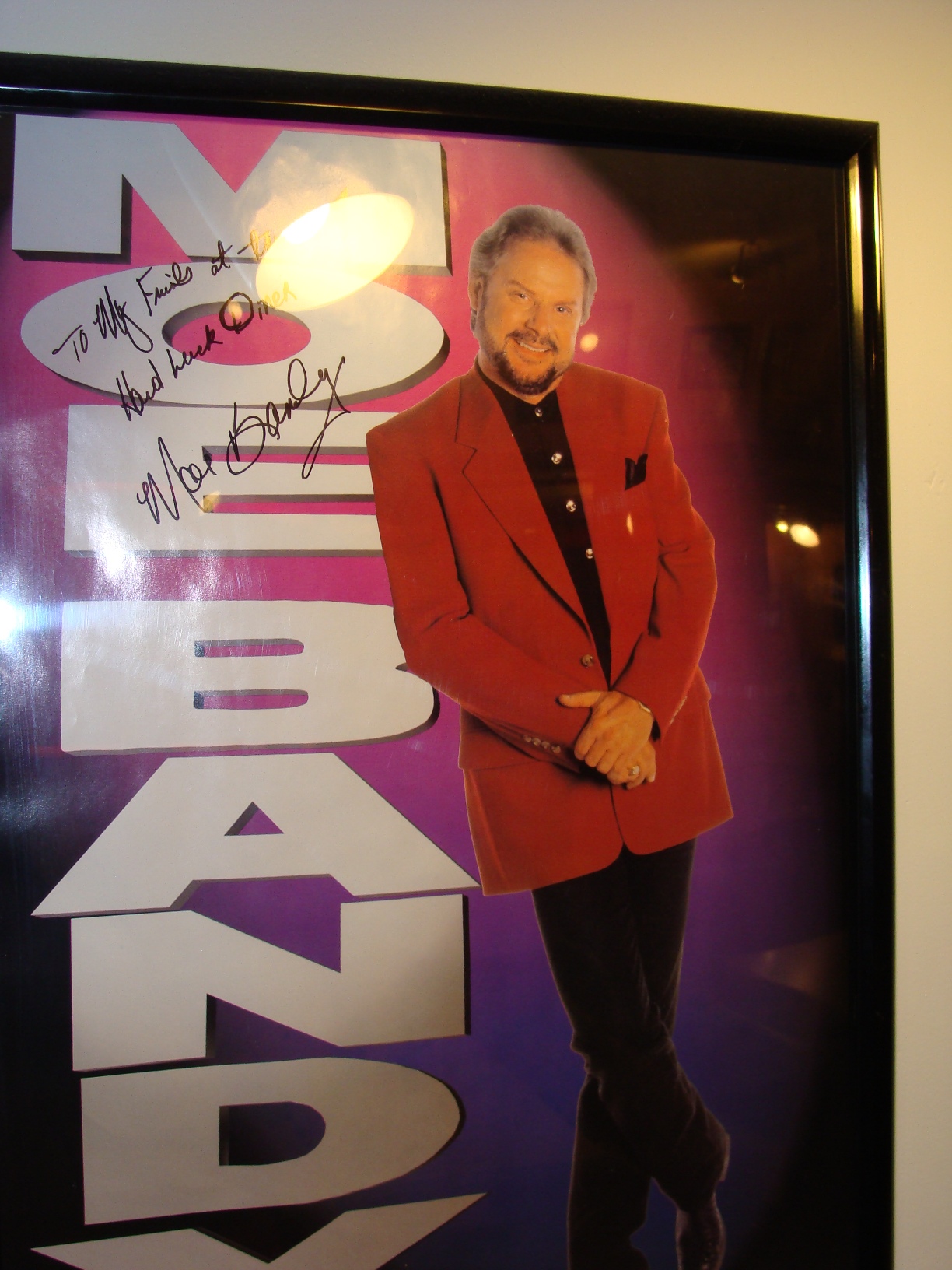
Mark Hooper  Moe Bandy

~~~~~~~~~~~~~~~~~~~~~~~~~~~~~~~~~~~~~~~~~~~~~~~~~~~~~~~~~~~~~~~~~~~~~~~~~~~~~~~~~~~~~~
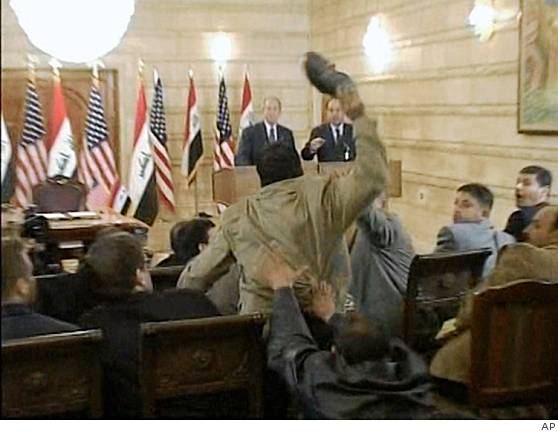
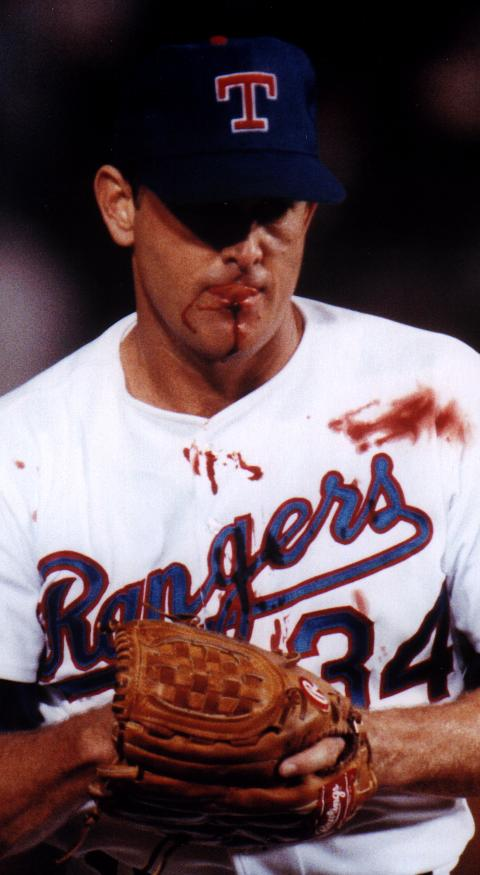
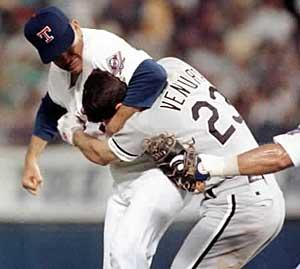
Look how Bush just stands there. And this was the SECOND shoe!If anyone ever — EVER — throws anything at me while I’m preaching, I hope I exhibit the same calm presence as President Bush. I’ve watched the video a hundred times. And I can’t get enough. He stared the guy down like Nolan Ryan facing Robin Ventura. It was like he was daring him to throw his camera or his hat. He dodged and then popped back up for another. Incredible. Hilarious. Bring it on!

I can’t see anyone in the pulpit really acting that way, though, except maybe John Bailey. The man throwing anything at John would be terrified if he actually hit him.

~~~~~~~~~~~~~~~~~~~~~~~~~~~~~~~~~~~~~~~~~~~~~~~~~~~~~~~~~~~~~~~~~~~~~~~~~~~~~~~~~~~~~~

WhitneyThe blogging may be sporadic, if not entirely shut down, for the rest of the week. Whitney, our oldest, goes into Scottish Rite Hospital in Dallas tomorrow morning for Thursday’s surgery. She’s having reconstructive surgery on her left foot to fix a couple of issues she’s been dealing with for a little over ten years. They’re actually taking some bone out of her hip and grafting it into her foot to straighten it out and give it a little more regular shape. She’ll be in the hospital until at least Saturday. And she’ll wear a cast and be on crutches and in a wheelchair for six weeks.

She finally admitted Sunday that she’s “a little nervous.” But she’s also looking very forward to getting everything fixed. Her parents are a little anxious, too. Please keep our precious angel in your prayers to our gracious Father this week.

Peace,

Allan

Joyful Righteousness

JoyfulRighteousness“Whatever was to my profit I now consider loss for the sake of Christ.” ~Philippians 3:7

 The apostle Paul hailed from the royal tribe of Benjamin. He might have even been named after Israel’s first king. He spoke both Hebrew and Aramaic. He had memorized most of the Holy Scriptures. His diploma carried the name of the leading school in religious thought. He belonged to the religious sect that upheld God’s law more than any other. He was unmatched in religious zeal. He had no tolerance for commandment-breakers. In short, Paul was perfect — as perfect as any God-fearing Jew could possibly be.

But when Paul opened up his books to read the ledger of his life, surprisingly he found he was completely bankrupt! He had nothing!

His faith was in his own righteousness. And it wasn’t enough. His trust was in his own abilities to keep God’s law. And it wasn’t even close. He had been comparing himself to others and had always been judged worthy. But when he was forced on the road to Damascus to compare himself to the Holy Son of God, he came up empty.

So he writes, “I consider everything a loss compared to the surpassing greatness of knowing Christ Jesus my Lord, for whose sake I have lost all things. I consider them rubbish, that I may gain Christ.” (Phil. 3:8)

Paul didn’t count his heritage or his good works as trash. He didn’t stop keeping God’s commands or renounce his schooling. He determined that his faith in those things was worthless. Trust in his own law-keeping and ritual-following was worthless. Paul realized that his own righteousness would never save him. He could only trust the righteousness that comes freely from God by faith in his crucified and resurrected Son.

That confidence in his salvation by faith in Christ is what allowed Paul to write, despite external opposition and internal conflict that plagued God’s Church, “My brothers, rejoice in the Lord!”

Peace,

Allan

Where Are The Sparks?

Where Are The Sparks?“In this [salvation from God] you greatly rejoice, though now for a little while you may have had to suffer grief in all kinds of trials. These have come so that your faith—of greater worth than gold, which perishes even though refined by fire—may be proved genuine and may result in praise, glory, and honor when Jesus Christ is revealed.” ~1 Peter 1:6-7

Suffering, while it may not be as much a part of the everyday fabric of our lives as it was when Peter was writing, should probably be more a part of our lives than it is. True, ours is an age of toleration and pluralism. These two characteristic virtues clearly retard a society’s inclination to persecute. Nor is our society as intense about its religious beliefs as other parts of the world, which inculcate both a quicker and more physical response to strange ideas and practices.

But even if we bracket out our Western civility, the contrast between the Christian community’s belief in the gospel as well as its commitment to holy living and our culture’s unbelief in the gospel and its permissiveness ought to generate more sparks than it does. I contend that one of the reasons there are so few sparks is because the fires of commitment and unswerving confession of the truth of the gospel are too frequently set on low flame, as if the church grows best if it only simmers rather than boils.

~Scott McKnight, 1996

Messy Sunday Nights

I look around the circle in my living room Sunday night. What a mess! Wow, what a mess!

A divorced single mom, struggling to make ends meet, dealing with fatigue and a teenage son. She’s cancer-free now for three years, but fighting other battles that just won’t go away. A couple who’ve just come back to the Lord after several years of living for themselves. Two teenaged children next to them. One was just baptized. One just gave birth to a baby girl last week. A single woman who just moved here from West Texas a couple of months ago for a job that now appears to be heading south. She’s stressed like you wouldn’t believe. And confused. A single dad with two teenagers. He’s dealing with all kinds of physical ailments like diabetes and bone and joint problems. A recently blended family, the product of infidelity and deceit. Four kids. All of them scarred by rejection and hurt. An older guy, a veteran soldier of Christ, struggling with his own arthritis and pain problems. An Hispanic couple from Puerto Rico with two young daughters; he’s burned out at work, she’s home-schooling the kids.

And I see myself in the mirror over the antique stereo in my living room. A new preacher filled with self-doubt. Overwhelmed by the enormity of his circumstance. Battling insecurities. Inadequacies. Ego. Sin.

In that circle on Sunday nights, we give our messes to our God and to each other. We carry each other. We serve each other. We encourage one another and affirm that our Father is holding our hands and walking with us on our journeys. We go around the circle and pray for each other. We go around the circle and tell our stories. We go around the circle and admit shortcomings and pledge to do better. We buy a baby stroller together and shower the new child-mother with the love of Christ. And we show that God forgives. We go out to dinners with the families struggling to renew their faith. And we show that God protects. We raise money for the single mom and present it to her as a gift of God’s grace. And we show that God provides. We visit hospitals and even a mental health facility once to help bear one another’s burdens. And we show that God cares.

And a week doesn’t go by that tears are not shed. Tears of gratitude. Tears of sorrow. Tears of joy. Tears of astonishment that our God can be so good.

I’m not sure what’s happening in the other 36 Small Groups at Legacy. I hear stories almost every week about members of our church family who are being carried and served by their Small Groups. A single dad in the hospital with emergency gall bladder surgery. A young police officer injured in a motorcycle accident. A neighbor displaced by a house fire. Small Groups providing meals and prayers and rides and support and money and strength to the kinds of people who would normally slip through the cracks in a church as big as ours. Without Small Groups, these folks have no connection, they have no one to call, no one to take care of them in a crunch, much less day-to-day and week-to-week. With Small Groups, they have everything. And more.

Our God put us in community. He calls us to be together. It’s his plan. It’s his purpose for his people. To minister to one another. To provide and protect and defend and lift up one another in the name of our Christ. We are, afterall, a Kingdom of Priests. Sacrifice and service. Giving up everything and dying for others. Being transformed. Becoming more like him.

We’ve got a wreck of a group in our house on Sunday nights. All kinds of problems and issues. Tons of baggage. But we’ve all seen, we’ve all experienced, every one of us without exception, our God working in us and through us together to draw us closer to him and to a realization of his divine purposes for our lives. We are not inadequate. We are not insecure. We are not weak or unable. We have our powerful God, the Creator of the Universe. And we have each other. Just the way he intends.

~~~~~~~~~~~~~~~~~~~~~~~~~~~~~~~~~~~~~~~~~~~~~~~~~~~~~~~~~~~~~~~~~~~~~~~~~~~~~~~~~~~~~

KK&C Top 20 Logo 

December 9, 2008

The final regular season “KK&C Top 20″ college football poll reflects not only the standings in most other highly respected lists, but also the national outcry (again) against the system that determines the national champion. OU receives four first place votes to leap into the top spot, followed by their title tilt opponent Florida. At just one point back, Texas falls to third, out of the only game that matters. In fact, a total of just four points separates our top three teams with Alabama and USC rounding out the top five.

Our die-hard regulars contributed their same great, entertaining comments to go with their votes. Familiar themes such as Mike Gundy’s manly boasts and Joe Pateno’s decaying hip make expected appearances. David Byrnes reacts typically to the postseason matchups: “Alabama vs. Utah? There’s no BCS computer! Someone’s just drawing names from a hat!” Charlie Johanson finishes strong with one final (for now) Oregon Duck crack. But his comment about Cincinnati and WKRP shows little knowledge of what a real TV sitcom should look like; or a pre-plasticized Loni Anderson.

Ball State fell out (nobody loses to Bufallo and stays in our poll) along with Boston College and Missouri, replaced by Virginia Tech, Pittsburgh, and Michigan State.

The final, final, final “KK&C Top 20″ will be released Friday night, January 9 after the coaches have voted the winner of the national championship game national champion, as per the arrangement.

As always, click on the green “KK&C Top 20” tab in the upper right hand corner of this screen to get the full poll, all the comments, and complete profiles of all the voters.

Peace,

Allan

Costly Truth

Costly TruthA little bit of the discussion stemming from Friday’s post, Beware The Shadows, has led me to consider anew how Truth, especially as it applies to God’s vision for his people, is costly. Christianity is risky. Discipleship is costly. Being a follower of Jesus is daring and dangerous. And a good many of us don’t have the stomach for it. Seeking that truth and living it out always comes with a price.

I’m reminded of another Lynn Anderson line in his book Freshness for the Far Journey: “Each of us is as free as all truth-seekers have been from Jeremiah to Sagdluk, provided we, like they, value truth highly enough to maintain the payments.”

Jesus said, “If anyone chooses to do God’s will…” (John 7:17) It’s always a choice. And sometimes it can be a very painful choice. Jesus also said, “How can you believe if you accept praise from one another, yet make no effort to obtain the praise that comes from the only God?” (John 5:44) Making that unpopular choice every single day is essential to Christian ministry. It’s paramount to our faith to tread that less-traveled road.

More from Anderson: “Those who most freely pursue God’s truth do so in spite of the fact that the environment does not encourage them. To be able to stand before His smiling countenance means far more to them than their security or their forum or the affirmation of their fellows.”

To apply this thought more directly to preachers and teachers and elders in God’s Church, I’ll pull an illustration from another portion of this same book: “Part of the reason Mozart ended up in a pauper’s grave was, according to legend, because he said, ‘I will not write what they want to buy. I will write what I hear.’ Such was Mozart’s artistic integrity. Question: Can any preacher of the Word do less? Dare we neglect ‘what we hear’ to live and preach only what ‘they will buy’?

~~~~~~~~~~~~~~~~~~~~~~~~~~~~~~~~~~~~~~~~~~~~~~~~~~~~~~~~~~~~~~~~~~~~~~~~~~~~~~~~~~~

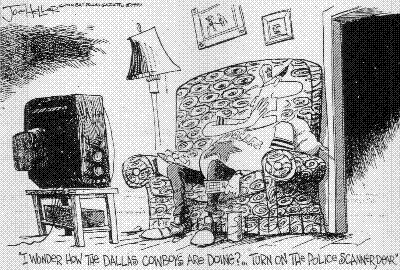
Some of the discussion from another recent post made me dig this up again. Enjoy.

Cowboys Scanner

Peace,

Allan

Beware The Shadows

Beware the ShadowsWe spent a lot of time in San Antonio Tuesday talking with Lynn Anderson about the mission of God’s Church. If we understand the teachings of Jesus and the apostles, Scripture shows us clearly that God’s people are to live their lives in such a way as to be lights of truth and salvation to the world. Our unity, our common love, our sacrifice and service should be so obvious to others they can’t help but wonder about the Savior who empowers us to live so differently from the rest of society. That’s God vision. That’s his purpose for his Church.

And that’s our vision as preachers and teachers and shepherds. Living like Jesus. Acting like the Christ. Being transformed more and more into his image. That’s what we proclaim. That’s what we profess.

But if we’re not careful, especially in moments of crisis, we can become driven by other things. Lynn calls those things our “shadow missions.”

When things get tough or shaky or uncertain, when things aren’t happening the way we planned or as quickly as we’d like—in other words, when Satan attacks—we have a human tendency to fall back on our human plans and human needs to meet our human expectations and defeat our human fears.

We often measure success in human terms. And those needs for numbers and applause and buildings and affirmation and contribution cause us to react in one of two ways: we either go into “success mode” or “survival mode.”

Church decisions made and policies produced in success mode are focused on new programs and perceived excitement and manufactured enthusiasm. Generally it’s done for the sake of the buzz it creates and the accompanying noise and bright lights. We become more “like the nations around us.” That’s not the Jesus Way.

Survival mode decisions and actions focus on the numbers; not offending anyone for fear they’ll leave; not upsetting anyone for fear they’ll stop giving money; not challenging anyone to grow for fear we won’t be able to pay the mortgage or the bills. That’s not the Jesus Way.

Lynn calls those our “shadow missions.” These kinds of things are always there, always lurking in the background, always a temptation. And a crisis will often cause these motives and these goals to overtake God’s vision. Our personal mission becomes a higher priority than God’s vision. It’s actually in contradiction with God’s vision.

We all have these shadow missons. We all have needs and wants that don’t necessarily jive with God’s vision. Close inspection reveals that most of our shadow missions are exactly the opposite of what Jesus teaches it means to be like him. Our Savior never knew success or money or buildings or prestige or applause. He didn’t seek it. He didn’t want it. Our challenge is to determine, in everything we do, that God’s vision for his people will never become second to our own missions for ourselves.

Jesus came to earth with absolutely no desire for success and certainly no intention to survive.

Peace,

Allan

« Older posts Newer posts »