Author: Allan (Page 417 of 492)

Why Johnny Can't Preach

Why Johnny Can’t PreachI’ve just finished reading a short book by T. David Gordon, a professor of religion and Greek at Grove City College in Pennsylvania, on the current state of preaching in America. The book is titled Why Johnny Can’t Preach. And it claims Johnny can’t preach because 1) Johnny can’t read and 2) Johnny can’t write. Gordon points to the rapid changes in the mass media culture of this country that have taken us from a literate society to a society based on images. And he says it’s killing preaching.

This book doesn’t come close to the ultimate work on the community and societal dangers of technology. Neil Postman’s masterpiece, Amusing Ourselves to Death, asks the questions we all should be asking about not what technology can do for us, but what technology is doing to us. His book, in my judgment, begins and ends all of those kinds of discussions. Every other conversation on this topic is a commentary on what Postman observed 30 years ago.

Gordon’s book isn’t bad. He points out that the “average weekday network news sound bite from a presidential candidate shrank from 42.3 seconds in 1968 to 9.8 seconds in 1988 (with only one percent of the bites lasting as long as 40 seconds that year). By 2000, the average was 7.8 seconds.” And he cleanly shows that these kinds of facts cause, and are a reflection of, an increasing inability to think seriously about serious things. He notes correctly that TVs and computers and cell phones are ruining us for personal communication, the skills to read and listen for more than just information and the talents to correctly organize and compose one’s thoughts. So, preachers are increasingly unable to preach. And, even if they were, the congregation is increasingly unable to discern good preaching if they hear it.

He’s right. He’s just a little over the top. His passion certainly shines through. But it’s unyielding and rigid.

Notice these lines about the way watching TV dulls our abilities to tell the difference between the significant and the insignificant: “Television-watching prohibits such discernment. One simply cannot regard the significant as more important than the insignificant, and then plop himself in front of a television for two to three hours an evening. The only way the conscience can survive such a colossal waste of a human life is for the individual to refuse to entertain the question of the difference between the significant and the insignificant.”

It’s good. It’s right. He’s dead-on right. But it’s a little much, don’t you think?

Gordon does spend half a chapter or so on the subject of moralisms in our Christian preaching, the practice of telling the congregation they need to shape up and start acting better, without a word of grace regarding how the Lord empowers us to act better. It’s preaching imperative without indicative. And I really struggle with that. I’m overly careful about it in my own preaching. I try to always include God’s grace through Christ and the power of his Spirit that enables us to live for him. Yet, I’ll ocassionally go back and still find moralisms all through my sermons.

Here’s Gordon on moralisms, which are, in his words, “never appropriate” unless they’re presented in the context of redemption: “Even when the faithful exposition of particular texts requires some explanation of aspects of our behavior, it is always to be done in a manner that the hearer perceives such commended behavior to be itself a matter of being rescued from the power of sin through the grace of Christ. When properly done, the hearer longs to be rescued from that depravity from which no sinner can rescue himself; and the hearer rejoices to know that a kind and gracious God is both willing and able to begin that rescue, which will be completed in its glorification.”

That helps me. That helps me a lot. Focus, Allan, focus. That’s good stuff. ~~~~~~~~~~~~~~~~~~~~~~~~~~~~~~~~~~~~~~~~~~~~~~~~~~~~~~~~~~~~~~~~~~~~~~~~~~~~~~~~~~~~~

DaveTippettI regret the firing of Stars coach Dave Tippett, the nicest of the head coaches I ever had the pleasure of covering during my time in sports radio. His personality might have actually been a factor in his firing: too nice a guy. New Stars GM Joe Nieuwendyk, who played the game hard and fair, who was everything you’d ever want in a team captain, is probably looking for a coach with a different kind of edge to try to make one or two quick postseason runs here with what is now an older team. Tippett was probably the right guy to take over for Ken Hitchcock who, despite taking the team to two Stanley Cup Finals and one title, had worn out his welcome with his star players. And it may be time for Tippett to go now, too. Who knows? But he was the last remaining of the four head coaches of Dallas’ major sports teams that I personally covered in my previous life. And one of my favorite. Although, I never got used to him without the mustache. Tippett was good for the Stars and he was good for his sport. He’ll catch on somewhere else. He’s too good not to. And I wish him all the best.

~~~~~~~~~~~~~~~~~~~~~~~~~~~~~~~~~~~~~~~~~~~~~~~~~~~~~~~~~~~~~~~~~~~~~~~~~~~~~~~~~~~~

SharonToday is my little sister Sharon’s birthday. To honor her, go to Bonanza and flirt with the cook, build a “howsh,” sleep through a tornado, and take four weeks to return all phone calls. I love you, Sharon.

Peace,

Allan
No Fun At All

Our Tuesday morning men’s Bible study here at Legacy is going quickly through C. S. Lewis’ classic Christian apologetic, Mere Christianity. I was captured all over again this week by Lewis’ brief, but mighty, description of repentance:

Lewis“Fallen man is not simply an imperfect creature who needs improvement: he is a rebel who must lay down his arms. Laying down your arms, surrendering, saying you are sorry, realizing that you have been on the wrong track and getting ready to start life over again from the ground floor — that is the only way out of the ‘hole.’ This process of surrender — this movement full speed astern — is what Christians call repentance. Now repentance is no fun at all. It is something harder than merely eating humble pie. It means unlearning all the self-conceit and self-will that we have been training ourselves into for thousands of years. It means killing a part of yourself, undergoing a kind of death.”

In our zeal to formulate salvation, to reduce God’s eternal plan for his creation down to an orderly handful of requirements, we’ve done the world a disservice and cheapened God’s grace.

By claiming for decades and generations that one has to repent first, confess next, and then be baptized in order to be saved has implied that these are all one-time steps to salvation. The truth is, we must repent every single day. Every day. Every morning when I wake up, as I’m turning off the alarm and getting ready to start another day in God’s Kingdom, I have to intentionally turn my life around. This world and its culture and its history, my human-ness and my nature and my surroundings, all have me going in the wrong direction. Every morning when I wake up, my tendency, because of my world, is to go in a way that is opposed to the will of my God for my life. I have to determine every morning that today I will live for Christ. Today I will not do such and such. Today I pledge to certainly do this and that. Today I repent from what my own instincts and impulses are pushing me to do, I turn away from what my nature says is in my best interest, I reject what my will wants. I surrender. I give up. None of self and all of Thee.

Repentance is an on-going process. So is Christian confession. It’s realizing, more every day, that Jesus is Lord of every part of my life. There’s not a time or a place that Christ does not sovereignly rule. Jesus is Lord in my driving habits, in my conversations, and in my work and play. Jesus is Lord over this blog, over every website I visit, over every email I write. He is Lord over every interaction I have with my wife, my children, my church family, my neighbors, my enemies. He is Lord when I pray. And he is Lord when I watch TV. I confess that every day. And I repent.

Today I return to my Lord and Master. Today I submit to his will. Today I promise to live for him and others, not for myself. Today I vow to act and to speak and to think in ways that bring my God glory.

Peace,

Allan

My Food

“My food is to do the will of him who sent me and to finish his work.” ~John 4:34

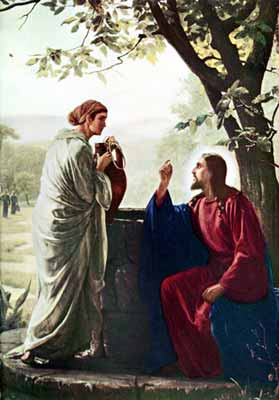
My FoodJesus says these words in the context of his encounter with the Samaritan woman at the well. She had come looking for water. But Jesus talked to her about living water. He visited with her about eternal life. He envisioned for her a genuine relationship with God based on spirit and truth. He met her needs. Not her physical needs. Not her culturally-defined needs. He met her eternal needs for love and grace, mercy and compassion, forgiveness and restoration and salvation.

That’s my food, Jesus says. That’s my passion. That’s my calling. That’s what sustains me. That’s what keeps me going. That’s my calling. That’s how I live.

Jesus says, that’s my need. To seek and save the lost.

If we’re not careful, we can give in to the temptation to give people what they want, not what they need. It’s actually a lot easier to give people what the culture tells them they need than what Holy Scripture says they need. And if we’re not careful, our focus can become all about using more media, initiating more programs, hiring more ministers, building bigger buildings, starting new focus groups, and forming more committees to offer people what they can already get at NorthEast Mall.

If God’s Church can’t offer the world something the world can’t already get at Wal-Mart or Six Flags or Chuck E. Cheese, than God’s Church is not meeting needs The Jesus Way.

Jesus has met our deepest eternal needs, the Jesus Way, by dying on a cross to redeem us from our sins and then breathing into our nostrils his resurrection. Our food — my food — is to do the will of him who saved us by meeting the deep eternal needs of our community the Jesus Way.

Peace,

Allan

The Jesus Way

“Whoever claims to live in him must walk as Jesus did.” ~1 John 2:6

The Jesus WayI’m concerned about us doing things the way Jesus did them. I’m worried about the way Jesus went about his business and fulfilled the Father’s mission and I wonder about the ways we go about our business and fulfill our Father’s mission. I find myself thinking about this a lot.

I’m afraid that we call ourselves followers of Jesus, but, without hesitation and, a lot of the time, seemingly without thinking, we embrace the ways and means of the world. We live our lives in the name of Jesus. But the way we do things and plan things and think about things is, instead, very worldly. The Jesus Way is the alternative to the world’s way — not a supplement. The Jesus Way is not just a little bit opposite of the world’s way or sometimes opposed to the culture’s way. It’s all the way opposite and it’s completely opposed to the way of the world.

“If anyone would come after me, he must deny himself and take up his cross and follow me. For whoever wants to save his life will lose it, but whoever loses his life for me and for the Gospel will save it” (Mark 8:34-35).

That’s The Jesus Way. Any other way is less than and actually opposed to The Jesus Way. And that seems easy enough to understand. And we say we get it. But I see us sometimes uncritically embracing the ways and means practiced by large corporations and important causes and high-profile congregations and rich people who know how to win wars and make money and manage people and sell products. And, more often than not, those ways violate the Way of Jesus. We are so quick, I’m afraid, to go along with whatever the culture decides is successful or influential or important, whatever gets things done, whatever gathers a crowd, whatever keeps a crowd, whatever’s new and improved. And we don’t stop and think long enough to notice that those ways are at odds with the clear way Jesus walked and calls us to follow.

We’re interested in the Way Jesus leads because this is absolutely and necessarily the Way we have to follow. We can’t follow Jesus any way we’d like. Our following must be consistent with his leading. The Jesus Way is not a vague generality pointing in some upward direction. Jesus lived his life prayerfully and scripturally attentive. Jesus deliberately chose the Way he would live. And, if we choose to follow him, we have to be just as prayerful, just as attentive to Scripture, just as deliberate.

The Jesus Way is always personal. It’s always lived in deep, personal, loving, and giving relationship. It’s never imposed. Never forced. Never manipulative. It’s never from a distance. It’s always up-close. It’s always sacrificial. Look at The Way Jesus acted and thought and felt and talked and gestured and prayed and healed and taught and forgave and died. That’s The Jesus Way. Everything Jesus did was based on relationship: close, intimate, sacrificial, serving, self-denying relationship.

May our Father bless us as we diligently practice with each other and for each other the Way of Jesus.

Peace,

Allan

Don't Be Afraid

“Do not let your hearts be troubled.” ~John 14:1

Don’t Be AfraidSo many of us live in fear. I’m not talking about temporary fear like the feelings you get stepping into the car of a roller coaster or listening to strange noises coming from the garage in the middle of the night. Not that kind of fear. I mean actually living in fear. I mean growing accustomed to — or even comfortable with — that constant worry about your life. Or your eternal body and soul. I mean accepting an uneasy feeling that your salvation is not secure and your future may be in doubt. It’s this “Once saved, barely saved” mentality that makes inner peace, the shalom that is the will of God for his children, impossible.

Living in fear means giving up control. Our fears begin to direct our thoughts and actions. We adjust our routine to accomodate our fears and our fears become our masters. Our fears dictate what we do or say. Or don’t do or say. If we’re not careful, fear barges into our lives and just makes itself at home. Fear will clean out your pantry and track mud all over your carpets and, eventually, take over shaping you and controlling you into an image very different from that of our Lord.

Fear keeps us from doing what we’re called to do as children of God and followers of his Christ.

Talk to my neighbor about Jesus? Oh, no, I’d be afraid.
Confront my sister in Christ about her sin? I’m afraid I just can’t.
Stand up for Jesus in front of others? I’m too afraid.
Fear of hurting feelings may keep us from disciplining our children.
Fear of straining relationships may keep us from sharing our faith.
Fear of being vulnerable may keep us from confessing sin or admitting our own wrongs.

Fear is powerful. And fear gets its power when it causes us to look away from the strength of our God and focus our eyes and attention instead on the opposition around us and our own weakness.

“Do not let your hearts be troubled. Trust in God, trust also in me.”

Jesus calms the storm and asks his apostles, “Why are you afraid?”
Jairus’ daughter is dead and Jesus tells him, “Don’t be afraid.”
Jesus tells his apostles around the table that last night — he tells us, his followers, today — “Don’t be afraid.”

Fear loses its power when we focus our eyes and attention on our God and his eternal nature to love and heal and forgive and provide and protect and rescue and save. Then, there’s no place for anxiety or fear. There’s no room.

Whatever you’re afraid of completely evaporates when our eyes are on our loving Lord. His presence dismisses the dread. His touch terminates the terror. His power prevails over fright and doubt. His perfect loves drives out fear.

“The Lord is my helper; I will not be afraid. What can man do to me?” ~Hebrews 13:6

Peace,

Allan

Naught From Myself

“I expect naught from myself, everything from the work of Christ. My service has its objectivity in that expectation and by it I am freed from all anxiety about my insufficiency and failure.” ~Bonhoeffer

Not quite. Not really. If I’m truly honest with myself (and with you) I am not completely freed from all anxiety about my insufficiency and failure. As the good news preacher here at Legacy, I realize that whatever is accomplished is done only by God’s grace, Christ’s work, and the Holy Spirit’s power. I know that. It’s not me. It’s never me. It’s my God working in me and through me. And that does relieve a lot of the pressure. That knowledge does fill me with confidence and courage.

But I don’t know if I’ll ever lose the feelings of inadequacy that overcome me on Sundays; the dread — almost — that one day everybody’s going to wake up and see me for the fraud I really am; the fear that some day soon everybody’s going to think, “You know, he’s really not that good.”

Christ in me. It’s my only hope. It’s my only chance. And I know that.

It’s been demonstrated to me — proven to me — every Sunday now for two years here at Legacy.

Two years ago today I stood before this church family and pledged my love and loyalty to our Lord and to my God-ordained task of studying and praying and teaching and preaching with them. I promised them that, while there would be times they would be disappointed in me, there would be times I would let them down, it would never ever be from a lack of giving everything I have to the task.

Two years ago today.

In some ways it’s easier now than it was then. In a lot of ways it’s even harder.

Time together makes things better. Relationship is key. Trust only comes with the passing of months and years. Time also means more opportunity to disappoint. And I know I’ve disappointed my brothers and sisters here. I’ve fallen short with our shepherds and my fellow ministers. There have been plenty of moments when I wish I had a do-over. But that’s where this time together also helps. We know each other now. We love each other more. And I feel their patience with me and their forgiveness of me, even their endurance of me, streaming out of relationship, pouring out of hearts united by our Savior and our common goal of serving and worshiping our God.

I can’t imagine being at a better place. Our Lord has blessed my family and me to be in a church with unlimited potential to advance the Gospel and turn Northeast Tarrant County upside down for the Kingdom. And he’s surrounded us with loving and caring people who are nurturing me to be the good news preacher God’s called me to be.

Until Christ is formed in us,

Allan

« Older posts Newer posts »