Author: Allan (Page 404 of 492)

Our Lord Is Faithful

Our Lord is FaithfulOur Tuesday morning men’s Bible study group dove into 1 Corinthians this week. And we were struck by Paul’s comments at the beginning of this powerful letter. He’s writing to a church that’s completely eaten up with pride and divisions and arrogance and immaturity. The leaders of this church are abusing the very gifts God’s given them to prove his holy presence. They’re running the church with worldly methods according to worldly standards. This church is a mess. It’s a wreck. It’s doing more harm for the Kingdom than good.

Yet, Paul writes:

“Therefore you do not lack any spiritual gift as you eagerly wait for our Lord Jesus Christ to be revealed.”

Huh?

Paul gives thanks for this church. He praises this church for their enriched speaking and knowledge. He calls them the “sanctified.” He claims that this whacked-out church in Corinth has just as many spiritual blessings and potential as any church that’s ever been established.

Huh?

How can he write that? How can he be positive and thankful? How can he, with a straight face, affirm anything good going on here?

“He [Christ] will keep you strong to the end, so that you will be blameless on the day of our Lord Jesus Christ. God, who has called you into fellowship with his Son Jesus Christ our Lord, is faithful.” ~1 Corinthians 1:8-9

God himself provides the guarantee. He will remain faithful to his promises to ultimately perfect his chosen people. No matter how immature they are, regardless of the ways they act toward one another and in their community, God is making his Church wholly blameless. We are forgiven of our sins and are in the process of “being saved.” We’re being remolded, transformed, even if it comes with great swings and dramatic ups and downs.

We’re always going to see the blemishes in God’s Church. His Church is made up of humans. Some days, those blights on the Bride of Christ are all we can see. It can be discouraging. It can bring us down. Especially when we recognize that, a lot of the times, we ourselves are actually part of the problem.

The key is to focus not on the unfaithfulness of God’s people but, instead, on the eternal faithfulness of our God. We are Christians still awaiting perfection, still awaiting the final revelation and completion and arrival of the Kingdom of God. It’s coming. And he promises that when it does, he will have made us ready.

That includes you. And me.

Peace,

Allan
One Man's Vision

For us in the Churches of Christ, I think some of the fear of publicly and openly recognizing other groups of Christians as brothers and sisters is that our people will leave and join those other churches. We’re going to lose members. If we admit that the members of all these churches are just like us in that we’re all calling on the name of the Lord, we’re all baptized into Christ, we’re all following the Word to our best abilities, and we’re all saved by the matchless mercy and grace of God, there’s nothing to keep our members or our children from embracing those other churches. We’ll lose members. As I’ve heard more than a couple of people put it, “If we’re not better, if we’re just like everybody else, then what are we calling our people to? What’s the point?”

OK. Hear me out.

I think that openly embracing other groups as Christian brothers and sisters will actually cause our specific Church of Christ stream to grow, not shrink. We can still hold and uphold certain practices and preach and teach certain doctrines. Those practices and doctrines are critical. They’re important. Saved by faith. Baptism for the forgiveness of sins. Weekly celebrations of that salvation around Christ’s table. Acappella singing. Yes! We stand strong for them. But just because we take ownership of certain doctrines and practices doesn’t mean we have a monopoly on God. We don’t. And if we’ll just recognize that, if we’ll just accept that we’re all doing the best we can with sincerity and faith, that we’re all saved by grace, it will change us for the better.

Here’s how: I think it would actually force us into where Christ inarguably calls us to be.

Instead of saying, “Be a member at Legacy” or “Be a member of the Churches of Christ” because our worship is correct, we’d be forced to say, “Be a member at Legacy” or “Be a member of the Churches of Christ” because our people are being shaped by Jesus. Be a member here because our people are so good. Be a member here because our people will love you and support you no matter what. Be a member here because we’re so involved in our community. Because Christ really does dominate our thoughts and deeds. Because we’re serious about being transformed into his image. Because we really have sold out to Christ Jesus as our Lord. Because we act like a family. Because we take care of each other. Because we really believe we are saved through no merit of our own. Come be a member of this church because God is using us in huge ways to impact his eternal Kingdom.

When we receive one another as Christ received us, when we forgive one another as God forgives us, when we love one another as God through Christ loves us, that will attract many more people to Jesus than a “correct” worship service on Sunday morning. Our focus will no longer be inward, on the “correctness” of our Sunday morning hour, but outward, toward loving one another and sharing God’s mercy and grace to a lost and dying world.

Just a dream? Maybe.

But I hope to pass it on to my children as the holy will of our God and something that needs to be pursued by his people with everything we’ve got.

Peace,

Allan

One Man's Vision

For us in the Churches of Christ, I think some of the fear of publicly and openly recognizing other groups of Christians as brothers and sisters is that our people will leave and join those other churches. We’re going to lose members. If we admit that the members of all these churches are just like us in that we’re all calling on the name of the Lord, we’re all baptized into Christ, we’re all following the Word to our best abilities, and we’re all saved by the matchless mercy and grace of God, there’s nothing to keep our members or our children from embracing those other churches. We’ll lose members. As I’ve heard more than a couple of people put it, “If we’re not better, if we’re just like everybody else, then what are we calling our people to? What’s the point?”

OK. Hear me out.

I think that openly embracing other groups as Christian brothers and sisters will actually cause our specific Church of Christ stream to grow, not shrink. We can still hold and uphold certain practices and preach and teach certain doctrines. Those practices and doctrines are critical. They’re important. Saved by faith. Baptism for the forgiveness of sins. Weekly celebrations of that salvation around Christ’s table. Acappella singing. Yes! We stand strong for them. But just because we take ownership of certain doctrines and practices doesn’t mean we have a monopoly on God. We don’t. And if we’ll just recognize that, if we’ll just accept that we’re all doing the best we can with sincerity and faith, that we’re all saved by grace, it will change us for the better.

Here’s how: I think it would actually force us into where Christ inarguably calls us to be.

Instead of saying, “Be a member at Legacy” or “Be a member of the Churches of Christ” because our worship is correct, we’d be forced to say, “Be a member at Legacy” or “Be a member of the Churches of Christ” because our people are being shaped by Jesus. Be a member here because our people are so good. Be a member here because our people will love you and support you no matter what. Be a member here because we’re so involved in our community. Because Christ really does dominate our thoughts and deeds. Because we’re serious about being transformed into his image. Because we really have sold out to Christ Jesus as our Lord. Because we act like a family. Because we take care of each other. Because we really believe we are saved through no merit of our own. Come be a member of this church because God is using us in huge ways to impact his eternal Kingdom.

When we receive one another as Christ received us, when we forgive one another as God forgives us, when we love one another as God through Christ loves us, that will attract many more people to Jesus than a “correct” worship service on Sunday morning. Our focus will no longer be inward, on the “correctness” of our Sunday morning hour, but outward, toward loving one another and sharing God’s mercy and grace to a lost and dying world.

Just a dream? Maybe.

But I hope to pass it on to my children as the holy will of our God and something that needs to be pursued by his people with everything we’ve got.

Peace,

Allan

Power In The Blood

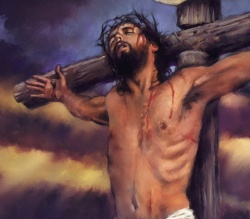
PowerInTheBloodThe blood of Jesus is what courses through our veins. It’s in our DNA. It’s the thing that unites us with all baptized believers who are saved by the grace of God through faith in the Son. The pouring out of his blood is what breaks down the barriers that divide us.

The moment our Christ died, the veil in the temple was ripped in two, torn in half from top to bottom. No more separation. The writer of Hebrews makes a pretty big deal out of this. The death of Jesus, his blood, opens up this new and living way by which we live an integrated life. We’re now integrated with God by total access to his throne in the Holy of Holies. And we’re integrated with one another to live in perfect Christian unity.

There’s an ancient communion prayer written by Hippolytus late in the 3rd century that speaks to the power of Christ’s blood:

“We render thanks to you, O God, through your beloved Son Jesus Christ, whom in these last times you sent to us as a Savior and Redeemer according to you will and in whom you were well pleased. And he was betrayed to voluntary suffering that he might destroy death and break the bonds of the devil and tread down hell and shine upon the righteous.”

Those are powerful words. Destroy. Break. Tread.

Those are fitting words, appropriate action verbs, worthy of what our crucified and resurrected Lord has accomplished for us by his great love and grace. Ephesians 2 tells us in no uncertain terms that when Jesus poured out his blood he “destroyed the barrier, the dividing wall of hostility” and he “abolished the certificate of debt that stood against us.”

He himself is our peace — our peace with God and with one another.

There’s power in the blood. Great power. Wonder working power.

~~~~~~~~~~~~~~~~~~~~~~~~~~~~~~~~~~~~~~~~~~~~~~~~~~~~~~~~~~~~~~~~~~~~~~~~~~~~~~~~~~~~~

100.7 FM, The WordThe Word FM — 100.7 on your radio dial — a local Christian talk radio station here in DFW, has designated Legacy as their Church of the Week. What it means for Legacy is a week’s worth of 60-second promotional spots that I recorded in their Irving studios a couple of weeks ago. I haven’t heard the edited versions yet, but they do focus almost exclusively on our outreach to our community. Specifically the spots mention our involvement with our local elementary schools. And I spend about 30 of those seconds talking up this Saturday’s 27th annual Legacy Give Away Day.

What it could mean for you is $250 cash. At 3:00 this afternoon Texas time, Janet Mefferd will begin her talk show and at some point during that first hour, between 3:00 and 4:00 today, she’ll ask callers to identify this week’s Church of the Week. The first caller to correctly identify the Church of the Week as “Legacy Church of Christ in North Richland Hills” wins the 250-bucks. The call-in number is 800-949-5973. Be ready for it.

And then you can take me to lunch on Friday. I’ll be listening for Janet to call your name.

Peace,

Allan

Bold Vision, Bold Men

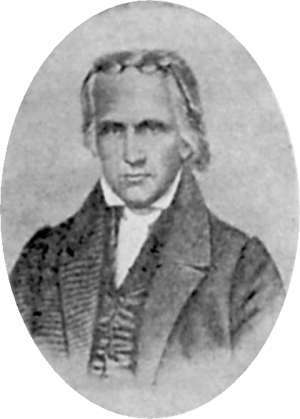
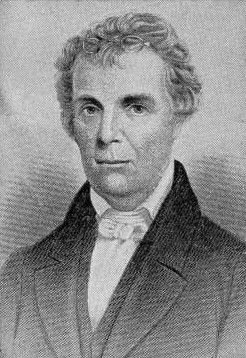
Thomas CampbellIn 1809, Thomas Campbell’s fiery sermons about Christian unity and his very public convictions that all Christians should return to a pure and simple form of New Testament Christianity got him censured by his presbytery and then fired by the Synod in Western Pennsylvania. A couple of years earlier, Barton Stone, a Presbyterian minister in Kentucky, dissolved his presbytery to unite with everyone who would simply be known as Christians and base their beliefs solely on the inspired Word of God.Barton Stone

Both Stone and Campbell had a bold vision. It was a mind-blowing, earth-altering vision. Christians only. Unity in Christ. For the sake of the world. Putting aside party zeal and tearing down denominational walls, these men dreamed and prayed about the one Church we read about in our Bible. The one Church Jesus prayed for the night he was betrayed. The physical and tangible unity of Christ’s Church that proves to the world that he really is the Messiah.

Bold vision.

It was risky. It was dangerous. It was career-ending. It cost them their jobs. It cost them many relationships with family and friends and professional colleagues. But they valued the Scriptural doctrine of unity more than they valued the denominational things that divided.

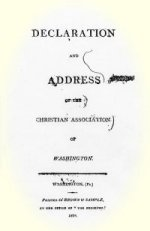
Bold men.Declaration and Address, September 7, 1809

They went into this thing knowing how difficult the road would be. But they believed they were acting in concert with the bold moves of Jesus’ disciples who’d gone before. They were only doing what they thought needed to be done in order to be pleasing to God. In Campbell’s Declaration and Address, long regarded as the founding document for Stone-Campbell Restoration Movement churches, he writes that they would never be dissuaded by men from their attempts at restoring the unity of the body of Christ:

“Indeed, should christians cease to contend earnestly for the sacred articles of faith and duty once delivered to the saints, on account of the opposition, and scanty success, which, in many instances, attend their faithful and honest endeavours; the divine cause of truth and righteousness might have long ago been relinquished.”

Knowing the road to Christian unity would be paved with potholes of preference and prejudice, knowing that they would face the intimidating forces of sectarianism and the walls of tradition, knowing they would be basically starting over from scratch with nothing but Holy Scripture and the grace of God, Campbell sums up their charge for unity in God’s Church by saying,

“What, shall we pray for a thing and not strive to obtain it! Sincerely and humbly adopting this model, with an entire reliance upon promised grace, we cannot, we shall not, be disappointed.”

Bold vision. Bold men.

Bold VisionDoes their story—no, our story!—have any implications for God’s children today? Does it mean anything? This is our heritage. It’s our history. These are our 200-year-old roots. This is our legacy: unity with God in Christ and unity with all those who call on the name of the Lord; profess Christ Jesus as Savior and King; are baptized into his death, burial, and resurrection; and celebrate that salvation around his table on his day.

“Not that we judge ourselves competent to effect such a thing; we utterly disclaim the thought. But we judge it our bounden duty to make the attempt, by using all due means in our power to promote it; and also, that we have sufficient reason to rest assured that our humble and well-meant endeavors, shall not be in vain in the Lord.”

Amen.

Allan

Intentionally One

Great CommunionThe American Restoration Movement began 200 years ago with Thomas Campbell’s Declaration and Address, a call for unity and peace among all Christian denominations based on the pictures of God’s Church we see in the New Testament scriptures and on Christ’s prayer for unity on the night he was betrayed. The founding document of our particular stream of the faith declares that the Church is “essentially, intentionally, and constitutionally one.” He called on all Christians everywhere to drop their denominational tags and creeds and party affiliations and come together as one body in our Lord Jesus. The plea was for disciples of Jesus to recognize that they are “Christians only, but not the only Christians.” Campbell exhorted all believers to speak only where the Bible speaks and to exercise grace and mercy where it didn’t.

Thousands and thousands of people gave their lives to Christ. And hundreds of churches dropped their denominational names and practices in order to embrace this call to Christian unity.

These are our roots. This is our foundation. It’s so simple. And powerful. This document spells out clearly the intentions of our founding fathers.

“…to manifest the realities of Christian unity in their tempers and conduct, to consider each other as the precious saints of God, to love each other as brethren, children of the same family and father, temples of the same spirit, members of the same body, subjects of the same grace, objects of the same divine love, bought with the same price, and joint heirs of the same inheritance. Whom God hath thus joined together no man should dare to put asunder.” Great Communion

One hundred years ago, in Pittsburgh, over 25,000 members of the Churches of Christ, Disciples of Christ, and Christian Churches came together at Forbes Field to celebrate a joint communion service in recognition of the 100th anniversary of Campbell’s Declaration and Address. This year, this Sunday October 4, bicentennial communion services are being held all over the world. Stone-Campbell Restoration churches are gathering together in Canada, Australia, China, Europe, and in dozens of places here in the United States to celebrate what Campbell called “that great ordinance of unity and love.”

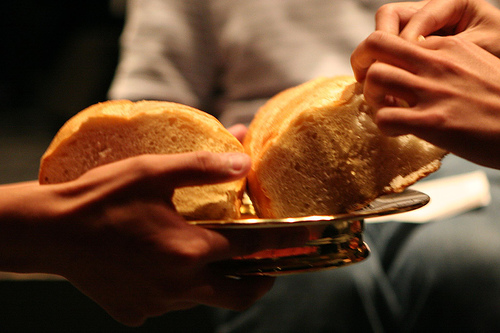
Breaking BreadThe Great Communion D/FW is being held at the Compass Christian Church in Colleyville this Sunday afternoon. I have no idea how many people will be there. I don’t know if we’ll be sharing communion with a couple hundred brothers and sisters or a couple thousand. I don’t know. I don’t know how many people really know or care about our history and heritage in Churches of Christ and the strong ideals of unity and love that founded our faith movement. I’m not sure how many, if any, of us have ever read the Declaration and Address with its unyielding call to unity. I do know that this joint communion service Sunday at Compass will serve as a sort of family reunion. It’ll allow us to come together on the many, many things on which we agree, including the importance of a weekly communion celebrated on the day our Lord was raised from the dead. It helps us break down barriers and tear down walls. It allows us to live out, if even for a moment, the unity we preach and pray for. It provides a time for us to remember the great contribution of the ones who’ve gone before and to reflect on the call for Christian unity that birthed our movement. And it gives us another way to celebrate together our common salvation in our one Lord and Savior Jesus Christ.

I hope to see you there.

 Peace,

Allan

« Older posts Newer posts »