Author: Allan (Page 353 of 492)

Do You See Anything?

Yesterday’s Skip-shot in this space has started something. I received a text from Byrnes very early this morning that said:

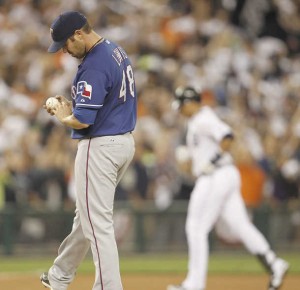
 “Rangers Subdued by Iron Fister.”

I countered with:

“Colby Serves Up the Cheese in Rangers Loss.”

If you’d like to add a corny headline about last night’s game before this afternoon’s begins, jump in.

~~~~~~~~~

We’re conditioned by our world — actually it’s in our nature and then reinforced by the world — to see the things we want to see and hear the things we want to hear. Anybody with a spouse or any children know this first hand. I’ll tell the girls “maybe” and they run to Carrie-Anne and say, “Dad said we could!” As a preacher, sometimes this works in my favor. Somebody will tell me how wonderful it was when I said such-and-such and I have no idea what she’s talking about. What this lady heard is nowhere near what I was preaching. But it meant something to her. And I still take credit for it. Of course, it certainly can work the other way, too.

In the Gospel of Mark, Jesus keeps asking people if they’re seeing correctly. Jesus asks the blind guy in Mark 8, “Do you see anything?” Same chapter, in the boat before Jesus and his apostles reach Bethsaida, he asks them, “Do you still not see?”

The blind guy in Mark 8 whose vision is blurry, whose eyesight is not perfectly clear, who sees something but not everything, represents everybody in the Gospel. And most everybody we encounter today. We see Jesus. But we don’t see all of him. We only see what we want. We embrace the Jesus who heals and forgives and feeds and loves and accepts and saves. We want to follow Jesus and live like that Jesus. But a Jesus who suffers and dies? Peter refused to see it. Most everybody did. Sometimes we don’t see it. And our picture of the Messiah is woefully incomplete. The Savior we teach is less than whole. The Gospel we preach is only partial truth.

We don’t see Jesus completely until we see his suffering and death. To see Jesus die is to understand who he really is and what he really came to do.

There are only two people in the entire Gospel of Mark who are said to “see.” One is Bartimaeus, the only other blind guy in the whole book, in Mark 10. This is Jesus’ final miracle, his last healing, as he enters Jerusalem to die. Bartimaeus calls out to Jesus, “Son of David!” That’s the Messianic title. The blind guy is the only one who sees. Jesus asks him, “What do you want me to do for you?” And Bartimaeus answers, “I want to see.” And the text tells us that “immediately he received his sight and followed Jesus.” To the cross. To his death.

The other one is the Roman Centurion. At the cross. At Jesus’ death. The crowds were shouting, “Come down from the cross that we may see and believe!” When the soldier “saw how he died,” he confessed Jesus as the Son of God.

If you tell Jesus “I want to see,” what you’ll see is a commitment to trials and ridicule and persecution and suffering. You’ll see a road, a way, that leads to your death. What you’re promised is the same exaltation and glory that he now has as the resurrected Lord reigning at the right hand of the Father in heaven.

Peace,

Allan

The Prayer of the Fellowship

If I were Skip Bayless, I would have headlined today’s post:

“Rain-gers Cruz to Detroit with 2-0 Lead!” 

I received the news of Nellie’s 11th inning drive via David Byrnes’ iPhone during Valerie’s choir performance at Amarillo High School. The Rangers won it right in the middle of Jubilate Deo. It means sing with joy to the Lord. And we did.

~~~~~~~~~~~~~

Yesterday’s post about our congregational prayer for Judy has pushed me even farther in reflecting on the importance of public prayer. So many times our hurried efforts at the pulpit or, worse, our rambling ruminations and repetition betray a careless attitude toward this sacred activity among the saints in the presence of God on his holy ground. Congregational prayer is never to be entered into lightly. It is serious. It’s heavy. It requires forethought and preparation. And it demands relationship. You really can’t pray appropriately for your brother unless you really know your brother.

Dietrich Bonhoeffer says as much in Life Together. And I agree.

“The prayer in the common devotion should be the prayer of the fellowship and not that of the individual who is praying. It is his responsibility to pray for the fellowship. So he will have to share the daily life of the fellowship; he must know the cares, the needs, the joys and thanksgivings, the petitions and hopes of the others. Their work and everything they bring with them must not be unknown to him. He prays as a brother among brothers. It will require practice and watchfulness, if he is not to confuse his own heart with the heart of the fellowship, if he is really to be guided solely by his responsibility to pray for the fellowship.”

If you’re asking people to lead prayers in your assemblies, please don’t wait until the day before to make that call. Give them several days, maybe a full week or more, to pray and prepare and practice for this awesome task. And if you’re leading these public prayers on behalf of an entire group of Christian brothers and sisters, by all means please take great care in the things you say and the ways you say them. Pray about it first, just between you and God; you’re going to need his help. Prepare the congregational prayer in advance; write down the words. Practice it; know what you’re going to say when you dare to address the Creator of Heaven and Earth.

Above all, remember that you are praying on behalf of the group. And that sanctifies you. It transforms you. Because when you intercede for others before the throne of God and focus more on their needs than your own, you are being like our Christ who always lives to intercede for us.

Peace,

Allan

Homothumadon

Our church at Central experienced homothumadon here together yesterday morning. Homothumadon is my second favorite Greek word from the New Testament, right behind koinonia. Homothumadon appears throughout the book of Acts to describe a fiery unity. It means passionate togetherness; emotional and active unity; intense and fevered oneness.

We had that here yesterday when we prayed to God together for our dear sister Judy Newton.

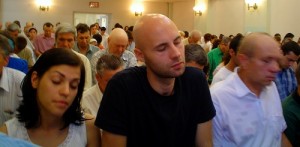
I had only anticipated a few of the people sitting around Lanny and Judy would actually gather around her and place their arms around her and hold her hands while we lifted up a congregational prayer on her behalf. She was diagnosed Friday afternoon with a couple of brain lesions in an out-of-the-blue, ambush, rip-the-rug-out-from-under-you, punch to the stomach, what-in-the-world-do-we-do-now kind of way. I was ready to lead that congregational prayer for her yesterday morning, but before I could start, people began getting up and walking over to Lanny and Judy and crowding around her in a spontaneous show of compassion and solidarity.

They came from all over our worship center. Those immediately behind and next to Judy wrapped their arms around her. But then a few people stood up to join them. And then a few more people. They came from a couple of rows over and from clear across the sanctuary. From the front and back and the middle. Young and old. People who’ve known Lanny and Judy for thirty years and people who’ve never met them. Men and women were crawling over people in their own pews to reach Judy. It’s a “preacher’s count,” I acknowledge, but I’m guessing almost a hundred of Judy’s brothers and sisters made their way to be with her during that prayer.

And I was so inspired. Yes, I thought, this is not doing church; this is being church.

As I watched the people stream toward Judy and surround her with love, I also became somewhat intimidated by my pressing task. As I waited and waited and waited while these people kept coming and coming and coming, I began to feel wholly inadequate for wording a prayer that would properly honor these folks, most of whom I still barely know, and these relationships, all of which I haven’t a clue. How could my prayer do it justice? I felt compelled to call on somebody else to lead it. How can my prayer match what I’m seeing?

When I finally started praying, it happened. Homothumadon. Unity in thought. Unity in mind. Unity in purpose. Unity in prayer. I wasn’t the one praying. We were all praying. We were all saying the “amen.” We were all together speaking with groans only the Holy Spirit can communicate to the Father. It was audible. It was genuine. It was together. We were in a fox hole together, as one, lifting this dear sister to the only God who can do anything about her circumstance. We were communicating to the gracious One who is sovereign over pain and disease. We were lifting Judy to the author of life and the destroyer of death. In faith. In desperation. In trust. As one.

We were all blessed by the prayer. Not the words of the prayer which, again, had everything to do with God’s Divine Spirit and nothing to do with me. We were blessed by the unity of the church. I know Lanny and Judy were encouraged and blessed. I know I was inspired. If you were here with us yesterday morning, I know you were moved, too. We all grew together yesterday morning. We matured spiritually as we considered Judy’s needs greater than our own. We grew together as family. And we became more childlike, more Christ like, as we depended solely on God.

E. M. Bounds said prayer does not prepare us for greater works; it is the greater work.

Judy is set for surgery on her brain at 8:00 tomorrow morning, Tuesday October 11.

Pray.

Allan

Their Deeds Will Follow Them

“Blessed are the dead who die in the Lord from now on. ‘Yes,’ says the Spirit, ‘they will rest from their labor, for their deeds will follow them.'” ~Revelation 14:13

It’s a promise from the future that impacts our every moment in the present. Your labor in the Lord is not in vain. Not at all. The things you’re doing right now for the Kingdom will last forever.

You know, salvation is not a private thing. God saves us to work through us to save others. And everything we contribute to the cause — everything! — is used by God toward that great and ultimate end. Just like the parables of the talents, what we use to his glory, whatever it is, will be multiplied and used by God for his purposes. Like the cup of cold water given in his name, it will be rewarded. Like the weekend food packed for needy school children. Like the check written for Breakthrough Sunday. Like the prayer lifted for the single mom and the errand run for the divorced dad. Our deeds will follow us into eternity. Our efforts for the Lord are going to last forever.

We are building for the Kingdom. All our work matters. Every minute is packed with heavenly potential. Every action is loaded with eternal consequences.

To his enduring praise and glory!

Peace,

Allan

Yet…

I happened by the grace of God upon Psalm 78 earlier this week. And it blew me away all over again. God’s great mercy. His incalculable love. It makes absolutely no sense.

Psalm 78 tells the story of God’s people. It describes God’s miracles and the great rescue of his children. It details God’s mighty acts on behalf of his people. He fed them. He protected them. He gave them everything he had ever promised.

“In spite of all this, they kept on sinning;
in spite of his wonders, they did not believe…
they would flatter him with their mouths,
lying to him with their tongues;
their hearts were not loyal to him,
they were not faithful to his covenant.” ~Psalm 78:32-37

It sounds so familiar, doesn’t it? It does to me. It sounds and feels way too familiar. In spite of God’s great gifts of sacrifice and salvation, Allan keeps on sinning; he lies to God with his tongue; his heart is not loyal to God; Allan is not faithful to God’s covenant.

Yet…

Here comes the good part. Here comes the truly wonderful part.

Yet…

“Yet God was merciful;
he forgave their iniquities and did not destroy them.
Time after time he restrained his anger
and did not stir up his full wrath.
He remembered that they were but flesh.” ~Psalm 78:38-39

Yet…

Why?? It makes no sense. Because he loves me? Again, why?? Praise God for the inequities of his great love!

You know, we have a tendency in this age of grace to feel like God owes us his love and forgiveness. God knows I’m human. He made me. He knows I’m going to sin. Of course God loves me; that’s his job!

No, it’s not his job. It is an unimaginable, unexpected, unnecessary wonder of the universe! It’s absolutely amazing. Mind boggling. And to the eternal praise of our Father, it’s not impossible! Despite my sins, despite my rebellion and acts of denial and betrayal, despite my brokenness and stubbornness and pride, God does not destroy me. He is merciful. He forgives me. And, somehow, he still views me as righteous.

And, you too.

Peace,

Allan

The Active Life

The life of a disciple is active, not reactive. It has nothing to do with just talking about faith or teaching religious principles or believing theological ideas or keeping biblical rules. It has everything to do with living one’s whole life in obedience to God’s call through personal action. It doesn’t just require a mind. It requires a body, too.

Ours is a life given to us by God to be lived not in some kind of rigid, cramped, crowded, small, compromised, legalistic way but in a full, wild, joyful, exuberant, cheerful, celebratory way. A way that apprehends and assimilates and then radiates the freedom we have from God in Christ.

Our Father wants his beloved children to operate out of joy and freedom to do what is good and right, not out of fear of making a mistake. Isn’t that one of the great lessons in Jesus’ story about the servants and the talents in Matthew 25?

The Christian life is an active life. Our God calls us to give our whole selves to him. Brakes off; no looking back; full steam ahead! We must act in faith that our God who calls us to live boldly and outrageously for him also promises us that if and when we do mess up in enthusiastic service to our King, he promises forgiveness and consolation and salvation.

Peace,

Allan

« Older posts Newer posts »