Author: Allan (Page 343 of 492)

On Arminius

(It was very strange to leave Love Field in Dallas following my layover last night to head “home” to Amarillo. Amarillo is my home. Strange. I found myself in the Love Field terminal defending the merits of living in Amarillo to a guy who just moved here from Denver four months ago. I was defending Amarillo. Strange. And when I got off the plane at Rick Husband and smelled the little bit of “cow” in the air, it felt… comfortable. Familiar. No cowboy boots or ten gallon hat. No belt buckle yet the size of a cookie platter. But Amarillo is home. Strange.)

Following four days with the world’s foremost scholars on Arminian theology, I have a new appreciation for Jacob Arminius and, surprisingly, the way he has shaped us. Most of us don’t even know his name. But we are deeply connected to his ways of viewing God and thinking about salvation. The longer the conference went on at Point Loma, the more I came to realize that I’m preaching this stuff. I’m already teaching this stuff. These are the things I’ve believed most of my life.

Keith summarized Arminian thought by laying out the five articles of the Remonstrance of 1610 — basically a defense of Arminius’ teachings by his students and followers just a few weeks after his death:

1) God chose to save through Jesus Christ all those who through grace would believe in him and persevere to the end.

2) Jesus Christ obtained forgiveness of sins sufficient for all.

3) Fallen humanity can think or do nothing that is truly good by free will.

4) God’s grace, which is not irresistible, is necessary for thinking or doing any good.

5) True believers are enabled by grace to persevere to the end, and it may be possible to lose this grace.

These five articles became the focus of almost a full decade of disputes and debates and conferences aimed at refuting them point by point, resulting finally in the canons of the Synod of Dort in 1619 that became for all of the Netherlands and much of Europe part of the confessional creeds. In the 400 years since, today, and for the next 400 years, I suppose, the discussions between Calvinists and Arminians will be along these same five lines.

Why does this matter? How is any of it really important? Well, how do you think about God? How do you respond to your salvation from God in Christ? The ways you view Christ’s salvation and God’s love and grace will, in large part, determine your Christian response.

These points of Arminian theology have everything to do with the questions we wrestle with all the time. For example, we know that our God is active and involved in our lives; we also know we are not just programmable robots. How do you reconcile that? We’ve all known wonderfully sacrificial servants of Christ, true disciples of our Lord, who, at death’s door, are not certain they are really saved; and others who are so certain of their eternal salvation that they believe their continued lives of sin and refusal to repent will result in no ill consequences. Where’s the correct ground between this hopelessness and carelessness?

The way we think informs the way we live.

God loves all mankind. He created us out of love and he desires that all men and women be saved to live with him in eternity, face to face. God provides the atonement for our transgressions in the sacrifice and resurrection of his Son, the atonement for all mankind. Every sin that’s ever been committed or thought and every sin that will ever be committed or thought has been paid for. Forgiven. Completely. And God’s grace to believe the Gospel story, God’s grace to put faith in Christ Jesus, God’s grace to live a life worthy of that salvation is available to all. To everybody. In equal measure. But God loves us too much to force us to do anything. He’s not going to make you. He’ll push you and compel you, his grace will cause you to know you must put your trust in him, his grace has opened your eyes to him. But he won’t force you. He won’t possess you to make you do something against your will. He loves you too much.

God loves and desires and works to save all; not just some. That’s the Christian confession. From day one.

And it motivates me to live for my Lord. It moves me to live a life of eternal gratitude to my Father. It pushes me to be serious about forgetting what is behind and straining toward what is ahead; pressing on; attaining to the whole measure of the fullness of Christ; adding to my faith in increasing measure. It means I, too, love and desire and work to save all; not just some. It challenges me to live in God’s grace every moment of every day, to accept his grace every hour, to give glory to God for this grace that saves me. To me, it puts all the focus and glory on a gracious Father who moves heaven and earth, who breaks through the barriers of time and space, to deliver me in all my sin. I live for that God.

Thanks, Jake!

Peace,

Allan

From San Diego

The tops of my cheeks are red and my forehead feels crinkly. A little too much California sun, maybe. The Rethinking Arminius conference begins early tomorrow morning at Point Loma Nazarene University. But today was spent with Keith sight seeing and touring this beautiful city of San Diego.

The day began with a four hour whale watching tour that took us out about 15 miles into the Pacific Ocean. We did manage to spot one whale, a Fin Whale, about three hours into the trip.  “There she blows!” Very exciting. The rest of the time was spent watching all the dolphins. Dozens and dozens of dolphins. We saw them everywhere. Huge pods of dolphins, swimming right toward our ship and then jumping right in front of the bow and gliding with us for four to five minutes at a time. Really amazing. And beautiful. And strange.

After lunch, we played with all the crabs and sea anemones in the tide pools along the coast. We hiked up to the old light house at the end of Point Loma and the Cabrillo National Monument. We climbed around on old U.S. machine gun dugouts that were hastily built and manned around the clock in the months following the attack on Pearl Harbor. And then we watched about 150 sunbathing seals (sorry; California Sea Lions) on the beach at what is called Children’s Pool. Really fascinating. To be up that close to all those sea lions. Watching momma seals swimming and playing with their baby seals. All those seals snorting and scratching and rubbing their backs along the rocks. Really amazing. And beautiful. And strange.

And then dinner at Miguel’s with Keith and four other renowned theologians from here at Point Loma, Calvin, Trinity, and Princeton. Once I recovered from the initial shock of being mistaken by one of the gentlemen for Keith’s dad (yeah, I’m seriously doubting this guy’s expertise and judgment on anything), it was a really nice time. Of course, they could have been talking calculus or quantum physics over their fajitas and enchiladas and I wouldn’t have understood the conversation any less. Great guys. A few laughs. But their language and topics and even their manner of dialogue was completely foreign to me. I kept waiting for somebody to say, “So what are the Rangers going to do this year?” or “I feel really strongly about a college football playoff system.” But they never did. It was about foreknowledge and Tillich and concurrency and Barth and certainty and Augustine and compossibles. I guess the conference started early for me tonight.

Peace,

Allan

To San Diego

I’m leaving today for sunny San Diego (expected high temperature today: 73-degrees) and Point Loma Nazarene University for a conference. I’ll be among the listeners, in the audience, for Rethinking Arminius: Wesleyan and Reformed Theology for the Church Today. I’ll be interested to learn more about Arminius thought, to hear the history of the Arminius debates, to understand better the development of Arminian theology. With Calvinism and Calvinist thought on a bit of an upswing in God’s Church in America — I hear tons of this stuff even in our Churches of Christ! — I believe a clearer knowledge of practical Arminianism will be good for me and good for our congregation at Central.

So, that’s one reason I’m going.

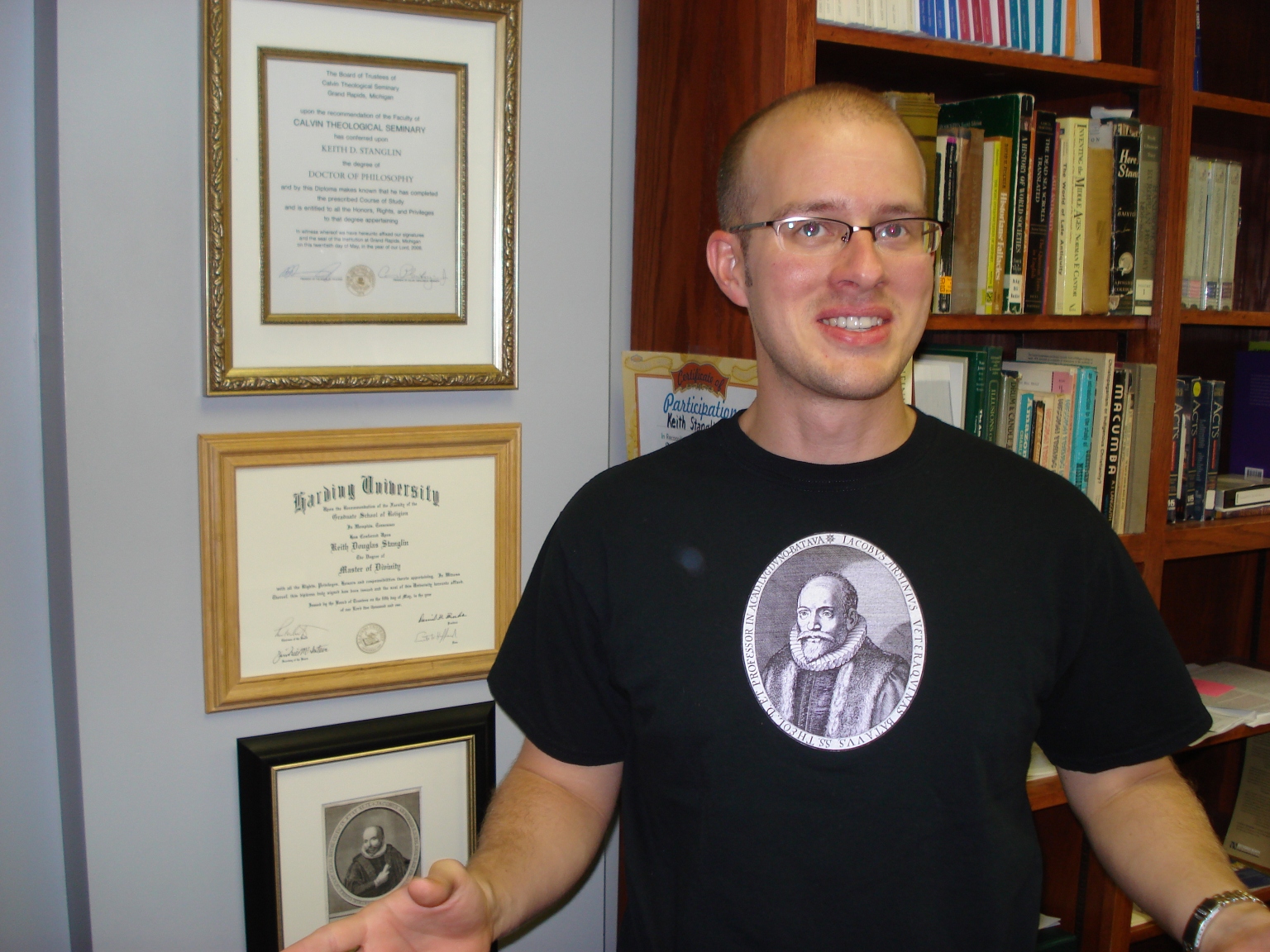
I’m also going because I’m getting to spend almost five full days with the world’s foremost leading scholar on Arminian Theology: my little brother, Dr. Keith Stanglin.

As the planner and producer of this conference on the coast, and one of its featured speakers, Keith is sharing the stage this weekend with some of the brightest minds in theology from Yale and Duke and Princeton and the University of Leiden in the Netherlands. But they all defer to Keith when it comes to the subject and thinking of Jacob Arminius. He’s the big shot at this thing. He’s the guy. And his work is benefitting God’s Church and the Kingdom of Heaven in critical ways. I’ve written many times before in this space about how proud I am of Keith. So proud. He’s brilliant. And he uses every ounce of his genius and every bit of his energy on serving the Christ to our Father’s eternal glory and praise.

Keith and I will share the plane ride from Love Field to San Diego today. And we’ll laugh. That’s mainly what we do when we get together. We laugh. We talk theology and church work, we share opinions and insights about books and speakers, we reflect on God’s work in redeeming the world and our share in that ministry of reconciliation. We also talk a lot about family, we remember together our childhoods, we reflect on where we’ve been and where we’re going. We poke fun at each other; we point out the other’s receding hairlines and middle-aged bellies; we quote from Airplane and Naked Gun. And we laugh.

Keith’s already planned a boat ride out into the ocean to go whale-watching. We’re riding bikes along some shoreline trails. And we’re going to make it to In-N-Out at least once. And that’s just tomorrow. Friday and Saturday we’ll be at the conference from morning to night. I’m looking forward to seeing Keith in yet another setting and context with which I’m not that familiar. Then we’ll worship together Sunday morning and board separate planes to go home.

In the middle of all this, I’m going to learn a lot. From Keith. He teaches me something every time we’re together. He teaches me something valuable, something I can use, something that makes my preaching and my ministry better, something that makes my congregation better. He sees it, he gets it, better than most anybody I know. And he knows how to talk about it so regular people can get it, too. He inspires. He’s good. Man, he’s good.

And he’s my brother.

The blogging will be sporadic for the rest of the week. No promises.

Peace,

Allan

The Leader as Self Aware

“The unexamined life is not worth living.” ~Socrates

Socrates said to look after and care for the soul was more important than money, honor, and even reputation.

One of the greatest dangers facing us as church leaders is that we can so easily become way too busy or too bored, too proud or depressed, so the things we desire the most go unexamined. Our thoughts and actions go unexamined. Because we want something so much, we assume it’s right for us and we are doing it well.

In Norman Shawchuck and Roger Heuser’s book Leading the Congregation, the authors remind that to be the right kind of spiritual leaders God is calling us to be requires that we pay attention to ourselves. Self care. Self awareness.

First, they suggest a continual examination of the quality and character of your life when you’re not in the public eye. When I’m by myself, what kind of a person am I? What thoughts do I entertain? To what private and secret activities do I give myself?

Second, we should examine the quality and character of our work and our lives when we are in the public eye, when everybody is watching. What are my values and behaviours as a leader? To what do I give myself? What are the true results of my leadership?

Martin Luther made it a practice at the end of every day to examine his motives and actions of the previous 24 hours, give the day and those motives and actions to God in prayer, and then go to sleep. His reasoning was that while he was asleep, while he was out of the way during the hours of his temporary death, God may finish his work. God would do for him in his sleep what he could not accomplish while he was awake. In John Wesley’s early years, he planned time every day for self examination. Later, he began setting aside the first five minutes of every hour, every day, to examine the past hour. Now, that’s intentional. And, yeah, it helped keep him on track.

Our congregations expect competent leaders. But they also expect elders and ministers who possess inner character and integrity. Above all, there must be a congruency between what we profess and what we do. The number one expectation — and it’s the right one! — is that we walk our talk.

This kind of continual self examination is not a barrier to leadership freedom; it is the door to true freedom as a leader of God’s people. Our interior lives do work their ways into and through all the other aspects of our ministries. Continual self evaluation guards against our manipulation of others for our own desires, it keeps us from using others, and from abusing ourselves. It keeps our eyes on the process of being saved, on being transformed into his likeness with ever increasing glory.

“O Lord, give me beauty of my inner soul, and let the outward person and the inward person be the same.”

~~~~~~~~~~~~~~~~~~~

By the way, Rangers pitchers and catchers report tomorrow. Tomorrow.

Thank you,

Allan

The Leader as Servant

“The Son of Man did not come to be served, but to serve and to give his life as a ransom for many.” ~Matthew 20:28

It is always essential that we love what we are doing. If we don’t love what we’re doing, we’re not going to be very good at it for very long. And we won’t last. The body and the mind and the sense have to all be totally into it. the intellect can’t do much without the aid of the heart and the liver and all the limbs. And vice versa. We have to love what we are doing with all of everything we have. Everything we are.

This is not untrue for those of us in spiritual leadership roles. We must love what we are doing, regardless of the level of difficulty which sometimes reaches “eleven” on a scale of one-to-ten. And we must do it with hearty abandon. The desire to be a leader has to burn like a fire in our bellies. Obviously, that desire to be a leader can’t get the job done alone. There are definitely other conditions and disciplines involved. But unless you truly desire to be a leader, you won’t be. You might wear the title and occupy the office, but you won’t fill the role.

Today, I’m still riding a wave of energy and enthusiasm that built up inside me during our elders/ministers retreat this past weekend. Our positive and productive time together has everything to do with a group of spiritual shepherds who are truly seeking God and wonderful ministers who are serious about following Christ and a gracious Father who continues to bless me far beyond what I could ever deserve. I’m going to reflect more in this space about those powerful 24 hours. Later.

For now, I’m still processing through Leading the Congregation and the four interior attitudes of the leader as presented by Norman Shawchuck and Roger Heuser.

Yes, it takes great desire. We talked about that Friday night. But that desire must be correctly placed. Your desire to serve others must be greater than your desire to lead. As with our risen Lord, leadership is a means of serving. Serving others comes first and then results in Christian leadership. Robert Greenleaf says, “Being a servant leader begins with the natural feeling that one wants to serve, to serve first. Then conscious choice brings one to aspire to lead. That perhaps is sharply different from one who is a leader first, perhaps because of the need to assuage an unusual power drive or to acquire material possessions. For such, it will be a latter choice to serve… The leader-first and the servant-first are two extreme types.”

What’s the difference between leader-first and servant first? Maybe it’s in making sure other people’s highest priority needs are met. The best test, and certainly a most difficult one to administer, in determining one’s own servant-first leadership is to ask, “Are those I’m serving really growing as persons? Do they, while I’m serving them, become healthier, wiser, freer, more likely themselves to become servants?”

Choosing to be a servant-first leader in our materialistic and power-grabbing society is always difficult since it runs counter to the values of leadership for the sake of power and position and wealth. To become a servant leader, we have to lead in a way that reflects what we see in our God.

“That God is beautiful is no secret. It is written on every flower, on the sea, and in the mountains. That God is immense is not secret. All you have to do is look at the unniverse. What is the secret? Here it is: God is a crucified God. God is the one who allows himself to be defeated, God is the God who has revealed himself in the poor. God is the God who has washed me feet, God is Jesus of Nazareth. We are not accustomed to a God like this.”

Peace,

Allan

Happy Birthday, Whitney!

Whit,

Your birthday was the day before yesterday. Friday. You turned nineteen. Nineteen? Oh, yeah. Nineteen.

We’re filling out college application forms and seeking scholarships, looking at high school graduation schedules and making plans for family visits that first weekend in June. We’re working on senior projects and taking a ton of pictures. You’re in your last year of high school, Whit. And your mom and I are so proud of you.

I’m so proud of the way you have just absolutely blossomed here in our new home in Amarillo. I honestly can’t hardly believe the friends you have made and the clubs you belong to and the activities with which you’re involved. Key Club. FCA. Student Council. I can’t believe how well you’ve adapted to this move. Cheerfully. Enthusiastically. Driving off with your friends to eat lunch or go to the mall or see all those movies. Driving to the Sandies basketball games and hanging out with those girls. You’ve come a long, long way from “Dad, you have ruined my life!” eight months ago.

Our God has placed kind and loving people in your path here in Amarillo, Whit. All those friends you have, all those teachers who love you so much are a gift from our Father, an obvious answer to our prayers. Coach K is a blessing from God. So is Mrs. Gramowski. Adam and Missy and Tanner and Jason and Kasey and Steve and Tammy all love you very much because, honestly, you are so very lovable.

God has created inside you, girl, a very sweet spirit. You and I have talked before about how God is using your medical issues and your struggles to make you more like Jesus. God has helped you conquer so many things in your life; we give him all the praise for all those victories. And you are better because of it. You are sensitive to the needs of others; just like Jesus. You are helpful and considerate, over-the-top loving and concerned about everything that’s going on around you; just like Jesus.

Your enthusiasm for your sports teams is infectious. Your deep need for conversation — constant conversation — is endearing. Your desire to please those you love is admirable. The way you trash talk me when we’re shooting hoops or playing backgammon is hilarious. You are precious, Whitney. Precious.

But the best part of you is the inside part, the part where our Lord dwells. I see our Savior in you, Whitney. I do. He shines out of almost every facet of your complex personality and quirky little mannerisms. You reflect Jesus. And it’s beautiful. And I’m very proud of you. I’m very proud to be Whitney’s dad.

I love you,

Dad

« Older posts Newer posts »