Author: Allan (Page 312 of 492)

He Did It Again

Our God revealed himself to us again yesterday. His children were gathered in his presence in a building on South Monroe in Amarillo, and he showed himself to us in a powerful way. Again.

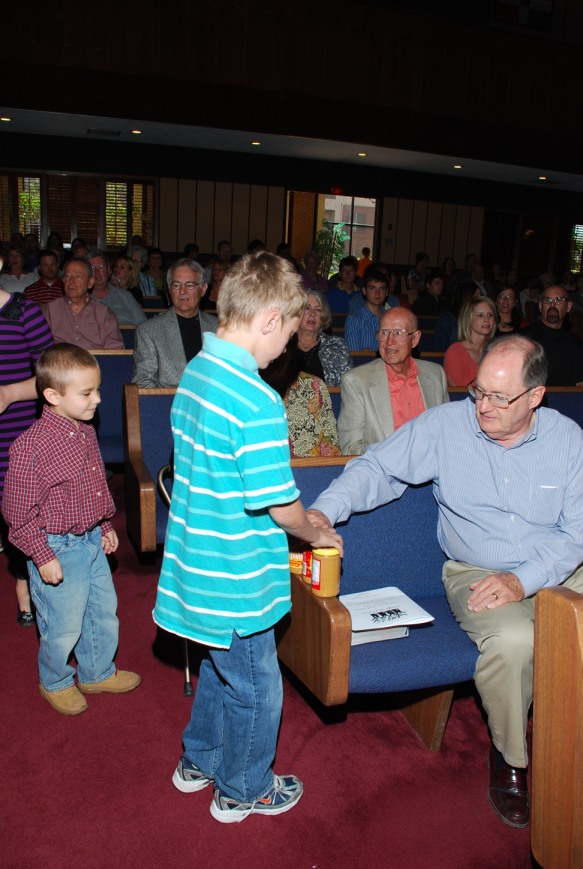
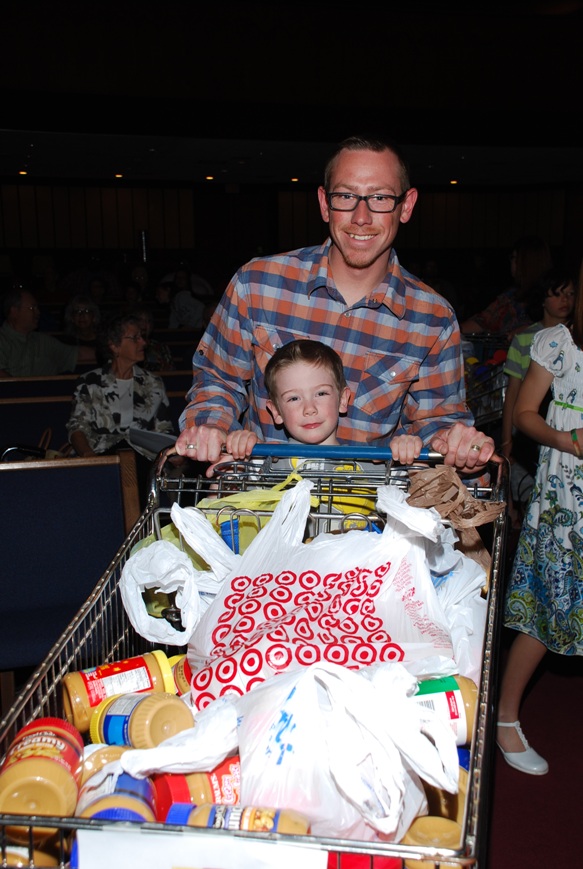
Our God showed us that he is the Father of the weak, the Defender of the helpless, in providing 607 jars of peanut butter for our Snack Pak program for Bivins Elementary School. We saw his glory reflected in the faces of our own young children as they scurried about the packed worship center, collecting the jars, passing the jars, chasing and dropping the jars, which will be used to feed at-risk students and kids living in poverty in our city.

Our God showed us that he is the Savior of the World in showering Great Cities Missions with more than $75,000 for the training and sending of missionaries and planting of churches in Latin America. We saw his glory reflected in the grinning faces of the GCM board members and Central missions committee members scattered all over our worship center.

Our God showed us that he is the Creator and Sustainer of the Universe in supplying through his faithful servants here $55,000 to begin the new permanent Alara school building in Kenya. Our God calls things that are not as though they are. He is faithful to finish what he starts. And we saw his glory reflected yesterday in the great generosity of Jack and Barbara Vincent.

Our God also showed us that he is a patient God, gracious and compassionate, abounding in love and faithfulness, forgiving wickedness, rebellion, and sin. When Kimberly Vasquez was baptized into Christ yesterday, we saw his eternal glory reflected in her face. And we all joined the angels in heaven rejoicing.

Our God is not an audience when his people gather to worship him. He is active, very active, in ministering to us, comforting us, encouraging us, inspiring us. He is present in every song, he is there in every prayer, he eats and drinks with us at his table, and he is working in every handshake and hug. Our God is revealing himself to us, he is transforming us more into the image of his Son, and he is giving us little glimpses of his Kingdom come in all of its fullness and glory.

Thank you for bringing the peanut butter. Thank you for clapping for Jack and Barbara. Thank you for cheering so wildly for Kimberly. And thank you for coming to our worship assemblies every Sunday morning expecting our God to do something big. Again.

Peace,

Allan

Happy Birthday, C-A

A wife like Carrie-Anne, who can find?
She is worth far more than rubies.
Her husband has full confidence in her and lacks nothing of value.
She brings him good, not harm, all the days of her life.
She selects wool and flax, pizza dough and hamburger meat, and works with eager hands.
She provides food for her family and portions for her girls.
She sets about her work vigorously; her arms are strong for her tasks.
She opens her arms to the poor and extends her hands to the needy.
When it snows, she has no fear for her household; for all of them are clothed in long johns and thermal socks.
She makes coverings for her bed; she is clothed in blue jeans and her “In Dust We Trust” sweatshirt.
She is clothed with strength and dignity; she can laugh at the days to come.
She speaks with wisdom, and faithful instruction is on her tongue, regardless of whether the kids at Tascosa are paying attention or not.
She watches over the affairs of her household and does not eat the bread of idleness; unless it’s Little Caesar’s Crazy Bread, she could sit there and eat that for days.
Her children arise at nearly noon on Saturdays and call her blessed; her husband also, but much earlier, and he praises her:
“Many women do noble things, but you, Carrie-Anne, surpass them all.”
Charm is deceptive and beauty is fleeting; but a woman who fears the Lord is to be praised.
Give her the reward she has earned (a 90-minute deep tissue massage at Bella Luna) and let her works bring her praise.

Happy Birthday, Carrie-Anne. I love you.

Allan

Peanut Butter Sunday

(I’m writing today’s message about peanut butter in hopes you will “spread” it around.)

The grocery carts have been secured, the children have been alerted, and the Snack Pack volunteers are ready to collect 700 jars of peanut butter at our worship assembly here at Central this coming Sunday. As most of you know, Central is the Snack Pack funder, organizer, and deliverer for Bivins Elementary. This important program provides food for the weekend for young children living in poverty in our church neighborhood who get their breakfast and lunch free of charge at school. Without Snack Pack, a lot of these at-risk kids would go hungry between lunch Friday and breakfast Monday morning.

In order to finish out the school year in style, we need more peanut butter. We need lots and lots of peanut butter. Skippy, Jif, Great Value, or Peter Pan. Smooth or crunchy. Regular or honey-flavored. It doesn’t matter. We need peanut butter.

The homework assignment is to bring a 16-ounce jar of peanut butter with you into the worship center at 10:15 this Sunday morning. Every single person, young and old, needs to bring a jar of peanut butter to offer. If you have a family of four, you need to bring four jars of peanut butter. Then — get ready — at some early point in the service, we’ll push the carts down the aisles and send all our little kids out into the pews to collect the jars and fill up the buggies.

It’ll be loud, a little chaotic, and a whole lot of fun. God will be praised and needy children in Amarillo will be blessed in the name of Jesus.

So, bring your 16-ounce jar(s) of peanut butter with you this Sunday morning. Good. Thank you. I hope this reminder “sticks.”

Peace,

Allan

Five Steps to Salvation

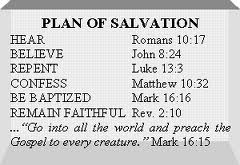
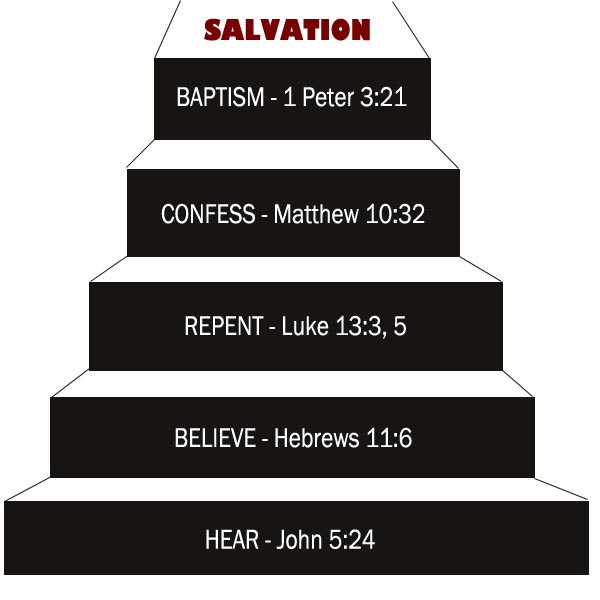
It’s just a Church of Christ thing, right? The “Plan of Salvation,” also called the “Five Steps of Salvation,” is unique to us, I think. And those of us who were raised in and by the Churches of Christ know them well: Hear, Believe, Repent, Confess, Baptism. In that order. As a kid in the ’70s, this was drilled into me by my Sunday school teachers in Bible class, by the preachers from the pulpits, by the youth ministers at the devotionals and rallies, and by the Open Bible Study my dad walked me through when I reached the “age of accountability.” The five steps were plastered on bulletin boards in the church hallways, illustrated by charts and diagrams on mimeographed handouts, and splashed across banners promoting the next Gospel meeting. These were the five steps, always accompanied by supporting verses of Scripture, that necessarily had to be followed — again, in order! — for one to be saved.

Hear. Believe. Repent. Confess. Be Baptized.

You ever wonder how that started? You ever question the validity of such a list? If you or your church were to make a list of supposed steps to salvation, what would you include? What parts of our CofC list would you leave out?

Historians point back to our movement’s focus on rational thought and enlightenment thinking that characterized the mainstream culture of America at the turn of the 19th century when Stone and Campbell and others were attempting to “restore” God’s Church. It was all about scientific reasoning and empirical evidence and deductive problem-solving. Society at this time was convinced that there were undeniable patterns, unalterable designs in nature and in the world that, if learned and applied, held the keys to everlasting peace and joy.

Alexander Campbell searched the Scriptures in this way and came up with what he called “the ancient gospel,” a pattern he believed was the divinely-ordained natural way to heaven. According to Campbell, it all boiled down to, in this order: gospel facts (death, burial, resurrection, and ascension of Christ), faith, repentance, reformation (of life), baptism, remission of sins, reception of the Holy Spirit, sanctification, resurrection of the saints, and eternal life. In that order. Campbell claimed that all Christian denominations believed in all these steps, but put them in different orders according to their own interpretations or theories of conversion.

At about the same time, Walter Scott came up with a biblical pattern and called it “the gospel restored.” He had six points originally. The first three were what humans had to do to be saved: believe, repent, and be baptized. The last three were what God promises to people who do the first three: forgiveness of sins, the gift of the Holy Spirit, and eternal life. Not too much later, Scott shortened his list to five points — one for each finger on a person’s hand, for easy remembering: faith, repentance, baptism, forgiveness of sin, and the gift of the Holy Spirit.

This method proved to be very successful on the early American frontier where most everybody had been trained in Calvinism which claimed that men and women were saved only by God’s predestination, that one couldn’t do anything to save himself, it was all up to God’s pre-ordained choosing. By telling these fiercely independent early frontier people that there really was something they could do to be saved, the Stone and Campbell churches fueled a massive rush to repentance and baptism.

As with most good things, we swung the pendulum a bit too far. Pretty soon, we were taking God’s initiative and the Holy Spirit’s active participation clear out of the conversion process. Preaching became all about proving “facts” with arguments and evidence. The Holy Spirit’s work in the past had been entered into the Biblical record and was there to be studied in a rational manner, but it wasn’t necessary for a person’s salvation. The emphasis was on logical fact-finding and step-following and persuading people to “obey the gospel.” The “gospel,” of course, being the steps.

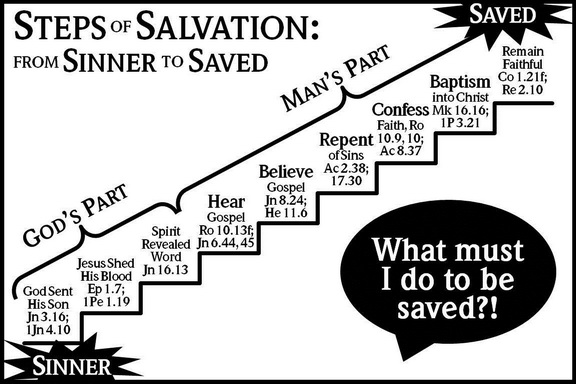
So, at some point in the middle of the 1800s, it gets boiled down to what we have today in the five steps of salvation or the plan of salvation: hear, believe, repent, confess, be baptized. Notice how God’s divine activity is completely absent from any of the steps. Notice how this chart here to the right — all of these charts were downloaded from Church of Christ websites this morning — actually gives much more responsibility or credit to man than to God for salvation. Where is God in our “plan of salvation?”

Why is baptism the last step? Who took out “sanctification,” the guiding of the Holy Spirit, and the grace of God to continually wash our sins?

It is God who works to will and to act according to his good purpose. It is God who initiates salvation, who begins the good work and sees it through to completion. Belief and repentance and confession are salvation steps to be taken every day, not once on a ladder list of human accomplishments. Baptism is never the end of what the apostle Paul calls “being saved,” it’s the beginning. Our five steps minimize our God. Our five steps neglect a lifetime of day-by-day, hour-by-hour difficult discipleship to Jesus. And they ignore the unmerited and continuous grace of our merciful Father.

OK, maybe that’s a little harsh. Too judgmental, probably, Yes, we come by the “five-steps” thing naturally. It’s been handed down to us by faithful men and women who were doing their very best with what they had to work with during the times they lived. And I’m grateful for it. Seriously. But I’m also so glad that we’ve recognized the many shortcomings in this kind of incomplete view of salvation. I’m so glad that we’re acknowledging together the active role of God’s Spirit in the calling and saving and sanctifying of the saints. And I’m glad we can change. I’m so glad, by God’s grace, we’re allowed and even compelled to change.

Peace,

Allan

Great Night for Great Cities

Whoever had the idea of hosting the annual DFW area fundraiser at the Ballpark in Arlington deserves a raise. Unless it’s Kelley.

What a magnificent time we had Friday night at the Rangers Hall of Fame with Jim Sundberg and about 600 of our good friends, eating delicious barbecue and raising a lot of money for Great Cities Missions. For Carrie-Anne and the girls and me, we experienced several worlds colliding as we ran into a bunch of great friends from Legacy, Central, Dallas Christian, and Oklahoma Christian. Yu Darvish struck out ten and the Rangers bats finally woke up in an enjoyable rout of the Mariners. And I ate for the cycle: barbecue, nachos, cotton candy, and ice-cream.

Yes, I admit it, I was gushing a bit when I introduced Jim Sundberg to the crowd and engaged in some Q&A with the Rangers’ legend. Darryn Pope accused me of almost kissing Sunny and Craig Gladman said the whole thing was a disgusting spectacle. But we all learned about Matt Harrison’s back injury, we heard what it was like trying to catch Charlie Hough, and we auctioned off nearly $3,000 worth of autographed baseballs. All told, Great Cities Missions raised right at $73,000 Friday night for the support of missionaries and the planting of churches in Latin America.

The following morning, Saturday, I was blessed to join the GCM board of directors for their meeting. I was honored to be invited to deliver the devotional at the beginning of their meeting and intended to use my time to praise and encourage this impressive group of faithful men and women who work so tirelessly in the Kingdom of God. But, in the end, I was the one who came away the most encouraged and inspired. Man, there’s a bunch of really great people at Great Cities Missions. What they are doing is God’s work. They see people the way God sees people and they turn their lives upside down for the Gospel.

Everyone Jesus met, he saw them as beautiful. Beautiful because of what they were meant to be. Beautiful because of what they were created to be. Beautiful because he saw in them what they were actually going to be. And the folks at Great Cities Missions embrace that kind of thinking and doing every day with everything they’ve got. They partner with and train and support the men and women who are giving their very lives to the great cause of Christ. They organize and raise money and pray and travel and sacrifice and serve for the ultimate promises of God in Christ. They don’t just believe in the mission; they are grabbing it! They’re investing in relationships, they’re making themselves vulnerable, they’re taking the risks, they’re holding nothing back.

At one point in the meeting, while listening to another trainer and church planter tell another powerful story about a missionary family working in a foreign field, I leaned over to John Todd and said, “Man, the people in this room, they’re all in, huh?” He said, “Oh, yeah. Every one of them.”

Yes, these people get it. They see the beauty of the street kids in Fort Worth and Brazil. They see the beauty of the lost people in Chile and Arlington. They see the beauty of the hurting men and women in Columbia and Mexico. They see all the people of the world not just for who they are and what they are, they see them for what our Father in heaven created and intended them to be.

The God who began a great work with Great Cities Missions is faithful to continue that work and, on that great final day of eternal glory, bring it to completion.

Peace,

Allan

If Stone and Campbell Could Do It…

In an effort to raise our “spiritual historical consciousness,” we’re studying Foster and Holloway’s Renewing God’s People in our Sunday morning Bible classes here at Central. As a church family, we’re acknowledging that Churches of Christ have a particular history, that we’ve been shaped by cultural and historical ideas and events, and that some of the things that have marked us as a faith tradition are really wonderful and some things are a little less than wonderful. My hope is that, through the course of this study, we’ll come to realize that our beliefs and practices are continually informed and molded by the culture. Through that realization, I hope, we’ll better see that some of the things we believe are sacred really aren’t and that some of the successful ways and means of the past aren’t necessarily the way to be church or impact a community in the present. And, I pray, we’ll commit to re-claiming the very best parts of our American Restoration Movement heritage and expressing them again in faithful ways.

The most beautiful thing about the Restoration Movement and Churches of Christ is that we were founded on the Christian principle of unity. The unity of all believers is a key biblical doctrine and it was the driving force behind our movement. So much so that, despite their massive differences of theology and opinion, Barton Stone’s and Alexander Campbell’s churches united on January 1, 1832.

Consider for a moment their immense differences:

While Campbell held to the Trinitarian concept of God as one divine deity living in community as three distinct persons, Stone didn’t see it that way. He believed doctrine of the Trinity couldn’t be found in Scripture, that it belonged to the creeds from which they were trying to distance. Because of that, Stone saw Jesus as the “son” of God, but not truly God himself. Yes, Jesus is our Savior, Stone argued, and he is exalted at the right hand of the Father, but he’s not God himself. Campbell disagreed, holding to the more traditional doctrine that Jesus is God himself in the flesh.

Concerning the Holy Spirit, Stone believed God’s active and continuous work in the world was done through his Spirit. The Spirit is active in the Church, he is active in the hearts and minds of God’s people, he is active and working in all of creation for the sake of the Kingdom. On the other hand, Campbell believed that the Holy Spirit inspired the writing of the Scriptures, and then pretty much ceased operating outside of them. Campbell taught that the Spirit only spoke to man, only worked on man, only compelled and shaped man, through the reading of the Word. Therefore, Campbell believed that the visible signs of the Spirit — speaking in tongues, healings, prophesying, etc., — had ceased, whereas Stone most certainly did not.

As for mankind, Stone leaned a little Calvinistic in his belief that man was unregenerate and stained with sin at birth. Stone taught that the Holy Spirit of God is the one who convicts and converts men and women to Christ. Campbell, of course, preached and wrote that God had given man a brain and good common sense and that, when reading the Bible with an open heart and open mind, one would make the right decisions about salvation through Jesus. Campbell saw humankind in a really optimistic kind of way: with our brains and hard work, people are getting better and better and America is the Promised Land where we’re going to restore the divine ancient order. Stone: not so much. He believed humans were getting worse, not better, and that only God’s Spirit could turn a man to heaven.

Stone saw salvation as the work of God’s Holy Spirit transforming men and women into the image of Jesus. Campbell saw salvation in terms of knowledge and intellectual assent. He stressed the atonement aspects of the cross, more as an economic transaction that paid for our sins. Stone concentrated his doctrines of salvation on the love and grace of a merciful Father. Stone’s churches placed a greater emphasis on an ordained ministry while Campbell maintained that all Christians were ordained ministers of the Church. Campbell wouldn’t allow anyone in his churches who hadn’t been baptized. Stone believed baptism was essential, but he’d allow unbaptized men and women to join his churches, saying that they were all just in different places on the road to understanding. Campbell’s churches celebrated the Lord’s Supper every Sunday, Stone’s much more infrequently. Stone was a pre-millennialist, Campbell a post-millennialist.

That’s a lot of differences.

In the seven classic categories of Christian theology, Stone and Campbell disagreed on all seven. And these are big issues. We’re not talking about order of worship or women’s roles, we’re talking about the very nature of God, the salvation role of Jesus, the importance of baptism and communion, church leadership structures, and the role of the Holy Spirit.

Yet, both of these men and their dozens of churches understood that Christian unity is the holy will of God; that breaking down denominational barriers and coming together in the name of Jesus is a true expression of the Gospel; and that divisions and separations among denominations is an evil distortion of the Gospel, an insult to Christ, and sends the worst kind of message to an unbelieving world.

And they did it.

It was difficult, extremely difficult. There were bumps along the way and hurdles to overcome. But for about 65-70 years, they did it. Together.

They made the decision that what they shared in common in Christ was far more important than anything on which they might differ. They believed it was truly God’s will and best communicated to the world what God was doing in Christ. To borrow from Foster:

“Christian unity may not always mean a physical merger of congregations or movements. But when Christians are convinced of the importance of unity and are willing to put up with each others’ peculiarities in the knowledge that all are committed to knowing and doing God’s will expressed in Scripture, the kind of unity seen in our Stone and Campbell history may be the best and fullest kind there is.”

So, the question today: Is sacrificing and working for visible expressions of the unity of God’s Church as important to us today as it was to Stone and Campbell? How important is it in shaping our congregations more into the image of Christ? How important is it to testifying to the power of Jesus in our city? How far would you or your church be willing to go to make the attempt?

All of Scripture points to God’s people as being one. God’s Church is his one chosen people around his one common table. We know we’re going to be one and eternally united in heaven. What are you and your church doing to lean into that right now so that’s God will is done here just as it is there?

Peace,

Allan
« Older posts Newer posts »