Page 405 of 497

Feeling Psalm 88

LamentHave you ever read Psalm 88? I would encourage you to read it. First, a word of caution: don’t read it as the last thing you do before you go to bed tonight. Don’t read it when you’re all alone. Or on a cloudy day. Try to read it in brightly-lit room full of your closest friends. Because Psalm 88 is a downer. It’s tough.

“My soul is full of trouble and my life draws near the grave.
I am set apart with the dead, like the slain who lie in the grave,
whom you remember no more, who are cut off from your care.”

Of the 150 Psalms, nearly half of them are labeled as lament psalms. Lamentations. Anger. Doubt. Bitterness. Confusion. Questions. Complaints against God. Even accusations against God. And Psalm 88 may be the most uncomfortable.Psalm 88

“You have put me in the lowest pit…”
“You have overwhelmed me with all your waves…”
“You have taken from me my closest friends…”

Psalm 88 is the only lament psalm that doesn’t, at some point, turn to praise. There’s no praise here. No thanksgiving. There’s not even any hope that God will eventually change his mind or eventually rescue. The psalmist here declares that praying to God is doing no good. God has abandoned him completely. And there’s no light at the end of the tunnel.

“Why, O Lord, do you reject me?”
“Your terrors have destroyed me.”
“The darkness is my closest friend.”

Maybe you’ve never read Psalm 88. But have you ever felt Psalm 88?

This past Sunday here at Legacy we read Psalm 88 and then we prayed it. We lifted up to God our despair and depression, our confusions and doubts. We lifted up to God all those in our congregation suffering from cancer and other disease, those dealing with divorce, those struggling with unemployment, those battling family issues such as rebellious children and abusive spouses, our people who are suffering through the loss of loved ones — both recent and a long time ago. On Sunday we were honest with our God about our faith and our fears. We asked him the hard questions. Why are these things happening? How long will they continue? We told God plainly that we don’t always understand.

Those aren’t easy words to pray. It’s unusual in that we rarely pray this way at all, especially in a corporate Sunday morning setting. But the reading and the prayer and the open and honest theme of the day seemed to be especially meaningful to the many, many, many, many people of our church who are feeling Psalm 88.

It would be impossible to share with you in this space the more-than-usual number of phone calls, emails, and pop-in visits I’ve received in just the two days since Sunday’s service regarding what we did together as a church family. Being publicly and completely honest with God and with ourselves about our pains — physical, emotional, and spiritual pains — resonated with young and old, men and women, from every background and worldview imaginable. It touched people. It bonded people. Because a whole lot of us are feeling Psalm 88. At some point, most of us have felt Psalm 88.

Some still balk at using this kind of language with God, even though all of God’s people in Scripture, from the Patriarchs and Judges and Prophets to Christ himself and the Saints in heaven, have used the language of lament to voice their complaints to God in the middle of great trial. But there’s great comfort in unburdening yourself. There’s great relief in unloading and getting things off your chest. There’s solace in knowing that he’s listening.

You know that.

It’s OK. God loves you, remember?

Peace,

Allan

Just Listen

Just ListenAfter seven days of mourning, things aren’t getting any better for Job. And so he lauches into another round of lamentations. Job 3 is some kind of tirade. It’s a doozie. Rated R for strong language and disturbing imagery. Job curses his own existence. He says in a dozen different ways, “I wish I were dead.” He doesn’t understand what God is doing. So he asks “Why?” Over and over again, “Why, God, why?”

“I want to die.”

And then one of Job’s friends, Eliphaz, decides somebody needs to say something. He tells Job in Job 4:1, “Let me say a word here. I can’t help it. I can’t keep from speaking.”

And Eliphaz spends two whole chapters trying to explain to Job what’s happening to him and why. “Job,” he says, “This is God’s will.” And he tries to spin everything theologically. He tries to make sense of it. He even accuses Job at one point: “Maybe you need to look at your own life. Maybe you’re doing something, or not doing something, that’s causing these bad things to happen. ” He gives Job advice about his prayers. Eliphaz says, “If I were you, Job, I’d think about praying more like this.”

All three of Job’s good friends start weighing in on the situation, speaking from the outside, giving advice, preaching to Job.

And this is exactly the opposite of what Job needed from his friends during his hour of great sorrow.

Hey, we’ve all had the experience of fumbling for the right words in the presence of tremendous suffering. We’ve all visited a family at a funeral home and been embarrassed because we didn’t say anything. Or we’ve felt awful because what we did say was so woefully inadequate. We take food to the home of a grieving husband or mother and we have no confidence in the things we say. We’ll see a griever at church for the first time and actually avoid speaking to him because we don’t know what to say.

Please understand this: You don’t have to say anything!

You don’t need to say a word. Just be there. Just be present. Just listen. Just sit in silence with the mourner and listen.

I know we feel like we have to say something because silence is so awkward for us. We’re uncomfortable with silence. And if we’re not saying something, we feel like we’re not doing anything. It’s like we’re not helping.

The very best thing you can do is just listen.

If the sufferer needs to cry, cry with him. If the mourner needs to complain about a family member or another specific part of his great trial, put your arm around him and nod. If the griever needs to curse his situation or shake his fist at God, sit right there beside him and let him.

Just listen.

The presence of God is experienced by his people through his people. The Church of God is a powerful tool by which our Father is present in this world and among his children. Our God invites us to speak and he promises us that he will be near. He will listen to us and he will comfort us in our lament. He will hear our cry. And he will console us and reassure us in our troubles.

And we can better be that loving and faithful witness and presence to others if we’ll just be there. And listen.

Peace,

Allan

How Long, O Lord?

How Long, O Lord? 

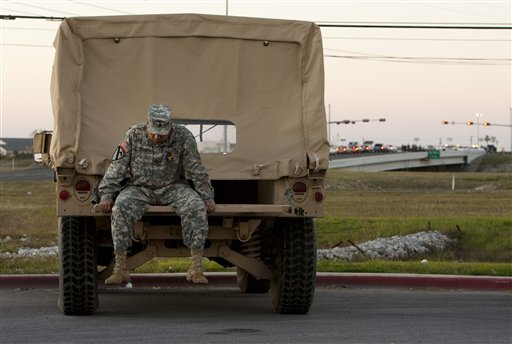
I’ve watched and listened to with fascination over the past 48 hours the continuing coverage of the horrible shootings at Fort Hood. I’m drawn to the news stories for several reasons.

My brother-in-law was stationed there for a couple of years right in the middle of the Gulf War. He and my sister lived there at Fort Hood. Carrie-Anne and I visited there, met their neighbors, played ping-pong and air hockey in the rec center there, and shopped at the military store there. On two different occasions, Brent was designated for deployment to the Persian Gulf. On both those ocassions they gave him less than 48 hours notice to tell Sharon and their families goodbye. And we prayed. And prayed. And prayed. And on both of those ocassions, after he had been packed and processed, the orders changed and his unit was told to stay put in Killeen.

Their daughter, my first niece, was born at Darnell Army Medical Center there at Fort Hood. Her birth, on New Year’s Day 1991, interrupted my plans to watch the #3 Longhorns and the #4 Miami Hurricanes in the Cotton Bowl. We spent two days at that hospital on that base for Cassie’s arrival.

A few years later Carrie-Anne and I saw Foreigner at a rock concert on base they called “HoodStock”.

Twice after that I called high school games at the Killeen Kangaroos football stadium.

And so, while I don’t know anybody in Killeen anymore, we do have some very deep and vivid memories of some wonderful family times there. I’m watching this thing unfold and listening to the horror and watching the tears of the families and feeling deeply impacted. This is a truly horrible thing that’s happened here. It’s awful. It’s evil. How Long, O Lord?

“Why, O Lord, do you stand far off? Why do you hide yourself in times of trouble?” ~Psalm 10:1

And I recall the age-old statement of the skeptic: If God is good, he’s not really God. And if God is really God, he’s not good. In other words, God could have prevented what happened at this army base in Central Texas. The fact that he didn’t must prove he’s not good. And if he could have prevented it, he must not be the powerful God we think he is.

Wrong. And wrong again.

How Long, O Lord?In times of tragedy — in our own lives, in our local communities, globally — we hold on in faith to the anchor of God’s eternal love for his creation. We know he loves. We know his great love is the force behind everything our Father does and everything he allows.

The truth is, we don’t see everything yet. We don’t fully understand everything. We’re assured that our God is working out everything according to his purposes. And we know that his purposes are driven by what’s in our best interests and what’s best for the redemption of his creation.

So, we trust and we pray.

It’s OK to appeal to God’s omnipotence and his righteousness and declare to him that we don’t understand. It’s OK to question God and wrestle with him and beg him to change things. These kinds of prayers actually reveal our deep faith. They say to God, “We know you are just and righteous and all powerful; we just don’t understand.”

“Pour out your hearts to him, for God is our refuge.” ~Psalm 62:8

Peace,

Allan

Glory Through Them

Glory Through ThemJesus is praying with and for his disciples on that dark night of his betrayal. He’s reflecting back on the heavenly plans that were made before the beginning of time and looking forward to the eternal results. He’s talking to the Father about receiving glory from him and giving glory to him. And then Jesus says a most remarkable thing. He begins talking to God about his disciples and he says, “Glory has come to me through them” (John 17:10).

Glory has come to me through them.

That’s an incredible statement.

It’s amazing to think that sinful man, me, in all my shortcomings and inadequacies, in all my failures, in my selfishness, somehow us, me, in all my sin, somehow we bring glory to the Holy Son of God. That’s unbelievable.

That part of Jesus’ prayer tells me a couple of things.

One, we are very, very, very precious in God’s sight. He finds glory — he actually receives glory — in the bumbling ways we try to live for him down here. We’re not perfect. Far from it. But our attempts bring him glory.

Two, we are radically and dramatically changed by the death and resurrection of our Lord. God creates inside us a brand new creature, full of his Holy Spirit, meant to experience everything in a brand new way. We are different. We are sanctified. We’re holy. We belong to him and we are set apart for his will and his purposes.

And that brings glory to the Son. It glorifies Christ Jesus when you and I show an act of kindness in his name. It brings glory to him when we put our trust in him for salvation. It glorifies Jesus even when we fail.

The Church gives glory to God. We exhibit great confidence because we’re protected by his name (John 17:11) and we possess the truth of his Word (John 17:17). We live this sanctified life in his great power. And the mission is unstoppable. The Kingdom advances. And Christ is glorified!

Peace,

Allan

Between Intention and Result

Between Intention & ResultI ran across a collection of letters last night written by famous Texas sportswriter / novelist Bud Shrake. Back in the mid ’60s Shrake, who wrote for the Dallas Times Herald and the Dallas Morning News, moved to New York to take a job with Sports Illustrated and to work on his novels and screenplays. During Shrake’s colorful career he managed to write ten novels exploring two hundred years of Texas history; several sports-related books, including Barry Switzer’s biography Bootlegger’s Boy; and five books with golf legend Harvey Penick, including the number one all time best-selling sports book in history, Harvey Penick’s Little Red Book.

Shrake died earlier this year at 77 years of age. And the current issue of Texas Monthly has compiled an edited selection of letters he wrote from New York in 1964-65 to friends back here in DFW and Austin. The letters are fascinating to me. They are of a long-gone style of writing that characterized the work of the best-ever sports writers from the ’50s, ’60s, and ’70s. But they also reveal the guts of a guy struggling to make it. Shrake is restless in his letters. Searching. Unsure of himself, but determined to keep on.

I see myself in a letter he wrote to his ex-wife, Joyce, on April 10, 1965:

“I do not think you can show me a writer who is not insecure about his work, unless he is one of those who is merely plodding over the same weary ground; a pattern mystery story man, or historical novel writer, or perhaps a memoirist. Or perhaps a [Thomas] Mann or someone in the later years of his craft when he is not doing anything that is for him new. Do you think Mailer, for example, was insecure about “An American Dream?” Sure he was, and is. Such feeling partially accounts for the sudden eccentricities, the erratic-nesses, the gropy destruction bouts of drunken wildness, the hysteria even, of writers who are at least trying to be serious regardless of their true merit. One simply does not know for sure what is being achieved, what the gap might be between intention and result.”

Couple of observations. One, can you imagine one of the current sportswriters of a major newspaper writing this way today? Incredible, huh? Stories about Bob Lilly and Don Meredith and Stan Musial and Bob Cousey were written this way.

Two, I don’t feel exactly this way as a preacher. There haven’t been any “bouts of drunken wildness.”

But I can certainly relate to the insecurity. I can easily relate to “trying to be serious regardless of [my] true merit.” It’s the last line of the letter there, this gap “between intention and result,” that perfectly captures my thoughts and feelings about being a proclaimer of the Word of God. I never know for sure what’s really being achieved.

What’s being achieved?I never know what’s going to happen. I never know. From day to day and week to week — sometimes it’s an hourly mystery — I never know how what I’m going to say is going to be received by those who hear it. I’m acutely aware that there are 900 sermons being preached at Legacy every Sunday morning. I’m preaching one and the 899 other participants are hearing their own. There’s a huge unknown gap between intention and result.

The maddening thing is that I have no control. None. It’s all on God. He guides me all week on the words I’m going to say. He shows me by his Holy Spirit what to preach. He gives it to me during long periods of prayer and meditation and study. And then he uses those words to do with them what he wants. Totally independent of me. I’m really of very little significance in all this. He speaks to people. He touches hearts. He convicts and converts. He does things I never imagine. He causes things I never could have planned. I understand that. I get it. And that should bring me a real peace. Those things should calm me and relax me. It’s not on me. It’s all on him.

But I really don’t know what, if anything, is “being achieved.”Insecurity

My security is in my God. Yeah, I know. But…

My confidence comes from God. Yeah, I know. But…

My “merit” is not mine. I don’t have any. It all belongs to God. But…

I haven’t been doing this long enough to know if it’s just me or if every preacher has these feelings of insecurity. Inferiority. Is it just a personality thing with me or are all preachers this way? How do I look at my own sinfulness and selfishness and fallenness and inclinations to evil and then presume to speak for God to a congregation of his holy children? I’m still not very good at this yet. And it frustrates me.

I take comfort from the words of Augustine. “My own way of expressing myself almost always disappoints me. I am anxious for the best possible, as I feel it in me before I start bringing it into the open in plain words; and when I see that it is less impressive than I had felt it to be, I am saddened that my tongue cannot live up to my heart.” OK, I’m in good company here. Augustine can relate.

I live in that gap between intention and result.

It’s all in God’s hands. And that’s good news. Better him than me. He’s never failed me. Those unknown results are nearly always better than my intention. Praise God! Give him the glory! It happens all the time.

But most days, that doesn’t give me the comfort or peace that I think it should.

« Older posts Newer posts »