Page 20 of 499

Disputable Matters

Before we get into part two of this week-long series on Christian unity from Romans 14-15, check out this picture of Sam and his granddad watching college football together two Saturdays ago. The little dude is locked in, huh? Two football zombies right there.

You already know I am a conscientious resistor when it comes to digital technology and smart phones. I never take my cell phone with me into a meeting or a restaurant or to any kind of social or business setting–my phone is always either on my desk or in my truck. Now, I’ve got another reason to make sure my phone is never on me: it keeps me from bugging every single person in my path with two dozen of the latest pictures and videos of my incredible grandchildren.

~~~~~~~~~~~~~~~~~~~

Most Christians I know agree that we should never divide over matters of opinion, or what we might call “disputable matters.” That’s the problem the apostle Paul is addressing in Romans 14-15: the Christians in Rome are arguing and separating over what he calls “disputable matters.” When Paul calls on the disciples in Rome to accept one another and stop looking down on others and stop judging others, the context is in these disputable matters.

The problem, though, is that when we argue and divide, at least one of the parties believes the issue is one of doctrine.

In Churches of Christ, we’ve generally used this as a guiding principle:

“In matters of faith, unity; in matters of opinion, liberty; in all things, love.” 

That’s a creed, by the way. And it’s fine. It’s good. But it doesn’t help much, because what some Christians consider a matter of opinion, others consider a matter of faith. We don’t agree on which is what. That’s where this gets touchy. Because if you and I are arguing about something and the argument and the feelings are such that it’s threatening to divide us, then at least one of us believes with all our hearts that it’s a matter of doctrine and faith.

But even then, the Bible says it’s okay. It’s not something that should divide us.

“One person considers one day more sacred than another, another person considers every day alike. Each one should be fully convinced in his own mind. The one who regards one day as special, does so to the Lord. The one who eats meat, eats to the Lord, for he gives thanks to God; and the one who abstains, does so to the Lord, and gives thanks to God.” ~Romans 14:5-6

Each of us should be fully convinced that we’re doing is the right thing to do in the eyes of God, but do not bind that on another brother who doesn’t feel the same way. If he believes or practices something different, you assume he’s doing it to the Lord, before the Lord, and in the presence of the Lord with a clear conscience. We give all Christians the benefit of the doubt. We always assume the best. I assume that my sister in Christ who has a different belief or a different practice is not believing or practicing arbitrarily or haphazardly. She’s doing it with careful study and serious prayer and reflection. And she’s fully convinced that she’s doing the godly thing. So everything’s fine. Don’t judge her. Don’t divide from her. Accept her.

As Paul reminds in Romans 14:9-10, this is the whole reason Christ was crucified and resurrected, so he can be Lord over these things and not you. Why are you judging your own brother in Christ? Why are you looking down on other Christians?

Now, there are some things that are non-negotiable doctrinal matters in which Christians must be unified. There are issues of settled, historical, biblical, orthodox Christianity that cannot be argued. As to belief, all of those are in the Apostles’ Creed; as to practice, all of those are in the sacraments; as to ethics, all of that has long been settled by the clear teachings of holy Scripture.

As for everything else? Anything else? Accept. Do not judge.

“To his own master he stands or falls. And he will stand, for the Lord is able to make him stand.” ~Romans 14:4

Peace,

Allan

Accept Without Judgment

This is our older (by 45-seconds) grandson Elliott, showing off his brand new teeth after his Saturday night bath. He and his brother, Sam, aren’t even four-and-a-half months old yet! This seems early for teeth, right?

As always, you can click on the pic to get the full size. While you’re at it, look at those eyelashes. Man, that’s a good looking kid.

I’m way behind on posting pictures here of Elliott and Samuel, so I’m going to post at least one a day this week, no matter what.

~~~~~~~~~

My posts this week will mainly be excerpts from the sermon we preached here yesterday at Golf Course Road Church on Christian unity from Romans 14-15. As we make plans for our annual “4 Midland” pulpit swap and Thanksgiving service this next weekend, it occurs to me that we have no problem putting aside the doctrinal differences that divide our Christian denominations for the sake of our God-ordained unity in Christ. But we allow disputable matters or matters of opinion to divide us within our own congregation. Why is that? And what do we do about it? Romans 14-15, I believe, has the answer.

The apostle Paul distinguished the disciples in that church in Rome as strong Christians and weak Christians–those are his words, not mine. Romans 14 details the problems Paul is addressing in his letter. The weak believers are vegetarians; the strong believers enjoy a good steak. The weak brothers and sisters keep all the Jewish holy days; the strong brothers and sisters don’t. The weak Christians are developing elaborate worship and lifestyle theologies and drawing lines in the sand over what’s right and what’s wrong; the strong Christians don’t have very many lines and they’re not as concerned about which worship and lifestyle practices are good or bad. The weak are criticizing the strong for being spiritually insensitive; the strong are looking down on the weak for being spiritually immature. The strong proclaim freedom in Christ; the weak say, “Yeah, but that doesn’t mean anything goes.” The weak tell the strong, “You’re wrong;” the strong tell the weak, “Grow up.”

Over what? Over food. Over worship styles and religious traditions. And… keep going?

Over women’s roles and deacons and divorce and remarriage. Song selection and church budgets and Lord’s Supper prayers. Small groups and creeds and Bible translations and politics.

Over… you name it. There are all kinds of issues and beliefs and practices that Christians in the same church argue about.

The Bible makes the solution to this problem easy because it gives both strong Christians and weak Christians the exact same instructions: Accept all Christians and don’t judge any Christians.

“Accept the one whose faith is weak, without passing judgement on disputable matters. One person’s faith allows him to eat everything, but another person, whose faith is weak, eats only vegetables. The one who eats everything must not look down on the one who does not, and the one who does not eat everything must not condemn the one who does, for God has accepted him. Who are you to judge someone else’s servant? To his own master he stands or falls.” ~Romans 14:1-4

Nobody look down on anybody. Nobody condemn anybody. For God has accepted him. Accepted who? Whom has God accepted? This brother or sister in Christ who disagrees with you about some church thing. This group of Christians who don’t see eye-to-eye with you on some disputable matter, some matter of opinion, that in no way should ever divide Christians. You are not that guy’s master. You’re not in charge of that Christian.

Whether he stands or falls is up to the Lord. Whether he’s right or wrong is up to the Lord. Paul says we can’t judge that. But then Paul goes ahead and makes the call. He judges it anyway.

“He will stand, for the Lord is able to make him stand.” ~Romans 14:4

He’ll stand. He’s fine. Whether y’all agree or not, whether y’all are on the same page or not, he’s good because he’s in Christ. Jesus died for him, Paul says in verse 9. That’s the whole reason Jesus died, so he could be the Lord over these things and not you. So you accept him without judgment. Because God accepts him in Christ.

Peace,

Allan

Micah 6: You and Me

“He has showed you, O mortal, what is good. And what does the Lord require of you?
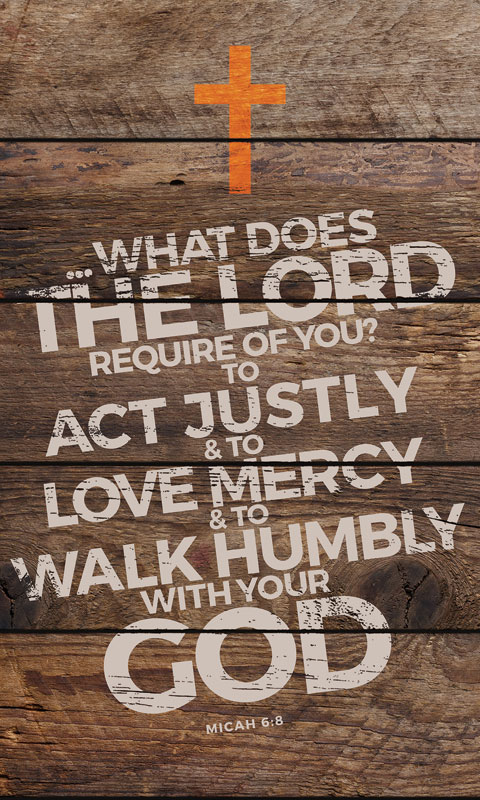
To act justly and to love mercy and to walk humbly with your God.” ~Micah 6:8

The three things in Micah 6 are not new. This isn’t a revelation to God’s people in the 7th century BC and it’s not new information for you and me this week. This has always been at the heart of God’s covenant with his people: Treat everybody the way I’ve treated you.


So, how has God treated you?

Allow me to remind you.

When it comes to your shortcomings and failures, when it comes to your rebellion and transgressions against God and neighbor, when it comes to your sin, our Lord Jesus looked at the Father and said, “Put that on my account.”

While we were still sinners, Christ died for us. While we were God’s enemies, we were reconciled to the Father through the death of Jesus. God has brought you life-changing justice and he has shown you amazing mercy. Not because you are so good or because you are somehow chosen or special–this is the way he is with everybody! And his number one priority is that you and I would act the same way, that bringing justice and showing mercy would be your top priority and my top priority.

Because then people would see him in us. People would experience God in us if our priorities and God’s priorities were the same.

Jesus showed people God. He invited people to follow him, to walk with him along the way. He ate with people he wasn’t supposed to eat with. He hugged people he wasn’t supposed to touch. He forgave people who were unforgivable. And they saw God.

You know how to do that. You know how to forgive someone who’s done you wrong. You know how to just sit with someone and be present. You know how to pray for somebody who wants to see you hurt. You know, because you’ve done that with your daughter. You’ve done all that with your son. You move heaven and earth to practice justice and mercy and love for your children and it doesn’t matter where they are or what they’ve done. It’s beautiful.

Jesus says, “That’s where I am.” The hungry and thirsty, the foreigner, the naked and sick, the people in prison; people who’ve done wrong, people who’ve messed up, people who can’t take care of themselves.

I can’t solve all the issues being created by the government shutdown. I can’t fix crime or cancer. I can’t solve unemployment or racism or poverty or addiction. I can’t fix that. You can’t figure any of that. We don’t have the solutions.

But I can have breakfast with a guy whose wife is dying. I can treat a lonely person like she really belongs. I can forgive someone who will never tell me they’re sorry. I can pray with someone who hasn’t been to church in years. I can stand with somebody when it might be easier to take the other side.

Isn’t that what you want to do with your life? What else would you want to do? Don’t you want to be that guy? Don’t you want to be that woman?

On that day of glory, when you get to heaven, the Father will look you right in the eye and smile and say, “Well done.” For what? Well done? Why would the Father say “Well done?”

Well done for going to the right church and worshiping correctly a couple of times a month?

No.

Well done for acting justly, for loving mercy, and for walking humbly with me.

Peace,
Allan

Micah 6: Priorities

“He has showed you, O mortal, what is good. And what does the Lord require of you?
To act justly and to love mercy and to walk humbly with your God.” ~Micah 6:8

God has announced to Israel that they have broken the covenant, that he is going to punish them because they have been disloyal to him, and they immediately figure it must have something to do with their corporate worship. What do I sacrifice to make God happy? How do we do church right? How do we need to worship correctly? What sacrifices do I bring, and how much?

And our God says, No! It’s not about the sacrifices. It’s never been about the sacrifices. The very heart of the covenant has always been you loving other people and treating other people the same way I’ve loved and treated you. Everybody.

See, God’s covenant is a relational covenant. He is in relationship with us. And his covenant relationship with us lays a holy claim on all our relationships. The relationship between you and your spouse. The relationship between you and your children. You and your brothers and sisters in your church. The relationship between you and your boss, you and your co-workers, you and your teachers and classmates, Your relationship with your neighbor on food stamps. Your relationship with your enemies. With your customers. With the lady in front of you at the store. Your relationship with the widow, the orphan, and the immigrant at the wall. All these people. Every single relationship. Everyone in your community. How do you treat them? What do you think about them? What do you say about them? What do you do for them?

Act justly, love mercy, and walk humbly with God.

It doesn’t matter what happens in the temple on Saturday or at church on Sunday if your life with your neighbors is out of whack the other six days of the week. God’s people know this. We’ve always known it.

“Does the Lord delight in burnt offerings and sacrifices as much as obeying the voice of the Lord? To obey is better than sacrifice.” ~1 Samuel 15:22

“I desire mercy, not sacrifice, and acknowledgement of God rather than burnt offerings.” ~Hosea 6:6

“Stop bringing meaningless offerings! Your incense is detestable to me!… I cannot bear your evil assemblies!… When you spread out your hands in prayer, I will hide my eyes from you; even if you offer many prayers, I will not listen…. Stop doing wrong, learn to do right! Seek justice, encourage the oppressed. Defend the cause of the fatherless, plead the case of the widow.” ~Isaiah 1:11-17

It’s very similar to what our Lord says in the Sermon on the Mount. If you’re offering your gift at the altar and remember you’re crossways with somebody, if you’re not acting with love or mercy or justice with somebody, get out of the temple! And don’t come back until you’ve made things right!

The expert in the Law told Jesus that to love God and love neighbor “is more important than all burnt offerings and sacrifices” (Mark 12:33-34). Jesus told him that his statement was correct and that he was “not far from the Kingdom of God.”

You know, it’s dangerous for Jesus to insist that loving your neighbor is more important than what happens in church services, but that’s what he always says all the time.

“You hypocrites! You give a tenth of all your spices–mint, dill, and cummin. But you have neglected the more important matters of the law–justice, mercy, and faithfulness (Jesus is quoting Micah 6)… You strain out a gnat, but swallow a camel!” ~Matthew 23:23-24

You can do worship exactly right–whatever “right” means to you or your friends or your group. You can close your eyes during every prayer, keep your hands in your lap while you sing ancient hymns, look up every Scripture during the sermon, and read Matthew 27 silently to yourself during communion. It doesn’t matter if you lied to your boss Friday and you plan on lying to him again tomorrow.

You can clap and raise your hands to contemporary praise songs and kneel down on the floor during every prayer and read responsive psalms ’til the cows come home and recite the Apostles’ Creed. But it’s not doing you or God any good if you’re ignoring the poor or cheating your customers or posting hateful speech online.

Priorities. Knowing how to pay attention to what really counts versus fooling around with insignificant issues. We don’t want to major in the minors. Jesus calls that neglecting the more important matters. The weightier matters. The heavy stuff.

If the specifics of our corporate worship are not the number one concern of God, why is it sometimes our number one priority? Have we misunderstood what pleases God? Or are we really just concerned with what pleases us?

Why are God’s people in Micah so willing to do the religious stuff, but not the heavy stuff that God cares the most about?

Act justly, love mercy, and walk humbly with God.

Peace,
Allan

Micah 6: Three Things

The St. Louis / Arizona Cardinals have played a total of 14 road games on Monday Night Football. The franchise is 4-10 all time in those games. All four wins have come against the Cowboys. The Cardinals always beat the Cowboys on Monday night. Even in Jerry Maguire, the Cardinals beat the Cowboys on Monday Night Football. Meanwhile, the Cowboys are the first team in NFL history to average more than 30 points per game in the first nine games of a season and still get outscored. I don’t think a Jets tackle and a 29-year-old Bengals linebacker are going to help this historically bad defense.

~~~~~~~~~~~~~~

“He has showed you, O mortal, what is good. And what does the Lord require of you?
To act justly and to love mercy and to walk humbly with your God.” ~Micah 6:8


I wrote about the context of this well-known passage in yesterday’s post. God has formally announced that Israel has broken the covenant by not taking care of their neighbors. By ignoring the poor. By exploiting the outsiders. By getting rich off the misfortunes of others. And Israel reacts by asking questions about their worship. Maybe we’re not sacrificing the right animals in the right ways. Maybe we need to worship more. Or better. And the Lord answers by reminding his people that none of that has ever mattered to him. What matters are these three things:

Act Justly – If you’re a covenant partner with God, you have to take care of everybody in the community. That’s justice. Helping the poor, protecting the immigrants, taking in the orphans, feeding the widows, speaking up for all the people whose voices don’t get heard, taking care of all the people in society who can’t take care of themselves–just like God takes care of me when I am completely unable to take care of myself.

Love Mercy – The definition of mercy is not getting what you really deserve or not giving to someone what they truly deserve. And we do love mercy. When it’s shown to us. But God tells us to love mercy for everybody. Don’t just act in a merciful way from time to time, love mercy consistently. Love mercy as a strategy, as a way of living, as a way of being and doing. Love mercy not only when it’s shown to you, but as you show it to others. Love mercy as your second-nature response, as your Holy Spirit instinct. Love it as a quality of God’s character he is forming in you.

Walk Humbly with Your God – Don’t carelessly or presumptiously do things your own way. Pay attention to God’s will. Put your will in a secondary position to his. Know your place next to God and walk with him–not against him, not in front of him–walk with God’s vision, walk with God’s character, walk with God’s priorities. God has brought you life-changing justice and has shown you amazing mercy because that’s how he treats everybody. Now, you walk with him and join him in doing those same things with everybody where you live.

Act justly, love mercy, and walk humbly with your God.

Peace,
Allan

« Older posts Newer posts »