On this date in 1955, the greatest electric guitar player, composer, innovator, influencer, and performer was born in Amsterdam. To celebrate, enjoy this video of Eddie Van Halen eradicating the dimensions of time and space on this earth with a twelve-minute guitar solo at the US festival in 1983.
Page 109 of 492
Jesus told us that the faith of a mustard seed could move mountains. Just faith, any kind of faith, any amount of faith, no matter how small, is all it takes to radically transform heaven and earth around us. It’s a captivating image that leads to a powerful question: Can we muster up any kind of faith at all?
What about the mustard plant faith of Jesus?
In Luke 13, Jesus says the Kingdom of God is like a mustard seed. It’s planted, it grows, it turns into a tree, and all the birds of the air make homes in its branches. It’s an interesting image when you consider the mustard plant is actually a nuisance weed. It’s a terrible weed that only grows to two or three feet tall at the most. Farmers hate the mustard plant. It’s a pain.
Can you hear the disciples? “Um, Lord, that’s a nice story, but, um, I’m not sure how much we like being called a bad weed.”
I can imagine Jesus looking up and down at the guys and saying, “Be thankful. Be happy I didn’t call you something worse. Like a tumbleweed. And rejoice that what is unimpressive to you is very impressive to me.”
Jesus gives us this image of a mustard seed, a mustard weed, a tiny scraggly mustard plant growing as tall as a mighty tree with every species of bird living in its massive branches. A mustard tree providing shelter and shade and homes for all the birds of the air. Jesus is telling us, “I see things you don’t see. I know things you don’t know. I’m busy right now doing things you can’t even imagine.”
It’s a captivating image that leads to a powerful question: If Jesus is already moving mountains around us, can we just put our trust in him?
Peace,
Allan
Valerie Nicole is 25 today. Our little middle has been blessing us and everybody in her world now for a quarter century. Her creativity. Her wicked sense of humor. Her passionate heart for the marginalized. Her fierce loyalty to her friends and family. Her careful attention to our Lord’s call and her faithfulness to follow.
Twenty five years ago she was a nine-and-a-half pound newborn, amazing the nurses, dwarfing all the other babies at South Austin Medical Center, and nearly killing her mom. Since that day, Valerie has been the light in every dark room. For twenty five years she has been the source of the funny lines, the keeper of the family traditions, the carefree wearer of socks and sandals (together), and the lover of Little Debbies.
Today she is making a Gospel difference in the lives of troubled teenagers in Tulsa. She is a Holy Spirit indwelled and empowered daughter of God and a brilliant Youth Minister in his eternal Church. She is doing what our Lord puts in front of her to do with all her talents and energy in a way that changes lives and points to Christ Jesus. Those kids are blessed. And so am I.
Happy Birthday, Val-Pal. I love you. And I thank God for what he is doing in you and through you to his glory.
Dad
After Cincinnati’s thrilling win over the Titans, there are now five teams in the NFL that have not won a divisional playoff game in at least 26 years. Five teams middling in mediocrity. Five teams that don’t know what they’re doing. Five teams that for more than a quarter century have been irrelevant patsies on those rare occasions they do qualify for the playoffs. Five teams consistently at the bottom of the mix.
Browns. Dolphins. Lions. Deadskins. Cowboys.
That’s some mighty fine company there.
Peace,
Allan
For ten years now, Carley and I have played Ping Pong together every single week – sometimes multiple times per week, but always at least once, and always at least two games every time we play. We got the table in the summer of 2011 when Carley was twelve and I imagine we’ve played probably 1,200 or 1,300 games of Ping Pong. And I’ve never lost.
I’ve never let Carley win, probably, because my dad never let me win. My dad and I duked it out under the aluminum patio cover on the back porch of our family home about as often as Carley and I play – it was constant. I don’t remember ever not having a Ping Pong table. It started out in the garage when I was too little to play and would only be set up when we had company. Couples from church, Uncle Gerald and Aunt Alice – after dinner we always wound up in the garage playing Ping Pong. But sometime in the mid ’70s, when I was about ten or so, we added another four feet to the concrete patio, had the cover installed, and got a new Ping Pong table to go with it. My dad and I played almost every day and he never let me win.
And then, one evening, during the summer between my sophomore and junior years in high school, under the glow of the yellow bug light on that back porch, I beat him. And it was a big deal. I don’t remember the score. But I remember celebrating very loudly. I remember yelling at the top of my lungs in great relief and tremendous joy. I remember running inside to tell my mom and my sisters. I remember feeling like I had really accomplished something really great. He did not let me win. He did not take it easy on me. I beat him one-on-one at his own game and it meant something. It was significant.
Carley’s never beaten me. She’s come close a half dozen times – I think we’ve gone to deuce once, maybe a couple of years ago. We play together as partners when my siblings and their families come to visit. But she’s never beaten me.
Until today.
It was bound to happen.
At about 1:20pm this afternoon, Carley had me down 15-10. Then she had me 19-16. Then she was up 20-18. I took the next two points on my serve to force the deuce. And then she got the next two points, on her serve, to take me down.
In victory, she did not disappoint. She was gone out of the room before I could even look up. “I am the champion!” she sang at the top of her lungs. “I am the champion, my friend!” It was more shouting than singing, through the kitchen, into the living room. “And I’ll keep on fighting, to the end!” Now it sounds like she’s coming back to the game room. “I am the champion! I am the champion!” I can hear her coming back down the hall. “No time for losers!” She synced up her song and her walk so that she re-entered the game room in time to point at me as she emphasized the word “losers.” Nice.
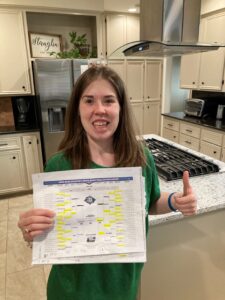
Carrie-Anne walked in. Well? She won? I was on my knees at my end of the table, still not quite believing what had just happened. Uh, yeah. She did. By this time, Carley was on the phone to Valerie, telling her middle sister about her victory. Whitney was beside herself with glee at my demise. The above picture was taken to commemorate the occasion. And Carley left for work.
It was going to happen. Carley’s paid attention to improving her forehand over the past month and for the past couple of weeks she’s concentrated on her serve – both have improved significantly. I just wasn’t ready for it to happen today. But it has.
She’s a winner. And I’m a loser.
Peace,
Allan
I got distracted last week and neglected to finish my thoughts on where we are and what we’ve learned as churches during COVID.
First, we’ve learned that temporary emergency measures can become standard operating procedure in a church if we’re not intentional in our communication, reflection, and practice. We didn’t as much learn this as it’s just been reinforced. During the early days of the pandemic, most churches complied with government recommendations and shut their doors to the Lord’s Day assembly. For the first time in history, healthy people in the United States were not allowed to worship God in their church building on Sunday. Most of us scrambled and began livestreaming our assemblies online so, at least, we could sing and pray, listen to a sermon and eat a communion meal in a virtual gathering. We understood that we were spiritually connected. And it was appropriate and good in this unprecedented emergency situation.
But now, nearly two years later, church online has become an acceptable and even sanctioned option for Christians and their churches. For a lot of disciples, the livestream service is normal now. It’s like the communion meal. I suppose there was a time when those “rip n sip” individually packaged communion kits were appropriate. But now, way past the emergency, many Christians and churches are still using them. (For my thoughts on communion during COVID, what we’ve lost with the “rip n sips,” and why we need to return to passing trays and “breaking bread,” please click here.)
The problem is that our language around the livestream was normalizing. We spoke in the very beginning about church online like it was already permanent. Instead of emphasizing that the livestream was a temporary, emergency procedure, we went out of our way to reassure the Christians who were staying home. Instead of saying that folks who are going to work, the grocery store, the gym, and restaurants should also return to the Sunday Christian assembly, we welcomed the online church and assured everyone watching that they were doing what was best by not coming to the building, even as a lot of those watching were attending football games and going out to eat.
The issue is that church online is not church. It’s something, certainly; it’s not terrible, of course. But it’s not church; it’s something else. By definition, church is a physical assembly. Flesh and blood people coming together in one place for a common purpose. Real, physical people gathering to worship God and serve one another together. Men and women and children, in the same place at the same time, being transformed together as they accept and forgive, bear with and love, compromise and laugh and cry with one another in the name and manner of Jesus.
Our faith is an incarnational faith in our incarnational Lord. God did not come to us virtually, he came to us in our flesh and blood. He didn’t send a text or a video, he sent us his Son. Our spiritual connections are important, but they are incomplete without our physical connections. Our Sunday gathering is not just any meeting that can be attended or substituted on a whim or out of convenience – it is the very Body of Christ. The Body of Christ is something that can be seen and heard and touched. Church online is a disembodied virtual experience. It’s not church.
Can you imagine being married and never going home to your spouse? I’ll just call her every night, it’s the same thing! Can you imagine telling your kids and grandkids at Christmas, “Don’t bother coming over for Christmas lunch and presents, let’s just Zoom it. It’s the same thing!
Of course, we all know it is decidedly not the same thing. What’s vital for some – the shut-in, the sick, those who work on Sundays – should not be normal for most.
But it’s normal now. It’s not surprising that something as convenient as online church would quickly become normal. If you’re out of town or on vacation, it’s much easier to hop online from your hotel room or your lake house and “do church” with your own congregation virtually than it is to hunt down a real live congregation of flesh and blood Christians and worship with them. To be shaped by the experience. To encourage other Christians and to be encouraged by meeting other disciples in a different place. To physically participate with the physical Body of Christ in all of its transforming power. We used to do that.
Maybe the compulsion to never miss church was misguided when, a few decades ago, we never dared skip the assembly. Certainly it was – a lot of us grew up believing that church attendance was the truest sign of faithfulness. The uncritical embrace of online church has exposed our shallow theology about church. As I’ve said before, the reasons online church is normal now and so many Christians opt to spectate from home instead of participate in person are three-fold: One, the pull of the culture toward individual consumerism is stronger than the pull of the Body of Christ; two, we’ve done a terrible job of teaching and communicating what’s really happening when God’s people come together in his presence, in the name of Jesus, and by the power of the Holy Spirit; and, three, our people have never really had a transforming experience in church. It’s all three.
The livestream should be done well for those who need it. And we would do better to address this from the pulpit on Sundays by saying things like:
“We’re so glad to make this livestream available to our sick and shut-ins; we pray it blesses you. For the healthy and mobile, please don’t let church online be the extent of your connection to God and to his people. Please come join us in person on Sundays and participate in all that God has planned for you through the Body of Christ.”
“We hope you are blessed by watching our worship service online. We also hope that you can join us here in person next Sunday.”
“If you are unable to be with us physically this morning, we’re grateful to be with you virtually. We understand that church online does not provide you the connection and the transformation that happens with the Body of Christ in here – but we hope this is beneficial. If you are able to be here but you’re watching online, we would encourage you to come join us in person next Sunday. Don’t let watching online be the extent of your engagement with God and his people. We would love to welcome you here to participate in what God is doing in us and through us together on Sundays.”
To be clear, I do believe there are benefits to livestreaming a worship service. Other than the aforementioned blessing for the congregation’s sick, shut-ins, and those forced to work on Sundays, I believe a livestream can be a wide on-ramp for people in your city. Folks in your community can be introduced to God and his people in your congregation through your livestream. But it must go beyond that. Strategies must be devised and resources must be deployed to engage those viewers and invite them into the physical assembly. We can’t be content with “hits” and “viewers;” we cannot mistake “time spent viewing” with engagement with Jesus and his Church; we must work hard to connect those online to the physical flesh and blood Body of Christ.
Finally, it’s on church leaders – shepherds, preachers, pastors, worship ministers – to teach and communicate better what God is doing during our worship assemblies, and to plan and practice so the holy community and transforming encounter of church is experienced on Sundays.
Peace,
Allan


Recent Comments