Category: Worship (Page 23 of 28)

Where Are The Kids?

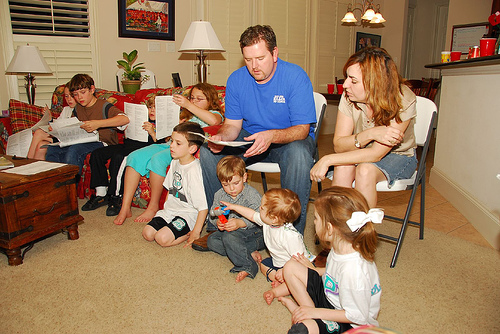
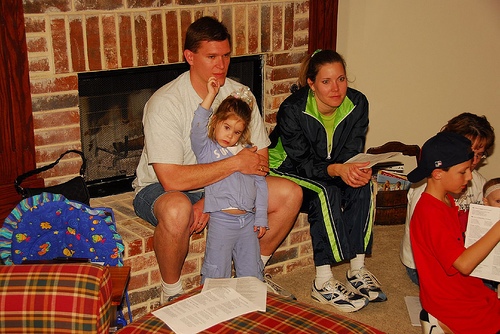
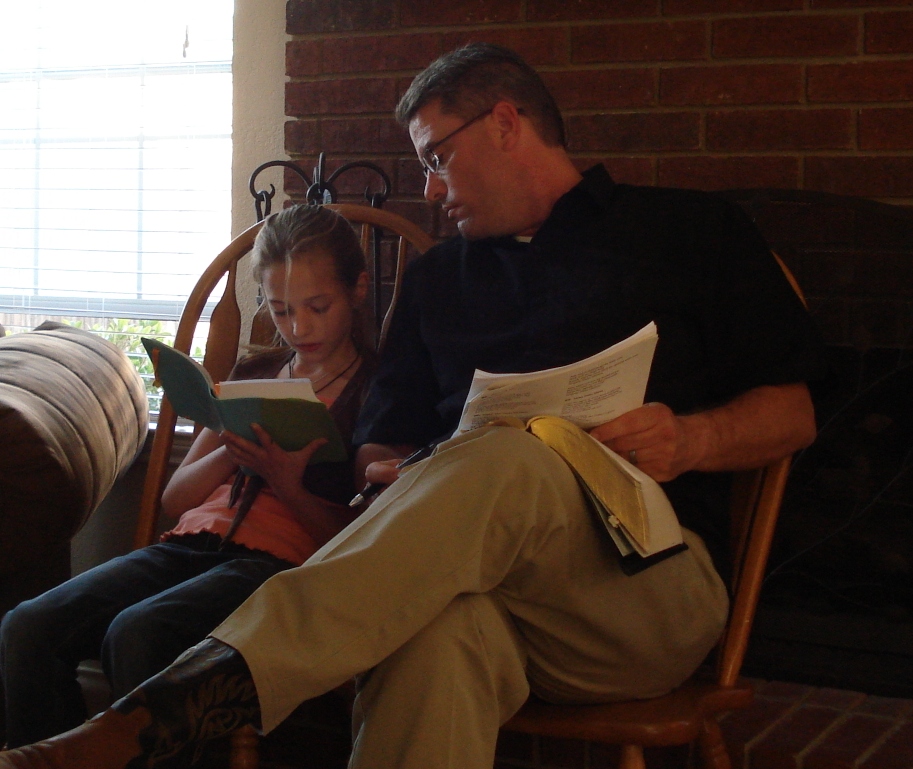
Where are the kids?Where are the kids? The local TV stations used to ask us at 10:00 every night. It’s the question I ask Carrie-Anne when I come home after work. Thirty minutes after church when I’m ready to get in the car. In a crowded mall. At the park. When it’s especially quiet in the house. When the bikes are left on the lawn. Where are the kids?

If we ask that question as we’re reading Scripture—where are the kids?—the answer always comes back, “right in the big middle of everything.” Right where God put ’em. Right where God wants ’em.

Matthew 21 – Jesus enters the temple in the last week of his life. The children are there shouting “Hosanna to the Son of CaddellsDavid!” The religious leaders in the temple are indignant. Maybe the kids were clapping, I don’t know. Maybe just the fact that the kids were in the middle of the temple being loud was enough to upset these teachers and priests. Jesus answers their indignation by quoting Scripture. “From the lips of children and infants you have ordained praise.”
Exodus 10 – Before the plague of locusts, God tells Moses he’s doing this “that you may tell your children and grandchildren…”

Exodus 12 – God insitutes the formational Passover Supper with everyone’s kids right there around the table. “When your children ask you…then tell them.”
WrightsExodus 13 – God explains the dedication of the first-born. “On that day, tell your son, ‘I do this because of what the Lord did for me.'” Also, “when your son asks you…,” tell him the great story.

Deuteronomy 4 – God’s giving the Law to his people. “Teach them to your children and to their children after them.”

Deuteronomy 6 – Same thing. “Impress them on your children. Talk about them when you sit at home and when you walk along the road, when you lie down and when you get up.” And again, when your son asks you, tell him the stories.

Joshua 4 – Setting up the stones to mark the spot where they crossed the Jordan River. When your children ask you, tell them.

Matthew 18 & 19, Mark 10, Luke 18 – Parents bring their children to Jesus. And he welcomed them gladly. They brought their kids to Jesus so he could touch them and bless them and teach them. And he did. Jesus took little kids in his arms, he placed his hands on their heads, he prayed for them. He warns us not to ignore them or neglect them or discourage them in any way because the Kingdom of Heaven belongs to our little children and he’s not willing that any of them should be lost.

In our Scriptures, the kids are always right in the big middle of everything. Exactly where God put ’em. In our Bibles, the Matt&Elizabethchildren are never on the edges, they’re not peripheral participants in the community of faith. They’re not sent to the other room. They don’t eat at a different table. They’re not placed in an “age-appropriate educational environment.” They are critical components. They are integral to God’s plan for his people. They are the centerpiece to our sacred conversations and the core of our holy gatherings.
Where are the kids?

When you’re praying. When you’re reading the Word. When you’re singing praises to God. When you’re at the common table with your brothers and sisters in Christ. When you’re talking about our Savior and the Gospel’s impact on your life.

Where are the kids?
First, Be Reconciled

“I plead with Euodia and I plead with Syntyche to agree with each other in the Lord.” ~Philippians 4:2

First, be reconciledThe apostle Paul believes Christian unity is huge. It’s critical. It’s paramount to the successful advance of the Gospel and it’s necessary for the continuing growth, or sanctification, of the Church. And not just in idealistic or imaginary ways. Paul means unity on every pew, in every relationship.

Jesus taught the same thing. In fact, I’d say this is where Paul gets it. The Holy Son of God says our relationships with one another are much more important than anything we do in our worship assemblies. But we always want to worry about our worship assemblies. We write about our worship practices, we discuss our worship trends, we fret over worship changes or lack of changes, we spend a lot of ink and time and energy and effort on what we do in a big room together for 75-minutes every week. Jesus says if you’re not reconciled to your own brother, forget it.

“If you are offering your gift at the altar and there remember that your brother has something against you, leave your gift there in front of the altar. First go and be reconciled to your brother; then come and offer your gift.” ~Matthew 5:23-24

If you’re fighting with your sister, if you’re arguing with your brother, if you’re not on speaking terms with somebody in your congregation right now, if there’s ill will between you and somebody in your church, Jesus’ instructions would be to make things right before you offer a song, before you offer a prayer, certainly before you come to the table.

You might say, “It’s none of your business. This is a private matter between us.”

Paul would say, “Oh, no. Your disagreement, your arguing is everybody’s business. The unity and sanctity of God’s Church is too important.”

First, be reconciled. Then, come worship.

Whether it was something that happened between you two last week or you two are nursing a grudge that was born twenty years ago. Make that phone call. Go to her house. Invite him out for coffee. Agree with each other in the Lord. It could be the most important New Year’s resolution you make. It would be just the kind of “starting over” a God of reconciliation who gives his people the ministry of reconciliation would be expecting.

First, be reconciled. Then, come worship.

It’s important.

Christmas Leftovers

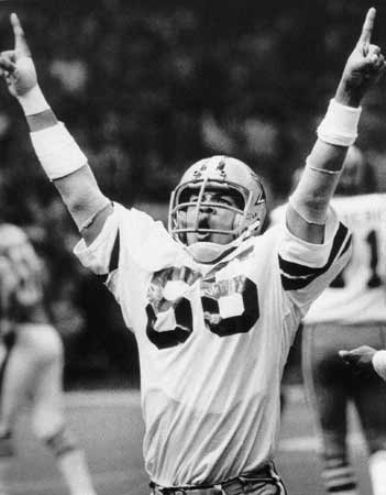
Butch JohnsonScattershooting while wondering whatever happened to Butch Johnson and the California Quake…

The “Lex Orandi Lex Credendi” post from last week was prompted by a conversation I’d had with one of our elders here at Legacy. He had read an article from another blog by another minister within our Church of Christ stream questioning our worship practices and how they do or do not match up with what we profess to believe. Our conversation centered on this man’s observation that PowerPoint probably does more harm than good in our worship assemblies. He names PowerPoint as something that, while introduced and used with noble intentions, “might form us in unhealthy or even ugly ways.”

I’ve had the chance to read the article now, and I recommend it to you. The young man’s name is Brad East. His blog is called “Resident Theology.” Here’s the link to that particularly provocative post.  

It’s long been my contention that using PowerPoint in our worship assemblies actually works to destroy what our assemblies are intended by God and our Scriptures and our church leaders to do. The constantly changing slides projected on to the huge screens demand our undivided attention. We’ve stopped looking at each other. Instead, we stare at the slides.

If a congregation of a thousand were singing “Jesus Loves Me” and the words were up on the screen, we’d all — every one of us — be staring at the screen. Not because we don’t know the words to “Jesus Loves Me.” Of course we do! But because when a screen is on, we look at it. That’s what we do. We’re conditioned by our culture to look at screens. In our homes, at work, in line at Wal-Mart, driving down the road in our cars, we stare at screens. If there’s a TV up in the corner in a restaurant, you and I won’t be looking at each other. We’ll be looking at the screen. Even if we can’t hear the sound. Even if it’s an infomercial. It’s what we do.

As a preacher, I’ve noticed that I can’t make eye contact with anybody during an invitation song. Forget it. Smile at someone? Wink at somebody? Encourage someone? Acknowledge a tough time somebody may be experiencing? Impossible! No chance! Everybody’s looking at the screen!

One of the reasons (among many, I know) that nobody comes forward anymore for confession or prayer is that we’re all too busy looking at the screens. As long as the screens are on, we’re tuned out to anything that’s really happening around us. Or within us. The screens come on and our minds and bodies go into neutral. Just like they do on the couch in front of a ballgame, in a theater in front of a movie, or in line for a ride at Six Flags. Do we honestly expect anything different just because the projected words and images happen to be sacred?

But to question the use of technology and PowerPoint in our worship assemblies is taboo. To suggest a day or a month when we don’t use the screens would be heresy. Unfortunately, our churches are spending so much money on the leading technology, the constant cry is to use it more. So, with seemingly no thought to the obvious messages it sends or the ways it shapes us as a church family, we use it more.

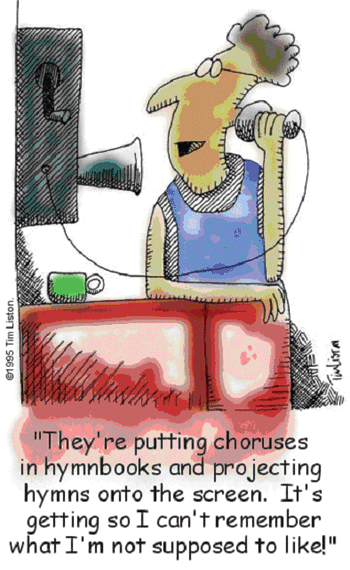
When’s the last time you held the song book for your wife? We don’t do that anymore. When’s the last time you handed your book to a late-arriving brother or sister in front of you? There’s no need. When’s the last time you helped a young child, maybe your young child, find the number in the book? There’s a chance you’ve never done that.

I’m not saying that going back to song books is the answer. I’m not advocating that we rip all the screens out of the walls and pawn off all the projectors. I’m not saying there are not some advantages to using PowerPoint in our assemblies (I can think of one). What I beg of our preachers and worship leaders and elders is that we consider carefully why we do what we do and that we think through the long term effects of those things.

The most encouraging part of Brad’s post is that, by the looks of his picture, he’s probably not even 30-years-old. He’s young. Wow, very young! But he recognizes that something’s wrong, something’s inconsistent and disconnected between our gospel and our technology. At least he’s thinking. Not reacting. Not mindlessly following. He’s thinking.

~~~~~~~~~~~~~~~~~~~~~~~~~~~~~~~~~~~~~~~~~~~~~~~~~~~~~~~~~~~~~~~~~~~~~~~~~~~~~~~~~~~~~~

Legacy To The WorldWe sent Corey and Emily Mullins off with a prayer breakfast here Monday morning. The Mullins are spending the holidays with family in East Texas and Tennessee, and then heading out to Australia as part of the first Church of Christ missionary team to go down under in 25 years. Their commitment is to preach the gospel in Australia for at least five years. They’ve only been with us here at Legacy for about six months. But we’ve all come to love them as our own. And Monday’s “goodbye” was pretty neat.

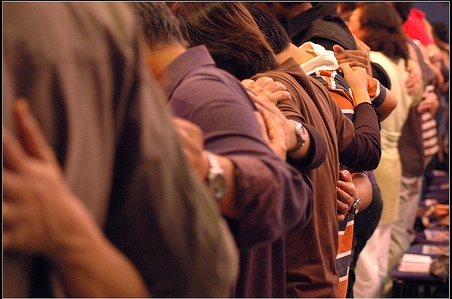
We all told them how much we love them. We charged them with being strong and faithful. We reminded them that they Corey & Baileyare joining what our Father is already doing there in Wollengong, redeeming his creation, his people, back to him. And we recognized that we are joining them, too. We circled close around them, put our hands on them and our arms around them and each other and lifted them up to our Lord. We prayed for courage and faith and protection. And we committed them and their work to him. Our hearts and our prayers go with Corey and Emily as they head to Australia.

You can keep up with the Mullins by reading their blog here. I’ll also keep the link active on the right hand side of this page.

~~~~~~~~~~~~~~~~~~~~~~~~~~~~~~~~~~~~~~~~~~~~~~~~~~~~~~~~~~~~~~~~~~~~~~~~~~~~~~~~~~~~~~

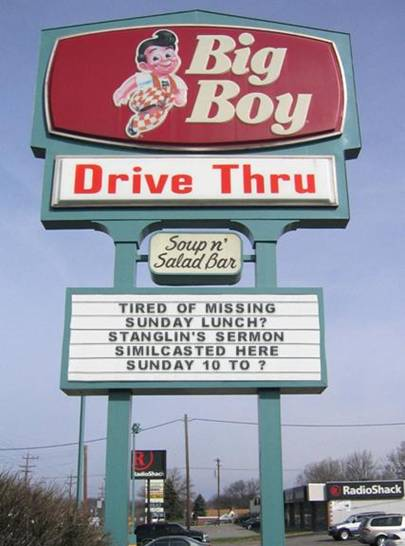
Got this picture from Mark Richardson this week.

Mark’s Sign

Thanks, brother. I’ll see you down front Sunday!

Peace,

Allan

Lex Orandi Lex Credendi

Christological LensThe Latin phrase “lex orandi lex credendi” means, loosely I suppose, “we worship as we believe” and / or “we believe as we worship.” There is a strong, unbreakable relationship between what we believe about our God and the Gospel of Jesus and the manner in which we worship. Christ’s Church has for centuries used this formula in shaping worship liturgies and assembly practices. But the fact is, the formula stands as true whether the Church and its various and scattered congregations recognize it or not.

Think about it.

Is our understanding of the Gospel reflected in the ways we worship? Do the ways we worship communicate to the church family and to non-members our understanding of God’s plan to redeem the world?

Most theologians and all church historians would say our Christian assemblies are intended to “rehearse the Gospel.” When we come together we re-tell the story, we re-enact the history of our God and his people. And how we worship is a fairly accurate indicator of how clearly we get it.

If we understand the Gospel as an all-inclusive effort by God to reach out to the entire world in all its diversity to forgive and redeem—all cultures, all peoples, all nations, all languages, all social classes, all ages, all backgrounds—does our worship assembly reflect that? If we see God’s plan as calling his people to live together in communities of faith and to be transformed more into the image of Jesus in the ways we sacrifice and serve each other, does our time together on Sundays communicate that? If we sing praises to God with great joy and enthusiasm, what does that say about our understanding of God’s grace? Do multiple cups and pre-broken bread at communion time say more than we want it to about our comprehension of community at the Lord’s table? Do our attitudes toward others—in an opposite corner of the worship center or in the pew directly in front of me—reflect our grasp of what Jesus has done for us? If we understand that to be like Christ is to die to ourselves and serve others, is that our practice and mindset when it comes to the assembly?

What if every single thing we did together as a community of faith were viewed through the lens of what Jesus’ birth, life, teachings, ministry, suffering, death, burial, resurrection, and eternal reign means for the child of God.

Jeff Childers and Frederick Aquino, in their great book Unveiling Glory, claim this is the only way to make decisions and form policies regarding our congregational worship.

“What if a community of believers paid such close attention to the meaning of Jesus’ coming into the world that they were gripped by the mission of God? They would have a guiding vision, a driving purpose that helps them make decisions fitting their sense of destiny. What if a preacher helped his church meditate on the deeper mysteries about Jesus, such as the significance of his being both human and divine? That church might develop some new attitudes about such things as diversity in the church or the place of tradition. What if a church’s leaders regularly talked together about the Apostles’ teachings on Christ? They might get excited about the Apostles’ basic aim of transformation into Christlikeness. This is a clear agenda, a Christ-centered ideal they could use to measure ministry decisions. They would look for worship policies that helped form a church environment that nurtures spiritual growth and maturity.

When we reflect carefully on a subject — like worship — in light of the meaning of Christ, we can come to see it in Christ-centered ways, to talk about it in Christ-focused language, and to keep our conclusions about it grounded in the central matters of the gospel.

Ultimately then, the aim is the same as that of our salvation: transformation. Done well, it forms us into the image of Jesus.”

~~~~~~~~~~~~~~~~~~~~~~~~~~~~~~~~~~~~~~~~~~~~~~~~~~~~~~~~~~~~~~~~~~~~~~~~~~~~~~~~~~~~~~

No new “KK&C Top 20” college football poll today. The next and final poll will be released on January 9 following the BCS national championship game.

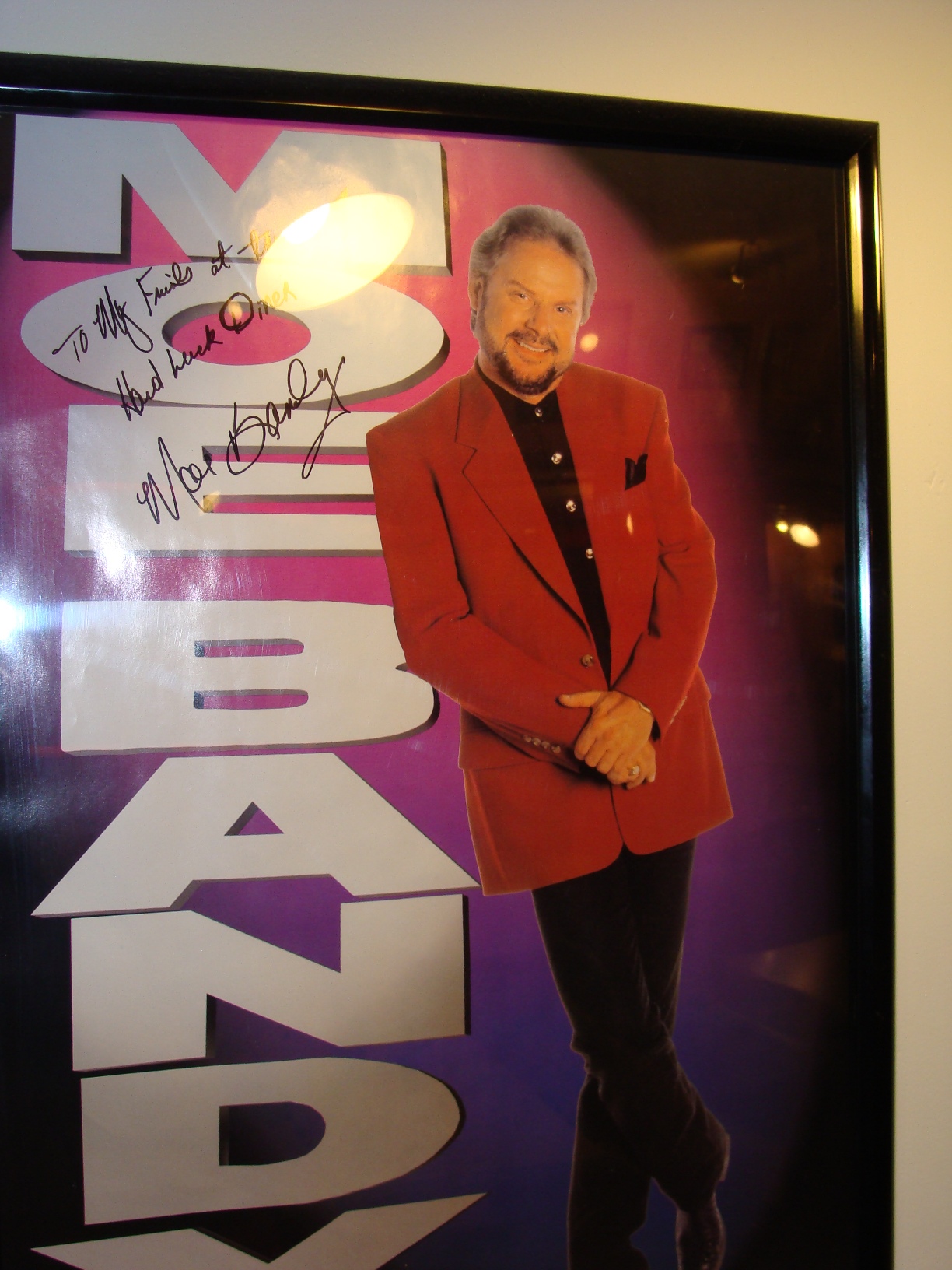
While vacationing in Branson recently, pollster David Byrnes noticed and commented on the striking similarity between fellow pollster Mark Hooper and Moe Bandy. After reviewing the photos, I must agree. Hooper’s out of town a lot. He’s emailed his weekly poll from all over the world. I’m going to have to go back through all the old records to see if we ever received a poll from Missouri. Nice wig, Hooper. We’re on to you.

Mark Hooper  Moe Bandy

~~~~~~~~~~~~~~~~~~~~~~~~~~~~~~~~~~~~~~~~~~~~~~~~~~~~~~~~~~~~~~~~~~~~~~~~~~~~~~~~~~~~~~

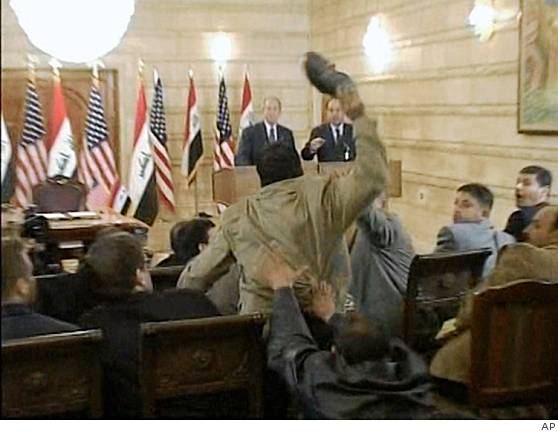
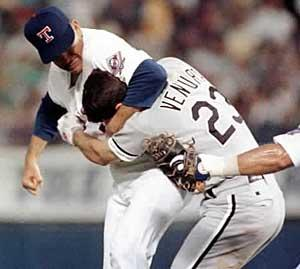
Look how Bush just stands there. And this was the SECOND shoe!If anyone ever — EVER — throws anything at me while I’m preaching, I hope I exhibit the same calm presence as President Bush. I’ve watched the video a hundred times. And I can’t get enough. He stared the guy down like Nolan Ryan facing Robin Ventura. It was like he was daring him to throw his camera or his hat. He dodged and then popped back up for another. Incredible. Hilarious. Bring it on!

I can’t see anyone in the pulpit really acting that way, though, except maybe John Bailey. The man throwing anything at John would be terrified if he actually hit him.

~~~~~~~~~~~~~~~~~~~~~~~~~~~~~~~~~~~~~~~~~~~~~~~~~~~~~~~~~~~~~~~~~~~~~~~~~~~~~~~~~~~~~~

WhitneyThe blogging may be sporadic, if not entirely shut down, for the rest of the week. Whitney, our oldest, goes into Scottish Rite Hospital in Dallas tomorrow morning for Thursday’s surgery. She’s having reconstructive surgery on her left foot to fix a couple of issues she’s been dealing with for a little over ten years. They’re actually taking some bone out of her hip and grafting it into her foot to straighten it out and give it a little more regular shape. She’ll be in the hospital until at least Saturday. And she’ll wear a cast and be on crutches and in a wheelchair for six weeks.

She finally admitted Sunday that she’s “a little nervous.” But she’s also looking very forward to getting everything fixed. Her parents are a little anxious, too. Please keep our precious angel in your prayers to our gracious Father this week.

Peace,

Allan

God Is The Fountain Whence

God is the fountain whence ten thousand blessings flow;
to him my life, my health, my friends, and every good I owe.
The comforts he affords are neither few nor small;
he is the source of fresh delights, my portion and my all.
He fills my heart with joy, my lips attunes for praise;
and to his glory I’ll devote the remnant of my days.

~Benjamin Beddome, 1817

« Older posts Newer posts »