Category: Holy Spirit (Page 10 of 14)

Gifted and Going

“Each of you should use whatever gift you have received to serve others, faithfully administering God’s grace in its various forms.” ~1 Peter 4:10

Once again, we’ve kicked off our summer Wednesday nights at Central by cancelling all our Bible classes. No, not to stay home and do nothing. Not as some reluctant surrender to the culture. And not because, hey, it’s summer and everybody’s schedules are nuts anyway. This summer, we’re cancelling our Bible classes on Wednesday nights so we can better practice as a church what we preach: that every single person who confesses Jesus as Lord is gifted by God’s Holy Spirit in different ways; that all the gifts are intended to serve other people with God’s love and grace; and that the exercise of those gifts will grow us more into the image of the Christ.

Throughout the month of July, our church family is participating in 27 different service projects throughout our city, mainly concentrating on the Plemons neighborhood around our church building. Most of the projects are just going to take about two hours each, most of them are fairly simple, and most of them require skills and abilities we don’t normally classify as spiritual gifts. We’re calling it “Gifted 2 Go.”

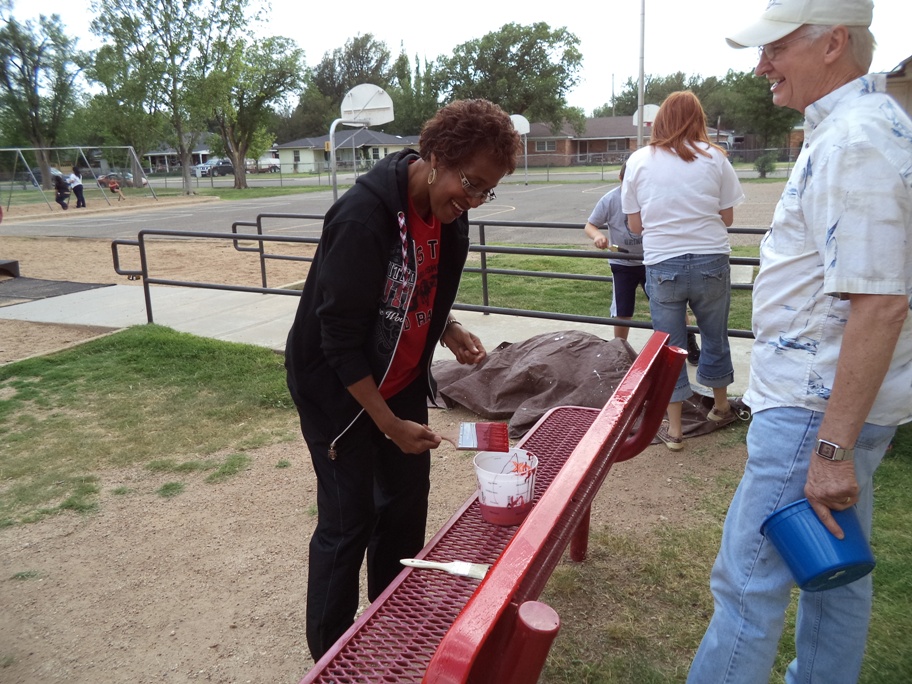
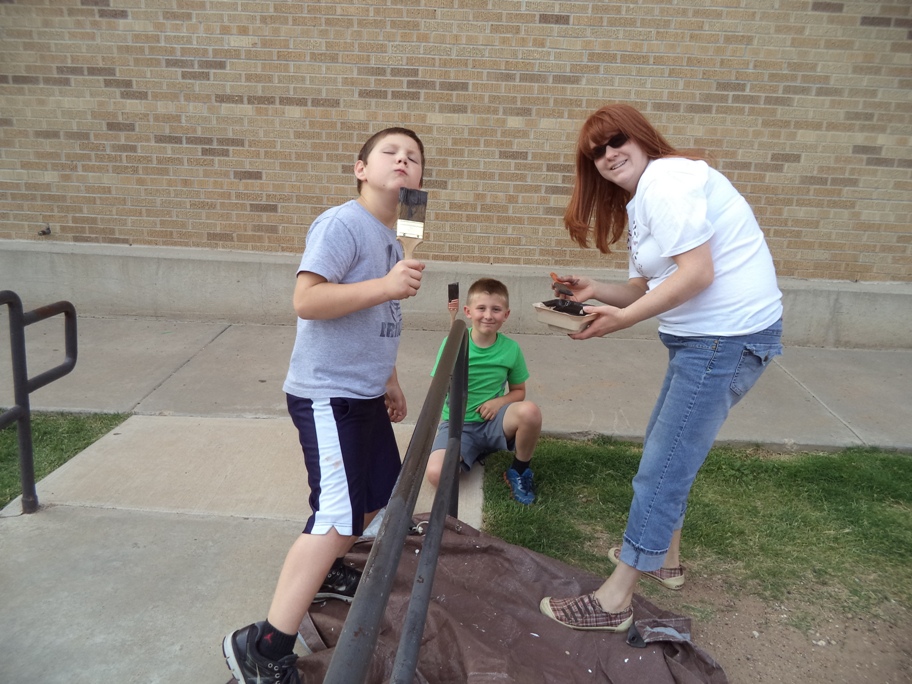
We’re painting benches and rails at Bivins Elementary, sharpening lawnmower blades and changing oil in cars, flying kites and building birdhouses, singing at hospitals and nursing homes, stuffing pillows, and doing small home repairs. Our aim is that we realize our very different and various talents come from God and that when we use them to bless others in his name, those are indeed spiritual gifts. We want to redefine the term “spiritual gift” so that the things we’re good at, the things we really enjoy doing, those are “spiritual gifts” when we give them to God to be used for his purposes.


This past Wednesday I led a group of about twenty-five — young and old, men and women, dressed in grubbies and armed with paint brushes and rags — to Bivins Elementary, just down the street from our church building. There we met the principal, Tim White, and we painted the benches and picnic tables around the school, the rails around all the ramps and stairs, some playground equipment, and a big wooden shed behind the gym. Kevin took a group of about forty-five — again, young and old alike — and they sang their hearts out at the Continental Assisted Living Center and Westgate Mall. Todd and Mary’s group put together a huge playscape thing at the Southlawn Assembly of God where we partner together on a weekly pantry ministry. Around sixty others sewed and stuffed 500 pillows for hospital and hospice patients. Twenty others cleared a vacant lot for Another Chance House. And another twenty or so knocked nearly 600 doors in the Plemons area, getting to know our neighbors and inviting them to the events and services to come in the following weeks.

My prayer is that the people of Amarillo will experience the love and grace of Christ Jesus in our efforts. I also pray that we will all realize that these very things we enjoy so much, the things we’re so good at individually, serve a much greater purpose than what we’ve always figured. And we don’t have to wait for our ministers or church staff to come up with programs to exercise those gifts. It should be a lifestyle. My small group should be figuring out ways to serve Amarillo in the name of Jesus on a regular basis, not just during the summer. My family should be blessing my neighborhood monthly, weekly, daily. My Bible class can be doing similar projects all the time. If our church finishes this summer series, celebrates with a slide show, and then sits around waiting for next summer’s special program, we haven’t apprehended the true meaning and purpose of “Gifted 2 Go!”

I believe “Gifted 2 Go!” is going to bless Amarillo in ways that we can’t yet begin to imagine. Our neighbors are going to experience God’s love and mercy through us. And I think we’re all going to be challenged to growth, spiritual growth in our righteous relationships with one another and with our Christ.

Peace,

Allan

Five Steps to Salvation

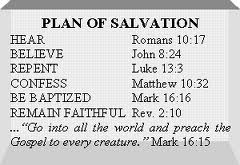
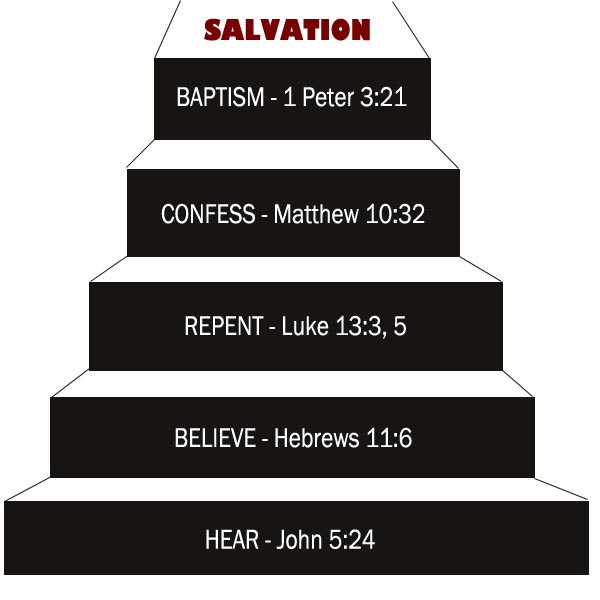
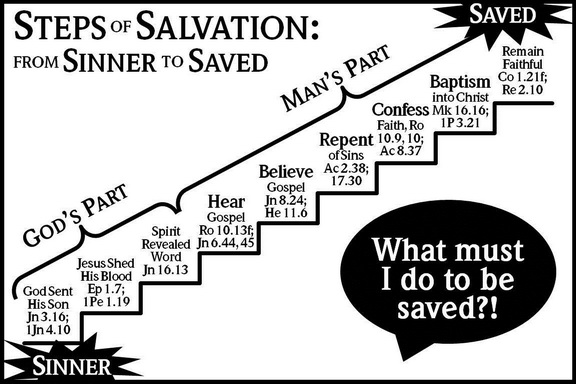
It’s just a Church of Christ thing, right? The “Plan of Salvation,” also called the “Five Steps of Salvation,” is unique to us, I think. And those of us who were raised in and by the Churches of Christ know them well: Hear, Believe, Repent, Confess, Baptism. In that order. As a kid in the ’70s, this was drilled into me by my Sunday school teachers in Bible class, by the preachers from the pulpits, by the youth ministers at the devotionals and rallies, and by the Open Bible Study my dad walked me through when I reached the “age of accountability.” The five steps were plastered on bulletin boards in the church hallways, illustrated by charts and diagrams on mimeographed handouts, and splashed across banners promoting the next Gospel meeting. These were the five steps, always accompanied by supporting verses of Scripture, that necessarily had to be followed — again, in order! — for one to be saved.

Hear. Believe. Repent. Confess. Be Baptized.

You ever wonder how that started? You ever question the validity of such a list? If you or your church were to make a list of supposed steps to salvation, what would you include? What parts of our CofC list would you leave out?

Historians point back to our movement’s focus on rational thought and enlightenment thinking that characterized the mainstream culture of America at the turn of the 19th century when Stone and Campbell and others were attempting to “restore” God’s Church. It was all about scientific reasoning and empirical evidence and deductive problem-solving. Society at this time was convinced that there were undeniable patterns, unalterable designs in nature and in the world that, if learned and applied, held the keys to everlasting peace and joy.

Alexander Campbell searched the Scriptures in this way and came up with what he called “the ancient gospel,” a pattern he believed was the divinely-ordained natural way to heaven. According to Campbell, it all boiled down to, in this order: gospel facts (death, burial, resurrection, and ascension of Christ), faith, repentance, reformation (of life), baptism, remission of sins, reception of the Holy Spirit, sanctification, resurrection of the saints, and eternal life. In that order. Campbell claimed that all Christian denominations believed in all these steps, but put them in different orders according to their own interpretations or theories of conversion.

At about the same time, Walter Scott came up with a biblical pattern and called it “the gospel restored.” He had six points originally. The first three were what humans had to do to be saved: believe, repent, and be baptized. The last three were what God promises to people who do the first three: forgiveness of sins, the gift of the Holy Spirit, and eternal life. Not too much later, Scott shortened his list to five points — one for each finger on a person’s hand, for easy remembering: faith, repentance, baptism, forgiveness of sin, and the gift of the Holy Spirit.

This method proved to be very successful on the early American frontier where most everybody had been trained in Calvinism which claimed that men and women were saved only by God’s predestination, that one couldn’t do anything to save himself, it was all up to God’s pre-ordained choosing. By telling these fiercely independent early frontier people that there really was something they could do to be saved, the Stone and Campbell churches fueled a massive rush to repentance and baptism.

As with most good things, we swung the pendulum a bit too far. Pretty soon, we were taking God’s initiative and the Holy Spirit’s active participation clear out of the conversion process. Preaching became all about proving “facts” with arguments and evidence. The Holy Spirit’s work in the past had been entered into the Biblical record and was there to be studied in a rational manner, but it wasn’t necessary for a person’s salvation. The emphasis was on logical fact-finding and step-following and persuading people to “obey the gospel.” The “gospel,” of course, being the steps.

So, at some point in the middle of the 1800s, it gets boiled down to what we have today in the five steps of salvation or the plan of salvation: hear, believe, repent, confess, be baptized. Notice how God’s divine activity is completely absent from any of the steps. Notice how this chart here to the right — all of these charts were downloaded from Church of Christ websites this morning — actually gives much more responsibility or credit to man than to God for salvation. Where is God in our “plan of salvation?”

Why is baptism the last step? Who took out “sanctification,” the guiding of the Holy Spirit, and the grace of God to continually wash our sins?

It is God who works to will and to act according to his good purpose. It is God who initiates salvation, who begins the good work and sees it through to completion. Belief and repentance and confession are salvation steps to be taken every day, not once on a ladder list of human accomplishments. Baptism is never the end of what the apostle Paul calls “being saved,” it’s the beginning. Our five steps minimize our God. Our five steps neglect a lifetime of day-by-day, hour-by-hour difficult discipleship to Jesus. And they ignore the unmerited and continuous grace of our merciful Father.

OK, maybe that’s a little harsh. Too judgmental, probably, Yes, we come by the “five-steps” thing naturally. It’s been handed down to us by faithful men and women who were doing their very best with what they had to work with during the times they lived. And I’m grateful for it. Seriously. But I’m also so glad that we’ve recognized the many shortcomings in this kind of incomplete view of salvation. I’m so glad that we’re acknowledging together the active role of God’s Spirit in the calling and saving and sanctifying of the saints. And I’m glad we can change. I’m so glad, by God’s grace, we’re allowed and even compelled to change.

Peace,

Allan

Pray More and Dispute Less

Last week’s Tulsa Workshop (excellent, as always!) has put me a little behind on tracking in this space with our adult Bible classes here at Central as we study together “Renewing God’s People.” I’ll try to get caught up here before the weekend hits.

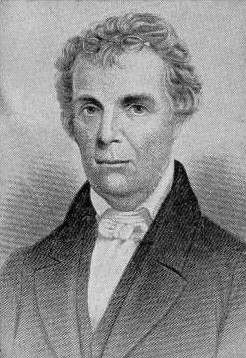
Chapter three of Doug Foster’s concise history of the Churches of Christ, Renewing God’s People, introduces us to Barton W. Stone, a co-founder of what has been called by historians the Stone-Campbell Movement or the American Restoration Movement. Stone was a college-educated Presbyterian minister who, in August 1801, participated with other Presbyterian, Baptist, and Methodist preachers in the largest and most famous camp meeting revival in American history. The success of the Cane Ridge Revival added fuel to the restoration fires of the time and influenced Stone to withdraw from the Transylvania Presbytery to begin the non-denominational Springfield Presbytery. It was an effort to promote Christian unity, to tear down the denominational walls that divide disciples of Jesus, to faithfully express the Gospel as it’s described in Ephesians 4: “There is one body and one Spirit — just as you were called to one hope when you were called — one Lord, one faith, one baptism…”

But after just a few months, it became apparent to Stone and his colleagues that their Springfield Presbytery was just another sectarian division among many. It was working against the Christian unity they so strongly desired. So they broke it up. And the document that proclaimed the dissolution of their organization became one of the two most important founding documents for Churches of Christ. The opening lines of The Last Will and Testament of the Springfield Presbytery quoted from Ephesians four and declared that they would “sink into union with the Body of Christ at large.” They renounced all denominational names of distinction; no more Baptists or Reverends, no more Presbyterians or Fathers. They called for a return to the Bible as the only authority for Christians and God’s Church, “the only sure guide to heaven.” The document affirms the autonomy of each congregation of Christian believers, liberating all churches to “adopt the law of the Spirit of life in Christ Jesus.” They claim that no governing body has the authority to decide anything for a group of churches, that “our power of making laws for the government of the church, and executing them by delegated authority, forever cease.”

Above all, Stone used the document to call for the unity of all Christian believers. “We will,” he writes, “that preachers and people cultivate a spirit of mutual forebearance; pray more and dispute less.”

Pray more and dispute less.

Sigh.

I’m convinced that one reason we in Churches of Christ got so far off track with the initial and Holy Spirit-inspired vision of Christian unity is that we so horribly distorted that Ephesians 4 passage that’s quoted in Stone’s Last Will and Testament. Consider…

I belong to a 750-member congregation in Amarillo; my parents belong to a 400-member congregation in East Texas; my friends David and Olivia belong to a twelve-member congregation that meets in their apartment in Kharkov, Ukraine; my friends Rick & Jaime Atchley belong to a 4,000-member congregation in Fort Worth; my friends Alaor and Miriam belong to a 90-member congregation in Sao Paulo, Brazil. Many, many different expressions of the one church. Those different expressions don’t diminish the truth of “one church” or “one body.”

I was baptized at eleven years old in a heated baptistry in a church building in Dallas; others are baptized as teenagers in a freezing creek at Camp Blue Haven; others are baptized at the age of 80 in crowded apartment bathtubs in Beijing; others are baptized in swimming pools. Many, many different expressions of one baptism. Those different expressions don’t diminish the truth of “one baptism.”

Most Sundays I eat a cracker crumb and sip some grape juice while sitting in a pew and call it communion. Most Sunday nights, I break off a huge chunk of bread and chug a big swig of juice around my kitchen table with our small group and call it communion. During a flu outbreak or a bird virus scare, we’ll eat little pre-broken chicklet-size pieces of cracker. Tortillas at a camp out in Colorado. Peta or flat bread in Peru. Many, many expressions of our Lord’s one meal. Those different expressions don’t diminish the truth of the one Lord’s Supper.

So, when did we start reading Ephesians 4:3-6 like this: “There is one expression of the body and one expression of the Spirit… one expression of faith, one expression of baptism?” And when did we start ripping this foundational passage completely away from its powerful context of unity? When did we start ignoring the opening lines: “Be completely humble and gentle; be patient, bearing with one another in love?”

Is our mighty God, who is One, not the God and Father of all this? Is he not over all this? And through all this? And in all this?

Yes, there is only one baptism; and God is over it, not you. Yes, there is only one Church; and God is in charge of it, not you. Yes, there really is only one faith; and our God is delighted that there are so many different expressions of that faith out there. Barton Stone called on all Christians to see the big picture of God’s eternal Kingdom, to see the beauty of divinely-ordained diversity, to experience the power of his love that destroys all the barriers that separate his children. The only way Stone believed we would ever get close to realizing it this side of glory would be to pray more and dispute less.

Peace,

Allan

Be Filled with the Spirit

“Be filled with the Spirit. Speak to one another with psalms, hymns, and spiritual songs. Sing and make music in your heart to the Lord, always giving thanks to God the Father for everything, in the name of our Lord Jesus Christ. Submit to one another out of reverence for Christ.” ~Ephesians 5:18-21

We worship in the Spirit. We submit to one another and sing and speak to one another in the Spirit. The Holy Spirit of God is who gives the Christian life its energy and enthusiasm. Its endurance. And power!

Be filled with the Spirit.

This is an imperative. It’s a command. So we do take some responsibility here. This singing together and submitting to one another is either the means by which we pursue this filling of the Spirit or the result of being filled with the Spirit. Or both. Either way, Paul says when we sing together, when we pray together, when we really belong to one another, we are filled with the Spirit.

And that tells me that God is not a spectator when we gather for worship. Audience of one? No way! God is not the audience of our worship. Our God is an active participant with us — inside us — when we worship together. God is not just sitting on his throne in heaven soaking up all the hallelujahs and amens. No. Through the Spirit, the Father and Son are engaged with us. Communing with us. Eating and drinking with us. Rejoicing with us. Transforming us. Changing us. Growing us. Shaping us more into the image of our Christ.

Be filled with the Spirit.

Encountering God together — in our Sunday morning assemblies, in our Wednesday night Bible classes, in our living rooms on Sunday evenings — being in the presence of God together allows us to recognize our own sinfulness and shortcomings. And that always leads to an acute recognition of his marvelous grace. And the power of God’s grace is not just forgiveness, it’s also transformation. New creature. New creation. Christ formed in you. Being saved. It’s a communal sanctification event that we participate in and experience together when we are filled with the Spirit.

Peace,

Allan

Beyond the Laws

“Do not conform any longer to the pattern of this world, but be transformed by the renewing of your mind.” ~Romans 12:2

Renewing the mind is, by definition, an internal process. Those of us who are baptized followers of Christ understand that God’s Holy Spirit lives inside us, shaping us into the image of our Creator. And that includes the changing of our very minds, the transformation of the very ways we think.

In God’s great wisdom, he has determined that this is a much better way to go about things than following laws. We know that laws cannot conceivably cover all the issues and circumstances we face in life. No matter how detailed the laws are — God’s laid down a few and we’ve come up with plenty ourselves! — they will always fail to cover some situation.

Living like Christ is not about conforming to commands. That kind of theology leads to duplicitous living. Some disciples are “Christian” in their behavior regarding laws they’ve been taught but thoroughly worldly when it comes to those things not specifically covered in Scripture. A Christian may not abort her baby because she’s been taught not to do that. But she may harbor racist attitudes or fudge on her taxes without batting an eye.

If renewing the mind is as important as Paul says, then the goal of the Church should be forming Christian minds in our people. We should be teaching and preaching beyond what is right and wrong and work as much — if not more — on shaping a worldview that puts Christ and our Christian transformations at the center.

“Inwardly we are being renewed day by day.” ~2 Corinthians 4:16

Peace,

Allan

Greater Things Than These

“I tell you the truth, anyone who has faith in me will do what I have been doing. He will do even greater things than these.” ~John 14:12

Around the dinner table on that last night, Jesus tells his closest disciples that, by the power of his Holy Spirit, they will do greater things than even he had done. “I’m leaving,” Jesus says. “But I’m sending my Spirit to you and you’re going to not only continue doing what I have done, you’re going to do even better.”

???????

I have a difficult time with this verse. I know my own life. I know my sins and my failures. They are many. I’m a dedicated follower of our Lord, yes, but I can’t begin to do what he did, much less more than he did. Or greater things than he did. Greater things? Greater things than Christ Jesus? Even with the almighty power of God’s Holy Spirit living in me, I can’t imagine anything I could ever do for God’s Kingdom as being classified by Jesus as greater than what he had done.

“Greater” could mean broader or wider. Yes, it could mean that the Spirit is working through the Church now to spread the good news of salvation from God in Christ around the whole planet. In that sense, the Church today has a “greater” reach than Jesus and his faithful disciples in and around Galilee.

But I can’t ignore the fact that Jesus uses the singular pronoun “anyone” when he talks about these greater things. He’s speaking about individuals.

Could it be that the really amazing things Jesus did on this earth weren’t really the healings and the exorcisms and the feedings of the multitudes? Is it possible that, in God’s eyes, Jesus’ acts of humility and service were really the “greater things?” While he walked in our shoes, the Son of God displayed amazing obedience and sacrifice. Our Lord humbled himself and put his very life at risk in order to save others. He submitted. He not only submitted to the Father, he submitted to the world. For the sake of the world. It is amazing what Jesus did while he was here.

Is it more amazing, again, in the eyes of God, that sinful human beings also sacrifice and submit and obey? The very fact that fallen and finite men and women, empowered by the Holy Spirit, can display incredible acts of humility and service might just blow the angels in heaven out of the water. God’s Spirit enables even us to serve like Jesus, to obey, to be submissive, to be generous to others as Christ was and is. It is great! It’s almost unbelievable! Greater than what Jesus did, maybe, in that we’re sinful humans! It’s mind-blowing! I think it might be a tremendous wonder in heaven when the angels consider that the Spirit of God actually does so much good through us weak and sinful human beings. They may applaud our measly acts of service and humility as the most amazing things in the universe!

Only by the grace of God and power of his Spirit are we able to truly obey, to really submit, to actually sacrifice and risk in order to serve others. His Spirit changes us. He transforms us. He enables us to act like and look like his Holy Son. A holy and righteous and eternal Creator living inside unholy and sinful and finite human beings in order to save the world. It’s not a different ministry from what Christ did on this earth. It’s the same ministry; it’s a continuation of God’s plan to redeem all of creation back to himself. So you are empowered to do these great things. You are enabled to sacrifice and serve. You are used by God to submit and obey. You are empowered to put others’ needs ahead of your own. You are a co-worker with God, partnering with him in this great salvation work. Believe it or not, in this blessed age of the Spirit, what’s happening right now through you, Christ’s disciple, is the greatest and most amazing yet.

Peace,

Allan

« Older posts Newer posts »