Category: Christ & Culture (Page 33 of 45)

Words We Cannot Ignore

If I were Skip Bayless, I’d write this morning that the “Cowboys O-Line Almost Costa Game!”

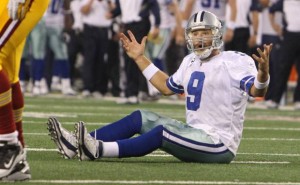
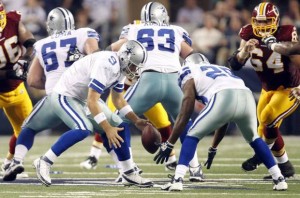
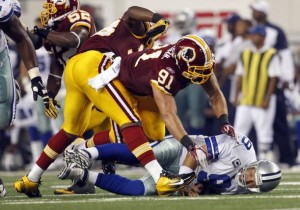
I detest the way Jon Gruden was wanting to ship Tony Romo’s cleats to Canton for immediate induction. But I give a lot of credit to the Cowboys’ quarterback for last night’s never-say-die, gut-it-out win over the Redskins. Romo was like a rookie catcher behind the plate with Charlie Hough or Tim Wakefield on the mound: just wait for the ball to stop rolling and pick it up. He had no help from his line or his receivers. He really is playing with a cracked rib. And the long scramble and throw to Dez on that late third-and-forever was a clutch play.

Still, that line is going to be the end of this team. If the secondary doesn’t kill ’em, that offensive line will. And I keep waiting for somebody to put out the over/under on when Rob Ryan goes all “Buddy Ryan punching out Kevin Gilbride on the sidelines” when Jason Garrett’s offense blows another first-and-goal at the two yard line or fumbles in the red zone after a tough defensive stand. Will that happen before, during, or after the November 20 game at Washington?

This is an 8-8 team that’s going to miss the playoffs again. But, as always, it’s a whole lot of fun to watch.

~~~~~~~~~~~~~~~~~~~~~

The Bible makes some pretty bold assumptions that we would all do well to recover. Scripture envisions the world as a much different place than the one we see and experience every day. The Bible calls us as children of God to live into the world differently than everybody else does, to challenge it, to change it. The Bible says that the world as it is right now is broken, it’s messed up, it’s not right. God wants it to be right, he’s working every moment to fix it. And as his agents of reconciliation, we are commissioned by him to live in such a way that moves things along in the right direction.

The Bible is a scandalous document. If you read it correctly, it can’t be ignored. And it calls us to be radically different from all that’s going on around us. We don’t conform to the culture; we convert the culture. And that’s tough.

In her book, An American Childhood, Annie Dillard asks why in the world her parents wanted her to read the Bible. She can’t understand why her mom and dad wanted her to study and memorize Scripture:

“If they had really read it themselves, I thought, they would have hid it from us. They didn’t recognize the vivid danger that we would, through repeated exposure, catch a case of its wild opposition to their world. Instead, they bade us study great chunks of it, and think about those chunks, and commit them to memory. And ignore it.”

Scripture is challenging. The words of the Bible shatter all our assumptions about life. They command us to seek justice, not just order; they demand that we show respect, not just politeness; they mandate that we act in love, not just friendliness.

God does not validate governments and power structures and the establishment the way we see it. The Bible calls us to question those structures and live lives of contrast to the values that sustain those structures and make sure those worldly values and structures never become a part of God’s Church.

That’s dangerous. It’s like quoting from the Declaration and Address — one of the Church of Christ’s founding documents — to a Church of Christ congregation. We don’t realize our faith and practices and traditions originate from such powerful words. Words that still challenge today. Words that call us to be different. Words that call us to partner with God in changing everything that’s wrong with his world. Words we cannot ignore.

Peace,

Allan

Upholding the Ideal: Part 2

In affirming the ideal picture of a diverse community of Christian disciples presented in Scripture and summarized in yesterday’s post and, at the same time, lamenting the failure of most churches to fully understand, grasp, and work toward that ideal, a most loyal reader of this space commented: “Maybe we should leave whitebread land…”

No. That’s not necessarily the answer.

The answer is to keep trying. Keep teaching. Keep working. Like our Sovereign God, keep calling things that are not as though they were. And see it. Live it. Do it. But that can only happen, I know, AFTER a church and its leaders fully understand the Gospel significance and power of a multi-racial, multi-ethnic, multi-generational, multi-cultural, multi-socio-economic body.

As long as we have churches for the poor and churches for the rich, white churches and black churches and brown churches, as long as we refuse to give and sacrifice and bend to one another enough to worship and serve and love and live together, we will be unable to give to the world anything it can’t already get at the social club or the mall or on the internet. I believe that people today are seeking truth. No, make that Truth, with a capital T. People are searching for a Truth that is bigger than themselves. A Truth that means something for eternity, that transcends what we experience on a daily basis, that is gargantuan in its scope and Truth-ness. Real Truth changes lives. It has the power to radically transform men and women and whole neighborhoods and cities. Gatherings of a bunch of people who look alike and think alike, who dress the same and make the same amount of money, can be found anywhere. Organizations that exist to cater to a certain select segment of our population are found everywhere we look. In fact, that’s all there is anymore. That doesn’t really speak a unique word to anyone. It’s certainly not some kind of all-surpassing, history-altering Truth.

The Truth of the Gospel is that God condescended to man, submitted to sinful humans, gave and served and sacrificed for others to the point of dying on a cross, and rose again to destroy eternally everything that separates man from God and man from one another. Christ Jesus destroys all the walls, his death demolishes the barriers, his resurrection defeats the differences. We’re all the same in our Savior. His Church is one body, one people, one eternal congregation of saints for ever. We know these things, we teach and preach these things, we write books about these things and uphold these things as pure soul-saving Truth.

But when we don’t live it, when we don’t show the world what it looks like, why are we surprised that the world yawns and turns away? We proclaim something radically different from the world, but we practice the same old thing that the world sees every day. I’m bored with it, too.

The scandal of the early Church was not that they were worshiping a different God. It wasn’t that they were preaching the Resurrection. The first Church was persecuted because they were destroying the social class systems of the Roman Empire. Greeks and Jews were sharing meals around the same table. Both rich and poor interacted in the same homes. Masters served their slaves. Educated  and ignorant, men and women, slave and free, ruling class and no class, they came together to live and worship and serve the Lord and King who saved them and called them to a better way.

That kind of submission and sacrifice spoke a word of Truth to the world. That kind of living turned the world upside down for the Kingdom of God. That kind of spectacle was so different from anything anybody ever experienced anywhere else that it sparked a global revolution that upset governments and changed the course of human history.

But we want to keep our tidy little lines of demarcation between white and black, rich and poor, English and Spanish, in our churches. We think it’s too hard to integrate. We think it’s too much to sacrifice. We think we’d have to give up too much in our worship styles. In the name of culture and comfort we decide it’s too difficult. We don’t think it’s worth the trouble.

Either we have underestimated the people in our congregations or we have horribly misunderstood the Gospel of Jesus.

~~~~~~~~~~~~~~

Jon Mark Beilue, a long-time columnist for the Amarillo Globe News, stopped by for an hour or so last week to interview me for the paper. His column came out this morning. You can read it by clicking here. The Garland cop is Jason Reeves. The cross above my computer is the collage of crosses Tracy Sharp did for me when we left Legacy. I was not a kid in suburban Dallas; I was born and reared in the heart of the Dallas hood, man — PGrove! I’m not sure why the color in the photo is so messed up; there’s no way my hair is really that gray. And Jon didn’t use my favorite line: Working for and with the Texas Rangers every day for four years drives most men into twelve-step counseling programs; it drove me to the ministry.

I really enjoyed my time with Jon Mark and the Globe News Photographer, Robert, who, like me, also hails from Big D. It’s a very nice column. And he’s right about this: our God could not have led me to a better church in a better setting in a better city than where we are right now today.

Peace,

Allan

Upholding the Ideal

Our holy Scriptures are full of lofty ideals. We listen to Jesus say, “Love your enemies,” and we realize, “Wait a second, I don’t even like my friends!” Give to everyone who asks. Never lust. Always forgive. Rejoice in persecution. Put the needs of others ahead of your own. Our Lord calls for a single-minded fidelity to following him without reservation. And it’s demanding. Impossibly so. Yes, the Holy Spirit of God empowers us to do what Christ is calling us to do. But we don’t always do it. We mess up. We sin. We fall.

To borrow from Yancey, I find that, personally, I talk and write about spiritual disciplines far better than I practice them.

How about you?

Yeah, I know.

But we keep trying, right?

We never put our feet on the floor in the morning and allow that, “I’m human so I’m going to sin today. There’s no way I’m going to be perfect today. I’m going to mess up. I’m human.” No! God forbid! We strive with everything in our power and by the strength of the Spirit to pledge that, today, I’m going to be like my Lord! We don’t ever give in to the world’s conclusion that we cannot possibly be like Christ. We keep trying.

Scripture paints a beautiful picture of the Kingdom of God and the coming wedding feast of the Lamb. It’s a gathering of “every tribe and language and people and nation.” We find “the poor, the crippled, the blind and the lame” around the table. Paul makes it clear that, in Christ, there is “neither Jew nor Greek, slave nor free, male nor female.”

I believe the very core of the Gospel of Jesus is that our Christ died and rose again in order to destroy completely and eternally all the barriers that exist between God and man and man and one another. Social distinctions. Cultural differences. Language obstacles. Socio-economic disparity. Zip codes and tax brackets. None of these things register as even a blip on our fellowship radar. These differences don’t even exist in Christ.

But we have black churches. And white churches. And hispanic churches. And rich churches. And poor churches. And somehow we’ve fooled ourselves into thinking that’s OK. We have begun to believe the lie that church has always been this way and it will always be this way. The cultural differences are too great. The language difficulties are too much. We’ve tried to integrate, we’ve tried to come together, but it’s just never worked. And it never will work.

So, why try?

Because there is honor in the trying. Trying is an act of faith. Our Father wants us to engage that struggle and try. He wants us to try.

Scripture gives us a crystal-clear mandate. It tells us in no uncertain terms that the table of Christ and the house of God is to be enjoyed by all. Together. United as one. Everybody equal. Everybody just as wretched and lost and condemned to death without Jesus and everybody just as holy and saved and righteous because of Jesus. Together. We uphold the ideals we find in Scripture. We lift up those ideals and we try with everything we have to bring heaven to earth, to practice God’s will on earth just as it is in heaven.

And we slip. And we fall. And fail. And do really stupid things. But we never give up. We never give in to the world’s conclusions that division along racial and economic and language lines is necessary. We keep trying. And we trust that Jesus, our King, is watching even as we are “straining at the oars.” He’s interceding for us as he watches. And he’s proud of us. He’s pleased with us as we keep trying.

Peace,

Allan

Worthy of the Gospel of Christ

“Whatever happens, conduct yourselves in a manner worthy of the Gospel of Christ.” ~Philippians 1:27

The apostle Paul intentionally uses political language, the very Greek words from which we get our English words “politics” and “politicians,” to drive home a very important point to the little church in Philippi: “Our citizenship is in heaven.” (Phil. 3:20)

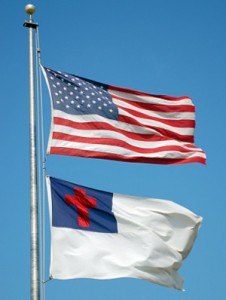
To confess that Jesus is Lord is to say Caesar is not. To claim citizenship in heaven is to declare our allegiance, first and foremost, to God’s Kingdom, not the Empire. To conduct ourselves politically or to behave as a citizen of that Kingdom and as subjects of our crucified and resurrected King is to first understand that none of it is of this world. The Kingdom to which we belong transcends all national borders. The Kingdom respects no geographical boundaries or distinctions of powers. And as colonists living under the rule of our Christ, we rise above any national thought, national pride, or national agenda. The Gospel of Jesus levels all of us into an eternal and international community of those who follow the Savior. And it’s his Kingdom that deserves — no, demands! — our undying allegiance.

If citizens of heaven do choose to engage in the politics of America or any other earthly country, we approach it, above all, from the standpoint of our relationship with God through his Son, our only King. Scripture tells us that disciples of Jesus survive in a hostile environment not by legal proceedings against persecutors but by endurance; not by imposing a lifestyle on others through law but by living holy lives that compel others to watch us; not by destroying others with emails and sound bites but by respecting them even as we witness to the eternal truths of the Gospel; not by hating and killing but by loving and serving. And praying.

With that in mind, I want to offer a few things this weekend for your reflection as you and I remember and respond to what happened ten years ago.

Christianity Today has devoted the entirety of its current issue to Christian reflection and response to the terrorist attacks of 9-11. It’s all very good reading. Varied and provocative. There’s an especially interesting section entitled How Evangelical Leaders Have Changed Since 9/11 which contains the thoughts of preachers and pastors and authors and worship ministers and other church leaders. It’s good. The best in that section comes from William Willimon, an outstanding Christian author and theologian:

On 9/11 I thought, ‘For the most powerful, militarized nation in the world also to think of itself as an innocent victim is deadly.’ It was a rare prophetic moment for me, considering Presidents Bush and Obama have spent billions asking the military to rectify the crime of a small band of lawless individuals, destroying a couple of nations who had little to do with it, in the costliest, longest series of wars in the history of the United States.

The silence of most Christians and the giddy enthusiasm of a few, as well as the ubiquity of flags and patriotic extravaganzas in allegedly evangelical churches, says to me that American Christians may look back upon our reponse to 9/11 as our greatest Christological defeat. It was shattering to admit that we had lost the theological means to distinguish between the United States and the Kingdom of God. The criminals who perpetrated 9/11 and the flag-waving boosters of our almost exclusively martial response were of one mind: that the nonviolent way of Jesus is stupid. All of us preachers share the shame; when our people felt very vulnerable, they reached for the flag, not the cross.

September 11 has changed me. I’m going to preach as never before about Christ crucified as the answer to the question of what’s wrong with the world. I have also resolved to relentlessly reiterate from the pulpit that the worst day in history was not a Tuesday in New York, but a Friday in Jerusalem when a consortium of clergy and politicians colluded to run the world on our own terms by crucifying God’s own Son.

~~~~~~~~~~~~~~~~~~

My great friend Jim Martin has used his blog, A Place For the God-Hungry, to ask preachers this week what they’re going to preach this Sunday. Again, the nearly 50 comments are worth reading. They are varied and provocative. Very helpful in guiding us to reflect and respond in a manner worthy of our Lord’s Gospel.

~~~~~~~~~~~~~~~~

Our Messiah has commanded us to love our enemies and pray for those who persecute us. As disciples of the Prince of Peace, we are also to pray and anticipate and work toward the ultimate shalom that will be realized when God’s Kingdom comes in all its glory, when our Father’s will is truly and finally done on earth just as it is in heaven. A good resource for meditation and reflection in these areas is the Book of Common Prayer. I would especially recommend the section on Prayers for Peace and Justice.

For Peace: Eternal God, in whose perfect Kingdom no sword is drawn but the sword of righteousness, no strength but the strength of love; so mightily spread abroad your Spirit, that all peoples may be gathered under the banner of the Prince of Peace, as children of one Father; to whom be dominion and glory, now and forever. Amen.

For Peace: Almighty God, kindle, we pray, in every heart the true love of peace, and guide with your wisdom those who take counsel for the nations of the earth, that in tranquility your dominion may increase until the earth is filled with the knowledge of your love; through Jesus Christ our Lord, who lives and reigns with you, in the unity of the Holy Spirit, one God, now and for ever. Amen.

For Our Enemies: O God, the Father of all, whose Son commanded us to love our enemies, lead them and us from prejudice to truth; deliver them and us from hatred, cruelty, and revenge; and in your good time enable us all to stand reconciled before you, through Jesus Christ our Lord. Amen.

~~~~~~~~~~~~~

A few months ago, Jim Gardner turned me on to Kurt Willems at The Pangea Blog. Kurt is a former classmate of Jim’s at the Fresno Pacific Biblical Seminary. You might check out his angle on how Jesus washing Judas’ feet on the night he was betrayed serves as our model for dealing with our enemies. The article is “9/11 and Jesus’ Approach to Enemies of the State.”

~~~~~~~~~~~~~~~~~~~~~

My great hope is that when we gather in the name and manner of our Lord Jesus this Sunday morning we will think and speak and behave and worship in a manner worthy of the Gospel of Christ. While we’re naming the evil, may we also point to the sovereignty of our Father who “reigns over the nations” and “is seated on his heavenly throne.” While we’re praying for soldiers of the United States military and their families, may we also lift up the soldiers and families of the Iraq and Afghanistan armies to our God “who takes no pleasure in the death of the wicked.” And while we teach and preach on the repentance and restoration of America and America’s churches, may we also teach and preach on the redemption and the reconciliation of all of creation according to the holy will of our eternal Father.

Lord, come quickly.

Allan

I Will Carry You

“Even to your old age and gray hairs
I am he, I am he who will sustain you;
I will sustain you and I will rescue you.” ~Isaiah 46:4

God speaks through his prophet in Isaiah 46 about the foolishness of our idols. He shows his people the absurdity of putting our faith in idols. God’s people were worshiping Bel and Nebo, Babylonian and Canaanite gods, right alongside Yahweh. They were worshiping God, yes. But at the same time they were hedging their bets, covering their bases — political, cultural, agricultural — by including all the regional gods of the land, too.

Technically, it’s called syncretism. Practically, I’d call it materialism. Or consumerism. Or nationalism.

The picture painted in Isaiah 46 is graphic. God’s people are burdened by their idols, having to carry their idols, even as they’re marched off to captivity in Babylon for worshiping those idols. They’re being driven out of God’s Promised Land and they’re carrying their idols with them.

And God says, “Listen to me! I will carry you!”

You’re carrying these lifeless idols around, these idols that can’t save you or protect you. You’re carrying them. And you’re bent over and weakened by the weight. They make the idols and then are forced to carry them. And our Lord points out the insanity of that when he says, “I have made you and I will carry you!”

We’re all getting older. Our hair is going to turn gray. Or turn loose. Or both. The instability of the economy scares us. The tenuous nature of the world’s governments unnerves us. Wars threaten us. Healthcare seems to be increasingly lacking for us. Everything’s changing. Nothing much seems dependable. And Isaiah 46 shows us very clearly the utter foolishness and sin of trusting in politics and governments and technology and goods for our peace. In the midst of the change and the turmoil and the uncertainty that surrounds us and sometimes overwhelms us, our mighty God says:

“Remember this. Fix it in your mind. Take it to your heart. I am God. And there is no other. I am God. And there is none like me.” (46:8-9)

~~~~~~~~~~~~~~~~~~~~~~~~~~~

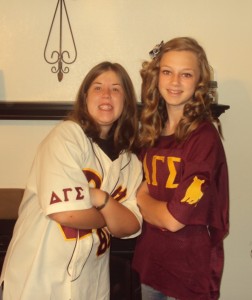
I’m still not real sure what “Howdy Week” is at Amarillo High. But Whitney and Valerie have been in costume for the past five days. It was 80s dress for Time Travel Tuesday. Suspenders and thick black glasses for NerdsDay. But today they’re sporting their dad’s old maroon and gold for Frat Friday. Eggleston will appreciate this picture of my two older daughters wearing Delta jerseys. Byrnes and Frost will make some immature comments about it that will betray their pathetic Sigma jealousies. When John-Tern sees it, he will laugh out loud.

But it just makes me proud.

Go Sandies.

Allan

Football Friday!

It’s going to be a record 101-degrees in Amarillo today, but it feels like fall. Drum lines and cheerleaders and football players and victory chants do it for me every time. It’s high school football season. Zero week starts tonight at Bivins Stadium when the Amarillo High School Sandies take on Midland. Carrie-Anne and I just returned from the pep rally in the Sandies Gym. We sat next to the Freshmen section and right across from the Seniors. But we never once saw either one of our girls. (If they had seen us, I’m sure they would have made sure we didn’t see them.)

There’s something really cool about being a part of this Amarillo High School scene. It’s the sense of genuine community. I’m sure it has a lot to do with the history of the place. Amarillo High has been around since 1889. There’s a lot of tradition here. In fact, they do all they can to keep the traditions alive. They still use the old 1920s mascot and logos on a lot of their literature and publications. They still employ a quaint rally chant from the ’40s, “Blow, Sand, Blow!” at opportune times during football games. While discussing tonight’s tailgating activities in the parking lot after the pep rally, we met a couple of people who went to school at AHS, sent their kids to AHS, and now have grandchildren here on the football team and on the spirit squads. There’s a lot of that here. They value their history. They uphold their traditions. When you’re a member of the Amarillo High School community, you’re a part of something much bigger than yourself. You’re a part of something that’s been vital and important since before your grandparents were born and something that’ll be vital and important long after you’re gone.

There’s a really provocative and interesting blog post in here somewhere about traditions in God’s Church, about traditions within our Church of Christ heritage, about the value of those traditions and what they mean to a community of believers. There’s a lot to write today about being connected to the greatness of the past, those men and women of the faith on whose shoulders we’re standing today. There’s plenty to consider regarding what we’re doing today and how it will impact future generations of disciples of Jesus.

But you’ll have to think about it and discuss it yourself. You’ll have to draw your own conclusions today. C-A and I are going to lunch and then we’ve got to find a couple of Sandies T-shirts before kickoff.

Hoping your team wins tonight. Unless it’s Midland.

Allan

« Older posts Newer posts »