Category: Bible (Page 5 of 10)

Nothing Not as Old as the NT

“Nothing ought to be received into the faith or worship of the church; or be made a term of communion amongst Christians, that is not as old as the New Testament.” ~Declaration and Address, Thomas Campbell, 1809

ChurchFathers

Our Stone-Campbell Movement was motivated by the desire to unite all Christians around the Bible only. The belief was that if we put aside all human doctrines and all human creeds and traditions and focused only as the Scriptures as our model and guide, all followers of Jesus would come together in one unified body. The ideal was to “restore” the New Testament church and for all of us to be New Testament Christians. One of the unfortunate consequences of this powerful vision has been our reluctance to embrace any church history or tradition before 1809. We ignore church history. We resist it, reject it.

My brother, Dr. Keith Stanglin, wrote an insightful article for the Christian Studies theological journal a couple of years ago that outlined a couple of key consequences that have resulted from our faithful pursuit of a New Testament Church ideal. The article is titled “Restorationism and Church History: Strange Bedfellows?” and you can read it in its entirety by clicking here. I’ll be using his article as a guide for this discussion that may take us through the remainder of this week.

The italicized statement at the top of this post is from the founding document of our Restoration Movement, Thomas Campbell’s Declaration and Address. This is proposition five, stated right after proposition four which said only the commands and ordinances of the New Testament will be binding on the church. Just as proposition four marginalizes the Old Testament, this proposition five marginalizes all church history. As Keith writes (or am I supposed to say, “as Stanglin writes?” This is kinda weird), “According to this rule, just as we should not consult Mosaic faith or tabernacle worship in the restoration project, neither should we consult Nicene faith or its liturgy.”

OK. Clearly, there’s a lot to consider here. Let’s just take this one step, one day, at a time.

“Nothing not as old as the New Testament” is a problem.

First, let’s consider what Keith calls the problem of logic. Receiving nothing into the church that is not as old as the New Testament is a self-contradictory statement. The rule doesn’t even meet its own criterion. People say things like this all the time: “There is no such thing as absolute truth” and “You should only believe statements that can be empirically proven.” Each of those statements fails to stand up to its own requirements. The same thing is true for Campbell’s rule that has had, and continues to have, a powerful influence on our Stone-Campbell churches. The statement itself is not as old as the New Testament!

There is also the problem of definition. What does Campbell mean when he says “the New Testament”? If he means the standardized list of 27 New Testament books, the earliest we can date that is toward the end of the fourth century. So, does Campbell mean “nothing not as old as the fourth century”? No, that’s probably not what Campbell meant. He certainly meant the time period in which the New Testament books were written. He’s talking about the first century. So, does Campbell mean “nothing ought to be received into the faith or worship of the church that was not believed or practiced in the first century?” Well, maybe. But then that gets complicated because the 27-book collection of the New Testament was not even thought of by the end of the first century. If our Bible is going to be the Bible of the first century church, then it must be the 39-books of the Old Testament. Only.

See where this takes us? The whole thing is a consistency issue. We can’t hold to Campbell’s rule, we certainly can’t impose it on our churches, if we’re going to use a 66-book canon of Scripture as our rule and guide. As Keith writes, “It is for similar reasons that we also cannot give anything more than passing consideration to slogans such as ‘No creed but Christ,’ and ‘No creed but the Bible.’ Whatever these slogans and the [statement] possess in rhetorical force they lack in coherence and meaning.”

I say all this to just lay a foundation for the discussion that will follow tomorrow and the next day or days. We’re not making any conclusions here yet. I’m certainly not disparaging Campbell’s inspiring and God-ordained vision for uniting all disciples of Jesus together as one universal body of believers. It’s not only a noble ideal, it’s the will of our crucified and risen Lord. The suggestion is this: maybe our churches should at least listen to the wisdom of the Christian believers through the ages. I’m not saying we should blindly adhere to everything that’s gone before. I’m not suggesting we ought to swallow everything that’s been believed before and obey everything that’s been practiced before. But I believe we should probably let the “church fathers and mothers, the medieval scholastics and mystics, the reformers and restorers all have a seat at the table. It means hearing the voice of the past with discernment. It means having a ‘critical reverence’ for the historic Christian tradition.”

We have traditionally ignored or flat-out rejected most church history as formative for us in any way. We typically view all church history before 1809 as corrupt men and women practicing faithless apostasy and dividing Christ’s body with scandalous squabbles over insignificant issues. As Keith observes, whether we invite them to the table or not, we are all strongly influenced and shaped by ancient church tradition and history. Whether we acknowledge it or not.

Stay tuned.

Peace,

Allan

Nouns and Verbs

“Peace be with you! As the Father has sent me, I am sending you.” And with that he breathed on them and said, “Receive the Holy Spirit.” ~John 20:21-22

CrossRoadsThe Father sent the Son here on a mission. God perfected Jesus through his obedience, he protected Jesus and provided for him, he confirmed him and filled him with the Holy Spirit. And he promised ridicule and rejection and even death. But God sent the Son here to serve and to bless the world. Now the Christ tells us, “I’m sending you to do the same things in the same way.” And he empowers us. He breathes on us and gives us his Spirit.

What are we afraid of? Why do we hesitate or hold back?

Mission is not one of the Church’s programs. As followers of the King, mission is who we are. All of us are sent by God in Christ to be a blessing. To serve. To rescue and heal and love and bless just like Jesus who says the student should be like his teacher and the servant should be like her master.

Student and teacher. Servant and master.

You know, it’s a lot easier to just be a fan of God. I can be a great fan of God. Jesus is the mascot. Weekly worship and a Bible study now and then is the show. The church is the audience. And I can get my religious fix when I want it.

Or I can be an admirer of Jesus. I can read a lot of books about Jesus, I can learn a lot of Scriptural language and I can quote Jesus and become a real Jesus expert. He’s so great!

Or I can be a believer in Jesus. I can memorize all the doctrines and recite all the theological truths and win a lot of arguments.

No. The student should be like his teacher. The servant should be like his master.

Here’s where I get into trouble. See if this is true for you. When I read the Scriptures, my tendency is to pay more attention to the nouns than the verbs. When we put the nouns first, when we concentrate on the nouns, we spend all our time translating and defining and exegeting and interpreting. And we go back and forth with different contexts. The culture was like this. The name of the mountain means that. This word in the original language implied something else. And we don’t have to land anywhere or do anything. Nouns in the Bible are tough. And if we emphasize the nouns, they can actually separate us from the Story. They can create distance between us and the script.

Verbs, though… verbs are every day and easy. Verbs are cross-cultural. They’re timeless. You don’t need a translation. There’s no distance. We share the verbs with all peoples for all time. We share the verbs with Jesus. The fastest way to make a script out of Scripture is to emphasize the verbs.

God tells Abram to go. He tells Moses to speak. God tells Joshua to lead. He tells Isaiah to prophesy. Mary, give birth to the Savior of the World. Paul, take Christ to the Gentiles.

God has put his Church on a mission. He’s put you — you forgiven and saved and Holy Spirit-indwelled Christ-follower — he’s put you on a mission. We’re in a position right now, you’re in a place right now, to do more for the Kingdom of our Father and to proclaim the Good News of salvation in Christ Jesus than has ever been done in your community before! That’s the call. And that’s our Lord’s expectation.

Pick your favorite Bible story this weekend — I don’t care which one, just pick one. Now read it out loud and pay special attention to the verbs. Maybe try employing a couple of those verbs into your prayers this weekend. Become more like the student, more like the servant our Lord is calling you to be. You’ve got his Spirit inside you. What’s holding you back?

Peace,

Allan

You Are What You Eat

“When your words came, I ate them; they were my joy and my heart’s delight.”
~Jeremiah 15:16EatTheWord

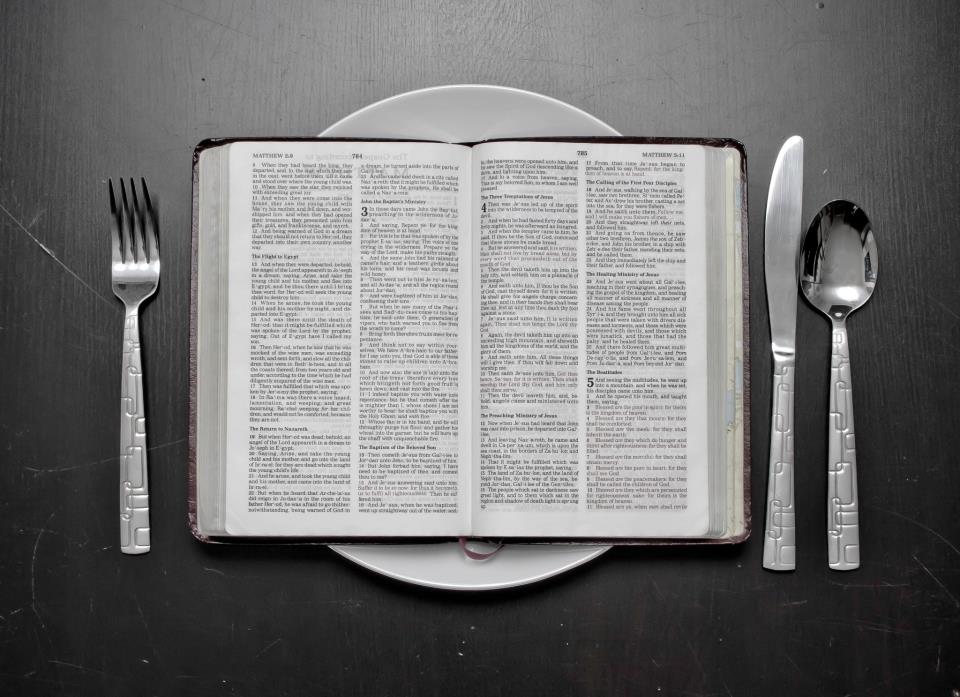
When we meditate on the words of God, they become a part of us. These words deal specifically with our souls and they’re written to transform us into people who reflect the glory of God. A daily diet of Scripture allows these holy words to enter our souls just like food enters our stomachs. It spreads through our entire system of blood and air and organs and nerves and functions. We assimilate it. And it becomes holiness and love and wisdom.

The same is true of prayer. It’s a complex act of speaking to and listening to the Creator of heaven and earth. It’s an act of submission. It’s a declaration of faith. It’s basking in the presence of our God, delighting in his love and grace, and taking comfort in his mercy and forgiveness.

Reading God’s Word and praying to the Father are not intellectual exercises. It’s not a hobby or a pastime. This is life and death. It’s urgent. It’s right now. It speaks to every facet of our everyday lives. It nourishes us. It transforms us. It gives us the Holy Spirit strength we need to live as mature disciples in a hostile world.

You are what you eat. When I look in the mirror, I can see that the Whataburgers and Oreos have become a part of me — the biggest part of me. Yesterday, we fasted and prayed together as a church family in preparation for our Missions Sunday. Fasting and praying. I was focused on the Word yesterday. I was zeroed in on prayer all day. I didn’t eat. And no Dr Pepper. But at the end of the day I was full. Satisfied. I was changed, if only a little. I assimilated a little more of God’s Word and his nature into my soul. I had grown.

Jesus made a habit of withdrawing “privately to a solitary place.” Our Lord spent much of his time in Scripture and prayer: listening to God, speaking with him, communing with him. As his followers, we too set aside a time every day for prayer and Bible reading. Thirty minutes. An hour. In the morning. During lunch. Bedtime. The time and place are not important. Making this communion with God a daily priority is very important. It’s a vital part of “attaining to the whole measure of the fullness of Christ.”

Peace,

Allan

Not a Law Book

TitleSlideWe believe that the Scriptures are the holy Word of God. Our God reveals himself to us — his name, his character, his will, his ways — in the Bible. And the Bible is the authority for God’s people. We will always stand on that; we’ll never shy away from the Scriptures as the authority for disciples of Jesus. And we believe just as strongly that how we read and interpret and apply the Scriptures is very important.

The Bible is a Story. It’s not a law book. One of our problems is that for decades — no, centuries! — we have read and studied and cited the Bible like it’s a law book. Law books are boring. This Story was inspired by God and handed down to us to capture us. To enthrall us. If it’s boring, we’re reading it wrong. One of the worst things that ever happened to the Bible was when they divided it up into chapters and verses in the 1500s. It has conditioned us to read it like a reference book instead of a novel. We consult it and study it and quote book, chapter, and verse like it’s an owner’s manual for your car or an employee handbook.

We struggle with this. We’ll read Jonah for three weeks, wondering whether a human can live inside a fish for three days and never once think about God. The Story is about God and what he’s doing, not about the whale and what he can do. Or we’ll argue about Paul’s words concerning divorce and remarriage, looking for loopholes, instead of dwelling on the covenant loyalty of our God who intends our marriages to reflect and witness to his perfect love and faithfulness. Esther is not about “you need to be more courageous.” It may as well be about “you need to be prettier, too.” The main point of Esther is that our God is at work to redeem everything and he uses every opportunity — even our moments in exile when we feel weak and powerless and trapped in circumstances beyond our control — to save us and redeem us. We are not forgotten. That’s the Bible as a Story.

Peace,

Allan

Story of God

WorshipCenter

Tomorrow at Central we start a brand new series we’re calling The Story of God. For six weeks we’re going to immerse ourselves in the Bible as a sweeping, epic story. We are moving as a church away from viewing the Bible primarily as a collection of God’s laws and commands and toward seeing the Scriptures as a narrative about our God and what he’s doing in the world. The Bible is a story. And we believe it should be read, interpreted, and applied as a story. Now, that’s not to say there aren’t any commands or laws in the Bible — there certainly are. But we believe those rules and laws are best understood by their place in the story.

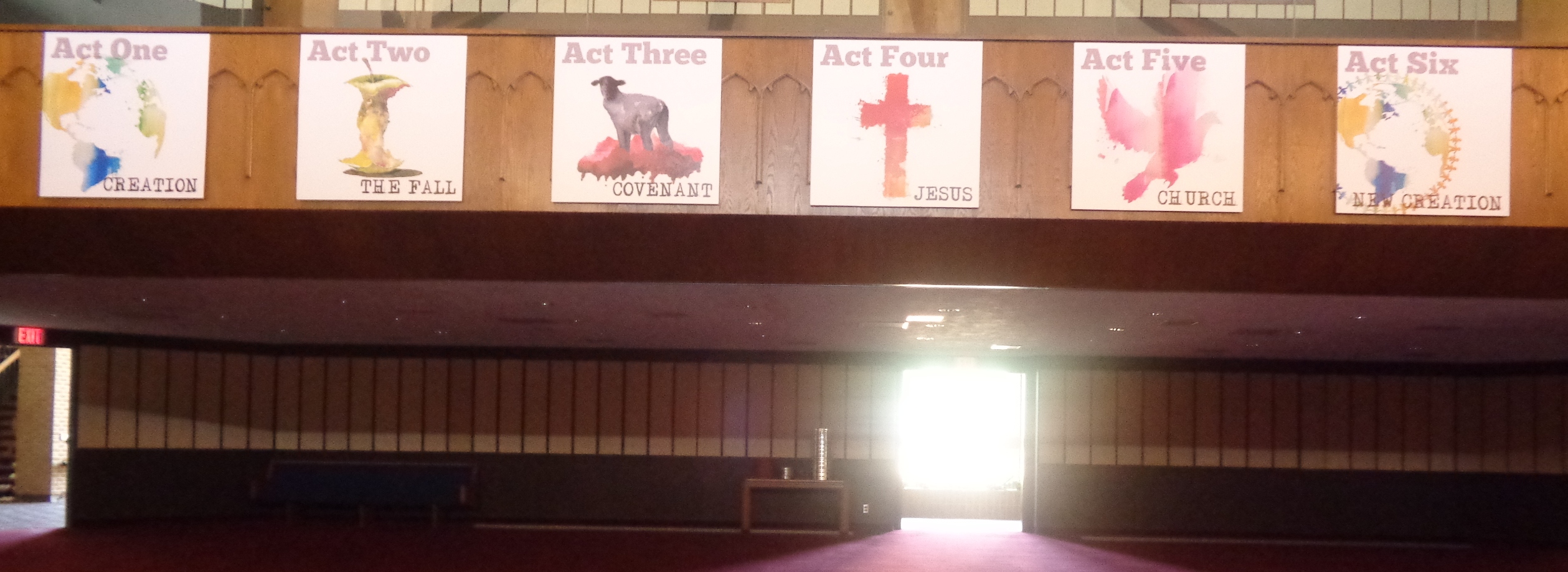
So, we’re diving in. Our Bible classes, worship assemblies, small groups, covenant groups, and daily emails will all be centered on this view of Scripture as a dramatic story in six acts.

Now, a disclaimer: making this shift is not going to suddenly give us easy answers to all our issues. We’re going to find there are fewer rules, the lines are not as black and white, it’ll lead to more questions, more reflection, more wrestling. It’s not a system. It’s more art than science. It’s like finger painting — it’s kind of messy. Most of us don’t want to live with it. I mean, finger painting is great fun with the kids and maybe we’ll keep one piece of the finger painting and hang it on the fridge. But you don’t want to finger paint every wall in your house!

What if the value or worth of seeing the Bible as a story isn’t in the questions that get answered or the issues that get settled? What if it’s just the process itself? What if the value of this is in becoming a more faithful Christian? A more faithful Christian community? What if reading and experiencing the Bible this way more frequently and more consistently moves me to surrender to God? What if it fosters a bigger faith and a bolder trust in God?

We believe it will.

Peace,

Allan

Knowledge of the Lord

“…asking God to fill you with the knowledge of his will through all spiritual wisdom and understanding.” ~Colossians 1:9

The Holy Scriptures are certainly a primary way we receive the gift of the knowledge of the Lord. We are shown through the Bible exactly what our God has done and is doing through our Lord Jesus Christ. It’s a beautiful story, a compelling drama that draws us into the action. It involves us, it inspires us, it moves us to join in. But some of us still view the Bible as something else. We see the Scriptures as a book of rules and laws that must be kept before an all-seeing and all-judging God. No, the Bible is something different. The Bible is the grand sweeping story of God and his faithful presence and activity with his people and his people’s faithful and sometimes not so faithful response. God created something beautiful and he is right now re-creating something beautiful. He’s restoring everything back to its original pre-sin condition. His will — what God is doing — this knowledge of the Lord, includes redemption for all of creation, including us.

What God is doing is a story. It’s a narrative. And this is how we’re going to explore it and experience it together at Central:

ACT 1
Genesis 1-2      Creation – Pattern of the
Kingdom

ACT 2
 Genesis 3-11      The Fall – Perished Kingdom

ACT 3
Gen. 12 – Malachi 4      Covenant – Promised Kingdom

ACT 4
Matt. 1 – John 21      Jesus – Present Kingdom

ACT 5
Acts – Rev. 20      Church – Proclaimed Kingdom

ACT 6
Revelation 21-22      New Creation – Perfected Kingdom

This more narrative view of Scripture helps us make more sense of things and brings more order to our own lives and experiences. We live today in the 5th ACT of the drama. So, more than restoring New Testament Christianity or going backwards to the times of Jesus or the days of the apostles, we’re called to move forward in the drama. We’re called to live it out, to play our roles and say our lines in ways that move the story forward toward its glorious conclusion.

Sometimes our biggest problems come when we place our lives and experiences in the wrong acts of the play. Leukemia belongs in ACT 2 of the play, not ACT 1. God did not create cancer; cancer is a result of living in a fallen world, broken by sin. Don’t let anybody tell you God gave you leukemia. The affair you’re having with that other man is not something God wants for you because your husband is a punk and God wants you to be happy. The adultery belongs in ACT 2 with sin, not in ACT 1 with the perfect things God created for us. Muslims are living today as if ACT 4 never happened; they’re still fighting the battles of ACT 3. A guy who is sleeping with his girlfriend before they are married because he’s a red-blooded American male and doesn’t really have a choice because nobody waits for marriage anymore needs to be reminded that we are living in ACT 5 of God’s story where our lives are a proclamation of the truth of Christ Jesus and his eternal Kingdom. Our lives are a testimony to the great change that was inaugurated when Jesus rose from the grave.

We need to know where we are. And we need to know what’s coming. We need to know that God is the author of the story and he has the last say. He writes the final word. And we need to see ourselves in the story and join it, live it, with everything we’ve got.

Isaiah says when the Kingdom is finally perfected, when God’s holy will has all been finally fulfilled, there will be righteousness and justice and peace because “the whole earth will be full of the knowledge of the Lord.”

Knowledge changes the whole world. And it changes us.

~~~~~~~~~~~~~~~~~~~~

After 22 years of serving the Central family as a member of the church staff, Connie Green is retiring at the end of this month. Connie started out here as a teacher with Kid University in 1993, moved on to work with our singles and membership ministries, and for the past fifteen years has served as a valuable administrative assistant and faithful ministry partner to the preacher. Since we moved here three-and-a-half years ago, Connie has kept me out of trouble and one step ahead. She makes me look good. And that’s a tough assignment: I can be impulsive and last-second.

Connie, we all feel great appreciation and admiration for your selfless service to Central. I’m so glad that you and Jay are remaining here in Amarillo and at Central. We all wish you the very best of God’s richest blessings in this next phase of your lives together.

Peace,

Allan

« Older posts Newer posts »