Category: Baptism (Page 5 of 8)

Let’s Astonish the World

What a tremendous response! What a terrific reaction to what our God revealed to us at Central this past Sunday! And, my, how it continues even now into the middle of the week! The emails and texts that began pouring in during lunchtime Sunday are still being received today in a fairly steady stream. There’s an enthusiasm over what we’ve discovered together as a church family. There’s an overwhelming resolve to jump wholeheartedly into what our God has put in front of us. There’s a continual hum, a buzz, a current of Holy Spirit energy that’s tangible in this place. It’s real. You can feel it. We’ve tapped in to something here. Maybe… God’s holy will?

Allow me to share with you in this space today the heart of the message we heard together Sunday from God’s Word. Tomorrow, my plan is to share some of the response to the message in an effort to further process what happened Sunday.

The lesson Sunday came from the last part of Jesus’ prayer in John 17, his plea for unity among all future believers. It served as the culmination of our sermon series on this powerful prayer. And it provided the theological base for our “4 Amarillo” partnership with First Baptist, First Presbyterian, and Polk Street Methodist.

My prayer, Jesus says, is that all of them may be one. May they be brought to complete unity. It’s this unity, this uncompromising love and acceptance we have for all baptized Christian believers that will prove to the world Jesus really is who he says he is and who we say he is. Our unflinching dedication to love and defend all Christians, to worship and serve with all Christians, will astonish the world.

Well, Allan, not all people who’ve been baptized, right? I mean, a lot of people are baptized in different ways than we are, and for different reasons. We can’t worship with and have fellowship with all Christians.

That’s why the church is not astonishing the world.

Christ’s prayer is for unity. Christ’s will is for complete unity among all his followers today. So, let’s go there.

If God accepts someone, I must also accept them, too, right? I can’t be a sterner judge than the perfect judge, can I? Nobody would say, “Well, I know that God accepts this woman as a full child of his, I know she’s probably saved, but she doesn’t meet all of my standards in the things she believes and the way she worships, so I’m not going to accept her.” Nobody would say that. We must fellowship everyone who has fellowship with God. We must fellowship everyone who is saved. All the saved.

So… who are the saved?

There was a time when we would say everyone who hears, believes, repents, confesses, and is baptized is saved. OK, for the sake of this discussion, let’s go with that. The next question is, “He who hears what?”

“The Gospel!”

“She who believes what?”

“The Gospel!”

“Whoever repents and confesses and is baptized by what or through what or into what?”

“The Gospel!”

Right. That means the next question is… what is the Gospel?

That Jesus Christ is the Son of the living God, that he alone is Lord, and that we are saved by faith in him. You might check out 1 Corinthians 15:1-8 or several other places in Scripture where Paul sums up the Gospel. It seems pretty clear that it’s about declaring Jesus as Lord and as the only way to the Father and submitting to his lordship in baptism and in a new way of life. We’ve never required anything else. The Church has never asked for another confession. We’ve never asked anybody their position on women’s roles or children’s worship before they’re baptized. We don’t put a teenager in the water and catalog all his views and opinions on instrumental worship before he’s saved. (Unfortunately, some of us do that about a month later.) That stuff is not Gospel. Paul says it’s nothing but Christ and him crucified.
Romans 15:7 says we are to accept one another as Christ accepted us. We are to receive others by the same standards we were received at our baptisms. You know, your acceptance by God is a gift. That fact that Christ Jesus has accepted you is pure grace. The imperative for us is to extend that same gift, to show that same grace, to all others who have received it from our Lord.

Well, what about the Christian who disagrees with me on divorce and remarriage, or on the age of the earth? What about the Christian who doesn’t see church names or the Lord’s Supper the way I do? What about our discord over steeples or shaped notes?

In Romans 14-15, the issues are eating mean versus vegetables and the observance of holy days. And Paul knows what’s right and wrong. He knows the correct answer. There is a right and wrong on these matters. But Paul says, in Christ Jesus, it doesn’t matter. You don’t believe me? Read Romans 14:1-15:7.

Now, here’s where it gets us. You ready?

Do you believe that you are perfect? Do you believe you have God’s will completely and perfectly figured out? That you are living exactly right, that you believe everything exactly right, that your worship is exactly right according to God’s plans? Do you think you know everything and do everything perfectly? No? That’s what I thought. Then what in the world saves you? What covers you in your innocent mistakes? What saves you in your accidental misunderstandings and your sincere misinterpretations? Why, it’s God’s grace, of course. His matchless grace.

Do you believe that the Churches of Christ are perfect? Do you think that the CofCs  have everything totally figured out? That we are worshiping exactly right, that our leadership structures are completely lined up with God’s intent, that we have all of God’s will entirely mapped out and expressed perfectly? No? That’s what I thought. Then what in the world saves us? What covers us in our innocent mistakes? What saves us in our accidental misunderstandings and our sincere misinterpretations? Why, God’s grace. Yes, his wonderful grace.

You think there’s any chance at all the Methodists might be doing something right according to the will of God that we’re not? You think the Presbyterians might possibly have something figured out that we don’t? What if the Baptists’ understandings of something in the Bible are richer and fuller than ours? What if another group’s practice is more in line with God’s will than ours? Is it even possible? Yes, of course. Then, what covers us in our innocent mistakes and accidental misunderstandings and sincere misinterpretations? Grace. Yeah, I know.

Now, let’s assume that we have it right on the Lord’s Supper and the Methodists have it wrong. Let’s pretend that we’re right about baptism and a plurality of elders and the Presbyterians and Baptists are wrong. Does the grace of God not cover them completely in their innocent mistakes and accidental misunderstandings and sincere misinterpretations? Are they any less saved?

But they’re wrong and we’re right!

So you get God’s grace where you lack understanding but they don’t? You get the grace of God in your misinterpretations of God’s will but they don’t? Why? Because you try harder? Because we’re more sincere? Because, somehow, we deserve it?

Whoa.

The unbelieving world looks at that and says, “No, thanks.” And I don’t blame them. A religion as visibly divided as ours does not reflect the truth. It reflects our fallen world, not the glory of our God.

Our Christian unity will have an eternal impact on our world. But the world has to see it. Our unity, which already exists as a gift from God, must be visible. It must be practiced and experienced. When it is, the world will believe.

A Methodist preacher, a Church of Christ preacher, a Baptist preacher and a Presbyterian preacher all walk in to a bar is the first line of a bad joke. The Methodist church, the Church of Christ, the Baptist and Presbyterian churches all putting aside their differences to worship and serve together for the sake of the city is a serious and everlasting testimony to the love and power of God! Our “4 Amarillo” efforts are a witness to the world that this is for real! That Christ Jesus is our King! That the world really is changing! That hearts are being melted and people are being transformed! That barriers are being destroyed and walls are coming down! That the devil has been defeated and the Kingdom of God is here!

Peace,

Allan

Five Steps to Salvation

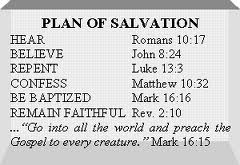
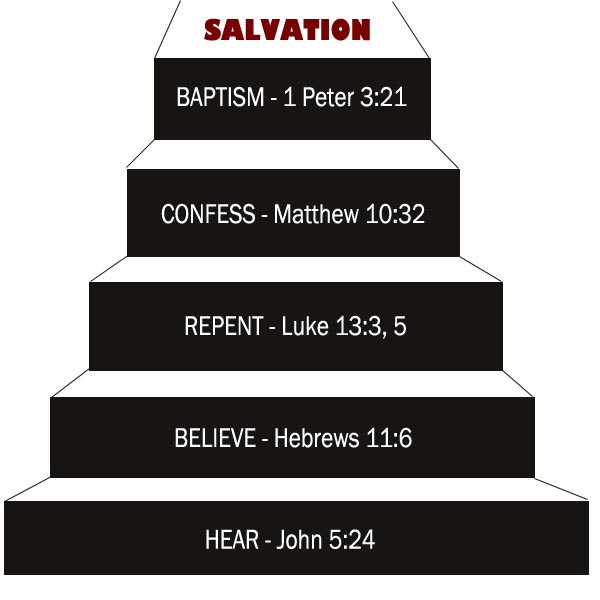
It’s just a Church of Christ thing, right? The “Plan of Salvation,” also called the “Five Steps of Salvation,” is unique to us, I think. And those of us who were raised in and by the Churches of Christ know them well: Hear, Believe, Repent, Confess, Baptism. In that order. As a kid in the ’70s, this was drilled into me by my Sunday school teachers in Bible class, by the preachers from the pulpits, by the youth ministers at the devotionals and rallies, and by the Open Bible Study my dad walked me through when I reached the “age of accountability.” The five steps were plastered on bulletin boards in the church hallways, illustrated by charts and diagrams on mimeographed handouts, and splashed across banners promoting the next Gospel meeting. These were the five steps, always accompanied by supporting verses of Scripture, that necessarily had to be followed — again, in order! — for one to be saved.

Hear. Believe. Repent. Confess. Be Baptized.

You ever wonder how that started? You ever question the validity of such a list? If you or your church were to make a list of supposed steps to salvation, what would you include? What parts of our CofC list would you leave out?

Historians point back to our movement’s focus on rational thought and enlightenment thinking that characterized the mainstream culture of America at the turn of the 19th century when Stone and Campbell and others were attempting to “restore” God’s Church. It was all about scientific reasoning and empirical evidence and deductive problem-solving. Society at this time was convinced that there were undeniable patterns, unalterable designs in nature and in the world that, if learned and applied, held the keys to everlasting peace and joy.

Alexander Campbell searched the Scriptures in this way and came up with what he called “the ancient gospel,” a pattern he believed was the divinely-ordained natural way to heaven. According to Campbell, it all boiled down to, in this order: gospel facts (death, burial, resurrection, and ascension of Christ), faith, repentance, reformation (of life), baptism, remission of sins, reception of the Holy Spirit, sanctification, resurrection of the saints, and eternal life. In that order. Campbell claimed that all Christian denominations believed in all these steps, but put them in different orders according to their own interpretations or theories of conversion.

At about the same time, Walter Scott came up with a biblical pattern and called it “the gospel restored.” He had six points originally. The first three were what humans had to do to be saved: believe, repent, and be baptized. The last three were what God promises to people who do the first three: forgiveness of sins, the gift of the Holy Spirit, and eternal life. Not too much later, Scott shortened his list to five points — one for each finger on a person’s hand, for easy remembering: faith, repentance, baptism, forgiveness of sin, and the gift of the Holy Spirit.

This method proved to be very successful on the early American frontier where most everybody had been trained in Calvinism which claimed that men and women were saved only by God’s predestination, that one couldn’t do anything to save himself, it was all up to God’s pre-ordained choosing. By telling these fiercely independent early frontier people that there really was something they could do to be saved, the Stone and Campbell churches fueled a massive rush to repentance and baptism.

As with most good things, we swung the pendulum a bit too far. Pretty soon, we were taking God’s initiative and the Holy Spirit’s active participation clear out of the conversion process. Preaching became all about proving “facts” with arguments and evidence. The Holy Spirit’s work in the past had been entered into the Biblical record and was there to be studied in a rational manner, but it wasn’t necessary for a person’s salvation. The emphasis was on logical fact-finding and step-following and persuading people to “obey the gospel.” The “gospel,” of course, being the steps.

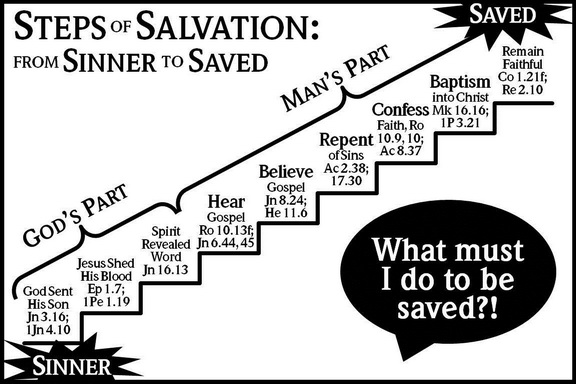
So, at some point in the middle of the 1800s, it gets boiled down to what we have today in the five steps of salvation or the plan of salvation: hear, believe, repent, confess, be baptized. Notice how God’s divine activity is completely absent from any of the steps. Notice how this chart here to the right — all of these charts were downloaded from Church of Christ websites this morning — actually gives much more responsibility or credit to man than to God for salvation. Where is God in our “plan of salvation?”

Why is baptism the last step? Who took out “sanctification,” the guiding of the Holy Spirit, and the grace of God to continually wash our sins?

It is God who works to will and to act according to his good purpose. It is God who initiates salvation, who begins the good work and sees it through to completion. Belief and repentance and confession are salvation steps to be taken every day, not once on a ladder list of human accomplishments. Baptism is never the end of what the apostle Paul calls “being saved,” it’s the beginning. Our five steps minimize our God. Our five steps neglect a lifetime of day-by-day, hour-by-hour difficult discipleship to Jesus. And they ignore the unmerited and continuous grace of our merciful Father.

OK, maybe that’s a little harsh. Too judgmental, probably, Yes, we come by the “five-steps” thing naturally. It’s been handed down to us by faithful men and women who were doing their very best with what they had to work with during the times they lived. And I’m grateful for it. Seriously. But I’m also so glad that we’ve recognized the many shortcomings in this kind of incomplete view of salvation. I’m so glad that we’re acknowledging together the active role of God’s Spirit in the calling and saving and sanctifying of the saints. And I’m glad we can change. I’m so glad, by God’s grace, we’re allowed and even compelled to change.

Peace,

Allan

Pray More and Dispute Less

Last week’s Tulsa Workshop (excellent, as always!) has put me a little behind on tracking in this space with our adult Bible classes here at Central as we study together “Renewing God’s People.” I’ll try to get caught up here before the weekend hits.

Chapter three of Doug Foster’s concise history of the Churches of Christ, Renewing God’s People, introduces us to Barton W. Stone, a co-founder of what has been called by historians the Stone-Campbell Movement or the American Restoration Movement. Stone was a college-educated Presbyterian minister who, in August 1801, participated with other Presbyterian, Baptist, and Methodist preachers in the largest and most famous camp meeting revival in American history. The success of the Cane Ridge Revival added fuel to the restoration fires of the time and influenced Stone to withdraw from the Transylvania Presbytery to begin the non-denominational Springfield Presbytery. It was an effort to promote Christian unity, to tear down the denominational walls that divide disciples of Jesus, to faithfully express the Gospel as it’s described in Ephesians 4: “There is one body and one Spirit — just as you were called to one hope when you were called — one Lord, one faith, one baptism…”

But after just a few months, it became apparent to Stone and his colleagues that their Springfield Presbytery was just another sectarian division among many. It was working against the Christian unity they so strongly desired. So they broke it up. And the document that proclaimed the dissolution of their organization became one of the two most important founding documents for Churches of Christ. The opening lines of The Last Will and Testament of the Springfield Presbytery quoted from Ephesians four and declared that they would “sink into union with the Body of Christ at large.” They renounced all denominational names of distinction; no more Baptists or Reverends, no more Presbyterians or Fathers. They called for a return to the Bible as the only authority for Christians and God’s Church, “the only sure guide to heaven.” The document affirms the autonomy of each congregation of Christian believers, liberating all churches to “adopt the law of the Spirit of life in Christ Jesus.” They claim that no governing body has the authority to decide anything for a group of churches, that “our power of making laws for the government of the church, and executing them by delegated authority, forever cease.”

Above all, Stone used the document to call for the unity of all Christian believers. “We will,” he writes, “that preachers and people cultivate a spirit of mutual forebearance; pray more and dispute less.”

Pray more and dispute less.

Sigh.

I’m convinced that one reason we in Churches of Christ got so far off track with the initial and Holy Spirit-inspired vision of Christian unity is that we so horribly distorted that Ephesians 4 passage that’s quoted in Stone’s Last Will and Testament. Consider…

I belong to a 750-member congregation in Amarillo; my parents belong to a 400-member congregation in East Texas; my friends David and Olivia belong to a twelve-member congregation that meets in their apartment in Kharkov, Ukraine; my friends Rick & Jaime Atchley belong to a 4,000-member congregation in Fort Worth; my friends Alaor and Miriam belong to a 90-member congregation in Sao Paulo, Brazil. Many, many different expressions of the one church. Those different expressions don’t diminish the truth of “one church” or “one body.”

I was baptized at eleven years old in a heated baptistry in a church building in Dallas; others are baptized as teenagers in a freezing creek at Camp Blue Haven; others are baptized at the age of 80 in crowded apartment bathtubs in Beijing; others are baptized in swimming pools. Many, many different expressions of one baptism. Those different expressions don’t diminish the truth of “one baptism.”

Most Sundays I eat a cracker crumb and sip some grape juice while sitting in a pew and call it communion. Most Sunday nights, I break off a huge chunk of bread and chug a big swig of juice around my kitchen table with our small group and call it communion. During a flu outbreak or a bird virus scare, we’ll eat little pre-broken chicklet-size pieces of cracker. Tortillas at a camp out in Colorado. Peta or flat bread in Peru. Many, many expressions of our Lord’s one meal. Those different expressions don’t diminish the truth of the one Lord’s Supper.

So, when did we start reading Ephesians 4:3-6 like this: “There is one expression of the body and one expression of the Spirit… one expression of faith, one expression of baptism?” And when did we start ripping this foundational passage completely away from its powerful context of unity? When did we start ignoring the opening lines: “Be completely humble and gentle; be patient, bearing with one another in love?”

Is our mighty God, who is One, not the God and Father of all this? Is he not over all this? And through all this? And in all this?

Yes, there is only one baptism; and God is over it, not you. Yes, there is only one Church; and God is in charge of it, not you. Yes, there really is only one faith; and our God is delighted that there are so many different expressions of that faith out there. Barton Stone called on all Christians to see the big picture of God’s eternal Kingdom, to see the beauty of divinely-ordained diversity, to experience the power of his love that destroys all the barriers that separate his children. The only way Stone believed we would ever get close to realizing it this side of glory would be to pray more and dispute less.

Peace,

Allan

Through Water to Salvation

“…this water symbolizes baptism that now saves you.” ~1 Peter 3:21

In recalling to his readers how Noah and his family were “saved through water,” the apostle Peter points us to Christian baptism that, in the same way, saves us. Peter’s clear, succint statement is astounding. For a lot of people, it’s scandalous. Peter tells us that baptism has a salvation function.

Paul draws the same conclusion as he looks back on the one foundational and identifying event for Israel: the exodus and the crossing of the Red Sea (1 Corinthians 10:1-4). He sees what happened in Exodus 14 as a baptism “into Moses” and compares it to our baptisms “into Christ” (Romans 6:3, Galatians 3:27). Paul wants us to understand our baptisms as a comparable moment of deliverance and redemption.

Baptism, just like the flood and the Red Sea crossing, is a saving event. Just as God saved Noah through cleansing the old world with water, so God saves us from our old lives through baptism. Just as God delivered Israel by using water to destroy their enemies, Pharaoh and his army, he delivers us by using water to eradicate our enemies of sin and death. Noah and Israel both pass through the waters into a new world, a new creation. Christians pass through the waters of baptism into a new world, eternal life with the Father through the death and resurrection of the Son.

It’s a divine gift. It’s a sacrament of God’s grace. It’s a salvation experience. In baptism our God redeems us, gives us a new identity, and frees us from slavery to sin and death. And it shapes who we are and how think and act as a people of God.

“We were therefore buried with him through baptism into death in order that, just as Christ was raised from the dead through the glory of the Father, we too may live a new life.” ~Romans 6:4

~~~~~~~~~~

What a marvelous joy to welcome into our home overnight Friday our great friends David and Olivia Nelson and their sons, Caleb and Seth. The Nelsons timed their furlough in the States from their missionary lives in Ukraine to coincide with the birth of Seth last month in Lubbock. David and Olivia figured one boy born in Kharkov in Hospital 17 was enough. So we were very blessed that they took a long, winding route from Lubbock to Fort Worth, through Amarillo, to spend almost 24 hours with us last weekend.

After answering several questions Friday night from servers and other customers at Blue Sky about David’s accent, we stayed up way too late passing Seth around, drinking egg nog and Dr Pepper (no kafir, David)  and playing our favorite, Phase 10. Caleb entertained us the next morning by splashing through his pancake breakfast. And then we spent a good long while with our Father in prayer, thanking him for the awesome privilege of serving him in his Kingdom together on opposite ends of his world.

The Nelsons are in Fort Worth now for another month, reconnecting with the church family at Legacy, stocking up on picante sauce and Jello-O and other stuff they can’t get in Ukraine, and being reminded of how much they are truly love and appreciated and admired by everyone who knows them.

I praise our God for the ways he works through and with David and Olivia. I thank him for our rich friendship and partnership in the Gospel. And I acknowledge gratefully that I’m a much better Christian, a more faithful follower of our King, because I know them.

Peace,

Allan

Dead on the Shore

“That day the Lord saved Israel from the hands of the Egyptians, and Israel saw the Egyptians lying dead on the shore.” ~Exodus 14:30

God’s people were trapped. This rag tag band of slaves was cornered. The sea on one side and the desert mountains on the other and the mighty power of the Egyptian army thundering over the sand ridges right toward them. They watched in horror as their violent doom descended on them. It was over. They were as good as dead and they all knew it.

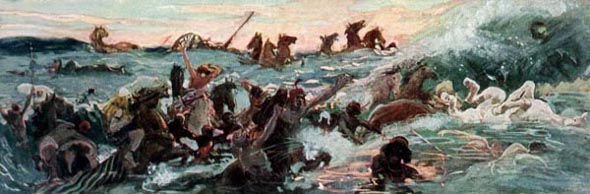
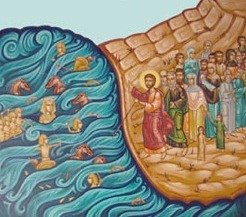
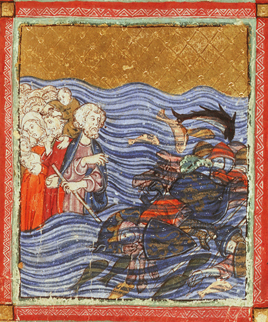
But then our God showed his power and sovereignty over nature and history by splitting the sea right down the middle so every last one of these rescued slaves could escape the enemy on dry ground. God caused the waters to spill back over the Egyptians — all their chariots, their horsemen, their archers. Scripture says “not one of them survived.”

“And Israel saw the Egyptians lying dead on the shore.”

Their enemies were powerless now to ever do them any harm. Ever. The escape was complete. The rescue was final. Their salvation was secure. They saw it. They saw their enemies dead now and strewn lifelessly about on the shore like washed-up seaweed. They saw it. And they feared the Lord and put their trust in him.

I believe God caused his people to see their dead enemies for a reason. He wanted them to see it. He wanted there to be no doubt that they were truly saved. They were totally secure. All threats had been erased. All evil against them had been eradicated. They really were free and in the faithful and loving arms of their all-powerful God. This visible and indisputable evidence gave God’s people the courage they needed to move from Egypt to Israel. God was taking them through the waters of salvation to a brand new place and they all needed to know that it was OK to press on in faith. He was taking them from one country to another. He was changing their story. They are no longer slaves; they are now the children of God. “The water flowed back,” Scripture says, cutting off thier connections to Egypt and their old way of life, their old story. They would only press ahead now, into the brand new story of freedom in YHWH, of salvation in the Lord.

As Moses and Miriam are leading the people in songs of praise to God for his mighty and final deliverance from their enemies and from their old horrible lives of slavery, it would have been impossible to imagine that within just a few weeks those same people would be begging to go back to Egypt. When things got difficult, their first instinct was to go back to Egypt. Their old lives were miserable; but they wanted to go back. Their old stories were terrible; but they longed to jump back. It was awful; but I suppose it was comfortable. Maybe. I’m not sure what made them want to return to Egypt back then. I’m not sure what makes us want to keep going back today.

Some of us are living the wrong story. We’re all on the other side of the Exodus. We’ve all crossed over from slavery to sin and death to a brand new life as God’s eternal people in complete subjection to him. In Christ, we’ve moved out of one country and into another. But some of us are determined to pass through those waters back to Egypt. Some of us are working for things and chasing dreams that the world says are important. And we’re not satisfied. We’re restless. Some of us are depressed or despondant because we don’t have the status or the security that our world says is so valuable. We’re unhappy. Some of us are living the story the world says is our story instead of the brand new story we’ve all been given by our God.

The enemies are dead on the shore! Do you see them? Our Father wants us to see those dead, lifeless, completely conquered enemies! In Christ, he has totally destroyed sin and death and Satan and all the things that might separate us from him. The pain, the past, the failure, the anxiety — all of it is helpless against our God. He’s already drowned it out in the salvation waters of our baptisms. It’s over! Whatever had so messed up our stories is gone now. In the promised Messiah, God has given us an eternal victory even more decisive than what the Israelites saw on the shore.

That’s our story. Our story is about the power of our God who acts in mercy and grace through his Son to deliver us from our enemies and bring us into a brand new life as his brand new people. Our identity is completely changed. Our values are totally different. Our story is radically transformed. Because the Kingdom we serve is not of this world. And neither is the King we worship!

May we be a people of the correct story — the story of salvation from God, not the story of fate and chance that comes from the world. And may that salvation story shape us by God’s grace into the holy people he has called us and saved us to be.

Peace,

Allan

Salvation Belongs to Our God

The Red Sea crossing in Exodus 14 is the ultimate foundational event that creates and identifies the people of God. And we always refer to it as the Exodus. But you may be interested to know that the word “exodus” never occurs one time in the actual narrative. The Hebrew words used in the book of Exodus to refer to the creation and redemption of God’s people are these:

ga’al – to protect or preserve the integrity of the family or clan

padah – to pay the purchase price to free a captive or a slave

ha’aleh – to cause to go up

hevi – to cause to bring in

hotsi – to cause to go out

As Israel is delivered from Egyptian bondage and saved through the waters of the sea, the focus of the activity is on God and what he’s doing. God is doing all of it. Israel is completely helpless and powerless to contribute one thing to the salvation process. It’s all on God. Israel’s job is to trust God, to “stand firm,” to “be still,” and to “see.” God is the one who brings them out and delivers them and saves them with his strong arm and outstretched hand.

Just as the Israelites passed through the waters of the sea, we pass through the waters of baptism into a new life in the Father through Christ Jesus. And, again, our God is the one redeeming and saving. We bring nothing to the table except our willingness to trust him and submit to him and his salvation purposes.

“Once you were not a people, but now you are the people of God.” ~1 Peter 2:10

Peace,

Allan

« Older posts Newer posts »