Author: Allan (Page 214 of 492)

Holy Spirit

Allow me to pick up where we left off yesterday and conclude this short conversation on holiness.

When you put on Christ in baptism, when you accept God’s will for your life to be holy and sanctified, everything becomes brand new. It’s panoramic. It’s all-inclusive. It’s rich and deep and it gets into every crack and crevice of your existence. It all belongs to God and he’s claiming it. You’ve got new desires, new interests, new instincts, new motivations. There’s no room for other gods, no place for selfish behavior, no time to waste in worldly pursuits. There’s only holiness. Holiness has to be pushed into the room and dominate what I do and say and think. “God did not call us to be impure, but to live a holy life.”

But, I can’t.

I find myself on a holiness roller coaster, some days great, some days awful, some weeks in tune with God and his will, some weeks or months living for my goals instead of his. I want to be holy, I want to live a pure life all the time. But, I can’t.

I know. Neither can I.

Which makes 1 Thessalonians 4:8 sound scary: “He who rejects this instruction does not reject man, but God.”

But, I can’t.

I know. Neither can I.

Which makes the rest of the verse a word of divine grace: “…God, who gives you his Holy Spirit.”

Being holy is powered by God’s Spirit. It’s the Holy Spirit living inside each one of us that works in us to make us holy. The Spirit is given to us to root out the sin in our lives and lead us in this process of sanctification. Yes, we’re called to be holy; but, praise God, we’re also equipped to be holy! It IS possible, only by the power of the Holy Spirit, to live in holiness. God is the one who makes it happen — not you, not me. God does it through his Son and by the power of his Spirit living in us.

God doesn’t merely provide the holy standard we’re to live by based on his character and holiness. He also provides us with the power and the resources to live that way.

I am the LORD who makes you holy! ~Exodus 31
I am the LORD who makes you holy! ~Leviticus 20
God in Christ makes us holy – Hebrews 2
Christ Jesus is our holiness – 1 Corinthians 1
We’re made holy through Jesus – Hebrews 10

The Christian life is not about working to become something you’re not; it’s about being what you already are. God’s Spirit is in us, working to sanctify us, working to make us holy — if we’ll just stop fighting it.

Paul doesn’t tell the Thessalonians to start loving each other and acting right. They already are. He acknowledges how well they’re doing in their walk with Christ. He just encourages them to do more. Take it further. Be so completely wrapped up in God’s claim on your life. Be so totally dependent on Jesus Christ for your salvation. Be so thoroughly led by the Spirit inside you to holiness and sanctification. Ride it, don’t fight it. It’s God’s will, let him do it.

It is God’s will that you should be sanctified. It’s what he wants to do. Let him do it.

“God did not call us to be impure, but to live a holy life.”

Peace,

Allan

Holy Life

“God did not call us to be impure, but to live a holy life.” ~1 Thessalonians 4:7

Can we take Paul’s instructions regarding our sexuality and sexual expressions and apply them to every part of our lives? The way you handle your money? The way you deal with jobs and career? How you treat your parents? What you do when nobody’s watching? Paul is telling the Christians in Thessalonica to think about their sexual conduct, not as a separate part of their lives, but within the larger framework of their walk with Christ.

Everything you do, everything you say, everything you think, from the moment you wake up until the minute you go to sleep — God claims all of it! His will is that all of it be holy. We don’t belong to ourselves. Every second, every square inch — we belong to the Holy Creator of the Universe. We need to change the way we look at things. It’s bigger than we think.

Christianity is not, “Hey, God does exist and he makes some demands on me through Jesus.” The Gospel is not a systematic approach to ethics, it’s not a rational understanding of morality. Jesus does not bring a new teaching or a new ethic or a new set of morals. He brings a brand new reality!

If anyone is in Christ: New Creation! Everything’s new. All of creation is brand new. Everything looks new. Everything’s re-interpreted. Jesus is not an add-on to the story; he IS the story! Jesus is not the missing piece to the puzzle; he IS the puzzle and the box it came in! And the card table and chairs and bag of chips and whatever else is in the room! That’s our reality. Our conduct is attached to how we see the world. We act according to our understanding of reality.

Think about what happened to your conduct the day you learned you were pregnant with your first child. Everything you know as reality shifted dramatically. And your priorities change. You spend money differently. You start saving money differently. The things you look at in the store are different. You’re checking consumer reports on baby strollers and car seats. There’s a baby coming! You’re painting your study or your workout room in warm pastels because you want the baby to feel welcomed. You’re buying little things to stick in the plugs and latches for the kitchen cabinets because you want the baby to be safe. Your wife starts eating differently and you can’t find Dr Pepper in the house anymore. The things you talk about and think about are different. Everything’s a little more serious. Your outlook on life becomes a little more big picture.

Why?

Most of this stuff had never occurred to you before. But now you’ve got a brand new reality. New creation. You’re seeing things you’ve never seen before. And your behavior changes to reflect it.

When you put on Christ Jesus in baptism, when you accept God’s will for your life to be holy and sanctified and like his, everything’s new. It’s panoramic. It’s all inclusive. It’s rich and deep and it gets into every crack and crevice of your existence. It all belongs to God and he’s claiming it. New desires, new interests, new instincts, new motivations. There’s no place for selfish behavior. There’s no time to waste in worldly pursuits. There’s only holiness.

God’s claim on my life in Jesus has to be pushed into the room and dominate everything I do and say and think about. It has to. It must be at the very core of my being and the very reason for everything I do.

Peace,

Allan

Holy Sex

“It is God’s will that you should be sanctified: that you should avoid sexual immorality; that each of you should learn to control his own body in a way that is holy and honorable, not in passionate lust like the heathen, who do not know God; and that in this matter no one should wrong his brother or take advantage of him. The Lord will punish men for all such sins, as we have already told you and warned you. For God did not call us to be impure, but to live a holy life.” ~1 Thessalonians 4:3-7

Of the many ways that holiness or sanctification impacts us, Paul focuses on sex. Why? In this particular context, with this specific group of Christians, as far as the apostle is concerned, this is the definition of holiness: Avoid sexual immorality. Why?

Think with me about this first century Hellenistic society in Thessalonica. There’s no real connection between religion and morality. The culture was such that as long as you provided for your wife and you didn’t abuse her physically, it didn’t really matter who you had sex with. No big deal. In this culture, as long as nobody got hurt, anything goes — wherever, whenever, whoever. Culturally, socially, mistresses, concubines, even religiously. Consider what was happening down the street at First Aphrodite Church: Naked priestesses and temple prostitutes — pagan worship rituals were based on and drenched in sex.

Now these brand new Christians are meeting in Jason’s house in Thessalonica for songs and prayers, words of encouragement and a meal. And these new converts to Christ have no understanding of a right or wrong way to behave sexually. This was the main issue for Christians back then.

And it’s the main issue for Christians in the United States today.

We live in a completely sexualized culture. I don’t have to tell you, I don’t have to point it out. It’s everywhere. And don’t think for a minute it’s not a problem in your church. In this country, three out of every four 4-year-olds has his or her own iPad or some kind of device with a search engine. We’re throwing our youngest into the line of fire and calling it good. In middle school, what they’re nonchalantly sharing with each other on Instagram and Snapchat is disturbing. The clothes we let our daughters wear — it’s a problem.

If the statistics are even close — recent surveys of church-going Christians in the U.S. — 77% of the men in your church are looking at pornography at least once a month. Thirty-five percent of the married men in your church have had an extra-marital sexual affair. Christians! Us! I’m not telling you this to point fingers, I’m telling you this so maybe we can get a better grip on the scope of the problem. We live in a hook-up culture where cohabitation before marriage and casual sex outside marriage are normal and we’re carrying easy and ready access to pornography in our pockets. That’s a problem.

How we behave sexually has everything to do with our Christianity. The two are very much connected. Paul shows us that “holy and honorable” are the opposite of “passionate lust.” He points out that “passionate lust” is self-centered and concerned only with my needs and my desires. “Holy and honorable” is concerned with what’s best for others.

Look at the contrast. The heathen don’t know God and they’re sexually immoral. They don’t control their bodies. If you do know God, you don’t act that way.

We know God. And that obligates us to honor him. With all of ourselves. With our bodies.

God’s will for us — to be holy, to be sanctified — is to enjoy sex only within the confines of holy marriage. Anything else — anyone else, anywhere else, anywhen else — is driven by passionate lust and self-seeking desires and it’s not holy.

But, look, my girlfriend and I are having sex. We’re going to get married in a couple of years but, yeah, we’re having sex right now. I have to have sex. We can’t wait that long. I’m a 21-year-old red-blooded American male. What am I supposed to do? If we don’t have sex, I’ll be forced to use pornography to relieve the situation. We either have sex before marriage or I have to go to porn. I’ve got to do one of the two. I don’t have a choice.

Yes, you do have a choice! In the name of Jesus and by the power of his Holy Spirit, you have lots of choices! How about abstaining? How about bringing your personal urges and personal desires into subjection to the lordship of Jesus? How about you and your girlfriend declaring together that Jesus is Lord over your sexuality, over every square inch of your bodies that he created and saved for his holy purposes?

We don’t talk about sex anymore in church because our culture tells us it’s nobody’s business. Sex is personal and private. No! Wrong answer! Sex is not personal or private! Every single sexual thing you do impacts our families, impacts our community, impacts our relationships with God, and impacts his Church. Holy sexual conduct honors and glorifies God and our relationships with each other and our community and our families and the Church. Unholy sexual conduct dishonors all that. It wrongs our brothers and sisters and takes advantage of other people.

God did not call you and save you and come to live inside you so you could live an impure life. We are redeemed and called by our loving Creator to be holy.

Peace,

Allan

Preaching with Tucker

A text this morning from a friend wondered if I had developed some carpel tunnel issues. Yes, it’s been a while since I wrote in this space. No, it has nothing to do with the health of my fingers. I have been out of town three of the past four weeks — in Malibu for the Pepperdine Lectures, on a sabbatical in a nice apartment near the bottom of Ceta Canyon, and in Austin for the annual Sermon Seminar at Austin Grad. I even mixed in a weekend trip to Edmond for my nephew Asa’s high school graduation. So, I appreciate the concern for my physical well-being. Thank you. Consider me back in the groove.

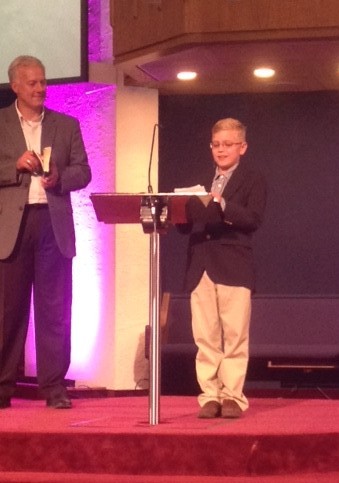
Yesterday marked our summer kickoff here at Central when all our 5th graders are officially promoted into the student ministry. The day is highlighted by the gifting of Bibles and blessings, lunch and a slide show, swimming and bowling, and an all-in youth meeting. But, for me, the best part of my Sunday was preaching with Tucker Haynes.


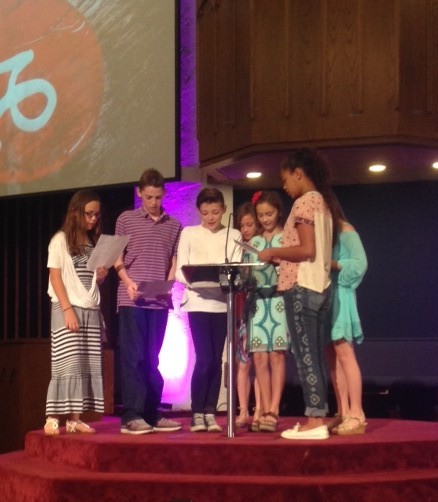
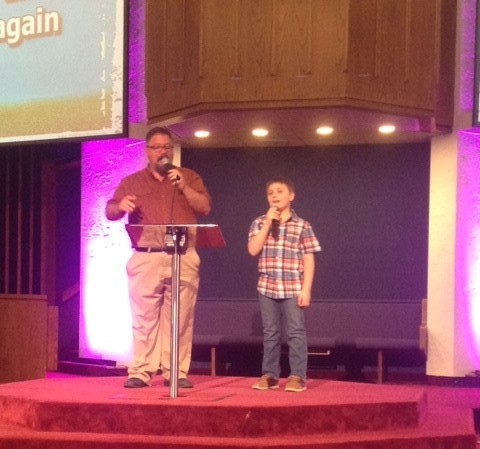
We’re a multi-generational church at Central and we are continuously on the lookout for creative ways to experience intergenerational relationships. We want to model and practice church as family. Christian community. Doing life together in Christ. So Sunday we had all of our incoming 6th graders participating in the leading of our worship assembly. Noah Hartman helped Kevin lead our singing. Several of the students read Scripture. And Tucker helped me preach.

The text was 1 Thessalonians 4:9-12: “Now about brotherly love…” Tucker worked especially hard the past two weeks on the Greek word for brotherly love, philadelphia, and what exactly Paul means when he tells the Christians in Thessalonica that God has already taught them how to love. And he nailed it! He and I went back and forth — me, trying to remember my memorized manuscript while Tucker read his expertly crafted lines. Tucker had the whole congregation eating out of his hand when he confessed frankly that “brothers and sisters can be annoying.” Then he pulled the rug out from under us with his observation that “We don’t get to pick our brothers and sisters; they are a gift from God.”

Oh, yeah. Central ate him up with a spoon. He was excellent!

I really enjoyed my time with Tucker on Friday, finalizing together everything we were going to do.  I asked him questions about the text and about his relationships with his older brother and sisters.  I listened while he wrestled with using a personal illustration to both connect with the listeners and explain the text. We did a mic check together in the worship center early Sunday morning and prayed together in my office fifteen minutes before the assembly began — he was distracted by the 2011 World Series program on my table and couldn’t hardly pray for lamenting the Cardinals and Nelson Cruz.

Tucker, you were terrific, brother. I’m so blessed by God that you and I are adelphus. And I’d be honored to preach with you any day.

Peace,

Allan


Able to Teach

This “quality” for a church elder is found in the list in 1 Timothy 3 right after the words “respectable, hospitable” and before the words “not given to drunkenness, not violent.” Because we’re Campbellites and we’re conditioned wrongly to read the Scriptures like the constitution or a list of laws, we’ve sometimes taken this short phrase and disqualified a candidate for elder because he doesn’t teach a Bible class or he’s not a polished speaker.

Well, I’d rather SEE a sermon than HEAR one any day. Yes? What’s the deal with teaching? How necessary is it?

We get a fuller description of what Paul’s talking about when we look at his list of elder qualities in Titus.

“He must hold firmly to the trustworthy message as it has been taught, so that he can encourage others by sound doctrine and refute those who oppose it.” ~Titus 1:9

The idea in Scripture isn’t so much the ability to teach a Sunday School class as it is the ability to pass the truth of the Gospel on to members of the flock. You know, you can teach a Bible class and still not have a good grasp of the Gospel. I’ve been in classes like that and you have, too. An elder needs to know and pass on that we are saved by faith in Christ Jesus, not be any good works of our own. That’s the Gospel. Sound doctrine. The truth.

Elders must uphold that truth, they must defend that truth, they must rebuke those who oppose that truth in order to keep the whole church in that truth.

And when Paul writes “truthful message” or “sound doctrine,” he’s not talking about how to organize a congregation or how to conduct a proper worship service. He’s talking about salvation from God in Christ. In Titus, he’s specifically correcting the errors of the circumcision group and the “sound doctrine” he uses to refute that group and to encourage the others is — are you ready? — more faith, more sacrifice, more reliance on the Spirit, more love. He’s talking to them about expressing more fully the truth of Jesus.

The classroom is just one way, but there are many ways to teach and model and pass on the truth of the Gospel.

I would hate for us to read the Bible passages on church leadership through a legal lens that bogs us down on two or three points and distracts us from the heart of a shepherd that’s actually being described. My recommendation would be to put more focus on words like “respectable,” “hospitable,” “gentle,” “not overbearing,” “not conceited,” “not quarrelsome.” Those words describe our Lord. Those words are characteristic of a Christ-like leader.

Peace,

Allan

Husband of One Wife

For a church elder, WHO he is is much more important than WHAT he is. We respond to our shepherds because of their great Christian character, not because their names are on the back of the bulletin or because they lead the prayers at the end. The New Testament never instructs God’s people to follow a leader because he holds an office or a title. It has everything to do with his character and his life.

That’s what we have in those two lists in 1 Timothy 3 and Titus 1. These are the marks of Christian maturity. These are the distinguishing traits of someone who has grown in Christ and experienced the life-changing power of the Lord. Their character, their consistency, is above reproach. Not perfect — that’s not what this means. If elders had to be perfect, we wouldn’t have any elders. Blameless, above reproach, means that nobody can legitimately accuse them of any conduct which is not fitting a mature disciple of Christ. It means these qualities should exist in a man’s life to such a degree that they should stand out as the kind of man he really is. It’s clear. He’s a model of Christian maturity.

Now, we have a tendency to view these lists as narrow, legalistic qualifications. We use these lists sometimes like a grid, holding it up to each elder candidate to see if he fits, to see if he checks all the boxes. Even then, we’re generally more concerned with two or three of the character traits than we are the others. And I want to specifically address two of these today and tomorrow and attempt to put them in their proper perspectives.

“Husband of one wife.” You find this exact same phrase in both of the lists, both times immediately after the general descriptive term “blameless” and “above reproach.”

The original Greek text in both lists is mias gunaikos aner. Literally translated it’s “of one woman/wife, man/husband.” Yeah, this is weird for us English speakers because gunaikos can mean woman or wife, depending on the context, and aner can mean either man or husband, again, depending on the context. It’s like the German herr can mean man or husband or sir or lord, depending on the situation. Frau can mean wife or woman, depending on when and where and about whom it’s being said. You’re not sure until you understand the context. The only thing I can point to in English that might be close is when we pronounce somebody “man and wife” at a wedding; you know that “man” means “husband” because we’re at a wedding.

For me, “husband of one wife” is the best English translation. But it’s just as possible and just as correct to translate it “man of one woman” or “man with one woman” or “a one-woman man” or just “faithful to his wife.”

See, the verb is present tense. It matches the present tense verbs in both of the passages. They’re all present tense. He is currently right now the man of one woman. He is presently faithful to his wife. The emphasis is on the man’s character, not his marital history. Maybe he’s had a previous divorce. Maybe he’s got sin in his marital past. The concern in these passages is what’s going on with him right now? Is he loyal? Is he sexually pure? Is he faithful to his wife in all things? Is there any indication he might not be faithful to his present wife?

That’s the way many English translations render this:

NIV – “faithful to his wife”
ESV – “husband of one wife” and a footnote: or “man of one woman”
NIRV – “faithful to his wife”
CEV – “faithful in marriage”
NLT – “faithful to his wife”
MSG – “committed to his wife”

For the Central church, this is our understanding and this is how we apply it: is he currently faithful to his present wife? This fits with the Scriptures and with the function of an elder much better. And it fits much more faithfully to the grace and forgiveness of the Gospel of Jesus than saying any divorce, no matter how long ago and no matter the reason, disqualifies a man from being considered as an elder. Divorce is not an unforgiveable sin — it never has been — no more than if a man at one point in his past had an issue with violence or greed. It doesn’t disqualify him from being an elder today.

Now, this doesn’t mean that the circumstances of a man’s past divorce are irrelevant. If he sinned in his marriage, he might fail some other qualities like blameless, loves what is good, self-controlled, holy, disciplined. Maybe. It needs to be vetted. Is the divorce a past sin that’s been confessed, repented of, and forgiven? Are those sins evident in the man’s life today or is he known as living proof of the Holy Spirit’s transforming power? Is his life an evidence and an example of faithfulness, of a heart saved and changed by God in Christ? Those are the concerns.

Marital faithfulness is a virtue. It has little to do with going through a divorce a long time ago. It has nothing to do with being married twice due to divorce or death. Those things do not reflect on the current Christian character of a candidate.

Peace,

Allan

« Older posts Newer posts »