Month: October 2009 (Page 1 of 3)

The Gift of Life

“I give them eternal life, and they shall never perish.” ~John 10:27

“I have come that they may have life, and have it to the full.” ~John 10:10

 “For you granted him authority over all people that he might give eternal life.” ~John 17:2

Gift of LifeEternal life comes from Christ Jesus. It’s a gift that’s represented in every facet of Jesus’ obedient revelation of the Father. Salvation is introduced in his birth, his ministry and teachings pave the way for it, and his death and resurrection ensures our participation in it.

Jesus’ gift of eternal life isn’t just a model or a standard of ethics and morals for us to follow. And it’s not just memorizing and/or practicing his teachings. Joining eternal life in Christ is becoming involved in him and his Body. It’s a close connection. It’s a deeply personal relationship.

We are not just people who follow Jesus. We are swept up and integrated into God’s mighty work of reconciling the world and redeeming creation. Salvation doesn’t just satisfy a legal requirement. Salvation frees us to participate in the eternal life of God.

It’s more than just a moment in time. It’s more than his crucifixion. It’s more than your baptism. Much more. It’s bigger and deeper. It’s infinitely more about our nature and character in relationship with God than it is about our legal standing. What Christ has done is abolish all the obstacles and empower us to be God’s children and live eternal life with him in abundance.

It’s a gift.

Thanks be to God for his indescribable gift!

Peace,

Allan

In The Spirit On The Lord's Day

Worshiping God together on Sundays is the single most important thing that happens in the world.

Casting our crowns at his feet

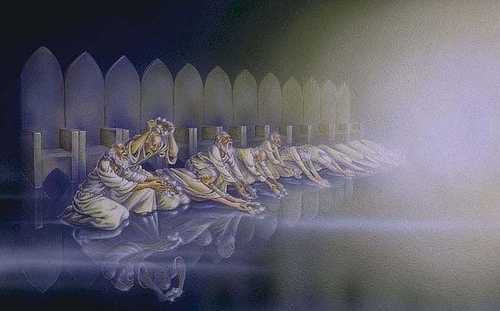
Revelation 4-5 give us a heavenly vision of the eternal worship of our God, first as Creator, second as Redeemer. The vision from Christ, relayed to us by the Holy Spirit through the apostle John, paints the worship of God as proof of his sovereignty. It’s the picture of his complete power and authority. And it shows us clearly that he is God. And we are not.

Every animal. Every human. Every angel. All of creation is represented here in the throne room of God. And they’re all worshiping. They’re all present. They’re all in the presence of God. And they’re all engaged in giving praise and glory to God.

It’s us. It’s all of us. We’re all together, joining with the saints of all time, when we gather to worship on the Lord’s Day. We bow down and we get off our thrones. We jump down off our high horses and we take off our crowns of accomplishment and status and wealth and power and position and authority and we fall on our faces before the only one worthy of our praise.

When the creature worships the Creator, it’s more important than anything that ever happens in Austin or Washington D.C. The eternal worship of God is bigger than anything that ever goes on in London or Paris or Tokyo or Baghdad. What happens on Sundays is that the creation order is restored and the order of redemption is proclaimed. Worshiping God is the culmination of every thing we were intended to do and to be. Worship restores the original Garden of Eden order of creation. It’s what we were made for and meant for. It’s what we’re being restored for. It’s why we’re being saved.

We were made to be caught up, not in our selves or our preferences or our comforts or our likes and dislikes. We were created to be caught up in love and wonder and praise of the Almighty.

Peace,

Allan

Last Call

We’ll wrap up our True Vision = Right Conduct discussion today by throwing out another couple of ideas for ways our churches can present a better picture of the realities of the eternal Kingdom of God.

True VisionWe’ve said this week that until we learn to see the world in the reality of the cross, see how the love of God and the sacrifice of Christ and the promises we have in that salvation act impact all of reality, our character won’t change and neither will our actions. There needs to be a mindset developed in our congregations that everything we do or say is directly controlled by our God. Our actions are always determined beforehand by what God has done for us, is doing for us currently, and has promised to do for us tomorrow. It all has to be connected.

We’ve talked about service and the spiritual disciplines. We’ve discussed prayer and the reading of Scripture. I appreciate your comments and suggestions. And I’m looking for more. Allow me to prime the pump with another couple of recommendations.

What’s wrong with incorporating some of the Liturgical Year into what we do as a church family? I’m not sure we could find book-chapter-verse that would sanction this (like we have for every thing else we do in worship) or if the very first church practiced it. But what’s wrong with following the life of Christ through the Lectionary readings and events over the course of a church year? We change our worship schedules according to the Super Bowl and Thanksgiving holidays, things celebrated by everyone in this country. Why not arrange our lives around things Christians celebrate as children of God? It would give a much needed sense of structure — Christian structure — to our hectic lives and serve as a weekly reminder of how our time and talents are gifts from God and should be used with him in mind. I’m thinking it would be really great to do this as a church family every five years.

I also love the idea of worshiping as a church family in public places and serving the community while we worship. Why not plan a big cookout and worship assembly at a city park or a public recreation center three or four times a year? Maybe on a holiday weekend or a beautiful spring evening. The whole congregation. Invite everybody already there at the park to join you for dinner. Feed everybody in the place. Meet people. Meet needs. And worship. Sing. Pray. Read Scripture. Proclaim the Gospel. Out loud. Together as a Church. The Church. What a huge statement to your community that being together and worshiping God is the most important thing you can do. It’s the most appropriate way to celebrate Labor Day or New Year’s Eve. Won’t that be the same statement your church takes away from the event? I think public worship would help shape our vision of our devotion to God and to each other steering our actions in the world, not the other way around.

I love the concept some churches have adopted of putting the baptistry outside. I’m reading of more churches that have put their baptistry outside in the parking lot, next to the main road, when they’ve built new buildings. The entire church family proceeds outdoors for baptisms where they stand and sing and pray and witness and participate together in a new birth in Christ. What a testimony to the whole community! We try to use the church marquee here at Legacy for welcoming new members into our family. Instead of just cute bumper sticker sayings, how about something like, “Welcome Mike & Pat Fry to the Legacy Church of Christ! See how God is blessing us!” Or maybe, “Congratulations to Trevor Podsednik, baptized into Christ on Sunday! Praise God from whom salvation flows!” Something like that tells the community—and reminds us—that we’re growing, we’re serious about what we’re doing, and that it’s God who gives the increase.

Our society, this culture in which we live, is not a good thing. It’s not even a neutral thing. Our churches should be taught to realize that almost everything about the way this country operates is designed to pull us away from our God and from one another. It works to make us less Christian, not more. It’s time we let go of the culture. It’s time we recognize God’s Church as counter-cultural, an eschatological community of faith, the boot camp that gets us ready for eternity with the Father.

That’s the vision that shapes the attitude that informs the actions.

What else?

~~~~~~~~~~~~~~~~~~~~~~~~~~~~~~~~~~~~~~~~~~~~~~~~~~~~~~~~~~~~~~~~~~~~~~~~~~~~~~~~~~~~

Out of Service from 8p Friday thru 8a SaturdayPlease be patient with the blog this weekend. Our server is being moved — actually, physically, being moved, I think — and will impact a couple of our blogs here at Legacy and our Legacy church website. We’re going to be down and unavailable, I’m told, from 8p Friday through about 8a Saturday. Sorry.

Go Angels. Go Falcons.

Peace,

Allan

Let's Get Specific Now

What can the church do?Thank you so much for your kind and thoughtful comments the past couple of days regarding this discussion of a church’s vision — or the vision a church may project — and its relation to how the members of that church act on a day-to-day basis. If Stanley Hauerwas is right in that the moral life is as much a matter of vision as a matter of doing; if one acts in the world according to how one sees the world; if our actions are informed and shaped by our attitudes and outlooks; then what can the church do about tweaking — or in some cases, maybe, completely overhauling — the vision?

What specifically can the Church, or a local congregation, do to help Christians see their faith and their citizenship in the Kingdom as a completely different world, a totally different time and space, that determines how we act in this world, in this time and space? Our actions need to be determined beforehand by what God has done for us, what he’s doing for us currently, and has promised to do for us tomorrow. It all has to be connected.

What can the Church do?

I’ll start this part of the discussion by suggesting a return to the spiritual disciplines. To me, it seems like the logical first step.

Corporate fasting would remind us that our devotion to God informs not only where we eat, but what we eat, and when. I’m in control of my growling appetites, not the world and not the culture and not my co-workers or neighbors. Fasting sharpens our spiritual focus. And it teaches us that we don’t have to conform to what’s happening around us. Nobody’s making us do anything.

Daily reading of the Scriptures fills our hearts and minds with faith language, faith images, and faith ideas. It’s a constant reminder that we live according to the big picture of what God is doing for us through Christ and that our work and play and activities of living on this temporary planet are small in comparison. It reminds us that Christ is Lord, not Caeser; that we’re citizens of heaven, not the Empire. It will shape our vision to pay more attention to heavenly things than earthly things.

Constant prayer keeps us in continual communication with the Father, which also fosters these same ways of looking at things.

I would recommend the church teaching the spiritual disciplines from the pulpit and in Bible classes. Frank discussions and direction regarding prayer and fasting, study and service, and confession and submission will energize a group of Christians. The reality that all of life is informed by our status as children of Almighty God will quickly set in. I would suggest the church develop curiculum for use in the home; fasting with a small group, praying with the family, studying with the kids, meditating with the spouse. Maybe just ten or fifteen minutes a day within each family, with small group discussions about the previous week on Sunday nights, is all it would take. A church family then sees itself as doing things the rest of the world doesn’t do. They experience being separate from the world and bound to each other in Jesus. And they’re much more able, even more willing, to let go of the society which has such a hold on us and embrace the eternal realities of God in Christ.

What else?

Peace,

Allan

Vision & Conduct

(Part Two of at least three or four……)

True VisionIf, as stated here yesterday, true vision fosters or leads to or results in right conduct, then we need to evaluate the vision. We need to be certain the vision is true. I believe the vision in our churches, the vision presented by our elders and preachers, needs to be tweaked. Or, in some cases, probably overhauled.

It seems that the vision a lot of churches create for Christians is one of looking inward to the here and now, all but ignoring the future there and then. A concentration on the Bible as a pattern or blueprint for how things are to be done instead of as a collection of inspired pictures to communicate to us what happens when one encounters the living God keeps us focused on the rules. And those rules are more and more about what we do in our Sunday assemblies and less about what we do with the other six days of the week. Ironically, the Bible has much to say about daily living in the world and very little to say about organized corporate worship. The whole of Scripture supports those priorities. But , instead, we seem to care more about what happens during our one hour of worship time on Sunday mornings than we care about how we act at work, at the park, or in line at the bank.

We’ve allowed the Sunday morning assembly to define our Christianity. We judge faithfulness based on how many assemblies one attends each year. The phrase “She’s a faithful member…” means she’s there every time the doors are open. Nothing more, nothing less. We rate churches on the “doctrinally sound” scale based on what and how they do that Sunday morning time.

When we see the Church as Sunday morning only and we see our lives as Christians centered on being there those Sunday mornings, Church and the Christian life becomes just another compartment in our world. Just as what I do in church has nothing to do with whether I make a sale at work or not, what I do at the office has nothing to do anymore with my walk with Christ. It’s all separate. Neither necessarily informs the other. And neither is necessarily more important than the other. People at work don’t care whether I go to church or not, just as long as I perform my job effectively. And, increasingly, people at church don’t really care anymore about what I do at work or play, as long as I’m there and worshiping correctly on Sunday mornings. It’s completely secularized.

Church and Christianity seem to be just another part of our world when it truly is a completely different world altogether that informs how we live in this world. And until we can learn to see our world in the reality of the cross, see how the love of God and the sacrifice of Christ and the promises we have in that salvation act impact all of reality, our character won’t change and neither will our actions.

There needs to be a mindset developed in the Church that everything we do and say and think is directly controlled by our God. Our actions are determined beforehand by what God has done for us, is doing for us currently, and has promised to do for us tomorrow. It all has to be connected. There cannot be a thought that what one does at work has very little to do with one’s claim to be a follower of Christ. It has everything to do with it!

But where do we start? What do we do? How do we tweak or overhaul the vision?

Peace,

Allan

True Vision = Right Conduct

(This is at least a three or four-parter. Hang with me on this for a few days.)

True VisionStanley Hauerwas says the moral life is as much a matter of vision as a matter of doing. One acts in the world according to how one sees the world. Our actions are informed by our attitudes, our values, and our dispositions. Those things are shaped and formed first and those, in turn, determine what we do and say in given situations. But it’s our vision, our way of looking at the reality around us, which initially informs our character.

So if the Church is charged, in large part, with shaping Christians and preparing them to lead a moral life in the struggles against the things that separate us from God, how are we doing? Are we concentrating on building Godly values and attitudes, which lead to proper conduct, by presenting the proper vision?

I’m afraid my experience tells me that the Church wants to do what is right and good, but it’s not as informed or motivated by a radical big-picture view of reality as it is by making sure things are done “decently and in order” and in accordance with the recognized norms of society. In the 1960s, Will Herberg wrote and lectured about the disconnect between what we do and what we confess. He suggested that, unfortunately, one doesn’t necessarily influence the other.

According to Herberg, our religion is so thoroughly secularist that “the familiar distinction between religion and secularism appears to be losing much of its meaning.” We all uphold and cherish certain basic values and organize our moral activities based on those common assumptions. Pagan and Christian alike, believer and non-believer, adhere to similar moral standards, not based on the Father and Son, but on what our culture deems acceptable.

James Davidson Hunter says:

Vast numbers of Christians today live in real cognitive dissonance respecting their claims to being religious and the conduct of their lives.  They retain a vague notion of religious identity but their lives are distinctly secular, with the experience of God in worship and prayer not figuring very prominently in all that they do. Increasingly these nominal Christians embrace the heady hedonism and narcissism of popular culture and do not see that this contradicts biblical faith. Middle-class suburbia is teeming with such persons.

It’s true.

Where has the Church failed? What can we do better?

If true vision fosters and leads to and results in right conduct, maybe we need to evaluate the vision. Or the presentation of the vision.

What can we do better?

Peace,

Allan

« Older posts