Month: May 2009 (Page 1 of 4)

Being Church At Home

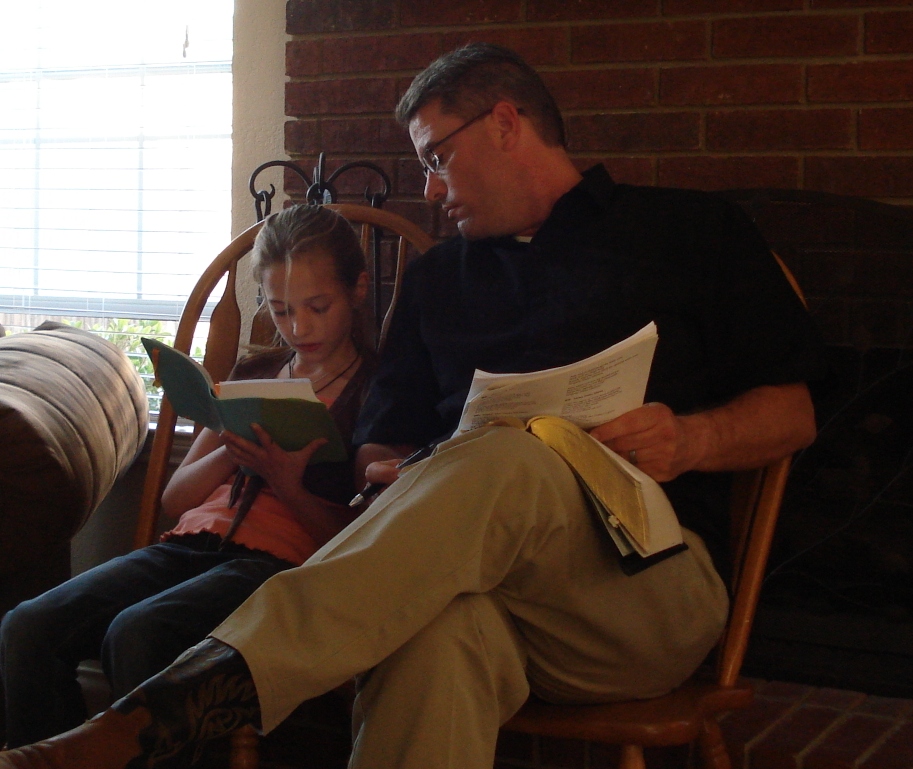
Being Church at HomePray with your kid today. Read the Bible with your child today. Don’t go to bed tonight without talking to your children about our gracious Father and his redemption plans for his people. And stop saying “go to church.” We don’t go to church. We ARE the Church. And we have to show our children that in our homes.

According to Search Institute and the results of a national survey of over 11,000 young people from 561 Christian congregations:

~ 12% of youth have a regular dialog with their mother on faith and life issues.

~ 5% of youth have a regular dialog with their father on faith and life issues.

~ 9% of youth have experienced regular reading of the Bible and devotions in the home.

~ 12% of youth have experienced a servanthood event with a parent as an action of faith.

George Barna research finds the same kind of conclusions. From Barna’s Transforming Children into Spiritual Champions:

“We discovered that in a typical week, fewer than ten percent of parents who regularly attend church with their kids read the Bible together, pray together (other than at meal times) or participate in an act of service as a family unit. Even fewer families — 1 out of every 20 — have any type of worship experience together with their kids, other than while they are at church during a typical month.”

Understand these statistics are all church kids! These are kids who go to church, whose parents go to church! These are our kids!

A Christian life in the home is much more influential than the Christian life in the church congregation. If that’s true — and I believe it is with all my heart — we need to all be asking ourselves some very important questions about being church at home. Do our children know beyond a shadow of doubt that our dedication to our Lord and to his Kingdom is the most important thing in our lives? Really? How do they know?

Pray with your kids today. Read a Bible passage together tonight. Impress it on your children. Talk about our Christ when you sit at home and when you walk along the road (I think that implies turning off the TV and pulling out the earbuds), when you lie down and when you get up.

Peace,

Allan
Church "Aliveness"

Wondering if the seamstresses at Nike headquarters in Eugene, Oregon are busy today sewing together Dwight Howard and Carmelo Anthony puppets…………

~~~~~~~~~~~~~~~~~~~~~~~~~~~~~~~~~~~~~~~~~~~~~~~~~~~~~~~~~~~~~~~~~~~~~~~~~~~~~

Healthy ChurchesPhilip Yancey and his wife recently visited all 24 different churches in their town on 24 consecutive weekends. They just went through the phone book (does anybody use the phone book anymore?) and went in alphabetical order. They visited churches with organs and choirs, churches with praise bands and electric guitars, and even a Church of Christ that featured acappella singing of songs projected on PowerPoint slides. They found churches full of suits and ties and others with blue jeans and cowboy boots.

Based on what Yancey is calling an unexplainable intuition, he says he could tell the “aliveness” of a church within just about five minutes. He bases some of this on the noise level in the foyer, laughter in the conversations, and activities promoted in the bulletin. He’s trying to put this “health-of-a-church-formula” into better organized thoughts and words. But most of it, he admits, is just a gut feel.

So far, Yancey’s come up with three main attributes of a healthy church, a congregation that’s alive. I’m quoting now from his November ’08 article in Christianity Today:

1) Diversity. As I read accounts of the New Testament Church, no characteristic stands out more sharply than this one. Beginning with Pentecost, the Christian Church dismantled the barriers of gender, race, and social class that had marked Jewish congregations. Paul, who as a rabbi had given thanks daily that he was not born a woman, slave, or Gentile, marveled over the radical change: “There is neither Jew nor Greek, slave nor free, male nor female, for you are all one in Christ Jesus.”

Diversity complicates rather than simplifies life. Perhaps for this reason we tend to surround ourselves with people of similar age, economic class, and opinion. Church offers a place where infants and grandparents, unemployed and executives, immigrants and blue bloods can come together. Just yesterday I sat sandwiched between an elderly man hooked up to a puffing oxygen tank and a breastfeeding baby who grunted loudly and contentedly throughout the sermon. Where else can we go to find that mixture?

When I walk into a church, the more its members resemble each other — and resemble me — the more uncomfortable I feel.

2) Unity. Of course, diversity only succeeds in a group who share a common vision. In his great prayer in John 17, Jesus stressed one request above all others: “that they may be one.” The existence of 38,000 denominations worldwide demonstrates how poorly we have fulfilled Jesus’ request. I wonder how different the Church would look to a watching world, not to mention how different history would look, if Christians were more deeply marked by love and unity. Perhaps a whiff of the fragrance of unity is what I detect when I visit a church and sense its “aliveness.”

3) Mission. The Church, said Archbishop William Temple, is “the only cooperative society in the world that exists for the benefit of its non-members.” Some churches, especially those located in urban areas, focus on the needs of immediate neighborhoods. Others adopt sister churches in other countries, support relief and development agencies, and send mission teams abroad. Saddest of all are those churches whose vision does not extend beyond their own facilities and parking lots.

Yancey’s list is, obviously, not complete. But, we can all agree that these three characteristics are huge for churches striving to reflect our Savior and his Gospel. And it’s not a stretch to see that all of our churches have work to do in all three areas.

This should not be a disappointment to us. We should view this as a challenge. And a great blessing and privilege — that our God would allow people like us to embody his presence on earth.

Peace,

Allan

Keep On Listening

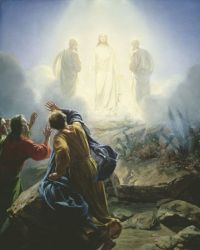
KeepOnListeningIn his account of the Transfiguration, Luke tells us that the three apostles “were afraid as they entered the cloud.” As they came into the presence of God, as they experienced this vision of God and his holiness and recognized their place as unholy people in that presence, they were scared.

But then the voice of God cuts through that fear with a word of grace, a word of peace, and then a command: “This is my Son, whom I have chosen; listen to him.”

Luke uses a greek word here that makes the command from God a continuing imperative. The idea is “Keep on listening to my Son.” “Continue listening to my Son.” “Don’t stop listening to my Son.”

The fact that God sent his Son to this planet to atone for us is an act of other-worldly grace and love. The fact that he alone is the Chosen One, the One who completely fulfills Moses and Elijah, completely completes the Law and the Prophets and God’s perfect plan of redemption for his creation, gives us great assurance and peace. And the command to keep on listening is just as urgent for us today as it was on that mountain.

Keep on listening.

Keep on attending the assembly when the Christians gather because God will always have new things to tell you. Keep on reading the Scriptures because God is still changing your life. Keep on praying because God speaks to you in the quiet of that solemn communion. Keep on serving your neighbor because God is sharing with you what it means to be like him. Our Father is always trying to grow us, to shape us, to encourage us, to strengthen us, to amaze us, to surprise us. God is talking to you through his Word and through his people. He has something to say to you.

Keep on listening.

Peace,

Allan

King Of All The Earth

Psalm 47 

“Clap your hands, all you nations;
     shout to God with cries of joy.
How awesome is the Lord Most High,
     the great King over all the earth!
God has ascended amid shouts of joy,
     the Lord amid the sounding of trumpets.
Sing praises to God, sing praises;
     sing praises to our King, sing praises.
For God is the King of all the earth;
     sing to him a psalm of praise.
God reigns over the nations;
     God is seated on his holy throne.
The nobles of the nations assemble
     as the people of the God of Abraham,
for the kings of the earth belong to God;
     he is greatly exalted.”

                                  ~Psalm 47

“They are all defying Caesar’s decrees, saying that there is another king, one called Jesus.” ~Acts 17:7

Strangers In The World

“To God’s elect, strangers in the world…”

Strangers In The WorldThe apostle Peter addresses his letter to God’s Church, calling them “strangers” (KJV), “pilgrims” (NKJV), “those who reside as aliens” (NASB), “strangers in the world” (NIV). This first line reminds all Christian believers — those scattered throughout Pontus, Galatia, Cappadocia, Asia, and Bithynia as well as those scattered throughout Texas, Oklahoma, California, Montana, and Kentucky — that we are an alternative society. We are a counter culture. The Christian community is called to show a desperate world how to think and speak and act and behave differently.

Holy Scripture and the life of our Christ and his apostles always calls us to change the world; never to conform, instead to convert. And the only way it works is for us to be different.

Vaclav Havel, President of the Czech Republic, was once asked why the revolution there against the communists was successfully non-violent. He answered, “We had our parallel society. And in that parallel society we wrote our plays and sang our songs and read our poems until we knew the truth so well that we could go out to the streets of Prague and say, ‘We don’t believe your lies anymore’ — and communism had to fall.”

God’s Church must be a similar kind of parallel society. And we best form that society when we assemble together to worship. We speak our language together, we read our stories of God and his work with his people together, we sing the hymns of faith together, we pour out our prayers together until we know the truth so well that we can go out into the world around us, denounce the lies that threaten to force us to conform, and invite the world to share the truth with us. We are shaped by a Biblical narrative that tells a much different story from the one in our surrounding culture.

Marva Dawn in A Royal Waste of Time: “Rather than becoming enculturated and entrapped by the world’s values of materialistic and experiential consumerism, of narcissistic self-importance and personal taste, of solitary superficiality, and of ephemeral satisfaction, members of Christ’s Body choose his simple life of sharing, his willingness to suffer for the sake of others, his communal vulnerability, and his eternal purposes.”

Sociologists know that any alternative way of life that is substantially different from the larger society around it needs its own language, customs, habits, rituals, institutions, procedures, and practices if it’s going to remain alternative. These things are paramount to upholding and nurturing a clear vision of how we are different and why it matters.

Are we as Christians committed to the alternative way of life described in the Scriptures and incarnated in the Christ? It’s the only way to communicate to the world what they’re missing. If we’re too much like the surrounding culture, we have nothing, no alternative, to offer.

“Dear friends, I urge you as aliens and strangers in the world…live such good lives among the pagans that, though they accuse you of doing wrong, they may see your good deeds and glorify God.” ~1 Peter 2:11-12

Peace,

Allan

Greetings From Austin

One of the highlights of my year is the annual Sermon Seminar at Austin Graduate School of Theology. For 28 years now the school has brought in preachers and teachers of preachers for three hard days of nuts and bolts study and reflection and application. From text to pulpit. From 9am to 9pm for three days.

Ben Witherington, who’s written the best commentary on Revelation I’ve ever read, worked with us last night on preaching Revelation 4. Just his two hours alone was well worth the price of admission. Gracious! Witherington took us straight to the throne room of God and inspired all of us with the heavenly vision of the eternal worship of our Lord and God. He led us all to understand that the worship of our God is absolutely the most important thing that happens in the world. It’s more important than what happens in downtown Dallas. It’s more important than what happens in Washington, DC. In London. In Tokyo. The worship of God restores the created order, when God’s creatures join all of heaven and earth — the rocks and trees and birds and beasts, the saints who’ve gone before and the ones who are coming after — to give glory and honor and praise to Almighty God. When creation worships the Creator it restores the order. It takes us to the ultimate goal. It’s important. It’s huge.

Salvation is not the goal. The eternal worship of God is the goal. Salvation is the means to that end.

Harold Shank, from Oklahoma Christian, is taking us through Exodus 32-34. Tim Willis, from Pepperdine, is teaching Jeremiah 1-7. And Stan Reid, the president of the school, is doing 1 Peter.

Like so many others, and just as Shane Hines articulated so well during last night’s worship, I come into this place to sit at the feet of some of God’s greatest teachers…and I’m overwhelmed. I’m not even smart enough to get the jokes. I preach a sermon on Exodus — I preach the life out of that thing, I preach it like crazy — and then I come here and realize I don’t know anything about it. I leave the Sermon Seminar and feel like I have to go back to Legacy and repent for every sermon I’ve preached in the previous year.

I’m here with my great friend Jason Reeves, sharing a hotel room and bags and bags of Lay’s Kettle Cooked chips and Carrie-Anne’s hot sauce. I’ve run in to Jim Martin and David Hunter. I’m catching up with all the Austin Grad crowd, including Charlie Johanson and Eric Gayle and Cynthia Agnell. Greg Neil, the preacher at the church in Marble Falls is leading our worship this morning. And I’m hoping to see Todd Lewis here with him.

Preaching God’s Word is an amazing privilege. Hanging out with God’s preachers is inspiring. I don’t belong here. And yet, by the grace of our Lord, I do.

The Legacy Church of Christ is going to benefit greatly from my being here. But not nearly as much as I do.

Peace,

Allan

« Older posts