Month: January 2008 (Page 4 of 4)

The Chart is for Losers

I’ll get to Tony Romo’s weekend later on in this post. But, first things first.

The Chart is for losers. You know, the two-point conversion Chart that every football coach references after an unsuccessful two-point conversion try. The Chart tells coaches when to kick the PAT and when to try to score two based on the point differential between the two teams being three or seven points. When you’re behind in a game, the idea is to do what you can to close the gap so there’s one full score difference between you and your opponent so you can tie or take the lead with a score of your own. If you’re ahead, do the same thing so your opponent can’t take the lead or beat you with a single score of their own.

 And, by overthinking it, coaches blow this call every single week.

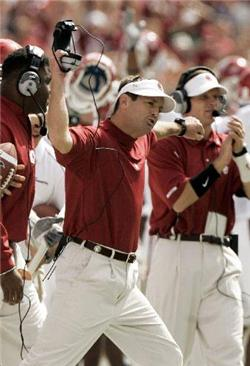
 There’s only one reason the Steelers lost at home to the Jaguars Saturday: Pittsburgh coach Mike Tomlin went for two, not once but twice, when he should have just kicked the extra point.

The Steelers scored a TD with 10:25 to play in the game to pull to within 28-23. An extra point makes it a six point game. But Tomlin elects to go for two, even when a holding penalty on the play pushed the attempt back to the 12 yard line. There’s still two-thirds of the fourth quarter to play, and he went for two. And failed. The Steelers scored again at the 6:21 mark to go ahead 29-28. And now they HAVE to try for the two-point conversion so a Jacksonville field goal won’t beat them, it’ll only tie them. The run failed. And Pittsburgh’s only up one. And, of course, the Jags march down the field and kick the game-winning, not game-tying, field goal with 37-seconds left to win the game.

And somehow today Tomlin is still employed.

I haven’t done the research on the numbers in almost four years. But four years ago in the NFL, a one-point PAT was more than a 99% certainty while a two-point try was good only 54% of the time.

If Tomlin kicks the automatic point on both of his TDs there right in the middle of the fourth quarter, the Jaguars cannot beat them with a field goal. The worst case scenario is that the game goes to OT. And Pittsburgh’s at home!

And I knew Tomlin would invoke The Chart in his post-game meeting with reporters. I knew Tomlin would deflect all personal responsibility for the poor decision to go for two by blaming it on the chart. And he did.

“We’re playing The Chart. That’s not out of bounds. That’s just baseball; everybody’s got The Chart.”

But then when these coaches are pressed on it, when they ought to be, they get defensive.

“If I had a crystal ball and I knew we would lose by two, we would have kicked the extra point if that makes you feel good.”

Here’s my beef with The Chart: it’s just a lousy excuse for a coach who won’t take responsibility for his call. If the two-point try is successful the coach talks afterward about how they had scouted out the situation, they had planned for just that exact circumstance, they had seen something during the week they could exploit, they had prepared for just that moment and just that play. But if the try is unsuccesful, they blame it on The Chart. It was out of my hands. The Chart said to go for two, so we went for two. I have no control.

The problem is that football coaches are the most controlling freaks in all of sports. They demand complete control over every single aspect of their football teams. They take great public and private pride in over-preparing for every single hypothetical situation. They drill their assistants and their players on the minutiae of every single circumstance, real and imagined. They leave no rock unturned. They don’t leave anything to chance. They’ve studied and re-studied every single angle looking for the edge. And we’re to believe that in the fourth quarter of a playoff game they say to their offensive coordinator, “Let’s just go with The Chart.”

No. They make the decisions every time. You only hear about The Chart when they’re wrong.

I tried to pin Bill Parcells down on all that following a Monday night game in Seattle in which he had gone for two in the second quarter of what wound up being a nail-biting win against the Seahawks. He, too, claimed The Chart. He said he went with The Chart everytime. But on their very next TD in that same game, The Chart would have said go for two also. But Parcells kicked the PAT. When I pointed that out, he got defensive and used the crystal ball answer that Tomlin threw out there Saturday. They only reference The Chart when they’re wrong. And they attempt to escape all blame by saying they always use The Chart in every situation. And when the inconsistencies are pointed out, they get angry.

I’m not really sure there is a Chart. I think, instead, there’s an agreement among the coaches to call it a Chart when they mess up the two-point conversion.

~~~~~~~~~~~~~~~~~~~~~~~~~~~~~~~~~~~~~~~~~~~~~~~~~~~~~~~~~~~~~~~~~~~~~~~~~~~~~~~~~~~~~~

What do you think the quarterback of the Dallas Cowboys was doing this past weekend? Up at Valley Ranch watching film or getting some treatment or maybe working out? He was at least hanging out at the house and watching the wildcard games, right?

No. Your quarterback was with Jessica Simpson and Jessica Simpson’s parents in Cancun.

Somebody explain to me what this guy’s doing!

You’re the quarterback of a team that hasn’t won a playoff game in over a decade. Your team has really struggled, especially the offense, over the past four weeks. You’ve already been in the news way too much with your celebrity girlfriend. The last time she was seen with you publicly you turned in the worst performance of your career. What are you doing?

Do you suppose Peyton Manning or Brett Favre thought the wildcard weekend would be a good time to get out of the country and hit the beach?

I doubt Simpson has much, if anything, to do with Romo’s execution on the field. But Romo knew beyond a shadow of a doubt that if he went to Cancun with his celebrity honey and her parents right in the middle of the playoffs it would dominate the conversation in the media and in the Cowboys lockerroom all this week. And he decided to go anyway. He knew his teammates and coaches wouldn’t be thrilled with his very public romance being headline news again, but he decided to go anyway. At best that shows a lack of judgment. At worst it shows that he doesn’t care.

I didn’t hear all of Wade Phillips’ media session with DFW reporters today. But I heard enough of it to know that Romo’s weekend getaway with Daisy Duke was the main topic. Not the Giants. And not the New York pass rush.

Add to that Tony Sparano and Jason Garrett jetting all over the country for job interviews with the Falcons and Dolphins and Ravens. Who’s actually thinking about Sunday’s game against New York?

Peace,

Allan

Can Small Groups Change our Whole Church?

“Since God so loved us, we also ought to love one another.” ~1 John 4:11 

This Sunday the Legacy Church of Christ becomes a Small Groups Church, not just a church that does small groups. The elders and ministers are committed to our church family applying the Word, connecting as a family, and evangelizing our community by meeting in each others’ homes every Sunday evening. And judging by the response—467 adults to date are signed up to participate in 34 different groups—the congregation is also committed to this new and exciting direction.

So many of us already know about all the wonderful things that happen when disciples of Jesus regularly get together to share with each other in their homes. Mutual love and service and hospitality. Mutual sharing of joys and burdens. Strong bonds that develop that can never be broken. The small group becomes a family. A caring and compassionate and Christ-centered family.

Can that atmosphere and that dynamic and that view of life together bleed over to impact the entire congregation? Will our small groups eventually, with time and consistency, transform all of us—those involved in small groups and those who aren’t—into the vibrant congregation as a whole that we all envision?

I think it will.

The power of changed lives is huge. The testimony from changed people draws people. It inspires people. Changed people have a profound impact on people who need to be changed. The people in the Gospel stories, all the crowds, were amazed by those Jesus had touched and healed. They were blown away by the change. The apostle Paul always preached and wrote about how Jesus had so drastically changed his life. And the testimony to changed lives within our small groups will have a similar effect on the body as a whole.

The power of weakness is huge. God is strong when we’re weak. God is glorified in our weakness. He is our rock. He’s our strength and our shield. And the sharing of our struggles and weaknesses in our small groups will open our eyes to see more clearly what our God is doing with us. That open and honest sharing of our problems, together, in our homes on Sunday nights will eventually bleed over into our assemblies on Sunday mornings. It will become a regular thing, not a rare thing, that somebody will go down to the front to confess a sin, to repent from a wrong, to ask for prayers, to share their struggles, and 20 or 30 of their loving brothers and sisters arrive down there at the same time to hug him and pray with him and confess with him. And this becomes a safe place, not the last place, to share our struggles.

More importantly, and most convincingly, the power of our God is huge. It’s not us. It’s God. We can’t forget that. It’s always God. And we turn all of this completely over to him through prayer. God, please change the lives of the people in our group. Lord, please heal this person, forgive that person, open my heart, open my eyes. Bring us one more lost soul, God. Show us, Father, your power and your love and your salvation in our groups.

In Mark 4, Jesus says the Kingdom of God is a farmer who plants a seed. Period. God does everything else. The farmer has no idea how it works. But it does. God makes it grow. God changes it and causes it to produce in wonderful and mysterious ways. It’s all on God.

Let’s all be together in fervent prayer as we jump into Small Groups Church. Let’s be willing to turn every bit of it over to God. And let’s be enthusiastic in our anticipation of all the amazing things our Father is going to do with us through our efforts to be church, not just do church.

Peace,

Allan

Prayer, Momentum, & Once More on the Incarnation

“Seek the Lord while he may be found; call on him while he is near. Let the wicked forsake his way and the evil man his thoughts. Let him turn to the Lord and he will have mercy on him, and to our God for he will freely pardon.” ~Isaiah 55:6-7.

PrayerThe disciples asked Jesus in Luke 11 to teach them how to pray. They want to be like him in every way. So they want to pray just like him, too. They want to identify with their rabbi and to be identified with their rabbi by praying like him. So Jesus gives them the basics as far as the words go and then he tells them a story so they don’t lose the big picture.

The parable of the persistent friend. It’s midnight, the guy’s in bed, his whole family’s asleep. He doesn’t want to get up and get his friend the bread he needs to feed his surprise guest. In fact, he tells the neighbor at the door it’s not going to happen.

“Hey, it’s late! We’re all in bed! The kids are going to school in the morning! I’ve got an early meeting at work! Buzz off!”

In Jesus’ story, the man does get up and give his neighbor the bread he desperately needs. But not because he wants to. He does it, Jesus says, because of the friend’s boldness or persistence. And I’ve heard this story traditionally interpreted like this: keep praying. Even if God says ‘no,’ keep praying. He’ll give in eventually if you keep praying. Keep bugging him. He’ll change his mind. He doesn’t want to give you this thing you’re asking, but he will if you just keep knocking.

For that to make sense, God has to be the guy in the bed. For that interpretation to hang with the story, the guy in bed is God. The guy in bed. The guy who’s already turned out all the lights. The guy who’s locked his door. The guy who’s only thinking of himself. The selfish guy who doesn’t want to get up from under the covers and give his neighbor what he needs. That guy represents God?

No way.

If Jesus had put God in this story, all the lights would be on in the house. All the doors and windows would be wide open. There would be huge search lights criss-crossing the sky and giant neon billboards with flashing arrows pointing to the house saying, “Get your bread right here! Get as much bread as you want right here! And it’s free!” You couldn’t even get to the door to knock because the man would be out in the street looking for you and running to meet you and give you the bread before you could even ask.

The guy in the bed is not God. The guy in the bed is the opposite of God. And there’s the point. There’s the teaching of Jesus. He’s drawing a stark contrast. He’s not making a comparison. Jesus says here’s a man who will eventually get out of bed and give bread to his neighbor, if not because they’re friends, then certainly out of a sense of duty or honor or hospitality. You fathers, if your child asks you for something he really needs, you’re not going to give him something that would hurt him. So if this reluctant sleepy guy and you imperfect human dads know how to provide good gifts, why would you ever assume that God doesn’t? Our God is definitely more kind and generous and loving and giving than any man, regardless of how decent or good that man may be.

Jesus’ point in telling the story in Luke 11 is that our God is never reluctant to help. We ask God knowing he’ll honor our requests. We seek God knowing we’ll find him. We knock on God’s door knowing he’ll give us what we need.

“This is the confidence we have in approaching God: that if we ask anything according to his will, he hears us. And if we know that he hears us — whatever we ask — we know that we have what we asked of him.” ~1 John 5:14-15

~~~~~~~~~~~~~~~~~~~~~~~~~~~~~~~~~~~~~~~~~~~~~~~~~~~~~~~~~~~~~~~~~~~~~~~~~~~~~~~~~~~~~~

FootballWith 6:23 to play in the third quarter of last night’s Fiesta Bowl, Oklahoma scored a touchdown to pull to within five points of West Virginia. By this point the Mountaineers had proven clearly that they were the faster, more athletic, more explosive team. And by kicking an extra point, the Sooners would only be down by four with some real positive momentum. Maybe even some potentially game-changing momentum.

But Bob Stoops decided to go for two. The pass was incomplete. And OU trailed by five. Not only that, but instead of feeling good about a success, the team felt bad about a failure. Instead of West Virginia feeling negatively about their failure in giving up a touchdown on a long drive, they felt positively about their success in stopping the two-point play.

Momentum is huge. The psychology of what happens in the course of a football game and how it all shifts back and forth at a moment’s notice is generally tied to turnovers and failed two-point conversions.

And then, to defy logic even further, Stoops calls for an onside kick. Halfway through the third quarter. West Virginia recovers at the OU 39 yard line and goes on to score three of the game’s next four touchdowns to salt it away.

It was like Stoops thought he was playing OSU or something.

If I were the owner or GM or AD of a football team, I would put it in my coach’s contract that he could never, ever, go for two before the start of the fourth quarter. Period. No exceptions. I don’t care how far we’re down or how lousy our kicker. Going for two, going against the percentages, unnecessarily risking that precious momentum, it doesn’t add up. It’s never worth it.

Someday we’ll discuss “the chart.”

~~~~~~~~~~~~~~~~~~~~~~~~~~~~~~~~~~~~~~~~~~~~~~~~~~~~~~~~~~~~~~~~~~~~~~~~~~~~~~~~~~~~~~

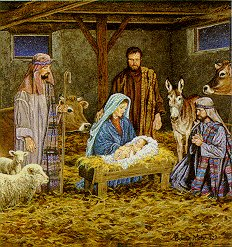
IncarnationFinally, my good friend Todd Lewis, down in Marble Falls, sent me a Christmas article he wrote last month exploring the ways the Christmas season produces cheer even in the midst of war, disease, and crime. His words go right to the heart of what we preached here at Legacy for the past three weeks, how we see ourselves in the infant Jesus — God’s intentions in creating us, our own potential, our high calling. Click here, Observations on Christmas Cheer, to read Todd’s excellent article.

Peace,

Allan

Life Together

“How good and pleasant it is when brothers live together in unity!” ~Psalm 133:1

AtTheCrossWe should never take for granted the great blessing we enjoy to be disciples of Jesus living with and among other disciples of Jesus. Most Christians know nothing first hand about that experience. They live in isolation with family members who do not follow our Christ or in communities where the Son of God is not recognized, or worse, where followers of Jesus are persecuted for their beliefs and practices.

The physical presence of other Christians is a source of great joy and strength to the believer. The imprisoned apostle Paul calls Timothy to come to him in the last days of his life. He remembers Timothy’s tears when they departed and longs to see his beloved son in the faith “that I may be filled with joy.” Remembering the saints in Thessalonica, Paul writes, “night and day we pray most earnestly that we may see you again.” John knows his joy will not be full until he can come to his own people and speak face to face with them instead of writing to them with ink “so that our joy may be complete.”

At times in their lives these great men of God did not have the fellowship with other believers that we enjoy daily, sometimes hourly. They longed for it. They relished it. They looked forward to it. And they savored it with great delight. Fellowship was everything. It’s what got them through.

Dietrich Bonhoeffer wrote this about Christian fellowship in 1934 in his classic work on the community of faith, Life Together:

“What is an unspeakable gift of God for the lonely individual is easily disregarded and trodden under foot by those who have the gift every day. It is easily forgotten that the fellowship of Christian brethren is a gift of grace, a gift of the Kingdom of God that any day may be taken from us. Therefore, let him who has the privilege of living a common Christian life with other Christians praise God’s grace from the bottom of his heart. Let him thank God on his knees and declare: It is grace, nothing but grace, that we are allowed to live in community with Christian brethren.”

We live together in and through Christ Jesus. The fellowship we share together is only in and through our Lord and Savior. Christian friendships should be treasured, never assumed. Time together should be cherished, never avoided. Opportunities to be together should be seized, never scorned.

“About brotherly love we do not need to write to you, for you yourselves have been taught by God  to love each other. Yet we urge you, brothers, to do so more and more.” ~1 Thessalonians 4:9-10

Peace,

Allan

Newer posts »